Power Outages Are Getting Longer. The Generator Is the Dangerous Part.
In This Series: Home Hazards & Indoor Environment
- The Safe Level of Air Pollution Keeps Moving Down
- The Mould Is Not the Problem. The Water Is.
- Nine Million Homes Still Drink Through a Lead Pipe
- It Looks Exactly Like Flu, Except for the Fever
- Lithium-Ion Battery Fires at Home: What the Research Actually Shows
- The Leading Cause of House Fires Is a Pan Nobody Is Watching
- Your Gas Stove and the Air in Your Kitchen: What the Measurements Found
Disclosure: this article contains affiliate links, marked (paid link). If you buy through one we may earn a commission, at no extra cost to you. As an Amazon Associate I earn from qualifying purchases. It costs you nothing and it does not change what we recommend.
Key takeaways · 9 min read
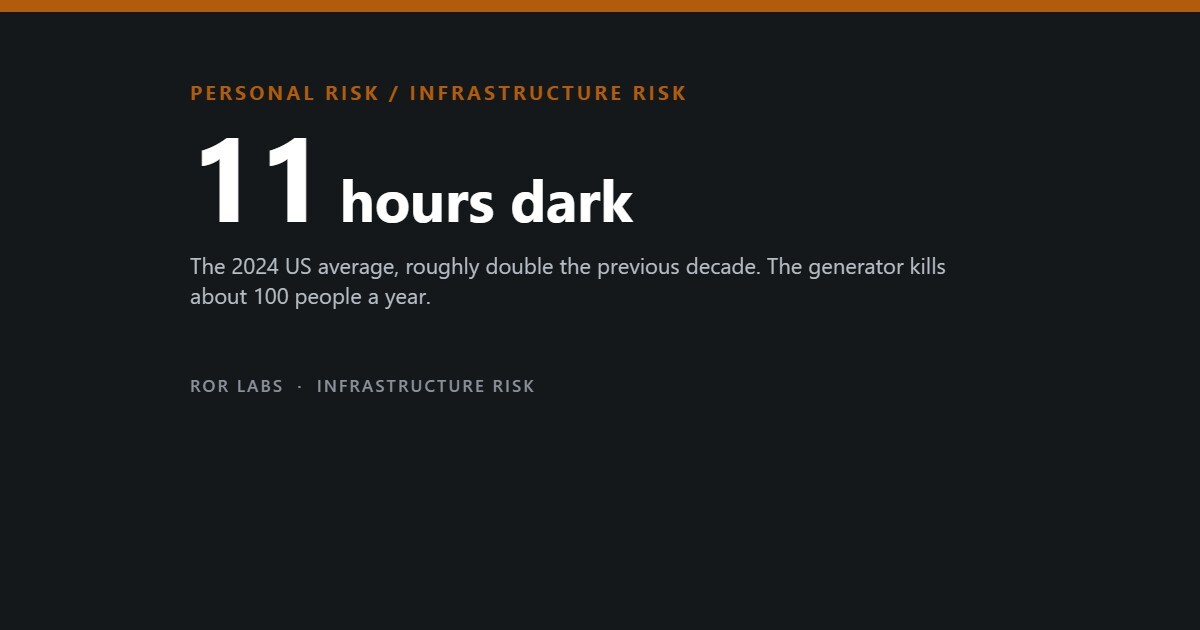
- U.S. customers averaged 11 hours without power in 2024 — about double the previous decade.
- 80% of those hours came from major events. Everyday faults accounted for roughly two hours a year.
- Portable generators kill about 100 Americans a year through carbon monoxide.
- 20 feet from the house, outdoors. CPSC states that opening a garage door does not provide enough ventilation to prevent lethal buildup.
A power cut used to be a candle and an early night. That model still fits most outages — the average American household spent about two hours a year without power for ordinary reasons, and ordinary reasons are still most of them.
What has changed is the tail. The rare, long, whole-region outage has been getting both longer and more common, and it is a fundamentally different event from a two-hour cut. It is the one that empties a freezer, takes out the heating, and kills about a hundred people a year — almost all of them by the machine they bought to protect themselves.
The number that changed
Average hours without electricity per U.S. customer
2024 versus the preceding decade. Energy Information Administration data.
Source: U.S. Energy Information Administration, “Hurricanes in 2024 led to the most hours without power in the United States in 10 years.”
The split inside that number is what makes it actionable. Of the 11 hours, roughly two came from ordinary faults — a car into a pole, a tree on a line, a substation problem. The other nine came from major events. Eighty per cent of the time Americans spent in the dark in 2024 came from a small number of large disasters.
Where the hours actually came from
2024, share of total hours without power.
Source: U.S. Energy Information Administration, 2024 annual electric power reliability data.
This is why generic “emergency preparedness” advice tends to miss. Preparing for a two-hour cut is a torch. Preparing for the event that produced 53 hours in South Carolina is a different exercise, and the things that matter are not the things most people buy first.
The generator kills about a hundred people a year

Before any shopping advice, this. A portable generator is the single most dangerous object discussed anywhere on this site, and the danger is not fire or electrocution. It is carbon monoxide.
What the Consumer Product Safety Commission says
Portable generator carbon monoxide guidance, 30 January 2026.
Source: U.S. Consumer Product Safety Commission, “Winter Storms Aren’t Over: CPSC Warns of Deadly Carbon Monoxide Risks and Fires During Power Outages,” 30 January 2026.
Read the second half of that again, because it is the belief that does the killing. “I left the garage door open” is the sentence that appears in these case reports. An open door is not ventilation. Nor is a covered porch, a carport, a basement with a window, or under an overhang. Twenty feet away, outdoors, exhaust pointed away from the building — and a working CO alarm inside, on every level.
Where a generator may and may not run
CPSC guidance, drawn.
Source: U.S. Consumer Product Safety Commission portable generator guidance (2026).
What actually stops working, in order
People prepare for darkness. Darkness is the least of it, and it is the problem you have already solved with the phone in your hand. The failures that matter arrive on a schedule.
The timeline of a long outage
What breaks, and roughly when.
| Elapsed | What fails | What it costs you |
|---|---|---|
| Immediately | Lights, wifi, anything mains-powered | Inconvenience. Mostly solved by a torch and a charged phone. |
| 2–4 hours | Mobile phone battery | Losing contact and information at the moment both matter most. |
| 4 hours | Fridge, if opened | An unopened fridge holds about 4 hours; a full freezer about 48. |
| 4–12 hours | Heating or cooling | The genuinely dangerous one in a cold snap or a heatwave, especially for older people. |
| 12–24 hours | Local mobile masts on backup | Signal degrades even with a charged phone. |
| 24 hours+ | Water, if you are on a well or a high floor | Pumps need power. Mains pressure usually holds, wells do not. |
| 48 hours+ | Freezer contents; medication needing refrigeration | The point at which an outage becomes an expense and a health problem. |
Sources: USDA food safety guidance on refrigeration during outages; EIA outage duration data (2024); CDC power outage guidance.
Match the kit to the outage you actually get
The single most useful question is not “what should I buy” but “which outage am I preparing for.” They need almost entirely different things, and buying for the wrong one is how people end up with an expensive machine in a shed and a dead phone in a blackout.
Three tiers, and what each one actually requires
Pick the row that matches where you live and how often the lights go out.
Sources: EIA outage duration distribution (2024); CPSC generator safety guidance (2026); Ready.gov power outage planning.
One point worth making plainly, because it inverts the usual advice: for most households in most places, a battery power station is the better first purchase than a generator. It runs indoors safely, it makes no noise, it needs no fuel stored in a garage, and it covers the tier of outage that actually happens to you. A generator is the right answer for genuinely long outages, and the wrong answer for a six-hour one.
The order we would actually buy in (paid link)
Cheapest and most useful first. Most households never need to get past the second row.
Browse on Amazon →
Browse on Amazon →
Browse on Amazon →
Browse on Amazon →
We are not linking portable generators. Not because they are useless — for multi-day outages they are the right tool — but because a generator bought from a product link, without the siting and CO-alarm context, is exactly the purchase that produces those hundred deaths a year. If you need one, buy it locally from someone who will talk you through installation and fuel storage, and read the CPSC guidance first.

Questions people ask
How long does food really last?
An unopened fridge holds safe temperature for about four hours; a full freezer for roughly 48, a half-full one about 24. The rule that saves the most food is simply keeping the doors shut — every look costs you. A cheap fridge thermometer tells you afterwards whether anything crossed into unsafe territory, which beats guessing by smell.
Can I run a generator to power my house wiring?
Not without a transfer switch installed by an electrician. Connecting a generator to household circuits any other way can push power back into the lines outside and electrocute utility workers. This is one of the few places where the correct advice really is “hire someone.”
What about medical equipment?
If someone in the house depends on powered equipment — oxygen concentrator, CPAP, a fridge for medication — tell your utility now rather than during an outage. Most operate a medical priority register, which affects both restoration order and advance warning of planned cuts. It is free and takes one call.
Is a heatwave outage worse than a winter one?
Often, yes, and it gets far less attention. You can add layers against cold; there is no equivalent against heat once indoor temperature climbs, and the people most at risk are the least mobile. If you are in a hot climate, the outage plan that matters is knowing where the nearest air-conditioned public building is and how you would get there.
The short version
- U.S. customers averaged 11 hours without power in 2024 — about double the previous decade.
- 80% of those hours came from major events. Everyday faults accounted for roughly two hours a year.
- Portable generators kill about 100 Americans a year through carbon monoxide.
- 20 feet from the house, outdoors. CPSC states that opening a garage door does not provide enough ventilation to prevent lethal buildup.
- The first thing to fail is your phone battery, within hours.
- For most households a battery power station beats a generator — safe indoors, silent, no fuel, and sized to the outage you actually get.
- Free actions worth more than most purchases: register medical equipment with your utility, and keep the fridge shut.
Carbon monoxide is a medical emergency. If an alarm sounds, or if several people in a building develop headache, dizziness or nausea at the same time, get everyone outside into fresh air and call emergency services from outside the building.
On the links above: some are affiliate links, marked (paid link). If you buy through one we may earn a commission at no additional cost to you. As an Amazon Associate I earn from qualifying purchases. We link to product searches rather than specific items so recommendations do not break as models change, and we say plainly when we are choosing not to link something. Full policy: Affiliate Disclosure.
Sources
- U.S. Energy Information Administration. “Hurricanes in 2024 led to the most hours without power in the United States in 10 years.” Today in Energy.
- U.S. Consumer Product Safety Commission. “Winter Storms Aren’t Over: CPSC Warns of Deadly Carbon Monoxide Risks and Fires During Power Outages.” 30 January 2026.
- U.S. Consumer Product Safety Commission. Portable generator carbon monoxide hazard reporting.
- U.S. Department of Agriculture, Food Safety and Inspection Service. Refrigerated food safety during power outages.