Falls at Home: The Fixes With Evidence, and the One That Was Withdrawn
In This Series: Healthy Ageing & Everyday Myths
- Two of the 14 Dementia Risk Factors Are Your Ears and Your Eyes
- The Wrong Cuff Turns 125 Into 144. Most People Have Never Had This Measured Properly.
- Every 3 Decibels Halves the Time. That Is the Whole Rule, and Almost Nobody Knows It.
- Sleep Regularity Beat Sleep Duration: What the Mortality Data Shows
- Sitting Is Not the New Smoking. The Standing Desk Did Not Help Either.
- Loneliness Raises the Risk of Dying by Fourteen Per Cent. The Fifteen-Cigarettes Line Came From Somewhere Else.
Disclosure: this article contains affiliate links, marked (paid link). If you buy through one we may earn a commission, at no extra cost to you. As an Amazon Associate I earn from qualifying purchases. It costs you nothing and it does not change what we recommend.
Key takeaways · 11 min read
- Falls are the leading cause of injury death after 65. One in four older adults falls each year; 3 million reach an emergency department.
- Exercise is the best-supported intervention — a 23% reduction in fall rate at high certainty, from 108 trials.
- Within exercise, balance and functional training is what works. Walking alone has not been shown to prevent falls.
- Vitamin D for fall prevention got a Grade D from the USPSTF in December 2024 — recommend against, with a small harm from kidney stones.
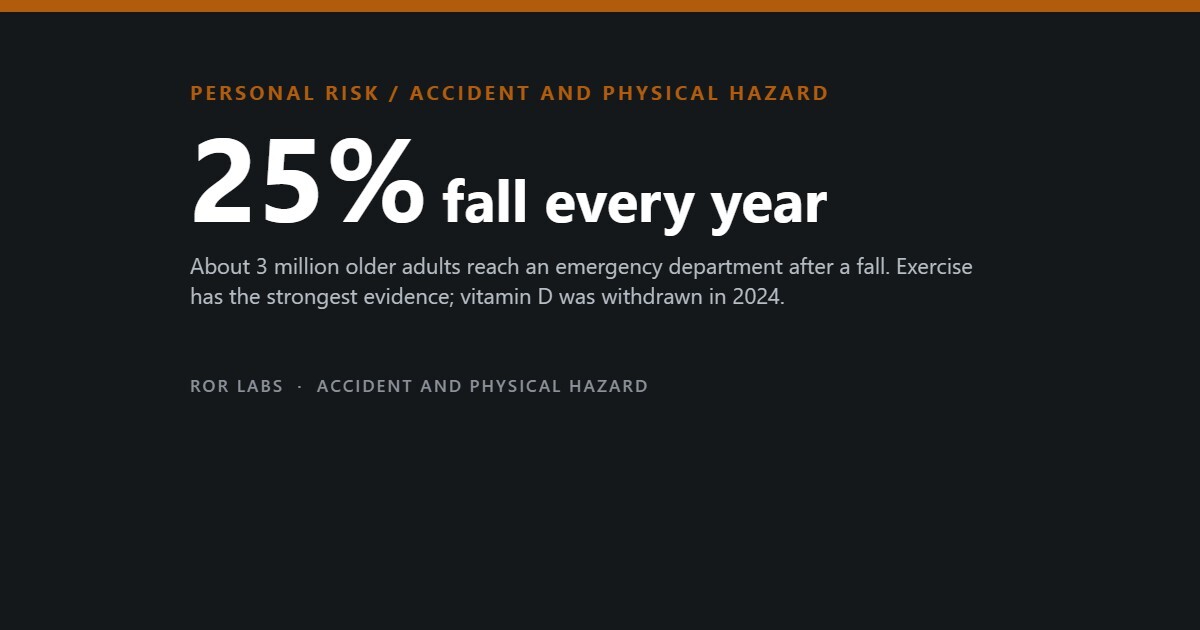
Falling over is the least respected serious risk there is. It sounds like slapstick, it happens in rooms people have walked through ten thousand times, and it is the leading cause of injury death for adults over 65. Roughly one in four older adults falls each year, and about 3 million of them end up in an emergency department.
There is an enormous amount of advice about this, and most of it is a list of things to buy. The research points somewhere less commercial. The intervention with the strongest evidence behind it is not an object at all, and one of the most popular purchases — recommended by well-meaning people for decades — was formally recommended against in December 2024.
Here is what the Cochrane reviews and the US Preventive Services Task Force actually found, sorted by how much they change your odds.
The scale of it
What falls do to older adults in the United States, each year
CDC surveillance figures.
Source: U.S. Centers for Disease Control and Prevention, “Facts About Falls,” Older Adult Fall Prevention.
The hip fracture number is the one worth pausing on, because a hip fracture is rarely just a broken bone. It is surgery, weeks of immobility, and for many people a permanent loss of independence. That is the outcome the rest of this article is trying to avoid.
The strongest evidence is for exercise, and it is not close
Cochrane pooled 108 randomised trials covering 23,407 people across 25 countries, mean age 76. Exercise programmes cut the rate of falls by 23% and the number of people who fell by 15%, both at high certainty — which in Cochrane’s grading means further research is unlikely to change the answer.
Which kinds of exercise actually reduced falls
Rate ratios below 1.00 mean fewer falls. Bars show the percentage reduction in fall rate.
Source: Sherrington C, Fairhall NJ, Wallbank GK, et al. “Exercise for preventing falls in older people living in the community.” Cochrane Database of Systematic Reviews, 2019. doi:10.1002/14651858.CD012424.pub2
Note what is at the top: not walking, and not lifting weights. Balance training — standing on one leg, heel-to-toe walking, sit-to-stand repetitions, movements that deliberately put you slightly off balance in a controlled way. Walking is excellent for many things; the evidence that it prevents falls on its own is not there.
The US Preventive Services Task Force reached the same conclusion on 4 June 2024, giving exercise interventions a Grade B recommendation for adults 65 and over at increased risk. It is the only intervention in this space that got a clear recommendation.
The vitamin D reversal
For years, vitamin D was standard advice for older adults worried about falls and fractures. On 17 December 2024 the USPSTF issued a Grade D recommendation — meaning recommend against — for vitamin D, with or without calcium, for preventing falls and fractures in community-dwelling postmenopausal women and men aged 60 and over.
Two interventions, two verdicts
Same task force, same population, opposite conclusions.
Sources: USPSTF, “Falls Prevention in Community-Dwelling Older Adults: Interventions” (4 June 2024); USPSTF, “Vitamin D, Calcium, or Combined Supplementation for the Primary Prevention of Falls and Fractures” (17 December 2024).
If someone in your family has been taking vitamin D specifically because they were told it would stop them falling, that is now the position of the body that reviews this evidence for American clinicians. It is worth a conversation at the next appointment rather than a unilateral stop, since there are other reasons a person might be prescribed it.
Home modifications work — but only for some people
This is the most misunderstood finding in the whole field, and it decides whether the shopping list at the end of this article is worth anything to you.
The same intervention, two populations
Removing home fall hazards: rate ratio for falls. Below 1.00 is a benefit.
Source: Clemson L, Stark S, Pighills AC, et al. “Environmental interventions for preventing falls in older people living in the community.” Cochrane Database of Systematic Reviews, 2023. (CD013258)
Read that carefully, because it is unusually clear for this kind of research. Decluttering, better lighting, removing loose rugs and fixing thresholds cut falls by more than a third in people who were already at high risk. In people who were not, the same work did nothing measurable.
So the honest version of the advice is conditional. If you are 55 and steady, grab bars in your bathroom are not a health intervention. If you have already fallen, or you feel unsteady standing up, or you are recovering from illness or surgery, the same fixes are among the best-supported things you can do.
Who counts as “high risk”
The markers clinicians use. Any one of these moves you into the group where home changes pay off.
Sources: USPSTF falls prevention recommendation (2024); CDC STEADI risk factors.
Where falls actually happen
Home hazard work is only worth doing if it is aimed at the right places. The pattern is consistent: the danger is concentrated at transitions — where the floor changes, where the light changes, where you turn or change height.
The five places worth fixing first
Where the hazard is, what the fix is, and why it works.
Sources: Clemson et al., Cochrane Database of Systematic Reviews (2023); CDC STEADI home-hazard checklist.
The grab bar warning nobody gives you
Search for a grab bar and the first results will be suction-cup models. They are cheap, they need no tools, and they are the single most dangerous product category in this article.
Two things that look like the same product
Only one of them is a grab bar.
Source: ADA accessibility requirements for grab bar load capacity (250 lb minimum); industry guidance on suction-cup compliance.
What to actually do, in order
Ranked by evidence strength
The first two are free and outrank everything you can buy.
Sources: Sherrington et al., Cochrane (2019); Clemson et al., Cochrane (2023); USPSTF (2024).
If you are in the higher-risk group (paid link)
The physical fixes with evidence behind them — useful if one of the risk markers above applies to you or someone you look after.
Browse on Amazon →
Browse on Amazon →
Browse on Amazon →
Browse on Amazon →
Two things we are deliberately not linking. Suction-cup grab bars, for the reasons above — they are the wrong product sold to exactly the wrong person. And vitamin D supplements for fall prevention, which the USPSTF recommended against in December 2024. Both are popular, both would earn us commission, and neither belongs in an article about what works.

Questions people ask
My parent refuses grab bars because they look medical. What now?
Common, and worth taking seriously rather than overriding — the resistance is usually about identity, not the bar. The interventions that do not look like equipment are the ones with better evidence anyway: balance exercise, a medication review, an eye test, brighter bulbs. Lighting and decluttering rarely get refused. Start there and the bathroom conversation gets easier later.
Do those alert pendants prevent falls?
No, and they are not sold as prevention. They shorten the time spent on the floor after a fall, which genuinely matters — long lies are associated with worse outcomes. But they belong in a different column from the interventions in this article.
Is it too late to start balance training at 80?
The Cochrane trials had a mean participant age of 76, and many enrolled people considerably older, including those who had already fallen. That is the population the 23% reduction came from. If mobility is limited or there is a heart or joint condition, the right first step is a physiotherapist rather than a video.
What about hip protectors?
Padded undergarments have some evidence for reducing hip fractures in nursing-home residents at high risk, and much weaker evidence for people living at home. Adherence is the recurring problem in the trials — they only work when actually worn.
The short version
- Falls are the leading cause of injury death after 65. One in four older adults falls each year; 3 million reach an emergency department.
- Exercise is the best-supported intervention — a 23% reduction in fall rate at high certainty, from 108 trials.
- Within exercise, balance and functional training is what works. Walking alone has not been shown to prevent falls.
- Vitamin D for fall prevention got a Grade D from the USPSTF in December 2024 — recommend against, with a small harm from kidney stones.
- Home modification works, conditionally. A 38% reduction for people already at high risk; no measurable benefit for people who are not.
- A fall in the past year, unsteadiness, fear of falling, or four-plus medications put you in the group where the home fixes pay off.
- Suction-cup grab bars are not grab bars. The load standard is 250 lb, and only a bolted fixing meets it.
- The two free moves — a pharmacist medication review and an eye test — outrank most of what you can buy.
This article summarises published evidence and is not medical advice. If you or someone you care for has already fallen, is unsteady, or is on several medications, a doctor or pharmacist can assess the specific risks — that assessment is more valuable than anything on this page.
On the links above: some are affiliate links, marked (paid link). If you buy through one we may earn a commission at no additional cost to you. As an Amazon Associate I earn from qualifying purchases. We link to product searches rather than specific items so recommendations do not break as models change, and we say plainly when we are choosing not to link something. Full policy: Affiliate Disclosure.
Sources
- Sherrington C, Fairhall NJ, Wallbank GK, et al. “Exercise for preventing falls in older people living in the community.” Cochrane Database of Systematic Reviews, 2019, Issue 1. doi:10.1002/14651858.CD012424.pub2
- Clemson L, Stark S, Pighills AC, et al. “Environmental interventions for preventing falls in older people living in the community.” Cochrane Database of Systematic Reviews, 2023. (CD013258)
- US Preventive Services Task Force. “Falls Prevention in Community-Dwelling Older Adults: Interventions.” Recommendation statement, 4 June 2024. Grade B for exercise interventions.
- US Preventive Services Task Force. “Vitamin D, Calcium, or Combined Supplementation for the Primary Prevention of Falls and Fractures in Community-Dwelling Adults.” Recommendation statement, 17 December 2024. Grade D.
- U.S. Centers for Disease Control and Prevention. “Facts About Falls” and the STEADI initiative, Older Adult Fall Prevention.
- ADA Standards for Accessible Design — grab bar structural strength requirement (250 lb minimum load).