Your Gas Stove and the Air in Your Kitchen: What the Measurements Found
In This Series: Home Hazards & Indoor Environment
- The Safe Level of Air Pollution Keeps Moving Down
- The Mould Is Not the Problem. The Water Is.
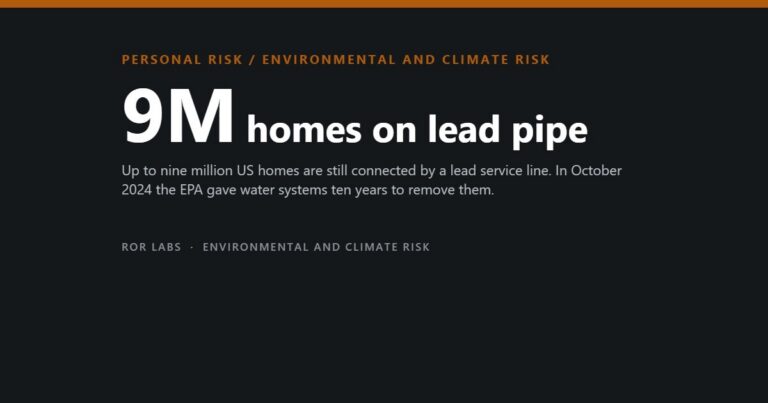
- Nine Million Homes Still Drink Through a Lead Pipe
- It Looks Exactly Like Flu, Except for the Fever
- Lithium-Ion Battery Fires at Home: What the Research Actually Shows
- The Leading Cause of House Fires Is a Pan Nobody Is Watching
- Power Outages Are Getting Longer. The Generator Is the Dangerous Part.
Disclosure: this article contains affiliate links, marked (paid link). If you buy through one we may earn a commission, at no extra cost to you. As an Amazon Associate I earn from qualifying purchases. It costs you nothing and it does not change what we recommend.
Key takeaways · 15 min read
- Gas and propane burners add about 4 ppb of nitrogen dioxide to long-term exposure — roughly three quarters of the WHO annual guideline, from the stove alone.
- They emit 10–50× more benzene than electric elements, and it travels beyond the kitchen.
- Room size is the multiplier. Under 800 sq ft means about four times the exposure of the largest homes, with the same appliance.
- The widely quoted asthma and mortality figures are modelled estimates. Solid in direction, soft in precision.
A gas burner is the only appliance in most homes that runs an open flame indoors, several times a day, usually with nothing between the flame and the person standing over it. That has always been true. What changed recently is that researchers started putting sensors in real kitchens instead of test chambers, and the numbers came back higher than the models predicted.
This is a topic where the coverage tends to arrive pre-shouted. One side says gas stoves are poisoning children. The other says it is a manufactured panic about a beloved appliance. Both are skipping the part that actually helps you: the measurements are real and reasonably consistent, and almost all of the risk is governed by three things you control — how much gas you burn, how big the room is, and whether the air leaves the building.
Here is what the peer-reviewed indoor air quality measurements found, what the health estimates do and do not establish, and which fixes have evidence behind them.

What actually comes off a burner
Burning methane in air produces carbon dioxide and water. It also produces things that are not on the label, because a kitchen flame is not a laboratory flame: it is a partial, turbulent, uneven burn happening at a temperature high enough to make nitrogen and oxygen — the ordinary air in the room — combine into nitrogen oxides.
Four things a gas burner adds to the room
Measured in occupied homes, not in a chamber. Induction and electric resistance produce none of the combustion products.
Sources: Kashtan et al., Environmental Science & Technology (2023); Kashtan et al., Science Advances (2024).
The benzene finding is the one that surprised the researchers. A Stanford team measured gas and propane burners emitting 10 to 50 times more benzene than electric stoves, with induction cooktops producing none that instruments could detect. The benzene did not stay in the kitchen either: it migrated into other rooms, and bedroom concentrations in some homes exceeded national and international health benchmarks. A single burner on high, or an oven at 350°F, could push indoor benzene above the average concentrations found in secondhand tobacco smoke.
Benzene: the gap between fuels is not subtle
Emission rates from cooktop burners and ovens, relative to electric resistance elements.
Source: Kashtan et al., “Gas and Propane Combustion from Stoves Emits Benzene and Increases Indoor Air Pollution,” Environmental Science & Technology, 15 June 2023.
How much NO₂ that adds up to
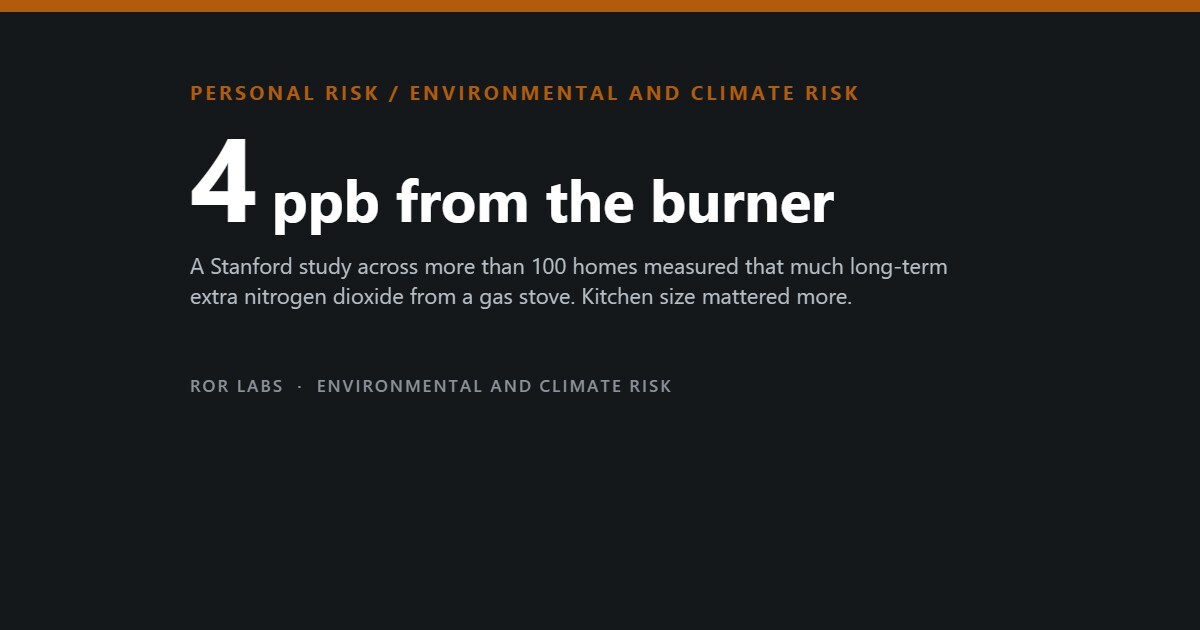
In 2024 a Stanford group published the first large study to combine measurements from more than 100 homes across California, Texas, Colorado, New York and Washington, D.C. with models of how the pollutant spreads and decays through an actual dwelling. They were after a number nobody had: not the peak during cooking, but the long-term average increase in what a person breathes because their stove burns gas.
The answer was about 4 parts per billion of nitrogen dioxide, averaged across the year. That number looks small until you put it beside the budget it eats into.
Typical gas stove use consumes about three quarters of the annual NO₂ budget
The World Health Organization’s annual guideline is a limit on total exposure — traffic, industry, everything. The stove’s share is what is left over for the rest of your life.
Sources: Kashtan et al., Science Advances, 3 May 2024; WHO Global Air Quality Guidelines (2021).
It is worth knowing what those guideline numbers actually are, because they were tightened sharply in 2021 and a lot of older writing still quotes the previous, far looser figures.
What the WHO guidelines say, since 2021
These are outdoor air guidelines. There is no separate indoor NO₂ standard for homes — which is part of the problem.
| Pollutant | Annual mean | 24-hour mean | Note |
|---|---|---|---|
| Nitrogen dioxide | 10 µg/m³ | 25 µg/m³ | Four times lower than the previous guideline |
| Fine particles (PM2.5) | 5 µg/m³ | 15 µg/m³ | Half the previous guideline |
Source: WHO Global Air Quality Guidelines, 2021 revision.
A follow-up study in PNAS Nexus in December 2025 extended this to all 133 million U.S. dwellings and reached a conclusion that reframes the whole question. For many households, the stove is not a contributor to NO₂ exposure alongside outdoor sources — it is the dominant one. As the senior author put it, you are often breathing as much nitrogen dioxide indoors from your stove as from every outdoor source combined. The study estimated that 22 million Americans are pushed above recommended long-term NO₂ limits by gas cooking alone, concentrated in smaller homes and rural areas.
Why the size of your kitchen matters more than the stove
This is the finding that gets lost in the argument about appliances, and it is the most useful one in the entire literature. The same burner, burning the same gas for the same twenty minutes, produces wildly different exposures depending on the volume of air it is diluted into.
Same stove, four times the exposure
Long-term NO₂ exposure attributable to the stove, indexed to the largest homes in the study.
Source: Kashtan et al., Science Advances, 3 May 2024.
Because smaller homes track income, the exposure tracks income too. The researchers found the burden falls unevenly along lines that have nothing to do with anybody’s cooking habits.
Who is breathing more of it
Long-term NO₂ exposure from stoves, compared with the national average.
Sources: Kashtan et al., Science Advances (2024); Kashtan et al., PNAS Nexus, 2 December 2025.
The practical reading of this: if you cook with gas in a studio apartment or a small galley kitchen, ventilation is not a nice-to-have. If you cook with gas in a large open-plan kitchen with high ceilings, you have a substantial buffer that a person in a 700-square-foot apartment simply does not have.
About those health estimates
You will see two figures quoted constantly: roughly 200,000 current childhood asthma cases attributed to gas stoves, of which about a quarter are linked specifically to NO₂, and around 19,000 annual deaths from long-term NO₂ exposure — about 40% of the toll attributed to secondhand smoke.
These deserve a caveat that almost never travels with them. They are modelled attributable fractions, not counted bodies. The chain runs: measured emissions → modelled concentrations across a housing stock → exposure-response functions borrowed from outdoor air pollution epidemiology → a national estimate. Every link is defensible and every link carries uncertainty, and the uncertainty compounds. Nobody performed a trial in which one group cooked on gas for thirty years.
What that means in practice: treat the direction as solid and the decimal places as soft. The measured concentrations are the strong part of this evidence base. The body count is an estimate built on top of them, and it should be read as an order of magnitude rather than a number.
The range hood problem

Everyone’s first answer is “use the hood.” It is the right instinct and it is also where most of the real-world failure happens, for two reasons that are easy to check in your own kitchen.
The first is that hoods vary enormously. Berkeley Lab tested seven models sold in the United States and measured capture efficiency — the share of the plume that actually goes up the hood rather than into the room — ranging from under 15% to over 98%. That is the difference between a working safety device and a decorative light fixture that makes noise.
Which burner you use changes the hood’s effectiveness more than the hood does
Capture efficiency for hoods meeting industry airflow standards.
Source: Delp & Singer, “Performance Assessment of U.S. Residential Cooking Exhaust Hoods,” Environmental Science & Technology (2012); Lawrence Berkeley National Laboratory.
The second reason is more fundamental, and a lot of people discover it only when they look up. Many hoods — especially over-the-range microwaves and anything in an apartment or a kitchen island without a duct run — do not vent outside at all. They pull air through a filter and blow it back into the room.
Ducted or recirculating: the only question that matters
A grease filter catches grease. It does not catch a gas.
Source: Berkeley Lab residential ventilation research; Kashtan et al., Environmental Science & Technology (2023).
A recirculating hood’s filter is designed for grease and, if it has a charcoal cartridge, some odours. Nitrogen dioxide passes straight through and returns to the room. The Stanford benzene work made the same point about hoods generally: they were not always effective at reducing concentrations, even when they vented outdoors. A hood is necessary. It is not sufficient, and a recirculating one barely counts.

What actually helps, in order of evidence
Everything below is dilution or removal. There is no filter you can buy that makes combustion products disappear from a sealed room, and anyone selling you one is selling you something else.
Ranked by how much they change the measured numbers
The first three are free.
Sources: Kashtan et al., Science Advances (2024); Delp & Singer, Environmental Science & Technology (2012); Kashtan et al., Environmental Science & Technology (2023).
And now the one that matters most, because it is the mistake people spend the most money on.
A HEPA purifier does not remove nitrogen dioxide
This is not a quality issue. It is a category issue.
Source: filtration mechanism — mechanical particulate filtration vs. gas-phase adsorption; see IQAir technical comparison of HEPA and activated carbon media.
Ventilation that actually moves air outside (paid link)
These are the items that address dilution and removal, which is the only mechanism that works on a gas.
Browse on Amazon →
Browse on Amazon →
We are deliberately not linking consumer “NO₂ monitors.” Low-cost nitrogen dioxide sensors are notoriously cross-sensitive to other gases, humidity and temperature, and a reading you cannot trust is worse than no reading — it will either frighten you or falsely reassure you. The research above used reference-grade instruments costing more than most kitchens.
Do you have to give up the stove?
No — and the research does not say you do. What it says is narrower and more useful: the fuel is the largest single lever, and if you happen to be replacing a range anyway, the evidence on which direction to go is not ambiguous.
What switching to electric actually buys
Modelled reduction in personal NO₂ exposure across 133 million U.S. dwellings.
Source: Kashtan et al., PNAS Nexus, 2 December 2025 (Stanford / PSE Healthy Energy / Harvard T.H. Chan School of Public Health).
Replacing a range is a four-figure decision that often needs an electrician, and telling people to do it is easy advice to give and expensive advice to take. There is a middle option that costs about the price of a good pan.
The cheap middle path (paid link)
You do not have to replace the range to move the biggest burns off gas.
Browse on Amazon →
A note on what we are not claiming: no study has shown that adding a portable induction hob to a gas kitchen produces a measured health benefit. The reasoning is mechanical — the 2024 study found total gas burned to be the dominant exposure driver, and this moves some of it. That is a sound inference, not a trial result, and we would rather say so.
We have narrowed the links here to the three that address the mechanism: extraction to the outside, extraction through a window when there is no duct, and a carbon monoxide alarm. Filtering appliances are not linked because a filter that removes particles does not remove nitrogen dioxide, and swapping the cooker is a renovation decision rather than a purchase we should be nudging.
Questions people ask
Is my gas stove leaking even when it is off?
Some do, and earlier research found measurable methane and benzene leakage from stoves that were switched off. But the 2023 combustion study found emission rates from burning gas were hundreds of times higher than the leakage figures. Leakage is a real and separate problem; combustion is the bigger one.
Does the blue flame mean it is burning cleanly?
A blue flame means the air-to-gas mixture is roughly right, and a persistently yellow or orange flame is worth having looked at. But nitrogen dioxide is formed because the flame is hot, from the nitrogen in ordinary room air. A perfectly adjusted blue flame still makes it.
What about the oven, or the broiler?
Same combustion, longer duration, and usually no hood coverage at all — an oven vents into the room, not up the hood. A gas oven at 350°F was one of the specific cases measured pushing indoor benzene above secondhand-smoke levels. If you have one high-exposure habit to change, a long roast in a closed kitchen is a better candidate than a two-minute stir-fry.
I rent. What can I actually do?
Everything in the ranked list except replacing the range: back burners, window open, hood on early and left running, long cooks moved to a plug-in appliance, bedroom door shut. Renters in small units are also the group the data shows carrying the highest exposure, so the free interventions matter more here, not less.
Should I be worried about my children?
Concerned enough to open a window and use the back burners; not frightened. Children breathe more air per kilogram of body weight and spend more time at home, so they sit at the higher end of the exposure distribution — which is exactly why the cheap interventions are worth doing consistently. If a child has asthma, this is a reasonable thing to raise with their doctor, who can weigh it against the rest of their triggers.
The short version
- Gas and propane burners add about 4 ppb of nitrogen dioxide to long-term exposure — roughly three quarters of the WHO annual guideline, from the stove alone.
- They emit 10–50× more benzene than electric elements, and it travels beyond the kitchen.
- Room size is the multiplier. Under 800 sq ft means about four times the exposure of the largest homes, with the same appliance.
- The widely quoted asthma and mortality figures are modelled estimates. Solid in direction, soft in precision.
- Back burners beat better hoods — 80%+ capture versus 50%+, for free.
- A hood that recirculates does essentially nothing for a gas. Check whether yours vents outside.
- HEPA does not touch NO₂. It is a particle filter; NO₂ is a gas. Activated carbon is the right category, and ventilation still beats it.
- You do not need a new kitchen. You need less gas burned, and the air leaving the building.
This article is about indoor air quality, not medical advice. If someone in your home has asthma or another respiratory condition, their doctor is the right person to weigh this against their other triggers.
On the links above: some are affiliate links, marked (paid link). If you buy through one we may earn a commission at no additional cost to you. As an Amazon Associate I earn from qualifying purchases. We link to product searches rather than specific items so that recommendations do not break as models change, and we say plainly when we are choosing not to link something. Full policy: Affiliate Disclosure.
Sources
- Kashtan, Y., Nicholson, M., Finnegan, C., et al. “Nitrogen dioxide exposure, health outcomes, and associated demographic disparities due to gas and propane combustion by U.S. stoves.” Science Advances, 3 May 2024. doi:10.1126/sciadv.adm8680
- Kashtan, Y., Wang, C., Nadeau, K., Jackson, R.B. “Indoor and outdoor sources of nitrogen dioxide exposure across U.S. residences.” PNAS Nexus, 2 December 2025. (Stanford Doerr School of Sustainability; PSE Healthy Energy; Harvard T.H. Chan School of Public Health.)
- Kashtan, Y., Nicholson, M., Finnegan, C., et al. “Gas and Propane Combustion from Stoves Emits Benzene and Increases Indoor Air Pollution.” Environmental Science & Technology, 15 June 2023. doi:10.1021/acs.est.2c09289
- Delp, W.W. & Singer, B.C. “Performance Assessment of U.S. Residential Cooking Exhaust Hoods.” Environmental Science & Technology, 2012. doi:10.1021/es3001079 (Lawrence Berkeley National Laboratory.)
- World Health Organization. WHO Global Air Quality Guidelines: particulate matter, ozone, nitrogen dioxide, sulfur dioxide and carbon monoxide. 2021 revision.
- PSE Healthy Energy. “Nitrogen Dioxide Exposure and Impacts from Gas Stoves.” Research summary.
- Stanford Report. “Gas stoves emit unsafe levels of nitrogen dioxide,” 3 May 2024; “Switching to electric stoves can dramatically cut indoor air pollution,” December 2025.