Turbulence Injuries: What the Evidence Shows
Key takeaways · 11 min read
- Turbulence caused 37.6% of US airline accidents from 2009 to 2018, almost all of them injury accidents.
- Flight attendants suffered 97 of 123 serious injuries, most of them in the rear galley.
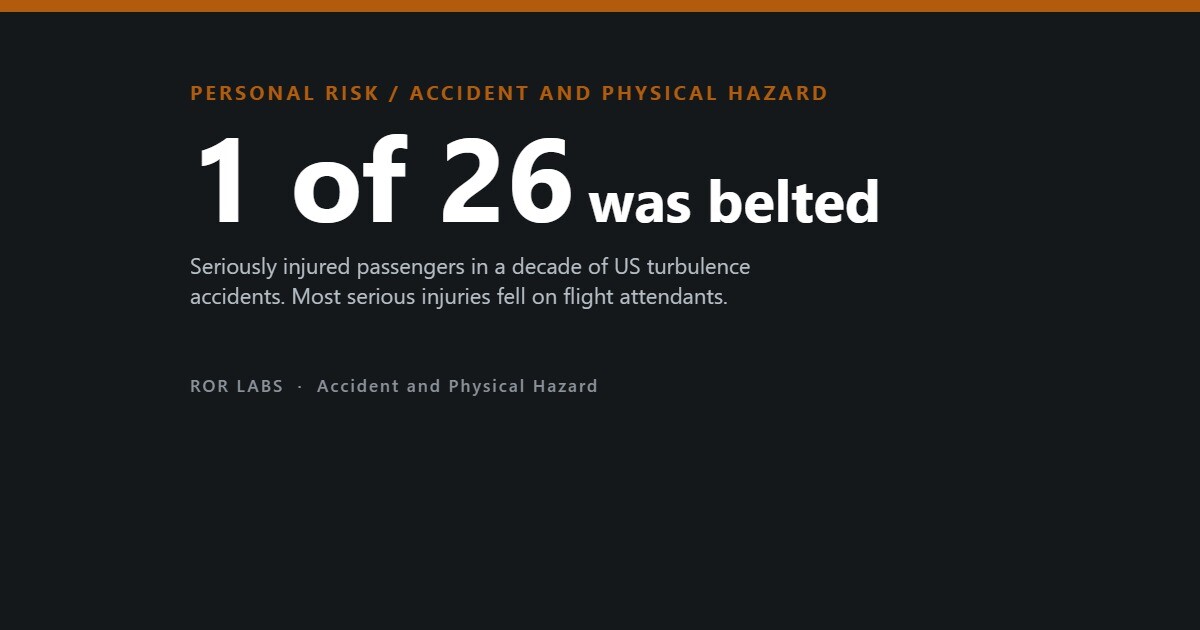
- Of 26 seriously injured passengers, one was wearing a seat belt.
- Severe clear-air turbulence over the North Atlantic rose 55% between 1979 and 2020 in reanalysis data, though attribution there is not settled.
Turbulence is the part of flying that most passengers fear and almost nobody is hurt by. Aircraft are built to take far more than the atmosphere usually throws at them, and a large jet has not been brought down by turbulence in modern airline service.
But turbulence is still the most common cause of accidents in US airline operations, because in aviation an accident includes anyone seriously injured on board. Those injuries follow a very specific pattern: who is standing, where they are standing, and whether they are strapped in.
This is what the evidence shows about turbulence injuries, who they happen to, whether turbulence is getting worse, and what the most-reported recent case actually turned out to be. One number from the US National Transportation Safety Board explains most of it: of 26 passengers seriously hurt in a decade, one was known to be wearing a seat belt.
What the accident records show
In 2021 the NTSB published a safety research report on turbulence in US airline operations under Part 121, the rules that cover scheduled carriers. Between 2009 and 2018 it found 111 turbulence-related accidents, 37.6% of all Part 121 accidents in the period. Turbulence was the single most common defining event.
Those accidents produced 123 serious injuries. Flight attendants suffered 97 of them, 78.9%. Passengers suffered 26. No pilot was seriously injured. The last death in a US Part 121 turbulence accident was in December 1997.
A 2025 study in The American Surgeon by Aditya Shekhar and Keith Ruskin extended the picture to 2023. Among 136 turbulence-related accidents with at least one serious injury from 2008 onward, flight attendants were injured in 126, or 92.6%. Most happened en route rather than on climb or descent.
The pattern is old. Anthony Tvaryanas reviewed US accident records from 1992 to 2001 and found 179 flight attendant injuries from turbulence, nearly half of them serious. Turbulence is, above all, an occupational injury.
Who is seriously injured
Serious injuries in turbulence-related accidents, US Part 121 airline operations, 2009 to 2018.
National Transportation Safety Board, Safety Research Report SS-21-01, 2021. 111 accidents, 123 serious injuries.
Where people are when it happens
The NTSB report is precise about location. Of the seriously injured flight attendants, 88.1% were in the rear of the aircraft, and 75.7% were in the galley. That is where the carts, ovens and meal service are, and where crew spend most of a flight on their feet.
Passengers followed the same geography. Of those seriously injured, 82.4% were in the rear section, and nearly half, 47.1%, were in or near a lavatory. Someone standing in a queue or sitting in a toilet cubicle has nothing to hold them down.
The seat belt finding is the one to remember. Among the seriously injured passengers, only one was wearing a seat belt. Among the seriously injured flight attendants, 83.5% were documented as not restrained. The NTSB concluded plainly that wearing a seat belt reduces the risk of serious injury for everyone on board.
The mechanism is simple. In severe turbulence the aircraft can drop or lift faster than an unrestrained body. A seated, belted passenger moves with the seat. An unbelted one keeps going until they meet the ceiling, a bin or another person.
Where the injured were
Share of seriously injured occupants by location, NTSB review of 2009 to 2018 accidents.
National Transportation Safety Board, SS-21-01, 2021. Categories overlap: the galley is part of the rear cabin.
The seat belt finding
Seriously injured occupants in turbulence-related accidents, NTSB review of 2009 to 2018.
National Transportation Safety Board, SS-21-01, 2021. Accident reports record the injured, not the belted passengers who were unhurt.
When it happens
Half of the accidents, 50.5%, happened during descent or approach, and of those, 65.3% occurred below 20,000 feet. That is the phase when crew are securing the cabin, clearing trays and walking the aisles, often after the seat belt sign has already been switched on.
In 29.7% of the accidents, the flight crew had no awareness that turbulence was likely. Some turbulence is detectable: storm cells show on weather radar and can be flown around. Clear-air turbulence, which occurs in cloudless air near jet streams, does not show on radar at all.
Clear-air turbulence is the reason the advice to keep a belt fastened is not only for bumpy weather. Pilots switch on the sign when they expect rough air. They cannot switch it on for air they cannot see, and the first sign of it is often the jolt itself.
The NTSB’s recommendations followed from this. It called for better sharing of turbulence reports between aircraft, better forecasting tools, and changes to when cabin crew should be seated, particularly during descent. Much of the risk sits with people who are working when the aircraft moves.
Why the crew are the ones hurt
Flight attendants are on their feet for most of a flight, and the job puts them in the aisle at exactly the moments when rough air is most likely to be noticed. A 2013 study in The International Journal of Aviation Psychology by Diane Damos, Kimberly Boyett and Patt Gibbs analysed cabin crew duties and described one of them: when the captain switches on the seat belt sign, a flight attendant must walk the cabin to check that every passenger is seated and belted.
The authors called this a dilemma between safety and service. The check is a safety duty, but it sends a crew member down the aisle just after the flight deck has decided the air is rough enough to seat everyone else. Carts, hot liquids and meal service add their own risks when the aircraft moves.
That is why several of the most useful changes are about timing rather than equipment: when crew should be seated during descent, how pilots tell the cabin what they expect, and whether service stops when the sign comes on. None of it depends on a passenger’s choice, which is part of why the injury burden falls so unevenly.
Phase of flight and warning
NTSB review of 111 turbulence-related accidents, 2009 to 2018.
National Transportation Safety Board, SS-21-01, 2021.
Is turbulence getting worse?
Probably, in some places. A 2023 study in Geophysical Research Letters by Mark Prosser, Paul Williams and colleagues at the University of Reading analysed clear-air turbulence from 1979 to 2020 in a modern atmospheric reanalysis, using 21 different ways of diagnosing it.
At an average point over the North Atlantic, the annual duration of light-or-greater clear-air turbulence rose by 17%, from 466.5 hours to 546.8. Moderate-or-greater rose 37%, from 70.0 to 96.1 hours. Severe-or-greater rose 55%, from 17.7 to 27.4 hours. The authors found similar increases over the continental United States.
Model projections go further. Luke Storer, Williams and Manoj Joshi estimated in 2017 that by 2050 to 2080 the volume of severe clear-air turbulence could roughly double over North America, the North Pacific and Europe, as warming sharpens the wind shear around jet streams. That is a modelled projection, not a measurement.
The picture is less settled than the headlines suggest. A 2024 study by Mohamed Foudad and colleagues in the Journal of Geophysical Research: Atmospheres also found positive trends in the reanalyses, but concluded that over the North Atlantic and North Pacific the signal from climate change could not yet be separated from natural variability. Clearer attribution came over North Africa, East Asia and the Middle East.
Clear-air turbulence over the North Atlantic
Increase in the annual duration of clear-air turbulence at a typical point, 1979 to 2020.
Prosser, Williams, Marlton and Harrison, Geophysical Research Letters, 2023. Diagnosed from reanalysis data, averaged across 21 turbulence diagnostics.
The case everyone remembers
On 21 May 2024, Singapore Airlines flight SQ321, a Boeing 777-300ER from London to Singapore, hit severe turbulence over Myanmar at about 37,000 feet. A 73-year-old British passenger died, most likely of a heart attack. Singapore’s Transport Safety Investigation Bureau reported that in 4.6 seconds the aircraft dropped 54 metres and vertical acceleration swung between roughly minus 1.5 and plus 1.5 g. Passengers who were not belted became airborne.
At the time, the event was widely described as clear-air turbulence and linked to climate change. The bureau’s final report, released in May 2026, found otherwise. The turbulence was convectively induced, from a rapidly developing thunderstorm whose clouds had grown to around 40,000 feet. The investigators could not rule out a malfunction of the aircraft’s weather radar, which had logged three previous faults in the preceding weeks.
Of the 211 passengers, 51 were seriously injured. The airline stopped hot drinks and meal service whenever the seat belt sign is on. The lesson is not that climate change is irrelevant to turbulence. It is that the most famous recent example turned out to be a thunderstorm that, on another day, radar might have shown.
Babies on laps
In the United States, children under two may fly on an adult’s lap without a seat of their own. In turbulence, an adult’s arms are the only restraint. The Federal Aviation Administration recommends that young children fly in an approved child restraint in their own seat, and the NTSB has argued for decades that it should be required.
After the Alaska Airlines door plug blowout in January 2024, NTSB chair Jennifer Homendy urged parents to put children under two in their own seat in an approved car seat. The FAA has not made it mandatory, and its reasoning is an example of a trade-off that is easy to miss.
A 1995 FAA analysis estimated that requiring seats for infants would prevent at most five child deaths in plane crashes over ten years, but would cause a net increase of 82 deaths over the same period, because some families would drive instead of paying for an extra seat. Road travel carries a far higher risk per mile. Canada’s Transportation Safety Board reached a similar conclusion.
That analysis is three decades old and was about crashes rather than turbulence, and the diversion estimate depends on assumptions about how families respond to cost. But it shows why the answer for an individual family, buy the seat if you can, is not automatically the answer for a regulator.
What the evidence does not show
It does not show that turbulence is a danger to the aircraft itself in modern airline service. The risk in the records is injury to people who are not secured, and in US data it has been nearly three decades since it killed anyone on a scheduled airliner.
It does not show that injuries have risen in step with the reanalysis trends. The accident counts are small and depend on reporting rules, and no study has yet linked the increase in diagnosed clear-air turbulence to a measured rise in injuries.
It does not show that climate change caused any particular event. SQ321 is the clearest example: it was reported as clear-air turbulence and investigated as a thunderstorm.
And the seat belt finding comes from accident reports. They record who was seriously hurt; they cannot count the belted passengers on the same flights who walked away unhurt, which is why the NTSB states the protective effect without putting a number on it.
Questions people ask
Can turbulence bring down a plane?
Modern airliners are designed to withstand severe turbulence. In US airline accident records, the harm from turbulence is injury to people on board, overwhelmingly those who are standing or not belted.
Who gets hurt in turbulence?
Mostly flight attendants. In NTSB data for 2009 to 2018 they suffered 97 of 123 serious injuries, most of them in the rear galley.
Should I keep my seat belt on all the time?
Whenever you are seated, keeping it loosely fastened is the advice given by airlines and aviation regulators. Of the 26 passengers seriously injured in the NTSB review, only one was wearing a seat belt.
Is turbulence increasing because of climate change?
Reanalysis data show clear-air turbulence over the North Atlantic rose from 1979 to 2020, with severe turbulence up 55%. One study found that the climate signal over the North Atlantic cannot yet be separated from natural variation.
What caused the Singapore Airlines turbulence?
The final report found it was convectively induced turbulence from a developing thunderstorm, not clear-air turbulence, and could not rule out a weather radar malfunction.
The short version
- Turbulence caused 37.6% of US airline accidents from 2009 to 2018, almost all of them injury accidents.
- Flight attendants suffered 97 of 123 serious injuries, most of them in the rear galley.
- Of 26 seriously injured passengers, one was wearing a seat belt.
- Severe clear-air turbulence over the North Atlantic rose 55% between 1979 and 2020 in reanalysis data, though attribution there is not settled.
- The SQ321 final report blamed a thunderstorm, not clear-air turbulence.
This article summarises published research and accident investigations. It is not safety guidance for any particular flight. Always follow the instructions of the crew and the seat belt sign, and ask your own doctor about any medical concerns before flying.
Further reading. National Transportation Safety Board, ‘Preventing Turbulence-Related Injuries in Air Carrier Operations Conducted Under Title 14 Code of Federal Regulations Part 121’, Safety Research Report SS-21-01, 2021, is free to read. Prosser and colleagues, Geophysical Research Letters, 2023, is open access.
- Not the End of the World, Hannah Ritchie (2024). A data scientist on which environmental trends are real and how large they are. A good companion to reading turbulence projections calmly.
- Flying Blind, Peter Robison (2021). An investigation of Boeing and the 737 MAX, and of how safety culture in aviation can fail even where engineering is excellent.
- The Scout Mindset, Julia Galef (2021). On changing your mind when evidence arrives, which is what a final accident report asks of everyone who reported the first explanation.
Sources
- National Transportation Safety Board. Preventing Turbulence-Related Injuries in Air Carrier Operations Conducted Under Title 14 Code of Federal Regulations Part 121. Safety Research Report NTSB/SS-21-01, 2021.
- Shekhar AC, Ruskin KJ. Injuries due to in-flight turbulence during United States commercial airline flights (2008–2023). The American Surgeon, 2025. doi:10.1177/00031348251397042.
- Tvaryanas AP. Epidemiology of turbulence-related injuries in airline cabin crew, 1992–2001. Aviation, Space, and Environmental Medicine, 2003.
- Prosser MC, Williams PD, Marlton GJ, Harrison RG. Evidence for large increases in clear-air turbulence over the past four decades. Geophysical Research Letters, 2023. doi:10.1029/2023GL103814.
- Storer LN, Williams PD, Joshi MM. Global response of clear-air turbulence to climate change. Geophysical Research Letters, 2017. doi:10.1002/2017GL074618.
- Foudad M, Sánchez-Gómez E, Jaravel T, Rochoux MC, Terray L. Past and future trends in clear-air turbulence over the Northern Hemisphere. Journal of Geophysical Research: Atmospheres, 2024. doi:10.1029/2023JD040261.
- Williams PD, Storer LN. Can a climate model successfully diagnose clear-air turbulence and its response to climate change? Quarterly Journal of the Royal Meteorological Society, 2022. doi:10.1002/qj.4270.
- Ministry of Transport, Singapore. Transport Safety Investigation Bureau preliminary investigation findings of incident involving SQ321. 29 May 2024.
- Transport Safety Investigation Bureau, Singapore. Final report on the SQ321 severe turbulence occurrence of 21 May 2024. 19 May 2026 (as reported by Mothership and Travel Weekly).
- Damos DL, Boyett KS, Gibbs P. Safety versus passenger service: the flight attendants’ dilemma. The International Journal of Aviation Psychology, 2013. doi:10.1080/10508414.2013.772822.
- Investigate TV. Deadly dilemma: how safety restraints on planes could lead to more infant deaths. 12 February 2024 (reporting the 1995 FAA analysis and NTSB statements).
- Sharman R. Nature of aviation turbulence. In: Sharman R, Lane T, eds. Aviation Turbulence. Springer, 2016.