Landmines and Unexploded Ordnance: What the Casualty Records Show
Key takeaways · 14 min read
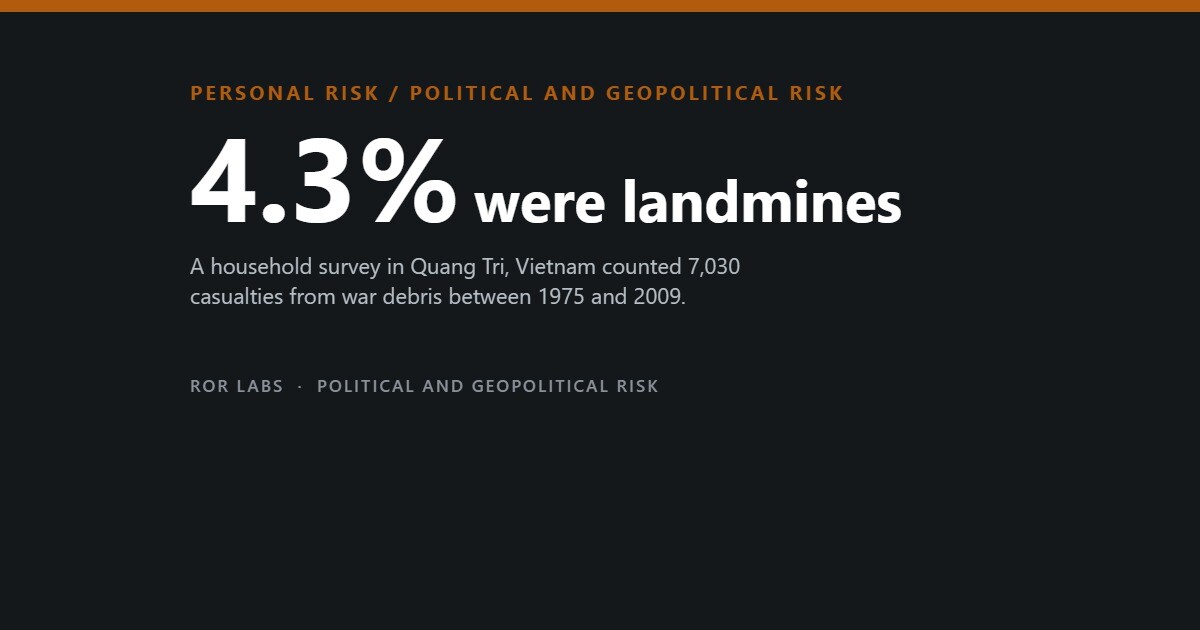
- In one Vietnamese province, only 4.3 per cent of 7,030 war-debris casualties over 34 years came from landmines. Most long-term harm comes from ammunition that failed to explode.
- Among 1,701 child casualties recorded worldwide in 2024, explosive remnants of war accounted for 55.6 per cent, antipersonnel mines for 14.0 per cent.
- Across 105,913 pooled records from 17 countries, 89.9 per cent of casualties were civilians and 38.8 per cent died — 44.5 per cent of women against 38.4 per cent of men.
- Antipersonnel mines were the least lethal category in that analysis, which is what they were designed to be.
In this article
A household survey in Quang Tri province, Vietnam, went door to door and counted everyone hurt by what the war left behind. Between 1975 and 2009 it found 7,030 casualties, about 1.1 per cent of the province. Of those, 4.3 per cent were caused by landmines.
The rest came from ammunition that was fired or dropped, failed to go off, and stayed where it landed: cluster submunitions, mortar rounds, grenades, bombs. The field calls these explosive remnants of war, and they are a different problem from a mine. A mine was buried on purpose where someone wanted the ground denied. A dud submunition is wherever the aircraft put it, and nobody wrote it down.
We call the whole thing the landmine problem because that is the name the campaign of the 1990s gave it, and the campaign worked. But the name points at the smallest category in most casualty records. Here is what those records say — including one finding about the main prevention programme that the people running it did not enjoy.
The word on the label is usually wrong
The categories behave differently. An antipersonnel mine is victim-activated and designed to injure whoever steps on it. An antivehicle mine needs far more weight. An improvised mine is homemade, the kind dominating in Myanmar and Syria. Unexploded ordnance was used as intended and failed; abandoned ordnance was never fired at all. The last two are most of what the sector means by explosive remnants of war.
The Landmine Monitor, the annual count kept by the International Campaign to Ban Landmines, records device type where it can. In 2024 it logged 1,701 child casualties across 34 countries, 494 killed and 1,205 injured. The breakdown puts antipersonnel mines third.
What hurt children in 2024
Share of 1,701 child casualties in 34 countries, by device type.
Landmine Monitor 2025, Impact on Children factsheet, covering 2024.
The pattern repeats wherever anyone counts carefully. In Nepal, community surveillance from 2006 to 2010 logged 307 casualties: 76 per cent improvised devices, 14 per cent other explosive remnants, 4 per cent landmines. In Afghanistan, surveillance across 390 health facilities found children under 18 were 2.4 times more likely than adults to be hurt by unexploded ordnance rather than a mine (2.1 to 2.8). Adults step on things. Children pick things up.
One qualification runs the other way. While a conflict is live, mines and improvised mines do much of the damage, which is what the 2024 figures reflect. The long tail, the part still killing farmers fifty years later, is overwhelmingly leftover ammunition. Which one you meet depends on whether the shooting has stopped.
Who is hurt, who dies, and why the death rate keeps moving
The largest pooled analysis appeared in Communications Medicine in February 2026. Stacey Pizzino and colleagues assembled 105,913 casualty records from mine action authorities and non-governmental organisations across 17 countries and territories. Lao PDR alone supplied 46 per cent, which says something about both the country and the dataset.
Who is in the record
105,913 records pooled from 17 mine-affected countries and territories.
Pizzino and colleagues, 2026.
The overall case fatality rate was 38.8 per cent. It hides a clean split: 44.5 per cent for females against 38.4 per cent for males, an odds ratio of 1.29 with a confidence interval of 1.24 to 1.34, and 1.31 after adjustment. Women are a small minority of casualties and a disproportionate share of the deaths.
Device type mattered too, and not in the expected direction. Improvised explosive devices carried the highest odds of death, an adjusted odds ratio of 4.02 against antipersonnel mines. Antipersonnel mines were the least lethal category. That is no accident: a blast antipersonnel mine is engineered to take a foot off rather than to kill, on the reasoning that a wounded soldier costs an enemy more than a dead one. The design worked, which is a strange thing to have to write down.
The same injury, four death rates
Case fatality among recorded casualties. The differences are mostly about who counted, and where.
Bilukha 2011 (Nepal) and 2007 (Chechnya); Pizzino 2026 (pooled).
A death rate that moves from 14 to 44.5 per cent across studies of the same injury is a warning about the data, not a finding about the weapon. Community surveillance goes looking for households, so it picks up people who died at the roadside. Clinic surveillance counts arrivals, and the dead do not arrive.
The 2026 authors are candid about their limits. Their data depended on established relationships between organisations and communities, so people with reason to distrust whoever holds the clipboard may not appear at all. There was no follow-up, so anyone who survived the first week and died in the second counts as a survivor. Their own conclusion is that the mortality rates may be underestimates.
The programme that was meant to prevent it
The standard intervention is risk education: teach people what the devices look like, where they are likely to be, and what to do on finding one. It is cheap and close to universal. In 1997 a research group called CIET was commissioned by the UN humanitarian coordination office to evaluate the two channels then running in Afghanistan: direct community training by three non-governmental organisations, and a BBC Afghan Service radio drama, New Home New Life.
The first finding was that many people listed as trained had no idea they were on the list. The second was worse. People who said they had received direct training were likelier than people in non-programme areas to report high-risk attitudes and practices, such as searching for scrap metal, or admiring someone who walks into a minefield without being a deminer.
Reported high-risk attitudes and practices, Afghanistan 1997-98
Respondents reporting risky attitudes or practices, by whether their area had a direct training programme. Odds ratio 1.73 (1.48 to 2.02).
CIET evaluation for the UN humanitarian coordination office, reported in Andersson and Mitchell, International Journal of Health Geographics, 2006. Bars scaled to the chart, not to 100 per cent.
The injuries followed the attitudes. Among trainees the evaluators found a higher risk of injury after the programme began, concentrated in the hands, arms, eyes and torso. That is the signature of taking a device apart, not of standing on one. Their explanation is hard to argue with: much of the training was delivered by deminers, who taught what deminers know, including where the detonator sits. People came out feeling competent.
The radio drama went the other way. Listeners were about half as likely as non-listeners to endorse risky behaviour: odds ratio 0.52, confidence interval 0.39 to 0.69, adjusted risk difference 5.4 percentage points. More than seventy candidate confounders were tested, including the obvious one, that radio owners are not economically identical to non-owners. None explained it away. A soap opera outperformed a curriculum.
Surveillance in Kabul found the same thing from the other end. Of 571 people killed or injured there between 1996 and 1998 — 161 traumatic amputations, 94 deaths — 19 per cent of those who could be asked had received mine awareness education beforehand, and most of those were hurt while handling or playing with a device.
This is one country and one era, and the programme was overhauled afterwards; the curriculum shifted from describing devices to describing behaviour. Did that help? A scoping review in Medicine, Conflict and Survival in December 2024 went looking. Across the entire history of the field it found nine evaluative studies in eight countries, only three of which compared people who received risk education against people who did not. It concluded that risk education reliably raises awareness, and that its effect on injury is still unknown.
Nine studies. For an intervention delivered to millions of people for thirty years, by a sector that measures cleared ground to the square metre, that is the whole evidence base.
Why people go into ground they know is dangerous
The Quang Tri survey asked what people were doing when it happened, and the answers are not mysterious. The accident rate was highest among villagers in mountainous areas, ethnic minorities and low-income families.
What people were doing, Quang Tri province, 1975-2009
Activity at the time of the incident among 7,030 casualties, by household survey.
Tran Kim Phung, Le and Husum, Prehospital and Disaster Medicine, 2012.
Scrap metal is the awkward one. It is the behaviour risk education most wants to stop, and also, for a household with no land and no wage, one of the few things that turns a contaminated hillside into money. The Afghanistan evaluators hit the same wall: households with the least radio access were under different economic pressure, and they said so rather than pretending the two were separable. Most affected communities never see a clearance team either; survey data from Yemen, Chad and Thailand found the majority adapt locally, marking ground informally and agreeing where not to walk.
Nepal makes the point differently. There, 38 per cent of injuries happened in the victim’s own home and half occurred while someone was tampering with a device — small improvised bombs that end up indoors because somebody carried them there. Risk education aimed at fields does not reach a kitchen.
What clearing it is worth on paper
Clearance is slow. A deminer advances on hands and knees behind a metal detector through ground salted with fifty years of scrap. Economists have periodically asked whether the money adds up. Their answers do not agree.
Four evaluations, four answers
Cost-benefit results for mine clearance. Nothing about the ground changed between these studies.
| Study | Place | Headline result |
|---|---|---|
| Harris 2000 | Cambodia | Net present value about minus 3,434 million US dollars |
| Elliot and Harris 2001 | Mozambique | Very large negative net present value |
| Byrd and Gildestad 2001 | Afghanistan | Benefit-cost ratio 1.2, rate of return 28 per cent |
| Harris 2002 | Afghanistan | Net present value 935 to 1,744 million US dollars |
Harris, Journal of International Development, 2000; Elliot and Harris, Development Southern Africa, 2001; Byrd and Gildestad, World Bank and UNDP, 2001; Harris, Disasters, 2002.
The Cambodian figure got the attention. Geoff Harris priced clearing the country over 25 years at about 140 million US dollars a year against annual benefits of about 0.7 million, and arrived at a net present value of minus 3.4 billion. Even halving the cost left it worse than minus 400 million, and he suggested policymakers consider alternatives.
Ted Paterson replied the following year that the method overstated costs, understated benefits, and was specified as an all-or-nothing decision about clearing a whole country. It could not evaluate what anyone actually does, which is clear the priority land first. With appropriate adjustments, he wrote, the economics are not bleak.
The deepest disagreement was about the price of a life. The early evaluations valued a death avoided at foregone income, roughly 2,000 US dollars over a lifetime in rural Cambodia. Michael Cameron and colleagues ran a contingent valuation survey in two Cambodian provinces, asking people what they would pay to cut their own risk, and got a value of a statistical life of about 0.4 million dollars — two hundred times higher. On that figure, lives and injuries saved dominate the sum and clearance stops looking wasteful.
The same sensitivity sits inside one study. The World Bank and UNDP evaluation put the benefit-cost ratio of the Mine Action Programme for Afghanistan at 1.2, an internal rate of return of 28 per cent. Strip out the welfare benefits of fewer accidents and it falls to 0.8. Halve the estimated accidents too and it falls to 0.6. Three numbers, one programme, and the difference is an accounting choice about what a leg is worth.
What the evidence does not show
None of the casualty figures here is a total. They are floors. Every dataset depends on somebody reaching somebody, and the pooled analysis says plainly that communities without a relationship to the reporting organisation are unlikely to be captured. The 6,279 recorded for 2024 is the number that could be recorded, where recording happens.
The risk education finding needs holding carefully. More upper-body injuries among trainees is not proof that training causes injuries. It is one evaluation, one country, almost thirty years ago, using cross-sectional data in a setting with enormous population movement — and the programme changed partly because of it. Nobody measured whether the change worked. That is the real state of the evidence: not that risk education fails, but that we cannot say whether it prevents an injury. A gap, not a verdict.

The economic evaluations are all modelling. Not one compares similar land that was and was not cleared. They are built from assumptions about yields, discount rates, accident frequency and the price of a life, so their range is a range of assumptions, not of findings.
The result that children face lower odds of death than adults deserves the most suspicion, and the authors flag it. A child killed outright far from a clinic is less likely to generate a record than one who survives to be treated. Adjustment cannot repair a casualty nobody wrote down.
The sector’s headline numbers also have a poor history. The figure of more than 110 million mines in about 70 countries circulated for two decades and appeared in peer-reviewed medical journals as late as 2003. It was never the product of a count. Estimates now come from formal survey and land release, and they generally fall sharply when anyone looks properly.
Finally, a rising annual total is not evidence that old contamination is getting worse. The 2024 increase to 6,279, the highest since 2020, came from Myanmar, which recorded the world’s highest national total for a second year, and Syria, where people returned to contaminated areas after the government fell. The long tail and the fresh wound go into one number, and the number cannot tell you which moved.
Questions people ask
How long does unexploded ordnance stay dangerous?
Indefinitely, for practical purposes. Laos absorbed about two million tons of ordnance between 1964 and 1973, leaving an estimated eighty million unexploded items and 50,754 casualties to 2017. A quarter of its villages are still affected. French and Belgian teams clear First World War munitions from farmland every year. Explosive fillings degrade, but degradation usually makes a device more sensitive, not less.
Are landmines the main danger once a war ends?
Usually not. In these records leftover ammunition does most of the long-term harm, while mines do more of it during a conflict or just after. Advice built around buried mines misses most of what people meet.
Does mine risk education work?
It reliably increases what people know. Whether it reduces injuries has not been established: a 2024 scoping review found nine evaluative studies in eight countries, only three with a comparison group. The one detailed evaluation that looked at injuries found more upper-body injuries among people trained by deminers, and a clear benefit from a radio drama that taught behaviour instead.
Is a country with recorded casualties unsafe to visit?
The casualties are overwhelmingly residents doing rural work, not visitors on roads and in towns. The risk concentrates on people who must use contaminated land to live. Marked areas and official advice exist for a reason, and nothing here substitutes for a current government travel notice.
What changed in 2025?
Estonia, Latvia, Lithuania, Finland and Poland began withdrawing from the Mine Ban Treaty, citing the Russian invasion of Ukraine. The treaty has 166 ratifications, and Tonga and the Marshall Islands joined the same year. Meanwhile 31 states parties have cleared all antipersonnel mines since 1999, Oman most recently. Donor funding for victim assistance fell by almost a quarter in 2024.
The short version
- In one Vietnamese province, only 4.3 per cent of 7,030 war-debris casualties over 34 years came from landmines. Most long-term harm comes from ammunition that failed to explode.
- Among 1,701 child casualties recorded worldwide in 2024, explosive remnants of war accounted for 55.6 per cent, antipersonnel mines for 14.0 per cent.
- Across 105,913 pooled records from 17 countries, 89.9 per cent of casualties were civilians and 38.8 per cent died — 44.5 per cent of women against 38.4 per cent of men.
- Antipersonnel mines were the least lethal category in that analysis, which is what they were designed to be.
- The one detailed evaluation of risk education found more risky practices and more hand, arm and eye injuries among people trained by deminers, and a benefit from a radio drama.
- A 2024 review found nine evaluative studies of risk education in the field’s whole history. Its effect on injuries is unknown.
- Cost-benefit evaluations of clearance run from minus 3.4 billion dollars to comfortably positive for the same work. The variable is how a life is priced.
This article summarises published surveillance data, epidemiological analyses and economic evaluations. It is not safety guidance and not a field manual. If you meet a suspected explosive item, the advice from every clearance organisation is the same: do not touch it, do not move it, retrace your steps, mark the spot from a distance and report it to the police or the national mine action authority. On the politics of these weapons it takes no position; it reports what the surveys found and where they disagree.
Further reading. Pizzino and colleagues in Communications Medicine (2026) is the largest pooled casualty analysis available, and open access. Shabila and Saleh in Medicine, Conflict and Survival (2024) is the place to start on prevention. Andersson and Mitchell in International Journal of Health Geographics (2006) carries the CIET evaluation, also open access.
- Why We Fight, Christopher Blattman (2022). A careful account of what the conflict data do and do not support, by an economist willing to say when a popular explanation fails a test.
- Calling Bullshit, Carl Bergstrom and Jevin West (2020). Aimed squarely at the problem here, a headline number nobody counted, though its examples lean on science and media.
- How to Talk to a Science Denier, Lee McIntyre (2021). Here for the opposite reason: why correct information often fails to change what people do.
Sources
- Pizzino S, Durham J, Wild H, Tippett V, Waller M. A multi-country epidemiological analysis of mortality from landmines and other explosive ordnance. Communications Medicine, 2026. 105,913 records; case fatality 38.8 per cent; female odds ratio 1.29 (1.24-1.34); improvised devices 4.02.
- Tran Kim Phung, Le V, Husum H. The legacy of war: cluster weapon and land mine accidents in Quang Tri Province, Vietnam. Prehospital and Disaster Medicine, 2012. 7,030 casualties; 4.3 per cent from land mines.
- Andersson N, Mitchell S. Epidemiological geomatics in evaluation of mine risk education in Afghanistan. International Journal of Health Geographics, 2006;5:1.
- Shabila NP, Saleh AM. Evaluation of landmine risk education programs: a scoping review. Medicine, Conflict and Survival, 2024. Nine studies, eight countries.
- Surrency AB, Graitcer PL, Henderson AK. Key factors for civilian injuries and deaths from exploding landmines and ordnance. Injury Prevention, 2007;13(3):197-201.
- Bilukha OO and colleagues. Injuries and deaths due to victim-activated improvised explosive devices, landmines and other explosive remnants of war in Nepal. Injury Prevention, 2011;17(5).
- Bilukha OO and colleagues. Seen but not heard: injuries and deaths from landmines and unexploded ordnance in Chechnya, 1994-2005. Prehospital and Disaster Medicine, 2007;22(6).
- Bilukha OO, Brennan M, Woodruff BA. Death and injury from landmines and unexploded ordnance in Afghanistan. JAMA, 2003;290(5):650-653.
- Harris G. The economics of landmine clearance: case study of Cambodia. Journal of International Development, 2000;12(2):219-225.
- Paterson T. Commentary on the above. Journal of International Development, 2001;13(5).
- Elliot G, Harris G. A cost-benefit analysis of landmine clearance in Mozambique. Development Southern Africa, 2001;18(5).
- Harris G. The economics of landmine clearance in Afghanistan. Disasters, 2002;26(1):49-54.
- Byrd WA, Gildestad B. The socio-economic impact of mine action in Afghanistan. World Bank and UNDP, 2001.
- Cameron MP and colleagues. The value of statistical life and cost-benefit evaluations of landmine clearance in Cambodia. Environment and Development Economics, 2010;15(4).
- Benini A, Moulton LH, Conley C. Landmines and local community adaptation. Journal of Contingencies and Crisis Management, 2002;10(2).
- International Campaign to Ban Landmines. Landmine Monitor 2025 and its Impact on Children factsheet, covering 2024.
- Human Rights Watch. Five European states withdraw from Mine Ban Treaty, 1 July 2025.
- Walsh NE, Walsh WS. Rehabilitation of landmine victims. Bulletin of the World Health Organization, 2003;81(9). Cited for the repeated 110 million figure.
- Franck B, Koolmees D, French S. Community-based inclusive development. Journal of Conventional Weapons Destruction, 2020;23(3). Laos figures.