
What Reduces Loneliness? What the Evidence Shows
A 2026 meta-analysis of 280 studies found loneliness interventions work on average, but not always the ones people expect. What helps, how much, and for whom.
Risk landing on social ties, networks, reputation, standing and social capital.
A 2026 meta-analysis of 280 studies found loneliness interventions work on average, but not always the ones people expect. What helps, how much, and for whom.
Nonviolent campaigns succeeded about twice as often as violent ones in the 20th century, but success rates have fallen. What the research shows about protest, violence and personal risk.
Estimates of gaming disorder range from 0.3% to 10%. What research shows about the WHO diagnosis, who is affected, and whether time limits work.
Mistaken eyewitnesses played a role in 76% of the first 250 US DNA exonerations. What research shows about confidence, lineups and wrongful convictions.
47% of US MLM participants lost money and 27% broke even. What surveys, FTC cases and experiments show about multi-level marketing and who pays.
File photo: a smartphone display. Photo: Skitterphoto, via Wikimedia Commons, CC0. In the news · August 2026 An experiment with 165 participants showed Instagram-style posts that were either new or repeated, with high or low like counts. Repeated statements were again judged more true than new ones, and like counts did not change that effect….
File photo: silhouettes of a group of people at sunset. Photo: Sue Huan (Unsplash), via Wikimedia Commons, CC0. In the news · July 2026 A Victorian parliamentary inquiry made 39 recommendations after reviewing 317 submissions and hearing from survivors of groups such as the Two by Twos and Geelong Revival Centre. It proposes outlawing group-based…
File photo: a teenager texting on a smartphone. Photo: Summer Skyes 11, via Wikimedia Commons, CC BY 2.0. In the news · June 2026 A Eurobarometer survey of 26,297 teenagers and 12,750 parents across the EU, carried out in March and April 2026, found that 25% of teens exceed six hours of daily screen time…
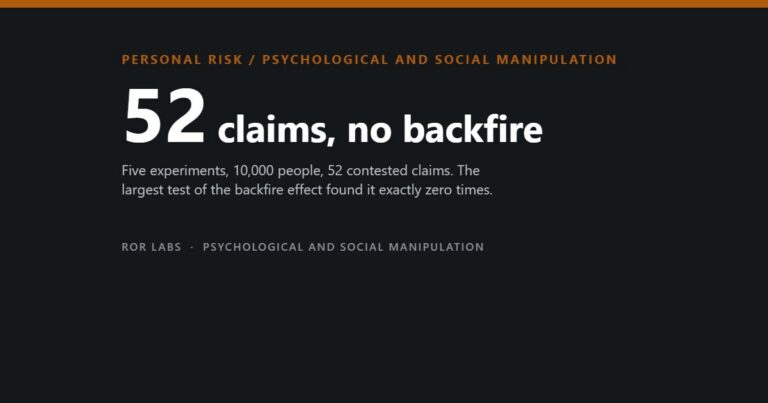
Key takeaways · 12 min read The backfire effect comes from a 2010 paper whose own second experiment failed to reproduce it at the group level. The largest test since — five experiments, more than 10,000 people, 52 corrected claims — found it zero times. Across the literature, 81% of reported backfires used a single-question…
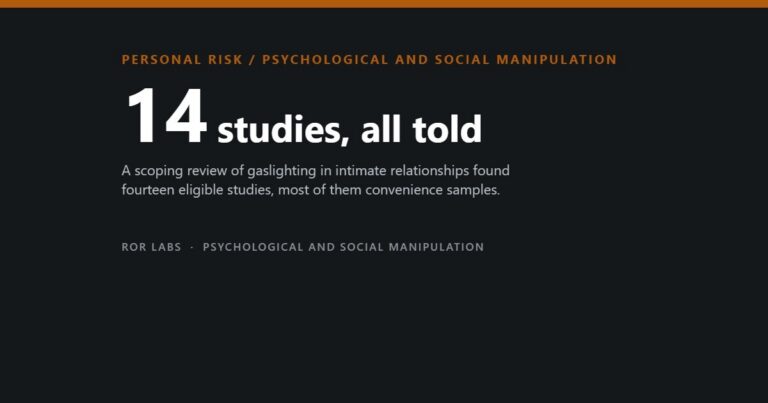
File photo: a woman sitting by a large window. Photo: Alexandre Chambon (Unsplash), via Wikimedia Commons, CC0. In the news · April 2026 A Scientific Reports study from Turkey surveyed 333 women aged 20 to 40 in romantic relationships. Using standardized scales and mediation analysis, it found that higher self-silencing was linked to greater exposure…