Wrongful Convictions: What the Evidence Shows
Key takeaways · 16 min read
- A 2014 statistical study estimated that at least 4.1% of people sentenced to death in the US are innocent; no one knows the rate for ordinary crimes.
- The US National Registry of Exonerations lists more than 3,800 exonerations since 1989 and over 36,000 years lost in prison, and calls this a basement figure.
- Official misconduct and perjury or false accusation each featured in about seven in ten exonerations in 2025; misleading forensic evidence in four in ten.
- About a quarter of known exonerees pleaded guilty, and in one experiment a third of innocent participants accepted a deal when offered a conditional bargain.
The worst mistake a court can make is to convict someone who did nothing wrong. In the United States, more than 3,800 people have been officially cleared of crimes since 1989, after spending on average more than a decade in prison. Those are only the cases that came to light. How many more there are is one of the hardest questions in criminology, because a wrongful conviction looks exactly like a correct one until someone proves otherwise.
Researchers have tried statistical models of death sentences, anonymous prisoner surveys and estimates from judges and lawyers. They agree on one thing: wrongful convictions are not freak events, and the known cases are a small, unrepresentative slice. Most involve murder or rape and followed a trial, which says little about the far larger number of cases settled by a guilty plea.
This article looks at what the estimates say, what the US registry of exonerations shows about how errors happen, why some innocent people plead guilty, what years in prison cost in health and life expectancy, and how compensation works. It compares the US with England and Japan. It avoids detail about the original crimes and does not name anyone harmed by them. Eyewitness error is covered in a separate article on this site.

Why the rate is hard to know
A wrongful conviction is only counted when it is undone, which usually needs new evidence, a lawyer willing to work for years and a court prepared to listen. Samuel Gross of the University of Michigan, a founder of the National Registry of Exonerations, argues that we cannot estimate the overall rate at all, only say that false convictions are not rare and far outnumber exonerations.
The cases that surface are skewed. Rape and murder make up only about 2% of US felony convictions, Gross noted in 2008, yet they dominate known exonerations because they get the most scrutiny. Innocent people who plead guilty to minor charges, receive short sentences or are convicted of crimes that never happened rarely have the time, money or incentive to fight. Their errors stay invisible.
The death-row estimate
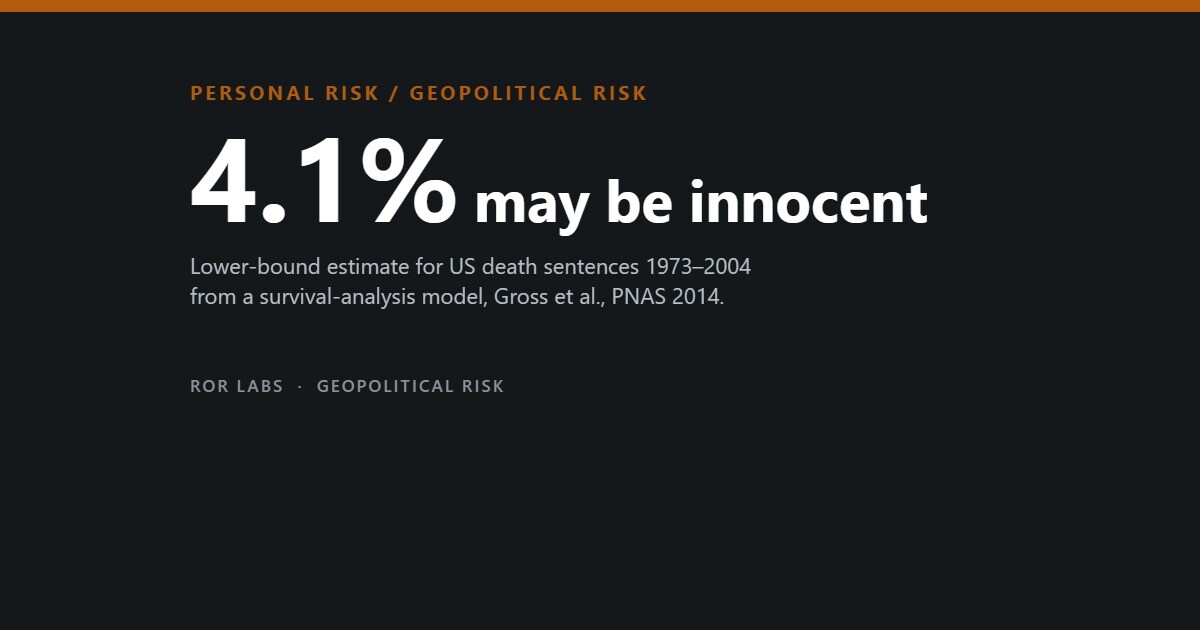
Death sentences are the exception, because each one is reviewed for years and exonerations among them are well recorded. In a 2014 paper in PNAS, Gross, Barbara O’Brien, Chen Hu and Edward Kennedy used survival analysis on people sentenced to death between 1973 and 2004. They estimated that if everyone stayed under sentence of death indefinitely, at least 4.1% would eventually be exonerated, about one in 25. They called that a conservative estimate of the share who are innocent.
How often are the innocent convicted?
Published estimates of the wrongful conviction rate, by method and type of case, %.
Sources: Loeffler CE et al., J Quant Criminol (2018), doi:10.1007/s10940-018-9381-1; Risinger DM (2007); Gross SR et al., PNAS 111(20):7230 (2014), doi:10.1073/pnas.1306417111; Gross SR, O’Brien B, J Empirical Legal Stud (2008); Zalman M et al., Justice Quarterly (2008). Methods differ.
Only about 1.6% of death-sentenced prisoners had actually been exonerated by the time of the study. The gap matters. Many people sentenced to death later have their sentence reduced to life, and the authors point out that far less effort then goes into investigating their innocence. With an error rate above 4%, the authors judged it all but certain that some of the more than 1,300 people executed since 1977 were innocent. The Death Penalty Information Center counts more than 200 death-row exonerations since 1973.
Other methods give answers in a similar range, but each has a weakness. An anonymous survey of new prisoners in one state, published in 2018 by Charles Loeffler and colleagues, estimated that 6% had been wrongly convicted, from 2% for drink-driving to 40% for rape. Self-report cannot be checked case by case, although the authors tested for implausible claims. Michigan judges, prosecutors, police and defence lawyers guessed under 0.5% for their own area and 1% to 3% nationally, with defence lawyers guessing highest.
Gross has tentatively suggested 1% to 5% for serious violent felonies, with the death-row figure the best-grounded number in that range. Reviewing every attempt in 2021, Marvin Zalman and Robert Norris note a recurring flaw: none properly accounts for guilty pleas or minor convictions, the great majority of cases. For those, the rate is unknown.
What the registry shows
The National Registry of Exonerations, run by university researchers, records cases in which a person convicted of a crime was later relieved of all legal consequences on the basis of new evidence of innocence. By early October 2026 it listed 3,863 exonerations since 1989, with more than 36,000 years lost in prison. Its 2025 report, published in April 2026, counted 97 new exonerations that year. The registry itself calls its total a basement figure: the real number of exonerations is unknown.
What went wrong
Share of US exonerations in which each factor contributed, %. Most cases have more than one.
| Factor | 2025 exonerations (97) | All registry cases, 2022 |
|---|---|---|
| Perjury or false accusation | 73% | 63% |
| Official misconduct | 72% | 59% |
| False or misleading forensic evidence | 40% | – |
| Mistaken witness identification | 23% | 27% |
| False confession | 20% | 12% |
Sources: National Registry of Exonerations, 2025 Annual Report (April 2026); all-case shares as reported by Catlin M, Redlich AD, Wrongful Conviction Law Review 4(1) (2023), from registry data as of June 2022.
Two factors dominate. Perjury or false accusation, such as a witness lying or an informant trading testimony for leniency, appeared in 73% of the 2025 cases. Official misconduct, such as police or prosecutors hiding evidence that pointed to innocence, pressuring witnesses or fabricating evidence, appeared in 72%. These often go together, as in the Virginia case in the news card. Across the whole registry, the shares were somewhat lower but in the same order.
False or misleading forensic evidence contributed to 40% of the 2025 exonerations. False confessions featured in 20%, and psychologists Kyle Scherr, Allison Redlich and Saul Kassin note they appear in almost 30% of DNA exonerations. Mistaken eyewitness identification featured in 23%. A third of the 2025 cases were “no-crime” cases, where no crime had in fact occurred.
These shares describe cases that were overturned, not all wrongful convictions, and the registry depends on who goes looking. In 2025, 23 exonerations came with help from conviction integrity units, review teams inside prosecutors’ offices, and 58% involved a professional exonerator such as an innocence organisation. Places without such teams produce fewer exonerations, not necessarily fewer errors.
Innocent people who plead guilty
Most US criminal cases end with a plea bargain, not a trial. A defendant facing a long sentence at trial may accept a short one, or immediate release, in exchange for pleading guilty, even if innocent. A 2023 study by Allison Redlich and colleagues found that about a quarter of the roughly 3,300 exonerations then in the registry involved guilty pleas. Those are the ones that were later overturned, which is especially difficult after a plea.
Plea cases were four times more likely than trial cases to involve a false confession and to be no-crime cases. Trial cases more often involved mistaken identification, forensic errors, perjury and claims of poor defence lawyering. When the evidence is a confession, or a charge that is hard to disprove, an innocent person may judge a deal safer than a jury.
When innocent people take the deal
Share of innocent mock defendants who accepted a plea offer in a negotiation experiment, %.
Source: Luna S, Redlich AD, J Exp Criminol (2025), doi:10.1007/s11292-025-09715-3. 316 community participants with trained actors as lawyers. A laboratory study; real stakes are far higher.
Experiments show how pressure works. In a 2025 study by Samantha Luna and Redlich, 316 adults played defendants negotiating with trained actors as lawyers. Guilty participants were over 16 times more likely to accept a deal than innocent ones, but when the offer was conditional, 32.9% of innocent participants accepted, against 5.0% without it. The other side of the evidence is the “innocence effect”: Avishalom Tor and colleagues found innocent people are generally less willing to accept plea offers than guilty ones.
Pleas also complicate what counts as an exoneration. The Virginia man in the news card was freed after his murder conviction was vacated, but only by pleading guilty to lesser charges, including an Alford plea, in which a defendant accepts that the evidence could convict without admitting guilt. Deals of this kind end long imprisonment quickly, but they leave a criminal record, and the person may not count as exonerated.
Years lost
Exoneration is slow. Brandon Garrett’s study of the first 250 DNA exonerations found an average of 14 years between conviction and exoneration. The registry’s 2025 figures are similar: the 97 people exonerated that year had lost an average of 14.2 years each to wrongful imprisonment, 1,373 years in all. More than a third had spent over 20 years in prison, 13 over 30 years and three over 40 years.
Time behind bars
People exonerated in the United States in 2025.
14.2 years
Average time lost to wrongful imprisonment per person, 1,373 years in total across 97 people.
37%
Share who had spent more than 20 years in prison; 13 people spent over 30 years and three over 40.
Source: National Registry of Exonerations, 2025 Annual Report (April 2026).
Long delays have causes. Gould and Leo’s 2015 study of 260 wrongful convictions found that convictions were hard to reverse without conclusive evidence of innocence, that most exonerations still needed DNA, and that police and prosecutors together were the largest source of opposition. Death sentences get the most review, one reason they surface more errors.
Life after release
People who are exonerated walk out with the same problems as anyone leaving prison after many years, often with less support. As the social work researcher Tina Simms has noted, they have fewer re-entry supports than prisoners released on parole. Many lost their jobs, homes, relationships and working years. Small surveys suggest a heavy mental toll, though they rely on volunteers and cannot show how many would have struggled anyway.

In a study of 59 exonerees led by Jeff Kukucka, released as a preprint in 2022, 80% reported trauma while in prison, about half screened positive for probable post-traumatic stress disorder and 51% for major depression. Those with stronger social support and full-time jobs had better mental health, while time served, time since release and compensation made no clear difference. A 2023 survey of 74 exonerees by Kathryn Thomas and William Hoyt reported rates of PTSD 11 times, anxiety seven times and depression four times higher than in the general population.
The harm reaches beyond prison walls. A 2023 survey of 101 people caught up in the UK Post Office scandal, accused or convicted because of faulty accounting software, found that 67% reported clinically significant post-traumatic stress symptoms and 60% depressive symptoms, whether or not they had been convicted. Accusation alone, it seems, can do lasting damage.
The mental toll
Mental health measures in surveys of people wrongly convicted or accused. Small, self-selected samples.
| Study | Group | Finding |
|---|---|---|
| Kukucka 2022, preprint | 59 US exonerees | Probable PTSD 48–52%; major depression 51% |
| Thomas & Hoyt 2023 | 74 US exonerees | PTSD 11 times, anxiety 7 times, depression 4 times general-population rates |
| Growns 2023 | 101 people in the UK Post Office scandal | PTSD symptoms 67%; depressive symptoms 60% |
| Catlin & Redlich 2023 | 186 US exonerees who had died | Died 13.2 years earlier than expected, after allowing for time in prison |
Sources: Kukucka J et al., PsyArXiv (2022); Thomas KA, Hoyt WT, J Forensic Psychiatry Psychol (2023), doi:10.1080/14789949.2023.2270504; Growns B et al., Legal Criminol Psychol (2023), doi:10.1111/lcrp.12247; Catlin M, Redlich AD, Wrongful Conviction Law Review 4(1) (2023).
A 2023 study by Mary Catlin and Allison Redlich went further. Among 2,657 registry exonerees, they found 186 who had died, against about 32 expected from US death rates; on average they died 13 years earlier than expected, even allowing for time in prison. The authors could not compare exonerees with guilty people released after similar sentences, and an average age at death describes only those who have already died.
Compensation laws
As of August 2026, 38 states and the District of Columbia had laws compensating people who were wrongfully convicted, according to the registry. Federal law allows up to $50,000 for each year of wrongful imprisonment, or $100,000 for each year under sentence of death. State payments vary widely, from about $5,000 to $200,000 per year, according to a 2025 review by Farina Barth. Eligibility rules differ, and the registry notes that payment frequently comes many years after the exoneration.
What compensation looks like
Selected US compensation rules and totals.
| Item | Figure |
|---|---|
| States with a compensation statute (plus DC), August 2026 | 38 |
| Federal maximum per year of wrongful imprisonment | $50,000 ($100,000 if sentenced to death) |
| Range of state statutes per year | About $5,000 to $200,000 |
| Illinois, after a 2026 law | Up to $50,000 per year, up from about $15,500 |
| State compensation and civil awards since 1989 | More than $5.5bn |
Sources: National Registry of Exonerations, compensation page and 2025 Annual Report; 28 U.S.C. § 2513(e); Barth F (2025); Injustice Watch (July 2026) on Illinois HB 3663.
Some states are raising payments. Illinois passed a law, signed in July 2026, lifting compensation from about $15,500 a year to up to $50,000 for each year in prison and removing a total cap of roughly $300,000. Across the country, state compensation and civil damages paid to exonerees since 1989 now exceed $5.5bn.
Does money help? A 2013 study of 118 exonerees by Evan Mandery and colleagues found that being compensated at all made no difference to later offending, but those paid more than $500,000 offended at a significantly lower rate. The Kukucka survey found no link between compensation and mental health. The evidence is thin either way.
Beyond the United States

England, Wales and Northern Ireland have the Criminal Cases Review Commission, set up in 1997 to review possible miscarriages of justice and send cases back to the appeal courts. It has referred more than 930 cases since then. In 2024–25 it received 1,541 applications and made 31 referrals; of 27 referrals decided that year, the courts allowed 18. After it admitted mistakes in handling three applications from Andrew Malkinson, whose conviction was later quashed, an independent review made nine recommendations, all accepted.
Japan shows the opposite extreme: a conviction rate above 99% and very few retrials. Iwao Hakamada, a former boxer arrested in 1966 and sentenced to death in 1968, was acquitted at a retrial by the Shizuoka District Court on 26 September 2024, aged 88. The court found that investigators had fabricated key evidence, including his confession. He had spent more than four decades in detention, most of it under sentence of death, before his release in 2014.
In March 2025 he was awarded about 217 million yen, around $1.4m. According to the criminologist David T. Johnson, retrials were granted in only about 1% of petitions between 2017 and 2021. In July 2026 Japan’s parliament passed the first revision of the retrial rules since the 1948 code, which in principle stops prosecutors appealing decisions to grant a retrial.
What the evidence suggests
Wrongful convictions are not rare. For US death sentences, the best estimate is that at least one in 25 is wrong; for ordinary crimes and guilty pleas, nobody knows. Overturned cases point mostly to lying witnesses, official misconduct and misleading forensic evidence, though they are a biased sample. Exonerees lose more than a decade on average, carry heavy mental strain afterwards and may die younger. Compensation is patchy, and other countries show that review bodies help but also make mistakes.
Questions people ask
How many innocent people are in prison?
No one knows. Estimates for serious crimes range from about 1% to 6%, but none is reliable for ordinary cases or guilty pleas.
What is an exoneration?
In the US registry’s definition, a case in which a convicted person is relieved of all legal consequences because of new evidence of innocence.
What is the most common cause of wrongful convictions?
Among known US exonerations, perjury or false accusation and official misconduct each feature in most cases, often together.
Why would an innocent person plead guilty?
To avoid the risk of a much longer sentence at trial, or to be released sooner. Conditional offers make it more likely.
Do exonerees get compensation?
Sometimes. Most US states have laws, but amounts and eligibility vary widely, and payment can take years.
The short version
- A 2014 statistical study estimated that at least 4.1% of people sentenced to death in the US are innocent; no one knows the rate for ordinary crimes.
- The US National Registry of Exonerations lists more than 3,800 exonerations since 1989 and over 36,000 years lost in prison, and calls this a basement figure.
- Official misconduct and perjury or false accusation each featured in about seven in ten exonerations in 2025; misleading forensic evidence in four in ten.
- About a quarter of known exonerees pleaded guilty, and in one experiment a third of innocent participants accepted a deal when offered a conditional bargain.
- Exonerees report high rates of PTSD and depression, and compensation laws vary widely from state to state.
This article summarises research and official data for general information. It is not legal advice. If you or someone you know may have been wrongly convicted, contact a criminal defence lawyer or an innocence organisation in your country. Anyone struggling with the aftermath of a conviction or accusation should consider talking to a doctor or mental-health professional.
Further reading: Gross et al., PNAS 111(20) (2014), for the death-row estimate. The National Registry of Exonerations’ 2025 Annual Report for current US cases and causes. Redlich et al., Psychology, Crime & Law (2023), for how false guilty pleas differ from trial convictions.
- Autopsy of a Crime Lab, Brandon L. Garrett (2021). A law professor examines how flawed forensic evidence leads to wrongful convictions and what better science would look like. Clear and well sourced; it covers forensics only, not the wider system.
- Charged, Emily Bazelon (2019). A journalist follows two cases to show how prosecutors’ choices, including plea offers, shape outcomes. Vivid on plea bargaining; it is about prosecution in general, not wrongful convictions specifically.
- Usual Cruelty, Alec Karakatsanis (2019). A civil rights lawyer argues that everyday practices such as cash bail and plea pressure are built into the system. Sharp on pleas and poverty; openly polemical rather than balanced.
Sources
- Gross SR, O’Brien B, Hu C, Kennedy EH. PNAS 111(20):7230 (2014), doi:10.1073/pnas.1306417111; University of Michigan news release (2014).
- Gross SR, O’Brien B. J Empirical Legal Stud (2008), doi:10.1111/j.1740-1461.2008.00146.x.
- Gross SR. Annu Rev Law Soc Sci (2008), doi:10.1146/annurev.lawsocsci.4.110707.172300.
- Gross SR. How many false convictions are there? (SSRN, 2013).
- Risinger DM (SSRN, 2007).
- Loeffler CE, Hyatt J, Ridgeway G. J Quant Criminol (2018), doi:10.1007/s10940-018-9381-1.
- Zalman M, Smith B, Kiger A. Justice Q (2008), doi:10.1080/07418820801954563.
- Zalman M, Norris RJ. New Crim Law Rev 24(4) (2021), doi:10.1525/nclr.2021.24.4.601.
- Garrett BL. Annu Rev Criminol (2020), doi:10.1146/annurev-criminol-011518-024739.
- Gould JB, Leo RA. The path to exoneration (SSRN, 2015).
- Scherr KC, Redlich AD, Kassin SM. Perspect Psychol Sci (2020), doi:10.1177/1745691619896608.
- Redlich AD et al. Psychol Crime Law (2023), doi:10.1080/1068316X.2023.2213381.
- Luna S, Redlich AD. J Exp Criminol (2025), doi:10.1007/s11292-025-09715-3.
- Tor A et al. J Empirical Legal Stud (2010), doi:10.1111/j.1740-1461.2009.01171.x.
- Catlin M, Redlich AD. Wrongful Conviction Law Review 4(1) (2023).
- Kukucka J et al. ExHaLE study, PsyArXiv preprint (2022).
- Thomas KA, Hoyt WT. J Forensic Psychiatry Psychol (2023), doi:10.1080/14789949.2023.2270504.
- Growns B et al. Legal Criminol Psychol (2023), doi:10.1111/lcrp.12247.
- Simms T. Social Work (2016), doi:10.1093/sw/sww003.
- Mandery EJ et al. J Crim Law Criminol 103(2) (2013).
- Barth F (2025).
- National Registry of Exonerations: 2025 Annual Report (April 2026), compensation page (August 2026), website totals (October 2026).
- Death Penalty Information Center, Innocence.
- 28 U.S.C. § 2513.
- Injustice Watch (July 2026).
- Criminal Cases Review Commission, Annual Report 2024–25.
- Johnson DT. Asia-Pacific Journal: Japan Focus (2024).
- Al Jazeera (25 March 2025); Japan Times (17 July 2026).
- Associated Press via News4JAX (29 September 2026).