Family Carers Are Widely Said to Face a 63 Per Cent Higher Risk of Death. In 1.1 Million Linked Records, They Died Less Often Than Everybody Else.
Key takeaways · 12 min read
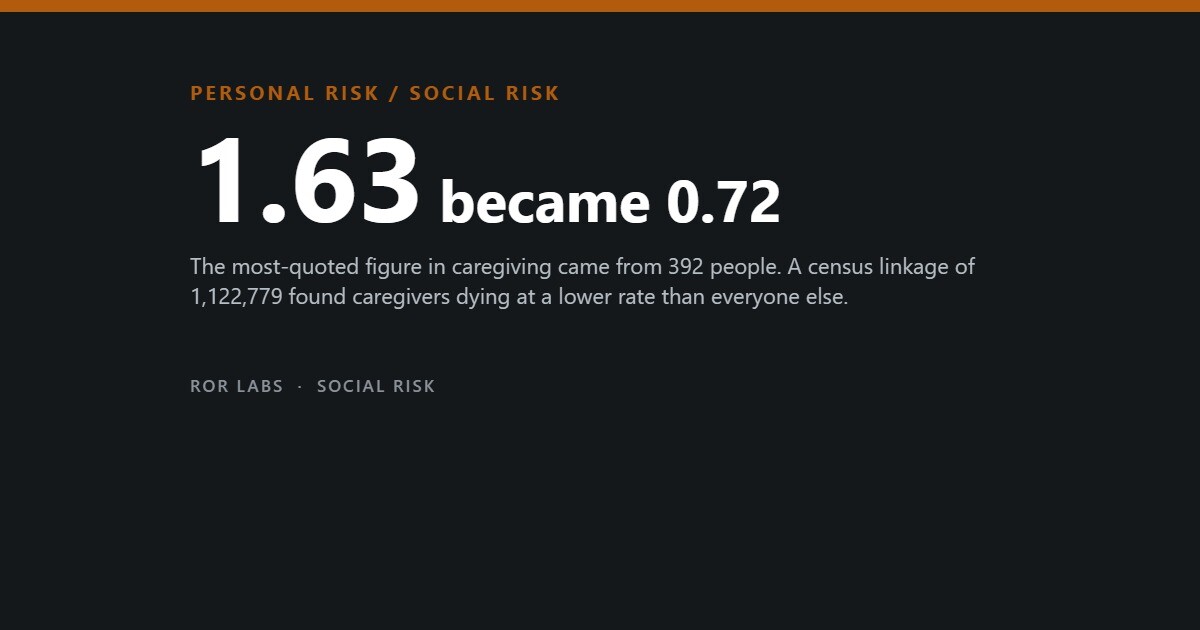
- The 63% figure comes from one 1999 study of 392 caregivers, applied only to spouses aged 66+ who were both helping and reporting strain. Its confidence interval ran from 1.00 to 2.65.
- A propensity-matched study of 3,503 caregiver pairs found the opposite: 7.5% of caregivers died against 9.0% of matched non-caregivers, hazard ratio 0.82.
- A census linkage of 1,122,779 people found a hazard ratio of 0.72, holding even at 50 or more caregiving hours a week.
- A meta-analysis of 12 studies and 2,685,347 people found 0.85. Seven of the twelve found lower mortality; none found it higher.
If you have ever read anything about looking after an ageing parent or a sick spouse, you have met this number: caregivers have a 63 per cent higher risk of dying. It appears in charity leaflets, in policy submissions, in newspaper features, and in the opening paragraph of a great many research papers.
It comes from one study, published in JAMA in 1999, and it is narrower than almost anyone who quotes it realises. It applied to spouses aged 66 and over who were both helping a disabled partner and reporting mental or emotional strain. There were 392 caregivers in the study. The confidence interval on the finding ran from 1.00 to 2.65 — the lower edge sitting exactly on no effect at all.
Since then, larger studies have looked at the same question. A census linkage covering 1,122,779 people found that caregivers died at a lower rate than everyone else. This article is about how a field reversed its headline finding, why the original result was not wrong so much as misread, and what the reversal does and does not license anyone to say.
Where the number came from
The Caregiver Health Effects Study followed 392 caregivers and 427 non-caregivers, all aged 66 to 96 and all living with their spouses, for about four and a half years. Richard Schulz and Scott Beach split them four ways: spouse not disabled; spouse disabled but not being helped; spouse disabled and being helped, with no strain reported; and spouse disabled and being helped, with mental or emotional strain reported.
Only the fourth group showed anything. Adjusted for demographics and for existing clinical and subclinical disease, strained helping spouses had a mortality risk 63 per cent above the non-caregiving controls: a relative risk of 1.63, with a 95 per cent confidence interval of 1.00 to 2.65. The other three caregiving groups did not differ from controls.
The paper’s own conclusion is careful and specific. It says that being a caregiver who is experiencing mental or emotional strain is an independent risk factor for mortality. It does not say that caregiving is. Almost every subsequent citation drops the qualifier.
What the 1999 study actually compared
Four groups of older married people, followed about four and a half years. Only one group differed from the controls.
Source: Schulz, R. and Beach, S.R., “Caregiving as a risk factor for mortality: the Caregiver Health Effects Study”, JAMA 282(23):2215–2219, 1999.
Then the larger studies arrived
The obvious way to test a mortality claim is to look at a lot of people. Over the following fifteen years several groups did, and they kept finding the opposite of what the field expected.
David Roth and colleagues used the REGARDS cohort, a national American study of adults aged 45 and over. They took 3,503 family caregivers and matched each one individually to a non-caregiver using a propensity score built from fifteen demographic, health history and health behaviour variables. Over an average six years, 7.5 per cent of the caregivers died against 9.0 per cent of the matched non-caregivers: a hazard ratio of 0.823. Subgroup analyses by race, sex, relationship and reported strain failed to find any subgroup with a raised death rate.
In Northern Ireland, Dermot O’Reilly’s group linked the census to death records: 1,122,779 people, of whom 183,842 were caregivers, followed for 33 months. Fully adjusted hazard ratio 0.72. The protective association held for the 51,927 people providing 50 or more hours of care a week — 0.77 for men, 0.76 for women — and it held among people who already had chronic health problems.
A meta-analysis of twelve longitudinal population studies pooled 2,685,347 people, of whom 414,797 were caregivers, over an average of nine years. Seven of the twelve found significantly lower mortality among caregivers and five found no significant difference. None found it higher. Pooled hazard ratio 0.85.
The same question, at four sample sizes
Mortality in caregivers relative to comparison groups. Below 1.00 means caregivers died at a lower rate.
Sources: Schulz and Beach, JAMA, 1999; Roth et al., American Journal of Epidemiology 178(10), 2013; O’Reilly et al., International Journal of Epidemiology 44(6), 2015; Mehri, Kinney and Rajabi Rostami, Innovation in Aging 2(S1), 2018.
By 2015 the reversal was explicit enough that Roth, Lisa Fredman and William Haley wrote a reappraisal in The Gerontologist saying so. Their summary is that the 1999 study has been widely cited as evidence for the physical health risks of caregiving and is often the centrepiece of advocacy for caregiver services, that five subsequent population-based studies found reduced mortality and extended longevity for caregivers as a whole, and that policy reports and media portrayals commonly present an overly dire picture.
Three reasons not to celebrate
It would be easy to read the reversal as good news: caregiving turns out to be healthy. That reading is wrong in at least three ways, and each of them comes from the same researchers who produced the reversal.
The strain finding survived
Molly Perkins and colleagues went back into the REGARDS cohort — the same data that produced the 0.82 — and looked at strain rather than caregiving status. Among the 3,710 caregivers, those reporting high strain had significantly higher adjusted mortality than caregivers reporting no strain (hazard ratio 1.55) and than those reporting some strain (1.83). The effect did not differ by race, sex or relationship.
So the population of caregivers as a whole lives longer, and inside that population the strained ones die sooner. Both are true at once. Schulz and Beach’s actual claim, the one with the qualifier attached, has not been overturned.
Two findings from the same cohort
REGARDS, a national American study of adults aged 45 and over.
Sources: Perkins, M.M. et al., Journals of Gerontology Series B 68(4), 2013; Roth et al., American Journal of Epidemiology, 2013.
It may not be caregiving at all
Lisa Fredman’s group followed 375 caregivers and 694 non-caregivers, all women, average age 81, in the Caregiver-Study of Osteoporotic Fractures. They measured perceived stress separately from caregiving status, which almost nobody had done, and the result rearranges the question.
Over the first three years, high perceived stress raised mortality whether or not the woman was a caregiver. The adjusted hazard ratio was 1.44 for high-stress caregivers and 1.69 for high-stress non-caregivers — and only the second of those reached statistical significance. Meanwhile caregivers who reported low stress had a hazard ratio of 0.67, and those who said the caregiving tasks themselves were not stressful, 0.57.
The authors’ conclusion is that higher stress, rather than caregiving as such, is what is associated with mortality. They add a methodological point that lands directly on the 1999 design: the effect of high stress was stronger among spouse caregivers than among caregivers generally, which they take as evidence that comparing spouse caregivers with married non-caregivers may overstate the harms of caregiving.
The survival advantage is probably selection
This is the one that should stop anyone from turning the reversal into advice. A Finnish register study of family caregivers found that older caregivers had markedly lower mortality than the age-matched general population, while younger caregivers had equal or only slightly lower mortality.
That age gradient is the fingerprint of a selection effect. Becoming someone’s carer requires being well enough to do it, and at 80 that is a far more selective requirement than at 50. The authors say so directly: the age dependency in relative mortality risk is likely to reflect the selection of healthier individuals into the caregiver role, and this possibility should be borne in mind when interpreting studies of caregiver health.
Propensity matching helps with this, which is why the Roth work matters more than the raw comparisons. But propensity scores can only match on what was measured. Nobody has a variable for the unrecorded frailty that stops a person from taking on care in the first place.
Why the healthy-caregiver reading is fragile
Sources: Mikkola, T.M. et al., Aging Clinical and Experimental Research 33, 2021; Roth, D.L., Brown, S., Rhodes, J. and Haley, W.E., Psychology and Aging 33(4), 2018.
The thing that is actually worth measuring
If the population-level mortality question has an answer and the answer is undramatic, the useful question is a different one: what happens to the person being cared for when the carer goes first?
Joseph Gaugler’s group put a number on it using the Health and Retirement Study, identifying couples in which one partner had dementia and began receiving functional help from the other. Their framing is the honest one for this literature: caregiving status is not what predicts death, but the loss of a caregiver is a concrete event with consequences for someone who cannot absorb it.
That is where the strain finding and the mortality finding meet. The population of caregivers is not dying early. A subset reporting high strain is at raised risk, that subset is identifiable by asking one question, and the person who depends on them has no fallback if they are wrong about coping.
What each study can and cannot support
| Claim | Supported? |
|---|---|
| Caregiving raises your risk of dying | No. Twelve pooled population studies, 2.7 million people, hazard ratio 0.85. |
| Caregiving lowers your risk of dying | Associated, but probably selection. The advantage rises with age, which is what selection looks like. |
| High strain raises your risk of dying | Yes, within caregivers. Hazard ratios of 1.55 and 1.83 in the same cohort that found 0.82 overall. |
| High stress raises your risk of dying | Yes, and in non-caregivers too. In one study only the non-caregiver estimate was significant. |
| Caregivers feel worse than non-caregivers | Yes. Matched caregivers reported more depressive symptoms and more perceived stress, and still outlived their matches. |
Sources: as cited throughout; Roth, Fredman and Haley, The Gerontologist 55(2), 2015, for the reappraisal.

Questions people ask
So is the 63 per cent figure simply wrong?
No, and that matters. It was a real finding in a real cohort, and it has never been retracted or failed to replicate on its own terms — strain within caregivers still predicts mortality. What went wrong is the citation, not the study. A result about strained spouse caregivers aged 66 and over became a result about caregivers, and a confidence interval whose lower bound sat on 1.00 became a flat statement of fact.
If caregivers live longer, why do they report feeling worse?
Nobody is sure. In the propensity-matched cohort, caregivers reported significantly more depressive symptoms and higher perceived stress than their matched non-caregivers, and still had better survival over seven years. The researchers who found it proposed a stress-buffering effect from prosocial helping as a possible mechanism. That is a hypothesis, offered as one, and it has not been demonstrated.
Does the number of hours matter?
Less than you would expect. In the Northern Ireland census linkage the lower mortality held even among the 51,927 people providing 50 or more hours a week, at hazard ratios of 0.77 and 0.76. Hours of care do not behave like a dose in this literature. Perceived strain does.
What should someone reading this actually take from it?
That the useful question is not whether you are a carer but whether you would describe yourself as strained, because that is the variable the data responds to. And that a great deal of what gets said about caregiver health is describing a subgroup as if it were everyone.
Why has the corrected picture not spread?
The reappraisal authors offer a candid answer: the dire version is more useful to advocacy. They argue the opposite case — that as the pool of family carers shrinks, an accurate and less alarming account is needed to encourage people into the role, and that services should be targeted at the highly strained minority rather than at everyone.
The short version
- The 63% figure comes from one 1999 study of 392 caregivers, applied only to spouses aged 66+ who were both helping and reporting strain. Its confidence interval ran from 1.00 to 2.65.
- A propensity-matched study of 3,503 caregiver pairs found the opposite: 7.5% of caregivers died against 9.0% of matched non-caregivers, hazard ratio 0.82.
- A census linkage of 1,122,779 people found a hazard ratio of 0.72, holding even at 50 or more caregiving hours a week.
- A meta-analysis of 12 studies and 2,685,347 people found 0.85. Seven of the twelve found lower mortality; none found it higher.
- Within caregivers, high strain still predicts death: 1.55 against no strain and 1.83 against some strain, in the same cohort that produced the 0.82.
- One study measuring stress separately found high stress raised mortality in caregivers (1.44) and non-caregivers (1.69) alike — and only the non-caregiver estimate was significant.
- The survival advantage grows with age, which is the signature of healthier people being selected into the caregiving role rather than a benefit of caregiving.
- Matched caregivers report more depressive symptoms and more perceived stress than their controls, and still outlive them. Nobody has explained this.
This article summarises published epidemiological research on mortality among family caregivers. It is not medical advice, and it describes population averages rather than any individual’s risk. Caring for someone can be exhausting and isolating whatever the mortality statistics say; if that describes your situation, a general practitioner or a local carers’ service is the right place to raise it.
Further reading: the 2015 reappraisal by Roth, Fredman and Haley in The Gerontologist is the single best entry point and is written for a general reader. The Northern Ireland census study is the largest thing in the field.
- Together, Vivek Murthy (2020). The US Surgeon General on the health effects of isolation — which caregiving can produce as much as loneliness does.
- Noise, Daniel Kahneman, Olivier Sibony & Cass Sunstein (2021). On unwanted variability in expert judgment.
- The Scout Mindset, Julia Galef (2021). On reasoning to see clearly rather than to defend a position.
Sources
- Schulz, R. and Beach, S.R., “Caregiving as a risk factor for mortality: the Caregiver Health Effects Study”, JAMA 282(23):2215–2219, 1999. (392 caregivers and 427 non-caregivers aged 66 to 96, living with their spouses, followed about 4.5 years. Four groups: spouse not disabled; disabled and not helping; disabled and helping without strain; disabled and helping with mental or emotional strain. Only the last differed from controls, at relative risk 1.63, 95% CI 1.00 to 2.65, adjusted for sociodemographic factors and prevalent and subclinical disease. The conclusion is specific to strained caregivers.)
- Roth, D.L., Haley, W.E., Hovater, M., Perkins, M.M., Wadley, V.G. and Judd, S., “Family caregiving and all-cause mortality: findings from a population-based propensity-matched analysis”, American Journal of Epidemiology 178(10):1571–1578, 2013. (3,503 REGARDS caregivers individually matched to non-caregivers on 15 covariates. Over an average six years, 264 caregiver deaths (7.5%) against 315 (9.0%), hazard ratio 0.823, 95% CI 0.699 to 0.969. No subgroup by race, sex, relationship or strain showed raised mortality.)
- O’Reilly, D., Rosato, M., Maguire, A. and Wright, D.M., “Caregiving reduces mortality risk for most caregivers: a census-based record linkage study”, International Journal of Epidemiology 44(6), 2015. (1,122,779 individuals including 183,842 caregivers, 33 months of follow-up, 29,335 deaths. Fully adjusted hazard ratio 0.72, 95% CI 0.69 to 0.75. Among the 51,927 providing 50 or more hours a week, 0.77 for men and 0.76 for women. Lower risk also held among people with existing chronic health problems.)
- Mehri, N., Kinney, J.M. and Rajabi Rostami, M., “Family caregiving and all-cause mortality: a meta-analysis of 12 longitudinal population-based studies”, Innovation in Aging 2(S1), 2018. (12 studies, seven American and five international, 2,685,347 individuals of whom 414,797 caregivers, average nine years, 118,533 deaths. Pooled hazard ratio 0.85, 95% CI 0.76 to 0.95. Lower in seven studies, non-significant in five.)
- Perkins, M.M., Howard, V.J., Wadley, V.G., Crowe, M.L., Safford, M.M. and Haley, W.E., “Caregiving strain and all-cause mortality: evidence from the REGARDS study”, Journals of Gerontology Series B 68(4), 2013. (Among 3,710 REGARDS caregivers, high perceived strain carried significantly higher adjusted mortality over five years than no strain (HR 1.55) and than some strain (HR 1.83). Effects did not differ by race, sex or caregiving relationship.)
- Fredman, L., Cauley, J.A., Hochberg, M., Ensrud, K.E. and Doros, G., “Mortality associated with caregiving, general stress, and caregiving-related stress in elderly women”, Journal of the American Geriatrics Society 58(5), 2010. (375 caregivers, 694 non-caregivers, women, mean age 81.3. In the first three years, adjusted HR 1.44 (0.77 to 2.69) for high-stress caregivers and 1.69 (1.01 to 2.81) for high-stress non-caregivers. Low-stress caregivers 0.67; those not stressed by caregiving tasks 0.57. The authors conclude that stress rather than caregiving drives the association, and that comparing spouse caregivers with married non-caregivers may overestimate the adverse effects of caregiving.)
- Mikkola, T.M., Kautiainen, H., Mänty, M., von Bonsdorff, M.B., Kröger, T. and Eriksson, J.G., “Age-dependency in mortality of family caregivers: a nationwide register-based study”, Aging Clinical and Experimental Research 33, 2021. (Older family caregivers had markedly lower mortality than the age-matched general population while younger caregivers had equal or only slightly lower mortality. The authors attribute the age dependency to selection of healthier individuals into the caregiver role and advise that this be borne in mind when interpreting caregiver health studies.)
- Roth, D.L., Fredman, L. and Haley, W.E., “Informal caregiving and its impact on health: a reappraisal from population-based studies”, The Gerontologist 55(2), 2015. (Argues that the Schulz and Beach result has been widely cited as evidence for the physical health risks of caregiving, that five subsequent population-based studies found reduced mortality and extended longevity for caregivers as a whole, and that policy reports and media portrayals commonly present an overly dire picture while ignoring the positive findings.)
- Roth, D.L., Brown, S.L., Rhodes, J.D. and Haley, W.E., “Reduced mortality rates among caregivers: does family caregiving provide a stress-buffering effect?”, Psychology and Aging 33(4), 2018. (3,580 REGARDS caregivers matched to non-caregivers on 15 variables. Caregivers reported significantly more depressive symptoms and higher perceived stress than their matches, p < .0001, while still showing better seven-year survival. A stress-buffering mechanism from prosocial helping is proposed as a hypothesis.)