
Shingles Vaccine and Dementia: What the Evidence Shows
Natural experiments in Wales, Australia and Canada linked shingles vaccination to fewer dementia diagnoses. What they found, and why the size is disputed.
Exposure inside the health system: hospitals, clinics, pharmacies and care homes.
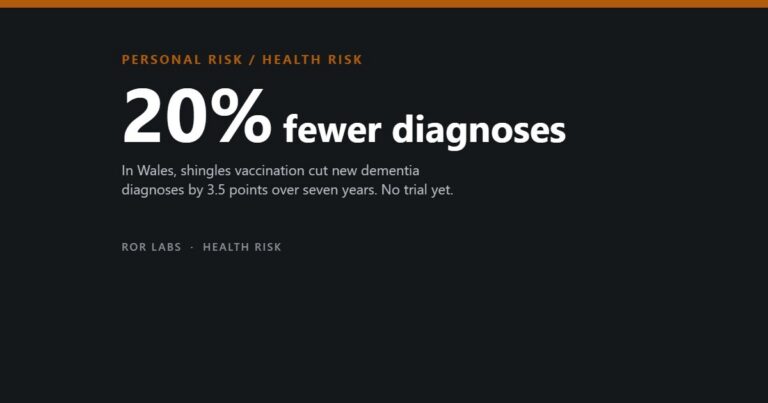
Natural experiments in Wales, Australia and Canada linked shingles vaccination to fewer dementia diagnoses. What they found, and why the size is disputed.
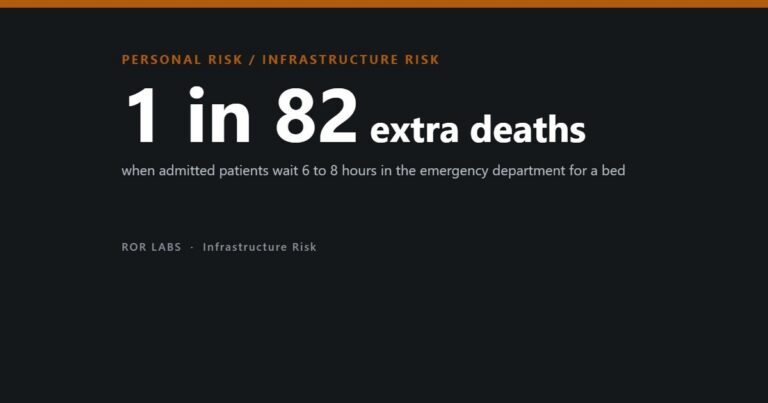
For every 82 admitted patients delayed 6 to 8 hours in the ED, one extra death follows. What research shows about emergency department boarding and what patients can do.
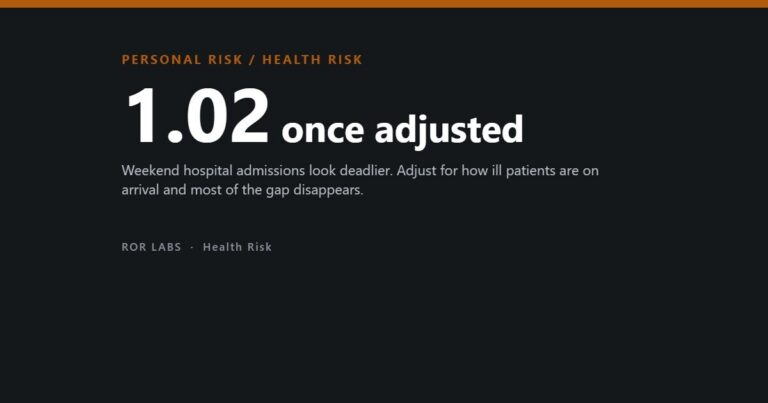
Patients admitted to hospital at weekends die at slightly higher rates. Adjust for how ill they are on arrival and most of the gap disappears. What the evidence shows.
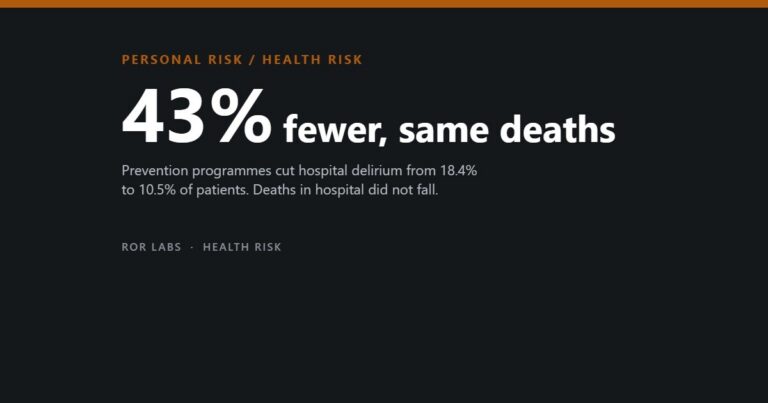
About 29% of older medical inpatients develop delirium, and many cases are missed. Prevention programmes cut cases by 43%, but did not reduce deaths. What the evidence shows on detection, dementia and treatment.
Official statistics record about 24 deaths per US hurricane. Excess-mortality studies find far more, in the months and years after the storm. What kills people directly, who dies later, and how much weight the biggest estimates can carry.
Stagnation and Legionella are genuinely linked — in dead legs and capped pipe spurs. An empty building is a different claim, and in the one building anyone measured, the standard remedy backfired.
File photo: a modern hospital room. Photo: JesusisGreat7, via Wikimedia Commons, CC0. In the news · September 2026 For World Patient Safety Day on 17 September 2026, the WHO focused on safe care for people with noncommunicable diseases. It states that about 1 in 10 patients are harmed during healthcare worldwide, roughly half of that…
Among Medicare patients already admitted when a ransomware attack began, in-hospital mortality rose 34 to 38 per cent. The harm also spreads to hospitals that were never attacked — and the security remediation that follows a breach has a measurable cost of its own.
A randomised trial found that using a regular adult cuff on someone who needs an extra-large one overestimates systolic pressure by about 20 mmHg – enough to turn 125/79 into 144/87 on the same arm. What the WHO numbers say about the 600 million who do not know, what SPRINT actually showed, and how to get a reading worth acting on.