Anticholinergic Medicines and Dementia: What the Evidence Shows
Key takeaways · 13 min read
- Anticholinergic medicines block acetylcholine, a chemical messenger the brain uses for memory. Some older antidepressants, bladder drugs, antihistamines and Parkinson’s drugs have strong effects.
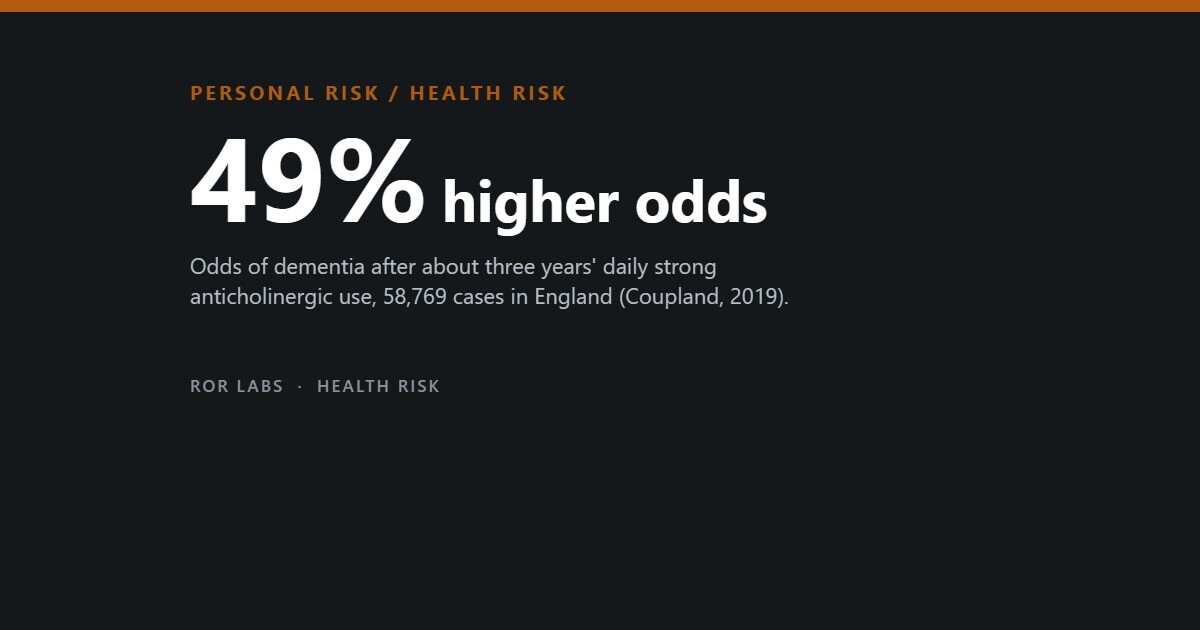
- In a large English study, the equivalent of three years’ daily use of a strong anticholinergic went with about 50% higher odds of a later dementia diagnosis (adjusted odds ratio 1.49).
- The signal sits mainly in some classes: anticholinergic antidepressants, bladder antimuscarinics and Parkinson’s drugs. It is weak or absent for gut antispasmodics and inhaled bronchodilators.
- All of the evidence is observational. These drugs are sometimes prescribed for early symptoms of dementia, and a Danish study found no extra risk when bladder drugs were compared with a non-anticholinergic alternative.
In this article
- What anticholinergic medicines are
- What the large studies found
- Dose, duration and age
- Which drug classes carry the signal
- The reverse-causation problem
- Does stopping lower the risk?
- What guidelines and regulators say
- What the regulator tells patients and prescribers to do
- Where the evidence is weak
- Questions people ask
- The short version
- Sources
Many older adults take at least one medicine that blocks acetylcholine, often without knowing it. The box might say it is for an overactive bladder, for sleep, for hay fever or for low mood. Over the past decade a series of large studies has linked long, heavy use of the stronger drugs in this group to a later diagnosis of dementia, and the headlines have been alarming.
This article looks at what that link rests on: the big UK prescription-record studies, a US cohort, newer Swedish and Danish analyses, the trials that tried to cut these drugs, and the July 2026 review by the UK medicines regulator. Earlier articles here covered modifiable risk factors for dementia and delirium in hospital.
The answer has two halves. The association is consistent, grows with dose and appears in several countries. But every study is observational, the drugs are often prescribed for symptoms that may themselves be early signs of dementia, and no trial has yet shown that stopping them lowers the risk.
What anticholinergic medicines are
Acetylcholine is a chemical messenger. The brain uses it for attention and memory; the body uses it to control the bladder, gut and glands. Some drugs block it on purpose, such as the bladder antimuscarinics that calm an overactive bladder. Many others block it as a side effect, including older tricyclic antidepressants, first-generation antihistamines and some drugs for Parkinson’s disease, nausea and sleep.
Laboratory measures of anticholinergic activity do not track effects on thinking well, so researchers rank drugs with expert-consensus scales. The most used is the Anticholinergic Cognitive Burden (ACB) scale. A score of 1 means possibly anticholinergic, with no known effect on cognition. Scores of 2 and 3 mean definite effects, and 3 is kept for drugs also linked with delirium (Richardson et al., 2018).
The short-term effects are not in dispute: confusion, dry mouth, constipation, difficulty passing urine and falls. The question here is different. It is whether years of use leave a lasting mark, measured as a higher chance of being diagnosed with dementia later on.
What the large studies found
The study quoted most often is Carol Coupland and colleagues’ 2019 analysis in JAMA Internal Medicine. Using English GP records from the QResearch database, it compared 58,769 people aged 55 and over who had a dementia diagnosis with 225,574 matched controls. It totalled prescriptions for 56 strong anticholinergic drugs in the 1 to 11 years before diagnosis; 56.6% of cases and 51.0% of controls had had at least one.
Exposure was measured in total standardised daily doses (TSDDs). More than 1,095 TSDDs, which the authors equate with three years’ daily use of one strong drug at the minimum effective dose for older people, went with an adjusted odds ratio of 1.49 compared with no use. The study was funded by the NIHR School for Primary Care Research.
The odds rise with cumulative dose
Adjusted odds ratio for a dementia diagnosis by total standardised daily doses (TSDDs) of strong anticholinergics prescribed 1–11 years earlier. No use = 1.
Source: Coupland et al., JAMA Internal Medicine (2019); 58,769 people with dementia and 225,574 controls in England. Odds ratios, not absolute risks.
A year earlier Kathryn Richardson and colleagues used another UK database, the CPRD, and looked 4 to 20 years before diagnosis in 40,770 patients aged 65 to 99 and 283,933 controls. Any drug with an ACB score of 3 carried an adjusted odds ratio of 1.11. For anticholinergic antidepressants (odds ratio 1.19), they estimated about 2 extra diagnoses per 100 people aged 65 to 70 over 15 years.
Dose, duration and age
What makes researchers take the link seriously is the gradient. In Coupland’s data the odds rose step by step with cumulative dose. A US cohort from the Adult Changes in Thought study, led by Shelly Gray in 2015, followed 3,434 people aged 65 and over, of whom 797 developed dementia; the top dose band had a hazard ratio of 1.54.
A 2025 Swedish nationwide study by Nanbo Zhu and colleagues, covering 199,526 people with dementia and matched controls, found the same kind of dose-response for strong anticholinergics (ACB 2 or 3) but none for weak ones (ACB 1). In all, 21.3% of cases and 17.4% of controls had been prescribed at least one strong drug.
Both large studies found stronger associations in people diagnosed younger. The Swedish authors point out that relative measures shrink when the background risk of dementia is already high, and that deaths before diagnosis can dilute the figures in the oldest groups.
Stronger associations in younger patients
Adjusted odds ratio for dementia in the highest cumulative-dose band of strong anticholinergics, by age at diagnosis.
Sources: Coupland et al., JAMA Internal Medicine (2019); Zhu et al., Alzheimer’s Research & Therapy (2025). Dose measures differ (TSDDs v. DDDs), so the two countries are not directly comparable.
Which drug classes carry the signal
‘Anticholinergics’ is not a single exposure. When Coupland split the drugs into 11 types, the highest dose band was linked with dementia for antipsychotics, bladder antimuscarinics, Parkinson’s drugs, antiepileptics and antidepressants. Antihistamines, gut antispasmodics, inhaled bronchodilators, muscle relaxants and heart-rhythm drugs showed no significant increase, though the last two were rarely used.
Not all anticholinergics look alike
Adjusted odds ratio for dementia with more than 1,095 TSDDs, by drug type, compared with no use of that type.
Source: Coupland et al., JAMA Internal Medicine (2019), table 5, fully adjusted models.
Richardson found the same core: antidepressants, bladder drugs and Parkinson’s drugs with an ACB score of 3 were linked with dementia, while gastrointestinal drugs, antihistamines and antipsychotics with that score were not. The antidepressants were mainly older tricyclics, and the links held for prescriptions written 15 to 20 years before diagnosis.
The picture is not identical everywhere. The Swedish study also found dose-response links for antihistamines and several psychotropic classes, partly, its authors say, because of its much larger sample. A 2024 English study of bladder drugs by Barbara Iyen and colleagues found raised odds for three of the most used antimuscarinics but no significant increase for five others.
The reverse-causation problem
Dementia develops for years before it is diagnosed. In that time people may have low mood, poor sleep, anxiety or bladder symptoms, and be prescribed exactly these drugs. If so, the medicine is a marker of a disease already under way, not its cause. Epidemiologists call this protopathic bias, and it is the main reason for caution.
Studies try to deal with it by ignoring prescriptions in the years just before diagnosis. In Coupland’s data the overall association barely moved when the window was pushed back to 5 to 20 years. The antipsychotic link did not survive, which the authors read as a sign of protopathic bias for that class. Some early symptoms, they note, can start up to 10 years before diagnosis.
Pushing the window back
Adjusted odds ratio for more than 1,095 TSDDs, by how many years before diagnosis the prescriptions were counted.
Source: Coupland et al., JAMA Internal Medicine (2019), tables 4–5 and text.
A sharper test compares drugs given for the same problem. Nelsan Pourhadi and colleagues studied 2.26 million Danes aged 60 to 75. Against non-use, anticholinergic bladder drugs carried a rate ratio of 1.44, highest in current users. But among 58,242 new users of bladder drugs, those on anticholinergics had no higher risk than those on a beta-3 agonist, a bladder drug that does not block acetylcholine.
The comparison group changes the answer
Incidence rate ratio for dementia with anticholinergic bladder drugs, Denmark, 2000–2022.
Source: Pourhadi et al., BMJ Medicine (2025). The active-comparator analysis covered 2,198 people with dementia and 10,990 controls.
The Danish authors suggest the link with non-use may partly reflect a connection between bladder symptoms and dementia rather than the drug. A large US records study also found higher dementia risk with the beta-3 agonist than in untreated patients (Sheyn et al., 2025). Doctors may also steer people they see as higher-risk toward the newer drug, which would bias the comparison the other way.
Does stopping lower the risk?
If the drugs cause harm, cutting them should help, but testing that is hard. A 2023 Cochrane review by Martin Taylor-Rowan and colleagues found only three randomised trials, with 299 older adults followed for one to three months. It rated the evidence on cognition as very low certainty and could not say whether reducing anticholinergic burden improves thinking.

A 2023 meta-analysis in Age and Ageing by Eve Braithwaite and colleagues pooled seven trials with 1,774 participants. It found no clear effect on cognition, falls or quality of life, but also no clear fall in anticholinergic burden itself, so most trials never really tested the question. In the German AgeWell.de trial, 67.6% of intervention patients and 72.1% of controls were still taking anticholinergics after two years.
A 2015 commentary on Gray’s study observed that recent and past heavy users had a similar risk, which could mean any harm is not simply undone by stopping, and that the safety of stopping had not been tested in trials. The US R2D2 trial, planned for 344 participants with cognitive testing every six months for up to two years, is designed to answer part of this.
What guidelines and regulators say
The American Geriatrics Society’s 2023 Beers Criteria list strongly anticholinergic drugs as potentially inappropriate for older adults, and first-generation antihistamines carry a strong recommendation to avoid. Anticholinergics are also among the drugs to avoid in people with dementia or cognitive impairment, and the criteria advise keeping down the number taken together, because the risks rise with the total burden.
The UK regulator was more cautious about dementia specifically. In its July 2026 review of bladder anticholinergics, the MHRA found the evidence ‘not sufficient to confirm’ a direct effect but said a small increased risk could not be ruled out. Its advisers judged all 17 studies at serious or critical risk of bias; only two had adjusted for cognition at the start.
Its practical advice matches the Beers approach: limit the number of anticholinergics older people take, at the lowest dose for the shortest time, and keep the short-term effects on memory in mind. Patients were told to discuss concerns with a health professional and not to stop a medicine without advice. Untreated depression, Parkinson’s symptoms and incontinence carry harms of their own.
What the regulator tells patients and prescribers to do
This section reports what the UK regulator and two other sources say. It is not advice to start, stop or change any medicine; that is a decision for the prescriber.
| Source | What it says |
|---|---|
| MHRA public assessment report on bladder anticholinergics (July 27, 2026) | The available evidence is “not sufficient to confirm” that these medicines directly increase the risk of developing dementia, and a small increased risk cannot be completely ruled out. Patients should not stop taking their medicine without medical advice and should discuss concerns with a healthcare professional. Prescribers should aim to limit the number of anticholinergic medicines older people take, using the lowest dose for the shortest time. |
| Commission on Human Medicines advice, as summarised in the report | There is considerable uncertainty about a causal link. Older people may be more likely to have memory, attention and thinking side effects, and several anticholinergics together may increase these risks. |
| American Geriatrics Society Beers Criteria, 2023 (nonprofit) | Lists first-generation antihistamines as medicines to avoid in older adults, noting that cumulative anticholinergic exposure is associated with increased risk of falls, delirium and dementia, and advises considering total anticholinergic burden during regular medication reviews. |
| NHS page on one antidepressant (reviewed Aug. 2023) | Says not to stop suddenly without talking to a doctor, and that there may be an increased risk of confusion and possibly dementia with medicines like it but more research is needed. A single-drug page, not general guidance. |
The practical thread in all four is the same: ask for a medication review rather than stopping on your own. That reading is ours, but each source supports its parts.
What we could not confirm: any FDA or NIH page on anticholinergic burden, a general NHS page on medicines that affect memory, and the last part of the MHRA report (we read about 90 percent of it). A 2015 NIA news item on this topic is dated and is not current guidance.
Where the evidence is weak
Almost everything here comes from prescription records. They show what was dispensed, not what was swallowed, and they miss over-the-counter antihistamines and sleep aids. Dementia is under-diagnosed in GP records, and anticholinergic scales disagree about which drugs to include. Richardson’s team added that treating a score of 3 as three times a score of 1 is hard to justify.
Not every study finds a link. In the UK Cognitive Function and Ageing Study of 8,216 people, the adjusted rate ratio for ACB-3 drugs was 1.28, with a confidence interval from 0.82 to 2.00. Among Canadians aged 18 to 64 starting bladder drugs, anticholinergics showed no excess risk against a beta-3 agonist (hazard ratio 0.99). A 2020 meta-analysis of 26 studies put the pooled odds ratio for any use at 1.20, with high heterogeneity.
What would settle the question is a long randomised trial of stopping or switching, with dementia as the outcome. None exists yet. Until then the fair summary is that the link is consistent and dose-related, concentrated in a few drug classes, and partly explained by reverse causation; by how much, nobody yet knows.
What to do
Steps sorted by when they matter. Each one says how strong the evidence is: Measured Official advice Untested
Before
- Ask your doctor or pharmacist to review all your medicines, including over-the-counter sleep aids and allergy tablets, for anticholinergic effects. Official advice see Sources
- Ask whether several of your medicines add up to a high anticholinergic burden, because guidelines advise keeping the number taken together low. Official advice see Sources
- Before taking a first-generation antihistamine regularly, ask a pharmacist about it: the Beers Criteria advise older adults to avoid these drugs. Official advice see Sources
- If you have an overactive bladder, ask your doctor whether bladder training or a non-anticholinergic option could suit you. Untested see Sources
If it happens
- Ask your doctor or pharmacist whether you are on the lowest dose that controls your symptoms, for the shortest time needed. Official advice see Sources
- Tell your doctor about new confusion, drowsiness, constipation or difficulty passing urine, which are known short-term effects of these drugs. Untested see Sources
Afterwards
- If your doctor suggests reducing or switching a medicine, ask how it will be done and which symptoms to watch for. Untested see Sources
- Ask for a follow-up review: in a German trial most people were still taking anticholinergics two years after a medication check. Measured see Sources
What not to do
- Do not stop or change a prescribed medicine on your own; the MHRA tells patients to seek medical advice first. Official advice see Sources
- Do not assume occasional use carries the risk seen in studies of years of daily use; antihistamines showed no significant increase in the largest UK study. Measured see Sources
- Do not leave depression, Parkinson’s symptoms or incontinence untreated out of fear; these conditions carry harms of their own. Untested see Sources
Not medical advice. Do not stop or change a medicine yourself; ask your doctor or pharmacist.
Questions people ask
Does taking an allergy tablet now and then raise my dementia risk?
The studies point to long, heavy use of strong anticholinergics, typically years of daily doses. In Coupland’s data antihistamines showed no significant increase at any dose. First-generation antihistamines still cause short-term drowsiness and confusion in older people, which is why the Beers Criteria advise avoiding them.
I take a bladder medicine. Should I stop it?
Not on your own. The MHRA tells patients not to stop without medical advice. Ask your doctor or pharmacist to review whether you still need it, whether a lower dose would do, and whether bladder training or a non-anticholinergic drug might suit you. Coupland’s team named both as alternatives.
Are newer antidepressants anticholinergic too?
Most newer antidepressants score 1 or 0 on the ACB scale. In Richardson’s study, score-1 antidepressants, mainly SSRIs, were linked with dementia only close to diagnosis, which the authors read as possible reverse causation. The lasting association was with score-3 drugs, mainly older tricyclics.
How can I find out my anticholinergic burden?
Ask a pharmacist. Scales such as the ACB give each drug a score, and the total is a rough measure of burden. The scales disagree in places and are not a diagnosis, but they help a pharmacist or doctor see when several medicines add up.
Does stopping reverse the risk?
Nobody knows. Confusion caused by these drugs is generally considered reversible when they are stopped, as Gray’s paper notes, but no trial has yet shown that long-term dementia risk falls afterwards. The trials so far were small and short and often did not manage to cut anticholinergic use.
The short version
- Anticholinergic medicines block acetylcholine, a chemical messenger the brain uses for memory. Some older antidepressants, bladder drugs, antihistamines and Parkinson’s drugs have strong effects.
- In a large English study, the equivalent of three years’ daily use of a strong anticholinergic went with about 50% higher odds of a later dementia diagnosis (adjusted odds ratio 1.49).
- The signal sits mainly in some classes: anticholinergic antidepressants, bladder antimuscarinics and Parkinson’s drugs. It is weak or absent for gut antispasmodics and inhaled bronchodilators.
- All of the evidence is observational. These drugs are sometimes prescribed for early symptoms of dementia, and a Danish study found no extra risk when bladder drugs were compared with a non-anticholinergic alternative.
- Trials that tried to cut anticholinergic use were small and short and have not shown that stopping protects memory. A larger US trial is under way.
- Guidelines advise avoiding strong anticholinergics in older adults where possible. Do not stop a medicine on your own: ask your doctor or pharmacist to review what you take.
This article summarises research, regulators’ reviews and news reports for general information. It is not medical advice. Do not stop or change a medicine without talking to your doctor or pharmacist; if you are worried about your memory or about what you take, ask for a medication review.
Further reading: Coupland et al., JAMA Internal Medicine (2019), for the largest dose-by-class analysis. Pourhadi et al., BMJ Medicine (2025), for how an active comparator changes the answer. The MHRA’s public assessment report on bladder anticholinergics (2026), for a regulator’s reading of all the studies.
Sources
- Medicines and Healthcare products Regulatory Agency. Bladder anticholinergics: review of risk of dementia. Public Assessment Report (27 July 2026).
- The Pharmaceutical Journal. MHRA report finds insufficient data on bladder anticholinergics dementia risk (29 July 2026), doi:10.1211/pj.2026.1.421977.
- Coupland CAC, Hill T, Dening T, Morriss R, Moore M, Hippisley-Cox J. Anticholinergic drug exposure and the risk of dementia: a nested case-control study. JAMA Intern Med (published online 24 June 2019).
- Richardson K, Fox C, Maidment I, et al. Anticholinergic drugs and risk of dementia: case-control study. BMJ 361:k1315 (2018), doi:10.1136/bmj.k1315.
- Gray SL, Anderson ML, Dublin S, et al. Cumulative use of strong anticholinergics and incident dementia: a prospective cohort study. JAMA Intern Med (2015), doi:10.1001/jamainternmed.2014.7663.
- Campbell NL, Boustani MA. Adverse cognitive effects of medications (invited commentary). JAMA Intern Med (2015).
- Zhu N, Eriksdotter M, Liabeuf S, et al. Anticholinergic burden and incident dementia: a Swedish nationwide case-control study. Alzheimers Res Ther (2025), doi:10.1186/s13195-025-01883-8.
- Iyen B, Coupland CAC, Bell B, et al. Risk of dementia associated with anticholinergic drugs for overactive bladder in adults aged ≥55 years: nested case-control study. BMJ Medicine (2024), doi:10.1136/bmjmed-2023-000799.
- Pourhadi N, Janbek J, Gasse C, et al. Bladder drugs and risk of dementia: Danish nationwide active comparator study. BMJ Medicine 4(1):e001125 (2025).
- Sheyn D, Murphy J, Mahajan A, et al. Pharmacotherapy for overactive bladder syndrome and the risk of incident dementia. World J Urol (2025).
- Andrade C. Anticholinergic drug exposure and the risk of dementia: there is modest evidence for an association but not for causality. J Clin Psychiatry (2019).
- Taylor-Rowan M, Alharthi AA, Noel-Storr AH, et al. Anticholinergic deprescribing interventions for reducing risk of cognitive decline or dementia in older adults with and without prior cognitive impairment. Cochrane Database Syst Rev (2023), doi:10.1002/14651858.CD015405.pub2.
- Braithwaite E, Todd OM, Atkin A, et al. Interventions for reducing anticholinergic medication burden in older adults: a systematic review and meta-analysis. Age Ageing 52(9):afad176 (2023).
- Deprescribing drugs with anticholinergic effects in older patients with increased risk of dementia in the multicomponent intervention study AgeWell.de. Br J Clin Pharmacol 91(12):3489–3500 (2025), doi:10.1002/bcp.70194.
- Campbell NL, Holden RJ, Gao S, et al. Deprescribing anticholinergics to preserve brain health: reducing the risk of dementia through deprescribing (R2D2): study protocol for a randomized clinical trial. Trials 25 (2024), doi:10.1186/s13063-024-08618-4.
- 2023 American Geriatrics Society Beers Criteria Update Expert Panel. American Geriatrics Society 2023 updated AGS Beers Criteria for potentially inappropriate medication use in older adults. J Am Geriatr Soc (2023), doi:10.1111/jgs.18372.
- Grossi CM, Richardson K, Fox C, et al. Anticholinergic and benzodiazepine medication use and risk of incident dementia: a UK cohort study. BMC Geriatr (2019), doi:10.1186/s12877-019-1280-2.
- Li B, Reid JM, McClure JA, Clemens KK, Welk BK. The impact of real-world use of overactive bladder medications on dementia risk in younger adults. Eur Urol Open Sci (2025), doi:10.1016/j.euros.2025.06.008.
- Pieper NT, Grossi CM, Chan WY, et al. Anticholinergic drugs and incident dementia, mild cognitive impairment and cognitive decline: a meta-analysis. Age Ageing 49(6):939 (2020).
- MHRA. Bladder anticholinergics: review of risk of dementia, public assessment report, July 27, 2026. gov.uk.
- 2023 American Geriatrics Society Beers Criteria Update Expert Panel. J Am Geriatr Soc (2023), doi:10.1111/jgs.18372, via PMC.
- NHS. Common questions about amitriptyline for pain and migraine. nhs.uk. Reviewed Aug. 14, 2023.