Precautionary Allergen Labels: What the Evidence Shows
Key takeaways · 13 min read
- ‘May contain’ and ‘made in a factory that also handles…’ labels are voluntary and mostly unregulated, yet appear on most supermarket products in Australia, Canada and the UK.
- Most labelled products contain no detectable allergen: in US and Irish surveys of products labelled for peanut, 5% to 10% tested positive.
- The minority that do can carry enough to cause reactions, and chocolate, cookies, bars and baked snacks account for nearly all the positives.
- The wording tells you nothing about the risk, and products with no warning at all are not always clean.
In this article
- What ‘may contain’ actually means
- How common the labels are
- What testing finds inside the packet
- How allergic shoppers respond
- Thresholds, reference doses and VITAL
- What regulators say
- The bigger risk: undeclared allergens
- What the FDA says to do
- Where the evidence is weak
- Questions people ask
- The short version
- Sources
Anyone who shops for a child with a food allergy learns to turn every packet over. The ingredient list comes first, then the small line underneath: ‘may contain nuts’, ‘may contain traces of milk’, ‘made in a factory that also handles peanuts’. They are on so many products that most families end up with private rules about which to take seriously.
This article asks what those warnings are actually worth. It draws on product-testing surveys, surveys of allergic consumers, the threshold research behind the VITAL system, the FAO/WHO expert consultation and the Codex guidance it produced, and analyses of allergen recalls. Earlier articles here covered early peanut introduction and allergy emergencies at school.
The answer has two halves that pull in opposite directions. Most products carrying these labels turn out to contain no detectable allergen, which is why so many people ignore them. A minority do contain enough to cause a reaction, the labels give no way to tell which, and in most countries nobody checks how they are applied.
What ‘may contain’ actually means
Food law in most countries requires a business to declare a major allergen when it is an ingredient. It says much less about allergen that gets into a food by accident, through shared equipment, shared air or a supplier’s ingredient. Researchers call this unintended allergen presence. A precautionary allergen label, or PAL, is the industry’s way of warning about it.
A 2024 review for the World Allergy Organization by Paul Turner and colleagues found that in almost all countries these statements are neither regulated nor standardised. Guidance in the US, Canada, the EU and the UK says only that they must not mislead. One 2006 US survey counted 25 wordings on 3,442 products. The wording is chosen by the manufacturer, and nothing obliges it to reflect a measurement.
There are exceptions. Since 2002 Japan has required declaration of specified allergens above 10 parts per million, whether they were added deliberately or not, and bans the phrase ‘may contain’ below that level, though other warnings are allowed (Fukuie and Akiyama, 2026). Switzerland and the Czech Republic set their own action levels. Elsewhere, whether a packet carries a warning is the manufacturer’s decision.

How common the labels are
Precautionary labels are not occasional. Turner’s review compiled supermarket surveys showing a majority of products carrying them in Australia, Canada and the UK. A survey of 10,254 packaged foods in six Latin American countries found them on 33.2%, and on 58.8% of baked goods. It also found them on 23.6% of foods that are naturally free of allergens.
Precautionary labels are on most shelves
Share of supermarket products carrying a precautionary allergen label, by country and survey year.
Sources: compiled in Turner et al., World Allergy Organization Journal (2024); Ontiveros et al., Nutrients (2020). Surveys differ in method and product mix.
The US figure is almost certainly an underestimate. Turner and colleagues point out that some US manufacturers list a possible contaminant as an actual ingredient, one of the last on the list, rather than as a warning. When a label is on most of the shelf, it stops working as a warning and becomes background noise.
What testing finds inside the packet
Since the early 2000s, researchers have bought labelled products and tested them for the allergen named. Most come back negative, and the positives cluster in a few product types.
Most labelled products test negative, but not all
Share of products carrying a precautionary label for the named allergen in which testing found it.
Sources: Hefle et al. (2007); Ford et al., AAAAI abstract (2009); Remington et al. (2013); Robertson et al. (2013); Khuda et al. (2016).
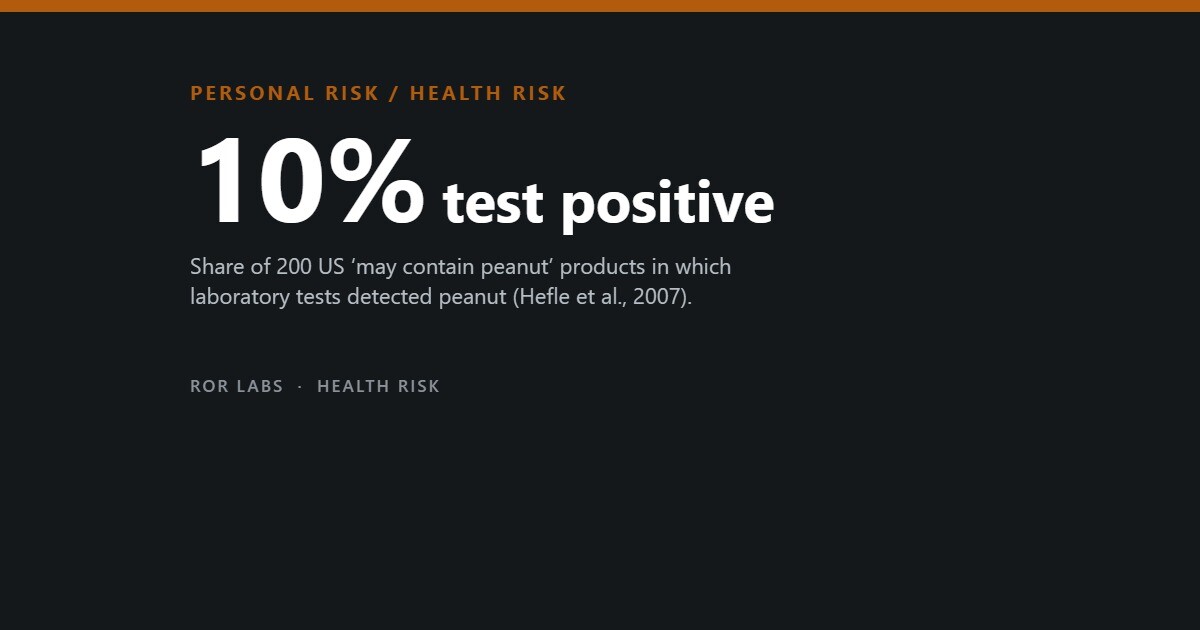
In Hefle’s US study, 13 of the 200 labelled products contained more than 1 mg of peanut. Ford and colleagues found allergen in 5.3% of labelled products overall, but also in 1.9% of similar products with no warning.
Targeted surveys of high-risk foods look very different. Turner’s review describes a study by Pele and colleagues of 544 cookies and chocolates from ten European countries: peanut was found in 32% of those with a precautionary label and in 25% of those without one. Across the studies it summarises, contamination was found only in snack foods such as chocolate, biscuits, bars and ice cream.
Dark chocolate is the textbook case. It is often made on the same lines as milk chocolate, and milk turns up in it frequently. Across a broader UK government survey of products with and without warnings, milk was found in 8.2% of 474 products tested, and peanut in only 2 of 950.
How allergic shoppers respond
In Hefle’s surveys at US patient conferences, the share who said they always heeded advisory labels fell from 85% in 2003 to 75% in 2006, and behaviour varied with the wording. A Canadian survey of 1,080 allergic adults and parents, published in 2025, found that 54% bought products with a precautionary label at least occasionally.
Many shoppers take their chances
What allergic consumers and their carers report doing and believing about precautionary labels.
Sources: Hefle et al. (2007), conference attendees; Graham et al., Nutrients (2025); Marchisotto et al. (2017), as summarised in Turner et al. (2024).
Those private rules often rest on a false assumption. Dutch research by Holleman and colleagues found people judged ‘produced in a factory’ to be lower risk than ‘may contain peanut’. Testing does not support that ranking: Turner’s review notes that products with softer-sounding wording often carried as much contamination as those saying ‘may contain’, or more.

Advice from professionals is just as varied. In a UK survey of 239 healthcare professionals, 38% told patients to avoid all foods with a nut warning, 22% said no avoidance was needed, and the rest decided case by case. Health Canada recommends that allergic consumers avoid every product with a precautionary statement.
Reactions do happen: a review by Katrina Allen and Steve Taylor put the share of allergic consumers reporting a reaction to a labelled product at up to 8%. In a Canadian registry of 651 accidental reactions, 37% were put down to not reading or not heeding a warning. A Swiss survey of 100 children who regularly ate such foods found 18% had reacted at some point, all mildly. In an Australian survey, 58 of 864 respondents reported anaphylaxis from an allergen not listed in a prepacked food’s ingredients; in 81% of those cases the packet carried a warning.
Thresholds, reference doses and VITAL
The way out, researchers argue, is to label by dose: below an amount almost no allergic person reacts to, no warning is needed. The Australian and New Zealand food industry’s Allergen Bureau built a scheme on this idea, VITAL (Voluntary Incidental Trace Allergen Labelling), first released in 2007.
Its reference doses come from oral food challenges, in which patients eat increasing amounts of allergen under medical supervision. Modelling those thresholds gives an eliciting dose: the ED01 is the amount expected to cause an objective reaction in 1% of people with that allergy, the ED05 in 5%. VITAL 3.0 used ED01 values. The FAO/WHO expert consultation recommended ED05, and VITAL 4.0, released in August 2024, adopted those figures.
Reference doses rose tenfold or more
Reference dose for precautionary labelling, in milligrams of protein from the allergenic food.
Source: Allergen Bureau, VITAL 4.0 Summary and FAQ (August 2024). Bars scaled to 5 mg.
Moving to ED05 means five times as many allergic people could have an objective reaction at the reference dose. The experts argued this would not mean five times as many symptoms overall: in the peanut data, the share with any symptoms rose from 14–23% at ED01 to 20–35% at ED05, typically mild. ED05 can also be measured in a laboratory, where ED01 often cannot.
Not everyone agreed. A subgroup of the UK Committee on Toxicity concluded in 2023 that there was insufficient evidence that moving from ED01 to ED05 would not significantly affect public health, and that the confidence intervals around ED05 values are very wide. An Italian study pointed the other way: 29 children with severe milk allergy ate dark chocolate containing 0.20 to 2.18 mg of milk protein, and none reacted.
What regulators say
Regulators largely agree on principles and differ on enforcement. The UK Food Standards Agency says a precautionary label should be used only when a risk of cross-contamination has been identified and cannot be controlled. It asks businesses to name the allergen (‘may contain milk’, not ‘may contain allergens’) and never to pair a warning with a ‘free from’ claim for the same allergen.
The US Food and Drug Administration says advisory statements cannot be used as a substitute for good manufacturing practice. Its 2023 draft guidance suggests firms that cannot avoid cross-contact should document why in their food safety plan and consider an advisory statement. In Australia and New Zealand, as in the EU and UK, allergen labelling law covers allergens used as ingredients, not unintended presence, so VITAL operates as an industry scheme. The EU has no harmonised rule. The Czech Republic has legislated, and the Netherlands has said it will apply the FAO/WHO approach in the interim.
Codex guidance adopted in July 2026 now follows the FAO/WHO line: a label only after allergen management and a risk assessment show a remaining risk. The expert consultation also recommended a single standard phrase and advised against the word ‘traces’, which it found ill-defined and likely to suggest that the risk is small.
The bigger risk: undeclared allergens
For all the attention precautionary labels get, they are not where most allergen failures happen. An FDA analysis by Girdhari Sharma and colleagues reviewed 1,471 allergen and gluten recalls of FDA-regulated foods between fiscal years 2013 and 2019.
Most allergen recalls start with a label mistake
US FDA recalls for major food allergens, fiscal years 2013–2019.
Source: Sharma, Ma and Luccioli, Journal of Food Protection (2023), as reported by Food Safety Magazine (10 April 2023).
A labelling error usually means the allergen is a real ingredient the label fails to mention, so the amount can be far larger than a trace. Bakery products led the US recalls, at 31.5%, followed by snack foods and candy.
Studies of real reactions point the same way. In a Dutch study of 157 adults with confirmed food allergy, 41% of 153 reactions followed prepacked foods, and in a third of those the suspected allergen appeared neither as an ingredient nor in a warning. Turner’s review adds that the UK Fatal Anaphylaxis Register, running for over 25 years, holds no death from trace contamination in a prepacked food with a warning, but at least one from a vegan wrap containing undeclared milk and carrying no warning.
What the FDA says to do
The US Food and Drug Administration (FDA) lists nine major allergens: milk, eggs, fish, crustacean shellfish, tree nuts, peanuts, wheat, soybeans and sesame. Sesame was added by the FASTER Act, effective 1 January 2023.
About “may contain.” The FDA says advisory statements are not required by law, so they are voluntary. They are meant to address unavoidable cross-contact, only where good manufacturing practices are in place, and must be truthful and not misleading.
What to do. Always read labels, avoid foods you are allergic to, learn the early symptoms of a reaction, and know what to do with your treatment ready. If symptoms occur, stop eating, decide whether epinephrine is needed, and seek medical care. After a reaction to a food with unclear labelling, keep the packaging, talk to a provider, consider contacting the manufacturer, and report the adverse event to the FDA.
What we could not confirm. The FDA’s older FALCPA page lists eight allergens and does not mention sesame, and its dates are inconsistent. Our access summarised the FDA “may contain” page rather than showing its exact text, so read the wording on fda.gov before quoting.
Where the evidence is weak
The reassuring headline, that most labelled products test clean, rests on surveys that are mostly old and small. The main US peanut surveys date from 2003 to 2009, and the Irish study tested 38 products. Manufacturing has changed since, and we found no large recent survey that samples products at random across categories.
Testing itself is uncertain. An FDA study of bakery and snack foods found egg in 5% of products with one commercial test kit and in 1% with another. Contamination from whole nuts or seeds is uneven: one sample can be clean and the next batch not, so a negative test does not clear a product.
The consumer evidence is self-selected. Hefle’s respondents attended patient conferences, and the Canadian survey drew mostly on a patient charity’s database. And much of the threshold science comes from a small group: the VITAL scheme belongs to an industry body, and the FAO/WHO modelling relied heavily on two papers by members of the expert committee, a point the UK toxicity committee raised.
What to do
Steps sorted by when they matter. Each one says how strong the evidence is: Measured Official advice Untested
Before
- Read the full ingredient list every time, not only the warning line: most US allergen recalls with a known cause came from labelling errors. Measured see Sources
- Ask your allergist how you, specifically, should treat ‘may contain’ labels, because professional advice on them varies widely. Measured see Sources
- Treat every precautionary wording as the same warning: ‘made in a factory’ products have tested positive as often as ‘may contain’ ones. Measured see Sources
- Take extra care with chocolate, cookies, cereal bars and baked snacks, where nearly all positive test results were found. Measured see Sources
- In Canada, Health Canada advises allergic consumers to avoid all products carrying a precautionary statement. Official advice see Sources
If it happens
- If symptoms start after eating, follow your allergy action plan and get medical help. Untested see Sources
- Keep the packet of the food you suspect, so the product and batch can be identified later. Untested see Sources
Afterwards
- Tell your allergist about the reaction and the product involved. Untested see Sources
- Report the product to the manufacturer and your national food regulator so it can be investigated. Untested see Sources
What not to do
- Do not assume a product without a warning is free of the allergen: unlabelled products have also tested positive. Measured see Sources
- Do not read ‘traces’ as harmless: the FAO/WHO experts found the word ill-defined and advised against it. Official advice see Sources
- Do not treat ‘vegan’ or ‘plant-based’ as milk-free or egg-free: milk protein was found in 5.7% of such products tested in Canada. Measured see Sources
Not medical advice. Follow your allergist’s plan.
Questions people ask
Is ‘made in a factory that also handles’ safer than ‘may contain’?
Not on the evidence. The wording is chosen by the manufacturer and is not linked to any measurement. Testing summarised by Turner and colleagues found products with softer wording contaminated as often as, or more often than, those saying ‘may contain’.
If a product has no warning, is it free of the allergen?
Not necessarily. Ford and colleagues found allergen in 1.9% of US products with no warning, and a European survey found peanut in 25% of unlabelled cookies and chocolates. Labels are voluntary, so their absence is not a guarantee.
Should I eat foods with a precautionary label?
That is a decision for you and your allergist, and professional advice differs. Health Canada recommends avoiding all such products. Follow your allergist’s plan, and ask if it does not cover precautionary labels.
Is ‘vegan’ the same as milk-free or egg-free?
No. ‘Vegan’ and ‘plant-based’ are marketing claims, not allergen claims. In a Canadian study, 86% of egg- or milk-allergic respondents said they would buy ‘vegan’ products; testing found milk protein in 5.7% of 87 such products and egg in none of 64.
Why are these labels on almost everything?
They are voluntary and may offer a business some protection if a customer reacts. Without an agreed threshold, a cautious firm has every reason to add one; Turner’s review notes that very strict thresholds could have the same effect.
The short version
- ‘May contain’ and ‘made in a factory that also handles…’ labels are voluntary and mostly unregulated, yet appear on most supermarket products in Australia, Canada and the UK.
- Most labelled products contain no detectable allergen: in US and Irish surveys of products labelled for peanut, 5% to 10% tested positive.
- The minority that do can carry enough to cause reactions, and chocolate, cookies, bars and baked snacks account for nearly all the positives.
- The wording tells you nothing about the risk, and products with no warning at all are not always clean.
- Many allergic shoppers now buy foods with these labels. Codex guidance adopted in July 2026 ties labels to risk assessment, but countries still have to make it law.
- Most US allergen recalls with a known cause (71.1%) come from labelling errors, not trace cross-contact. Read the ingredient list every time and follow your allergist’s plan.
This article summarises research, regulators’ guidance and news reports for general information. It is not medical advice. Follow the allergy action plan your allergist has given you, and see a doctor about any reaction or question about what is safe for you to eat.
Further reading: Turner et al., World Allergy Organization Journal (2024), for the most complete recent review of precautionary labelling. The Allergen Bureau’s VITAL 4.0 Summary and FAQ (2024) for the current reference doses. Sharma, Ma and Luccioli, Journal of Food Protection (2023), for why allergen recalls happen.
Sources
- Farming News. FAO: Global food safety standards body Codex adopts new guidance on ‘may contain’ allergen labels (8 July 2026).
- Turner PJ, Bognanni A, Arasi S, et al. Time to ACT-UP: update on precautionary allergen labelling (PAL). World Allergy Organization Journal (2024).
- Ontiveros N, et al. Characteristics of allergen labelling and precautionary allergen labelling in packaged food products available in Latin America. Nutrients 12(9):2698 (2020).
- Hefle SL, Furlong TJ, Niemann L, et al. Consumer attitudes and risks associated with packaged foods having advisory labeling regarding the presence of peanuts. J Allergy Clin Immunol (2007).
- Ford L, et al. Food allergen advisory labeling and product contamination with egg, milk and peanut. Conference abstract, AAAAI (2009), reported by HealthDay; letter in J Allergy Clin Immunol (2010).
- Remington BC, Baumert JL, Marx DB, Taylor SL. Quantitative risk assessment of foods containing peanut advisory labeling. Food Chem Toxicol (2013), doi:10.1016/j.fct.2013.08.030.
- Robertson ON, Hourihane JO, Remington BC, et al. Survey of peanut levels in selected Irish food products bearing peanut allergen advisory labels. Food Addit Contam A (2013), doi:10.1080/19440049.2013.804953.
- Khuda SE, Sharma GM, Gaines DW, et al. Survey of undeclared egg allergen levels in the most frequently recalled food types (including products bearing precautionary labelling). Food Addit Contam A (2016).
- Food Standards Agency. Quantitative risk assessment of food products cross-contaminated with allergens (2019).
- Graham F, Waserman S, Gerdts J, et al. A survey of allergic consumers and allergists on precautionary allergen labelling: where do we go from here? Nutrients 17(9):1556 (2025).
- Holleman B, van Os-Medendorp H, van den Bergh H, et al. Poor understanding of allergen labelling by allergic and non-allergic consumers. Clin Exp Allergy (2021), doi:10.1111/cea.13975.
- Allen KJ, Taylor SL. The consequences of precautionary allergen labeling: safe haven or unjustifiable burden? J Allergy Clin Immunol Pract (2018), doi:10.1016/j.jaip.2017.12.025.
- Allergen Bureau. VITAL 4.0 Summary and FAQ (August 2024).
- Committee on Toxicity (UK). Assessment of the Codex report on food allergen thresholds (2023).
- Fiocchi A, Monaci L, De Angelis E, et al. Reactivity to allergenic food contaminants: a study on products on the market. Clin Transl Allergy (2023), doi:10.1002/clt2.12301.
- Food Standards Agency (UK). Precautionary allergen labelling (PAL), business guidance.
- US Food and Drug Administration. Draft guidance, Chapter 19: Undeclared major food allergens (2019).
- Allergic Living. FDA advice to cut food allergy label errors: what will it change? (12 October 2023).
- Sharma GM, Ma Y, Luccioli S. Recalls associated with food allergens and gluten in FDA-regulated foods from fiscal years 2013 to 2019. J Food Prot (2023), doi:10.1016/j.jfp.2023.100069.
- Food Safety Magazine. Most major food allergen recalls caused by preventable labeling errors, study finds (10 April 2023).
- Dominguez S, Théolier J, Lizée K, et al. ‘Vegan’ and ‘plant-based’ claims: risk implications for milk- and egg-allergic consumers in Canada. Allergy Asthma Clin Immunol (2023), doi:10.1186/s13223-023-00836-w.
- Fukuie T, Akiyama H. Risk-based allergen labeling: reference doses, Japan’s 10-ppm policy, and emerging challenges. Curr Opin Allergy Clin Immunol (2026), doi:10.1097/ACI.0000000000001161.
- FDA. Food allergies: what you need to know (current as of 16 August 2024). fda.gov.
- FDA. Food allergies (current as of 11 March 2026). fda.gov.