Backcountry skiing avalanches, and the ten minutes that decide most burials
Key takeaways · 10 min read
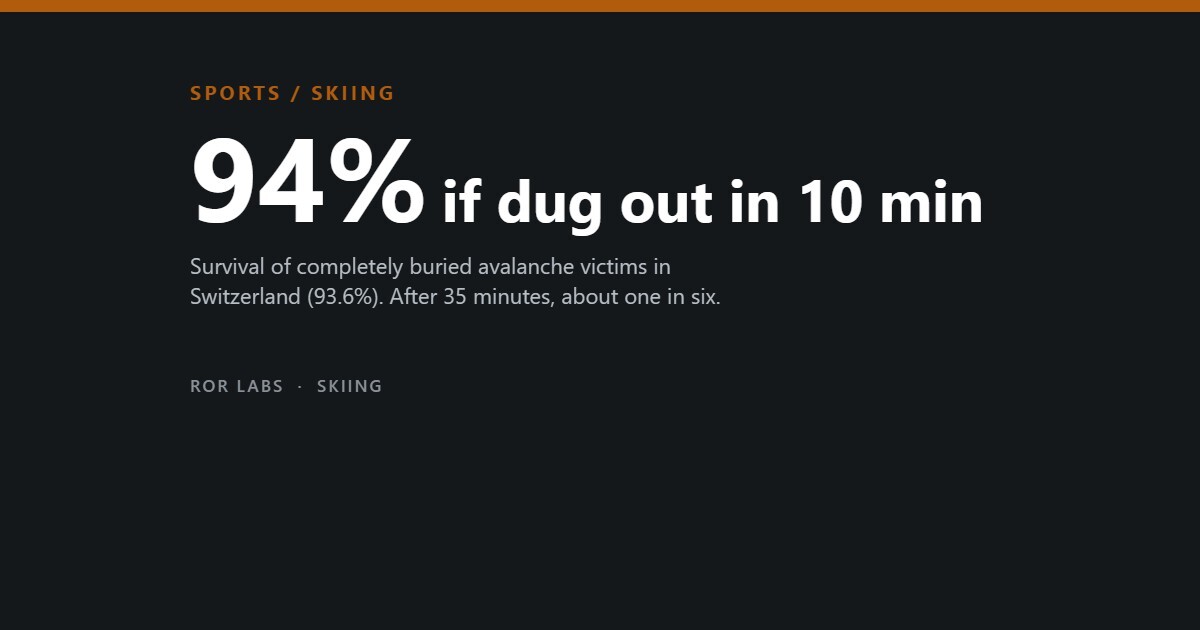
- Most completely buried avalanche victims die of asphyxia. In Swiss data more than nine in ten survive if dug out within ten minutes, and survival collapses after that.
- About 100 people a year die in avalanches in the Alps and about 27 a winter in the US, almost all in uncontrolled terrain and mostly in slides they triggered.
- Most fatal accidents happen at danger level 3, “considerable”, not at the extreme levels, on slopes of about 39 degrees.
- Companions with transceiver, probe and shovel save far more lives than organised teams can; airbags help, but less than early figures claimed.
On 17 February 2026, a party of 15 backcountry skiers, four guides and eleven clients, was heading out from the Frog Lake huts near Castle Peak, north of Lake Tahoe, at the end of a three-day trip. Forecasters had warned of high danger that morning. A slide ran about 400 vertical feet down a north-facing slope, burying 13 of them. Nine died. In August the Nevada County Sheriff’s Office confirmed that all nine had died of asphyxia.
Asphyxia is the usual way avalanches kill, and it turns every burial into a race against a short clock. In Swiss records, people buried with their head under the snow died 52.4% of the time; those whose head stayed free, 4.2%. The classic survival curve, built from 332 complete burials in Switzerland in the 1980s, found 93% still alive at 15 minutes and only about a quarter at 45.
This article covers what an avalanche does to the people it catches, who dies and in what conditions, what has been measured to improve the odds, from transceivers and companion rescue to airbags and decision aids, and why the evidence points towards skiing carefully rather than staying at home. It is written for off-piste and backcountry skiers and snowboarders, and it is no substitute for an avalanche course.
What happens to people an avalanche buries
Two things decide most outcomes: whether the head and chest end up under the snow, and for how long. Someone with an air pocket can hold on for a while, until carbon dioxide builds up or an ice lens seals the pocket. A Canadian–Swiss comparison of 1,247 complete burials from 1980 to 2005 found survival almost identical in both countries for people dug out within ten minutes, and very different after that.
Survival after complete burial, by time under the snow
Share of completely buried people who survived, by how long they were buried. Canada n = 301, Switzerland n = 946, 1980 to 2005. Observational records.
Source: Haegeli et al., CMAJ 183(7):789 (2011), Table 2; data from the Canadian Avalanche Centre and the Swiss institute SLF.
The Canadian curve dropped earlier, at about ten minutes rather than eighteen. The authors put this down partly to trauma and partly to denser snow in maritime ranges, which may cut a buried person’s oxygen supply faster, and suggested ten minutes as the better rule of thumb there. Overall survival still came out the same, 46.2% against 46.9%, because Canadians were dug out faster: a median of 18 minutes against 35.
Not everyone dies for lack of air. A review of 204 avalanche deaths in western Canada from 1984 to 2005 found that asphyxia caused 75% and trauma 24%. Two-thirds of the trauma deaths involved hitting trees, and only about half of those killed by trauma had been fully buried. Trauma ranged from 9% of deaths among snowmobilers to 30% among helicopter and snowcat skiers, and head injuries made up 42% of single-system trauma deaths.
How avalanche victims die
Share of avalanche deaths by immediate cause in three North American series and one global meta-analysis. Ranges are 95% confidence intervals.
Sources: Boyd et al., CMAJ 180(5):507 (2009); Logan et al. (2026), doi:10.15788/1790098713; McIntosh et al., Wilderness & Environmental Medicine (2007); Rong et al., PLOS Global Public Health (2025).
The mix depends on terrain. In Utah, 85.7% of 56 deaths from 1990 to 2006 were from asphyxia alone. A 31-year Colorado review published this year put asphyxia at 65% and trauma at 22%. A 2025 meta-analysis of studies since 2000 estimated trauma in 29% of deaths and asphyxia in 82%; the two add up to more than 100% because some victims had both. Hypothermia accounted for only about 2%.
Where the risk concentrates
Avalanches now kill mostly people at play. A combined analysis of seven Alpine countries counted 4,750 deaths from 1970 to 2015, a mean of 103 a year, and the share that happened in uncontrolled terrain, away from roads, villages and pistes, rose from 72% in 1970–84 to 97% in 2001–15. Switzerland alone averages about 24 a year. In the United States, the Colorado Avalanche Information Center reports an average of 27 deaths each winter over the last ten.
Japan has smaller numbers with a distinctive shape. A 2026 analysis counted 316 deaths in 214 fatal avalanches over 35 years, 84% of them during winter outdoor recreation. Skier deaths rose between 2006 and 2016, and in the past ten years half the skiers killed were foreign nationals, many of them experts such as guides or professional skiers. Across North America and Europe, more than 90% of fatal recreational avalanches are triggered by the victims themselves.
Avalanche accidents by forecast danger level
Share of accidents or deaths at each level of the five-level European avalanche danger scale, Swiss data.
Sources: Harvey, WSL Institute for Snow and Avalanche Research SLF (2002); Techel & Zweifel, International Snow Science Workshop (2013).
“Considerable”, level 3 of five, sounds middling, but it is where most accidents happen. The SLF cautions that these counts do not measure individual risk: levels 4 and 5 are not safer just because fewer accidents are recorded then. What changes little is the terrain. In the Swiss data, human-triggered avalanches started on slopes of about 39 degrees at every danger level except “low”, where the average was 41.
What has been measured to work

Because the clock is so short, the people already on the slope matter most. In 217 search reports from Switzerland and the Tyrol, 75% of victims found by their companions survived, against 30% of those found by organised teams. A US review of more than 300 burials from 1999/00 to 2008/09 was less reassuring: only 56% of buried companions survived. Organised teams increasingly arrive to give medical care rather than to search.
Companion rescue depends on equipment. A study of 1,504 people caught in Swiss and Austrian avalanches found that, among completely buried victims with nothing visible at the surface, those wearing a transceiver were dug out after a median 25 minutes, against 125 without one, and died 55.2% of the time against 70.6%. In the Canadian death review, only 13% of out-of-bounds skiers whose equipment was recorded wore a transceiver.
Transceivers and who does the digging
Completely buried victims with no visible signs at the surface (transceiver rows), and victims located by companions or by organised rescue teams. Observational data.
Sources: Brugger et al., Resuscitation (2007), Swiss and Austrian data; Slotta-Bachmayr, Natural Hazards (2005).
Airbag packs aim to stop the burial in the first place. The early estimate was striking: in the same Swiss–Austrian data, 2.9% of people wearing an airbag died, against 18.9% of the rest. A larger re-analysis led by Pascal Haegeli in 2014, covering accidents involving airbag users in seven countries from 1994 to 2012 and adjusting for avalanche size and injuries, found that inflation cut the risk of critical burial from 47% to 20% and mortality from 22% to 11%.
The authors themselves concluded that the benefit is smaller than earlier reports suggested. One reason is that one airbag in five did not inflate, and about 60% of those failures came from users who did not deploy it. An adjusted halving of the death rate is well worth having, but it is a long way from the near-immunity the raw comparison seemed to promise.
Avalanche airbags: early and adjusted estimates
Mortality and critical burial (head and chest under the snow) among people caught in avalanches. The 2014 figures are adjusted for avalanche size and injuries.
Sources: Brugger et al., Resuscitation (2007); Haegeli et al., Resuscitation (2014), doi:10.1016/j.resuscitation.2014.05.025.
A second worry is that airbags tempt people onto riskier slopes. A 2018 survey of 392 skiers, mainly from Switzerland, Germany and Austria, found answers suggesting risk compensation was likely, but its choice experiment found no conclusive evidence. A 2026 field study of 157 ski tourers and freeriders found no extra risk-taking among airbag users. It found something else: participants overestimated both the chance of dying in an avalanche and the airbag’s benefit by nearly twofold.
Decision aids act further upstream, and their numbers need care too. Applied retrospectively to 751 US accidents, five rule-based aids would have prevented between 60% and 92% of them: a hypothetical estimate of what would have happened had the victims followed the rules. Independent researchers later failed to replicate the prevention values printed on one Canadian card, and in a 2026 review the safety researcher Ian McCammon pointed out that trained people still die on slopes they were taught to avoid.
Why the answer is not to stop skiing
None of this means off-piste skiing is reckless. Across the Alps, deaths in uncontrolled terrain have stayed roughly flat since the late 1980s even as winter backcountry recreation kept growing strongly, and Switzerland’s deaths have edged down since their peak in the mid-1980s. Swiss researchers credited better avalanche education, clearer danger communication and faster rescue. The aim is to ski carefully: to match terrain to the day’s forecast, and to be able to dig a friend out fast.
In practice that means everyone carries a transceiver, probe and shovel and practises with them; the group reads the regional forecast before leaving and treats “considerable” as a serious day, not an average one; people cross and descend steep slopes one at a time; and everyone wears a helmet, because trauma causes around a fifth to a quarter of deaths in North American series. An airbag adds a margin, provided it is checked and its owner will pull the handle.
The single most useful step is a recognised avalanche course with a day in the field, followed by regular practice of companion rescue with the people you ski with. For the injuries that happen on groomed runs, where the knee is the commonest skier injury, see our earlier article on skiing and snowboarding injuries.
What to do
Steps sorted by when they matter. Each one says how strong the evidence is: Measured Official advice Untested
Before
- Take a recognised avalanche course with a field day, and practise companion rescue with the people you ski with. Official advice see Sources
- Read the regional avalanche forecast before leaving, and treat level 3, considerable, as a serious day. Most fatal accidents happen at that level. Measured see Sources
- Everyone carries a transceiver, probe and shovel. Buried transceiver users were dug out after a median 25 minutes, against 125 without one. Measured see Sources
If it happens
- Cross and descend steep slopes one at a time, and regroup in safe spots. Official advice see Sources
- Wear a helmet: trauma causes about a fifth to a quarter of avalanche deaths in North American series. Measured see Sources
- If you carry an airbag, be ready to pull the handle. One in five did not inflate, mostly because the user did not deploy it. Measured see Sources
What not to do
- Do not leave to fetch help while a companion is buried; organised teams usually arrive too late to search. Official advice see Sources
Not safety training or medical advice. Take an avalanche course before travelling in avalanche terrain, and call emergency services as soon as someone is caught.
Questions people ask
How long can someone survive under avalanche snow?
In Swiss data more than nine in ten survive if dug out within about ten to fifteen minutes; Canadian data suggest the fall starts nearer ten. By 35 to 45 minutes only about a quarter are still alive, mostly those with an air pocket.
Do I need a transceiver if I only ski just outside the resort?
Yes. Off-piste slopes beside ski areas are uncontrolled terrain. In Swiss and Austrian data, completely buried transceiver users were found about 100 minutes sooner, at the median, than people without one.
Do avalanche airbags work?
They reduce burial and death, but by less than early figures suggested: an adjusted fall in mortality from 22% to 11%. One in five failed to inflate, mostly because the user did not deploy it.
Which avalanche danger level is most dangerous?
Most fatal accidents happen at level 3, “considerable”, with level 2, “moderate”, next. The counts reflect how many people are out as well as how unstable the snow is, so higher levels are not safer.
The short version
- Most completely buried avalanche victims die of asphyxia. In Swiss data more than nine in ten survive if dug out within ten minutes, and survival collapses after that.
- About 100 people a year die in avalanches in the Alps and about 27 a winter in the US, almost all in uncontrolled terrain and mostly in slides they triggered.
- Most fatal accidents happen at danger level 3, “considerable”, not at the extreme levels, on slopes of about 39 degrees.
- Companions with transceiver, probe and shovel save far more lives than organised teams can; airbags help, but less than early figures claimed.
- Ski carefully: take an avalanche course, read the forecast, practise rescue and wear a helmet, because trauma causes about a quarter of deaths.
This is a summary of published research, not safety training or medical advice. Take a recognised avalanche course before travelling in avalanche terrain and check the regional avalanche forecast every day. If someone is buried, start the companion search at once and call emergency services as soon as you can. After any injury in the mountains, see a doctor or physiotherapist.
Further reading: Haegeli et al., CMAJ 183(7):789 (2011), for the Canadian and Swiss survival curves. Haegeli et al., Resuscitation (2014), for the airbag re-analysis. Techel et al., Geographica Helvetica 71:147 (2016), for 46 years of Alpine fatality data.
Sources
- Fortin-Caldera A. Lake Tahoe avalanche: crews recover bodies of all victims. KTVU FOX 2 / FOX 11 Los Angeles, 21 February 2026.
- Nowicki K. Avalanche victims near Donner Summit last February died of asphyxia. KSNV News 3 Las Vegas, 7 August 2026.
- The deadliest avalanche in California history is now in the hands of prosecutors. Active NorCal, 10 August 2026, citing The New York Times, 8 August 2026.
- Brugger H, Paal P, Boyd J. Prehospital resuscitation of the buried avalanche victim. High Altitude Medicine & Biology (2011), doi:10.1089/ham.2011.1025.
- Brugger H, Falk M. New perspectives of avalanche disasters: phase classification using pathophysiologic considerations (1992), PMID 1580073.
- Radwin MI, Grissom CK. Technological advances in avalanche survival. Wilderness & Environmental Medicine (2002).
- Haegeli P, Falk M, Brugger H, Etter HJ, Boyd J. Comparison of avalanche survival patterns in Canada and Switzerland. CMAJ 183(7):789 (2011).
- Boyd J, Haegeli P, Abu-Laban RB, Shuster M, Butt JC. Patterns of death among avalanche fatalities: a 21-year review. CMAJ 180(5):507 (2009).
- Logan S, Wang DS, Sheets A, Greene E. Cause of death in avalanches in Colorado, USA: a 31-year review. Conference paper (2026), doi:10.15788/1790098713.
- McIntosh SE, Grissom CK, Olivares CR, Kim HS, Tremper B. Cause of death in avalanche fatalities. Wilderness & Environmental Medicine (2007), doi:10.1580/07-WEME-OR-092R1.1.
- Rong G, Ahonen L, Pfuhl G, Cowley BU. Death of backcountry winter-sports practitioners in avalanches: a systematic review and meta-analysis of proportion of causes of avalanche death. PLOS Global Public Health (2025), doi:10.1371/journal.pgph.0004551.
- Techel F, Jarry F, Kronthaler G, et al. Avalanche fatalities in the European Alps: long-term trends and statistics. Geographica Helvetica 71:147 (2016).
- WSL Institute for Snow and Avalanche Research SLF. Long-term statistics (web page, accessed October 2026).
- Colorado Avalanche Information Center. Statistics and reporting (web page, accessed October 2026).
- Degawa A. Changes in avalanche fatalities by activity and associated challenges in winter outdoor recreation in Japan. Conference paper (2026), doi:10.15788/1790099421.
- McClung DM. The strength and weight of evidence in backcountry avalanche forecasting. Natural Hazards (2011), doi:10.1007/s11069-011-9856-y.
- Harvey S. Avalanche incidents in Switzerland in relation to the predicted danger degree. WSL Institute for Snow and Avalanche Research SLF (2002).
- Techel F, Zweifel B. Recreational avalanche accidents in Switzerland: trends and patterns with an emphasis on burial, rescue methods and avalanche danger. International Snow Science Workshop (2013), paper and poster.
- Slotta-Bachmayr L. How burial time of avalanche victims is influenced by rescue method: an analysis of search reports from the Alps. Natural Hazards (2005), doi:10.1007/s11069-004-3421-x.
- Atkins D. Avalanche rescue: the United States experience, 1999/00 to 2008/09. International Snow Science Workshop (2010).
- Brugger H, Etter HJ, Zweifel B, et al. The impact of avalanche rescue devices on survival. Resuscitation (2007), doi:10.1016/j.resuscitation.2007.06.002.
- Haegeli P, Falk M, Procter E, et al. The effectiveness of avalanche airbags. Resuscitation (2014), doi:10.1016/j.resuscitation.2014.05.025.
- Haegeli P, Rupf R, Karlen B. Do avalanche airbags lead to riskier choices in the backcountry? (2018), ZHAW digital collection, hdl 11475/14677.
- Streicher B, Brugger M, Schwiersch M, et al. Winter backcountry travel and avalanche airbags: assessing risk-taking in a field study. Journal of Outdoor Recreation and Tourism (2026), doi:10.1016/j.jort.2025.101009.
- McCammon I, Hägeli P. An evaluation of rule-based decision tools for travel in avalanche terrain. Cold Regions Science and Technology (online 2006), doi:10.1016/j.coldregions.2006.08.007.
- Uttl B, McDouall J, Mitchell CM. Evaluating the Avaluator Avalanche Accident Prevention Card 2.0 (2012).
- McCammon I. Beyond better decisions: accident reduction in avalanche terrain. Conference paper (2026), doi:10.15788/1790099331.