Wrestling cauliflower ear, and the 69% of former wrestlers who still carry it
Key takeaways · 10 min read
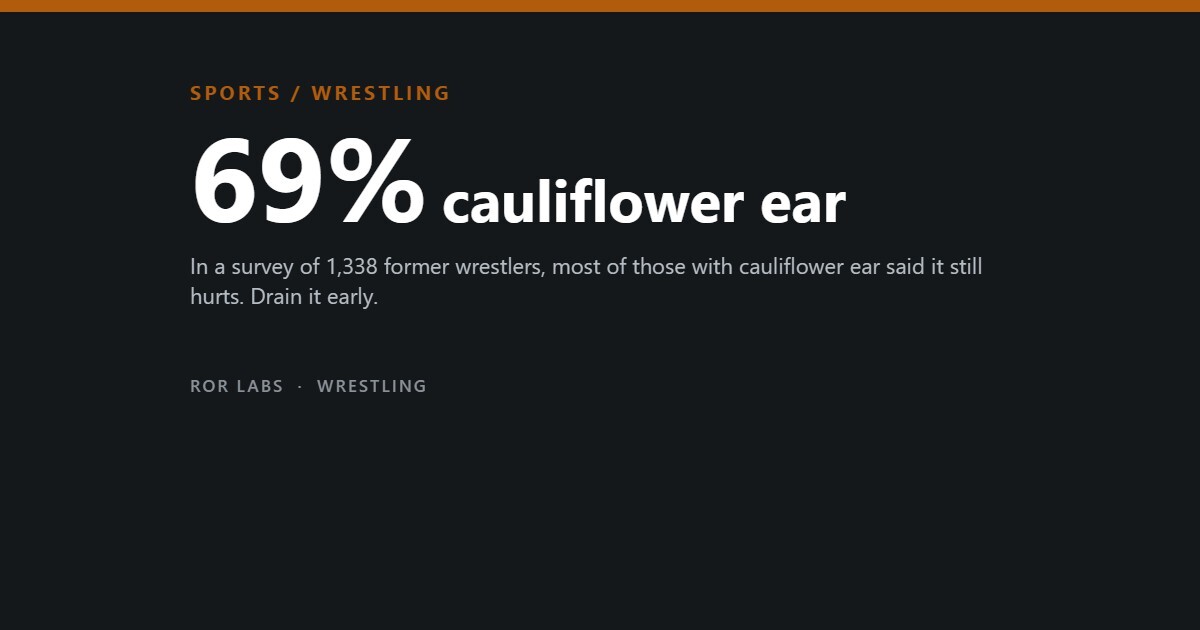
- In a 2026 survey of 1,338 former wrestlers, 69% had cauliflower ear; of those, 59% reported pain and 12% hearing problems.
- The deformity forms when blood trapped under the ear’s lining is not drained and the cartilage scars, starting as early as seven to ten days after injury.
- Among elite men it is the norm: 84% of Finnish wrestlers and judokas and 70% of senior male judokas worldwide.
- Headgear roughly halved reported haematomas in a 1989 survey, but only about a third of college wrestlers wore it all the time in practice.
In 2026 a team of plastic surgeons published a survey of 1,338 former wrestlers, almost all men, with an average age of 45. Sixty-nine per cent said they had cauliflower ear. Of those, 59% reported pain, 30% trouble sleeping and 12% hearing problems, and 15% felt self-conscious or embarrassed around other people. Only 11% had ever considered surgery, and more than half said they were unaware or only somewhat aware that surgery was an option.
On the mat the ear is a trophy as much as an injury. When Finnish researchers surveyed national and international wrestlers and judokas, none of those with cauliflower ear regretted it and 41% considered it desirable. Doctors see something else: a lump of scar and new cartilage grown from a pocket of blood that nobody drained, and one of the most preventable injuries in contact sport.
This article covers what happens inside an injured ear, which athletes end up with the deformity, what headgear and treatment have been measured to do, and why the evidence behind both is thinner than the confident advice suggests. The answer is not to stop wrestling. It is to wrestle carefully: wear ear guards in practice as well as in matches, and have a swollen ear drained promptly by someone medically trained.
What actually happens inside the ear
The outer ear is a sheet of cartilage wrapped in a thin layer called the perichondrium, which carries its blood supply, under skin bound tightly to it. Grinding, twisting and blunt blows shear that layer away from the cartilage, and blood or serum fills the gap. Cut off from its supply, the cartilage can die, and the body fills the space with fibrous tissue and disorganised new cartilage. The result is the thickened, lumpy ear named after a vegetable.
Timing matters. According to the StatPearls clinical review, a liquid haematoma starts turning semi-solid within about six hours, which is why needle aspiration is usually kept for small, fresh swellings and larger or older ones are opened with an incision. Abnormal new cartilage may begin forming seven to ten days after the injury. Once it has, draining fluid no longer restores the original shape.
The damage is not only cosmetic. Among 411 club wrestlers in Tehran, where ear guards are rarely worn, 11.5% of those with cauliflower ear reported hearing loss, against 1.8% of those without. A follow-up study tested 340 wrestlers with audiometry and found hearing loss more common in deformed ears at every frequency tested except the highest, along with more narrowed ear canals. A 2024 Turkish study of 28 wrestlers with deformity in both ears found raised hearing thresholds, particularly above 4,000 hertz.
Living with cauliflower ear
Share reporting each problem among former wrestlers with cauliflower ear in a 2026 US survey, and reported hearing loss among club wrestlers in Tehran. All self-reported.
Sources: Elmer et al., Aesthetic Plastic Surgery (2026), 910 of 1,338 respondents with cauliflower ear; Kordi et al. (2007), 411 wrestlers in Tehran.
Infection is the other worry. A deformed canal can trap wax and moisture, and in the Tehran audiometry study 8.4% of cauliflower ears had a history of ear infection against 4.9% of normal ears, a difference that fell just short of statistical significance. An untreated haematoma can also become infected itself: half of one Indian series of 40 wrestlers arrived with perichondritis, an infection of the cartilage lining.
Where the risk concentrates
Cauliflower ear turns up wherever athletes grapple with their heads pressed together, and its frequency follows three things: sex, headgear habits and whether anyone treats the swelling.
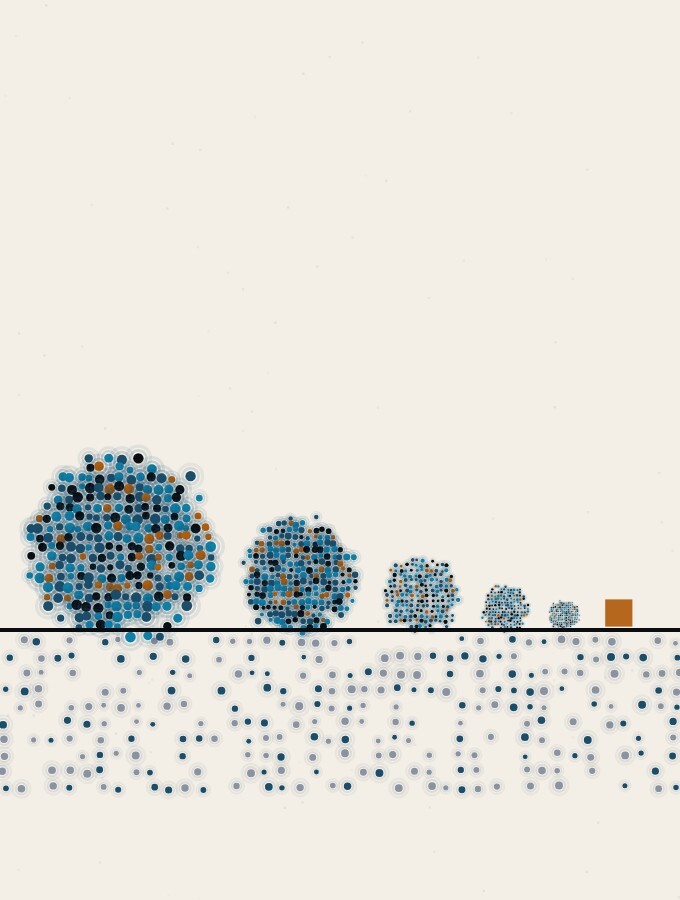
The highest figures come from elite men. Among 55 Finnish male wrestlers and judokas, 84% had cauliflower ear; none of the eight women did. In Korea, 44 of 58 elite male wrestlers had a deformed ear. A German team examined profile photographs of 1,632 senior judokas on the International Judo Federation website and found deformity in 70% of men and 32% of women, with the share rising steadily with age.
Weight class worked in an unexpected direction. Among the male judokas, the lightest division had the most deformed ears, 76.7%, and the heaviest, over 100 kilograms, the fewest, 50%. In Tehran 44% of club wrestlers had cauliflower ear, and in 1989, 39% of 537 American college wrestlers reported a permanent deformity. For Brazilian jiu-jitsu and mixed martial arts we found no comparable survey, though a 2009 report noted that professional fighters, who do not routinely wear headgear, are at increased risk.
Who has cauliflower ear
Share of athletes with a deformed ear in six studies. Groups and methods differ: questionnaires, clinical photographs or public profile pictures.
Sources: Manninen et al., Scand J Med Sci Sports (2019); Kim et al., Korean J Sports Med (2015); Nitsch et al., Scientific Reports 13:17351 (2023); Elmer et al. (2026); Kordi et al. (2007); Schuller et al., Arch Otolaryngol Head Neck Surg (1989).
The second driver is how the swelling is handled. In the Finnish survey 96% had sought treatment for a haematoma, nearly always needle aspiration, but 76% had been treated by someone who was not a health professional, and only one athlete described a successful result. In Korea 56% had simply iced the ear and 10% had it aspirated and compressed. In Tehran only 23% of those with cauliflower ear had received any treatment for the original swelling.
How the swelling gets treated
Share of athletes reporting each response to an ear haematoma, in three surveys of wrestlers and judokas.
Sources: Manninen et al. (2019), 63 athletes; Kim et al. (2015), 58 wrestlers; Kordi et al. (2007), wrestlers with cauliflower ear.
Researchers in Iran describe the deformity as a symbol of honour there, and say most wrestlers avoid treating ear injuries for that reason. The habit has spread beyond the mat: in June 2026 a South African plastic surgeon warned that some young men were trying to create the look at home after seeing it on social media, and said surgery rarely restores an ear’s original shape.
What has been measured to work
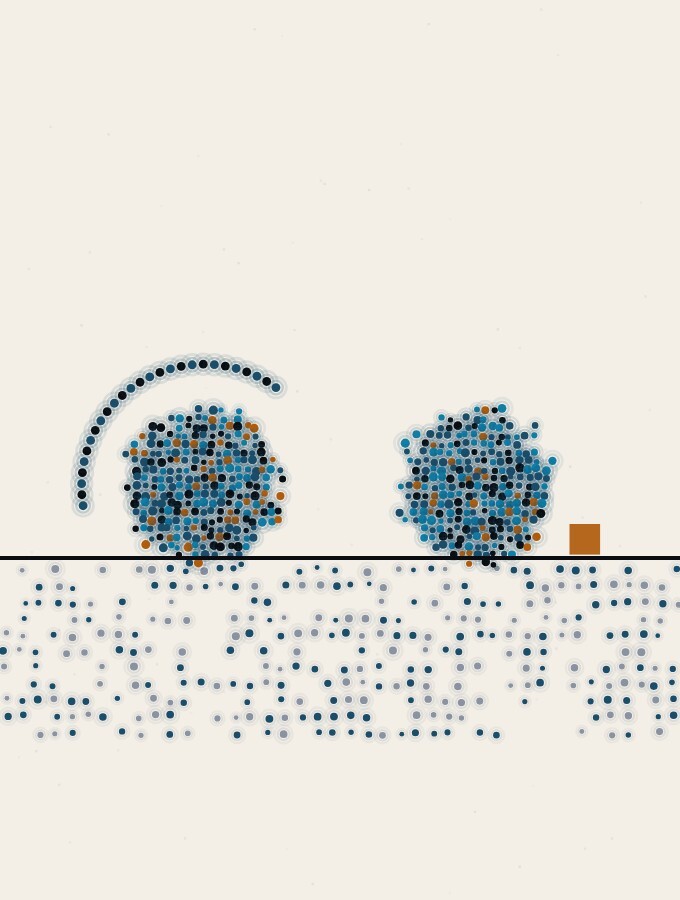
Headgear is the obvious defence. US high school rules require wrestlers to wear rigid, padded ear guards made for the sport. International freestyle and Greco-Roman rules do not, and USA Wrestling’s rule book calls headgear recommended but not required in those styles. The evidence rests largely on one survey: in 1989, American college wrestlers reported developing a haematoma in 26% of cases while wearing headgear and 52% while not.
The same survey showed the gap. Of the 537 wrestlers, 92.4% wore headgear all the time in competition but only 35.2% did in practice, where most of the hours are spent, and discomfort was the most common reason for leaving it off. The authors concluded that headgear gives only partial protection and that not wearing it is widespread.
Headgear in one 1989 survey
Self-reported by 537 US Division I college wrestlers.
Source: Schuller et al., Archives of Otolaryngology – Head & Neck Surgery (1989), doi:10.1001/archotol.1989.01860300068019. Observational.
Once a haematoma forms, the aim is to drain it and stop it refilling. In a Jordanian series of 45 patients, the swelling returned after needle aspiration and a pressure dressing in 37.5%, after incision and drainage with a dressing in 22.2%, and after incision with the ear stitched between two dental rolls in 9.1%. A 2024 American review of 48 patients found recurrence in 23.3% with a bolster and 58.3% without, with a median of two days before the swelling returned.
In 2026 a 15-year chart review in The Laryngoscope compared bolster dressings with through-and-through quilting stitches in 43 patients: 30% of the bolster group had a recurrence and none of the 13 quilted ears did. Among wrestlers, an Indian series of 40 treated with incision and mattress sutures reported no recurrences, and an American technique that let athletes keep training was used on 24 haematomas in 19 wrestlers.
How often the swelling came back
Recurrence after drainage, by method, in three retrospective series. Small groups; methods were not randomly assigned.
Sources: Sbaihat and Khatatbeh, Journal of the Royal Medical Services (2011); Phillips et al., Craniomaxillofacial Trauma & Reconstruction 17(4) (2024); Cheng et al., The Laryngoscope (2026).
These numbers deserve caution. When Cochrane reviewers looked for randomised trials, case-control or cohort studies of any treatment for acute auricular haematoma, they assessed 48 full papers and found none that qualified, and updates to 2011 found none either. Every recurrence figure here comes from small series, often reported by surgeons describing their own technique. The headgear evidence is a self-reported survey from 1989. The Tehran hearing tests were done in wrestling clubs rather than sound-proof booths, without bone-conduction testing. And the judo photographs excluded about a third of women because hair covered their ears.
Why the answer is not to stop wrestling
Wrestling builds strength, balance and composure, and its signature ear injury is one of the few in contact sport that is both common and largely preventable. As our article on wrestling injuries and the rule of 1998 showed, a sport can change its rules after a crisis; protecting ears needs only habits. Wear ear guards in practice as well as in matches, keep them snug, and check ears after hard sessions.
If an ear swells, see a doctor the same day if you can, not a teammate with a syringe. Expect drainage and some form of compression, a bolster or stitches, kept on for about five to seven days, then roughly ten to fourteen days away from contact, according to StatPearls. If the ear has refilled before, ask about quilting sutures or a stitched bolster. Redness, heat or fever can signal infection of the cartilage and need urgent care.
For an ear that has already hardened, surgeons can remove scar tissue and excess cartilage and reshape it. The surgeon quoted in June 2026 called the result an improvement rather than a restoration, and said several operations may be needed. Among the former wrestlers in the 2026 survey, only 11% had considered it. Whether to keep the ear is a personal choice; the time to make it is before the cartilage scars, not after.
What to do
Steps sorted by when they matter. Each one says how strong the evidence is: Measured Official advice Untested
Before
- Wear ear guards in practice as well as in matches, and keep them snug. In a 1989 survey, haematomas were reported half as often with headgear, but only 35.2% wore it all the time in practice. Measured see Sources
If it happens
- Check your ears after hard sessions for any swelling or soft bulge. Official advice see Sources
Afterwards
- If an ear swells, see a doctor the same day if you can. Liquid blood starts to set within about six hours, and new cartilage can form in seven to ten days. Measured see Sources
- Expect drainage and compression with a bolster or stitches for about five to seven days, then roughly ten to fourteen days away from contact. Measured see Sources
- If the ear has refilled before, ask about quilting sutures or a stitched bolster. Quilting had no recurrences in a 13-patient series. Untested see Sources
What not to do
- Do not let a teammate drain your ear with a syringe. In a Finnish survey, 76% were treated by non-professionals and only one athlete reported success. Measured see Sources
- Do not ignore redness, heat or fever in a swollen ear. It can mean cartilage infection and needs urgent care. Official advice see Sources
Not medical advice. A swollen ear is easiest to fix in the first hours; see a doctor promptly and ask when it is safe to return to contact.
Questions people ask
Does cauliflower ear go away?
No. Once the trapped blood has turned into scar and new cartilage, the shape is permanent. Surgery can improve it but rarely restores the original ear.
Should I drain my own ear?
It is not advised. In the Finnish survey most athletes were drained by non-professionals and only one reported success. A doctor can drain it under sterile conditions and add compression to stop it refilling.
Do ear guards prevent cauliflower ear?
They help, but only partly. In the 1989 survey haematomas were reported half as often with headgear, but most wrestlers did not wear it all the time in practice.
Can cauliflower ear affect hearing?
Studies of wrestlers in Iran and Turkey found more hearing loss in deformed ears, possibly from narrowed ear canals. The studies were small and cannot prove cause.
The short version
- In a 2026 survey of 1,338 former wrestlers, 69% had cauliflower ear; of those, 59% reported pain and 12% hearing problems.
- The deformity forms when blood trapped under the ear’s lining is not drained and the cartilage scars, starting as early as seven to ten days after injury.
- Among elite men it is the norm: 84% of Finnish wrestlers and judokas and 70% of senior male judokas worldwide.
- Headgear roughly halved reported haematomas in a 1989 survey, but only about a third of college wrestlers wore it all the time in practice.
- Stitched compression after drainage had the lowest recurrence in small series. No randomised trial of any treatment exists.
This is a summary of published research, not medical advice. If your ear swells after training, see a doctor promptly, ideally the same day, and ask your doctor or physiotherapist when it is safe to return to contact.
Further reading: Manninen et al., Scandinavian Journal of Medicine & Science in Sports (2019), for athletes’ own attitudes. Nitsch et al., Scientific Reports (2023), for the judo photograph study. Jones and Mahendran, Cochrane Database of Systematic Reviews (2004), for the missing trials.
Sources
- Elmer NA, Mehdizadeh M, Foster L, et al. A badge of honor? Assessing self-reported experience with cauliflower ear and interest in reconstructive surgery in 1,338 former wrestlers. Aesthetic Plastic Surgery (2026), PMID 41491314.
- Manninen IK, Blomgren K, Elokiuru R, et al. Cauliflower ear among Finnish high-level male wrestlers and judokas is prevalent and symptomatic deformity. Scandinavian Journal of Medicine & Science in Sports (2019), doi:10.1111/sms.13530.
- StatPearls. Auricular hematoma. StatPearls Publishing, NCBI Bookshelf (accessed October 2026).
- Kordi R, Mansournia MA, Nourian RA, Wallace WA. Cauliflower ear and skin infections among wrestlers in Tehran (2007), PMID 24198702.
- Noormohammadpour P, Rostami M, Nourian R, et al. Association between hearing loss and cauliflower ear in wrestlers, a case control study employing hearing tests. Asian Journal of Sports Medicine 6(2):e25786 (2015).
- Özal N, Çetin Kara H, Çögen T, Özdoğan HA. Effect of external ear deformity on hearing in wrestlers. American Journal of Audiology (2024), doi:10.1044/2024_AJA-23-00277.
- Kirdak VR, Chintale SG, Shaikh KA, Jatale SP. Our experience of auricular hematoma treatment in wrestlers. International Journal of Otorhinolaryngology and Head and Neck Surgery (2018).
- Kim JS, Sin YU, Koo YP, Kim SH. Prevalence, characteristics of ear deformity and treatment tendency for auricular hematoma in elite wrestlers. Korean Journal of Sports Medicine (2015), doi:10.5763/kjsm.2015.33.1.13.
- Nitsch A, Marx H, Fischer CS, et al. Prevalence of cauliflower ear in high level judoka. Scientific Reports 13:17351 (2023), doi:10.1038/s41598-023-42635-8.
- Schuller DE, Dankle SK, Martin MG, Strauss RH. Auricular injury and the use of headgear in wrestlers. Archives of Otolaryngology – Head & Neck Surgery (1989), doi:10.1001/archotol.1989.01860300068019.
- Roy S, Smith LP. A novel technique for treating auricular hematomas in mixed martial artists (ultimate fighters). American Journal of Otolaryngology (2009), doi:10.1016/j.amjoto.2008.09.005.
- National Federation of State High School Associations, wrestling rule on ear guards, as reproduced by the Oregon School Activities Association; USA Wrestling Rule Book, section 5.1 (freestyle and Greco-Roman).
- Sbaihat A, Khatatbeh WJ. Treatment of auricular hematoma using dental rolls splints. Journal of the Royal Medical Services (2011).
- Phillips AL, Luttrell JB, Berry JM, Dedhia RD, Eid A. Auricular hematomas in a high-volume trauma population: a retrospective review. Craniomaxillofacial Trauma & Reconstruction 17(4) (2024), doi:10.1177/19433875241244587.
- Cheng CF, Neevel AJ, Brenner MJ, Rudy SF. Management of auricular hematoma with bolster versus quilting: a retrospective cohort study. The Laryngoscope (2026), doi:10.1002/lary.70680.
- Schuller DE, Dankle SD, Strauss RH. A technique to treat wrestlers’ auricular hematoma without interrupting training or competition. Archives of Otolaryngology – Head & Neck Surgery (1989), doi:10.1001/archotol.1989.01860260076018.
- Jones SEM, Mahendran S. Interventions for acute auricular haematoma. Cochrane Database of Systematic Reviews (2004, search updated 2011), CD004166, doi:10.1002/14651858.CD004166.pub2.
- Staff reporter. Cauliflower ear: a trendy deformity with serious consequences. IOL, 17 June 2026.