Sitting Is Not the New Smoking. The Standing Desk Did Not Help Either.
In This Series: Healthy Ageing & Everyday Myths
- Two of the 14 Dementia Risk Factors Are Your Ears and Your Eyes
- The Wrong Cuff Turns 125 Into 144. Most People Have Never Had This Measured Properly.
- Every 3 Decibels Halves the Time. That Is the Whole Rule, and Almost Nobody Knows It.
- Sleep Regularity Beat Sleep Duration: What the Mortality Data Shows
- Falls at Home: The Fixes With Evidence, and the One That Was Withdrawn
- Loneliness Raises the Risk of Dying by Fourteen Per Cent. The Fifteen-Cigarettes Line Came From Somewhere Else.
Disclosure: this article contains affiliate links, marked (paid link). If you buy through one we may earn a commission, at no extra cost to you. As an Amazon Associate I earn from qualifying purchases. It costs you nothing and it does not change what we recommend.
Key takeaways · 8 min read
- In a one-million-person meta-analysis, sitting 8+ hours a day raised mortality risk by 59% in the least active people and by essentially nothing in the most active.
- Inactive people who sat under four hours a day still had 27% higher mortality. The sitting was never the mechanism.
- Roughly 60–75 minutes of moderate activity daily erased the excess risk of long sitting entirely.
- In 83,013 accelerometer-tracked adults, standing more produced no cardiovascular benefit and more varicose veins and DVT.
“Sitting is the new smoking” is one of the most successful health slogans of the last twenty years. It sold a great many standing desks. It is also wrong in a specific and useful way, and the correction points at something you can act on.
The strongest evidence says the problem is not the chair. It is what is missing from the rest of the day — and the fix that most offices bought does not appear to work.

A million people, and one clear pattern
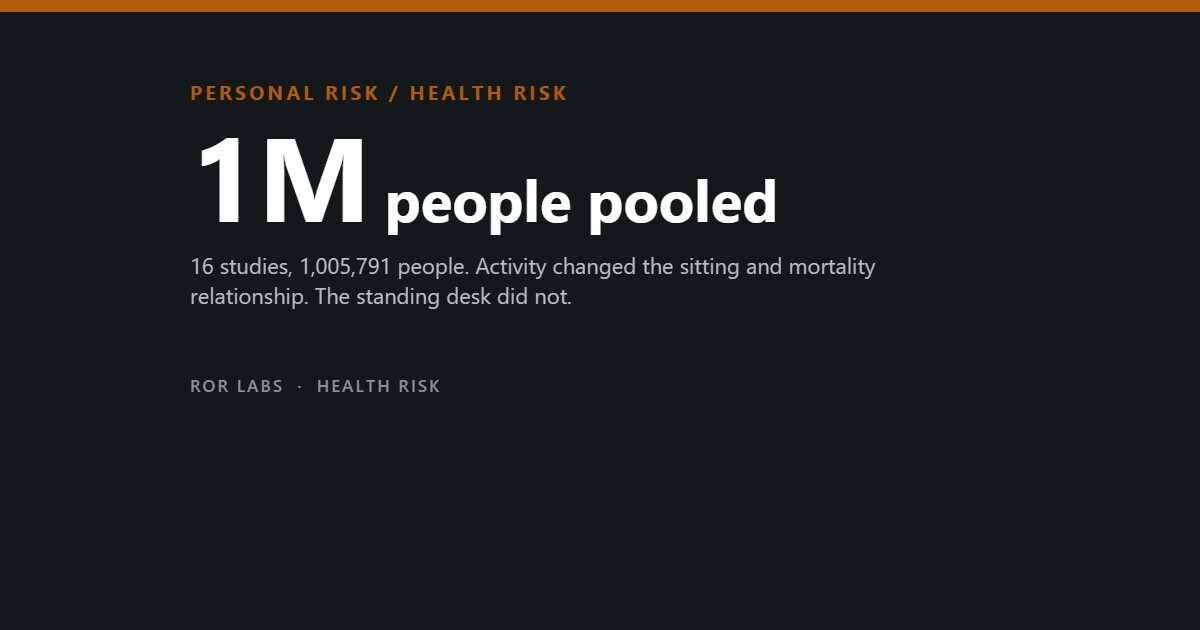
In 2016 a team pooled 16 studies covering 1,005,791 people to ask a question the earlier scare headlines had skipped: does physical activity change the relationship between sitting and dying? Over follow-ups of up to 18 years, 84,609 participants died.
Sitting is only dangerous in the company of inactivity
All-cause mortality risk versus the reference group (most active people who sit under 4 hours a day).
Source: Ekelund U, Steene-Johannessen J, Brown WJ, et al. “Does physical activity attenuate, or even eliminate, the detrimental association of sitting time with mortality? A harmonised meta-analysis of data from more than 1 million men and women.” The Lancet, 2016.
Look at the least-active bar on the left. Even sitting under four hours a day, inactive people carried 27% higher mortality. They were sitting less than almost everyone and still doing worse, because the thing that was hurting them was never the sitting.
The amount of activity that removed the excess risk was roughly 60 to 75 minutes of moderate activity a day. That is a demanding number and it deserves honesty: it is more than most public health guidelines ask for, and more than most desk workers will do. But the shape of the finding still holds at lower doses — the risk curve bends most steeply at the start, where someone goes from almost nothing to something.
The one that behaves differently: television
All-cause mortality risk with more than five hours of daily TV viewing.
Source: Ekelund et al., The Lancet (2016).
The standing desk did not do what it was sold to do
If sitting were the poison, standing would be the antidote. In 2024 researchers tested that directly, using wrist-worn accelerometers on 83,013 UK adults with no heart disease at baseline, followed for seven to eight years. Real measured posture, not a questionnaire.
What standing more actually did
83,013 adults, accelerometer-measured, 7–8 year follow-up.
Source: Ahmadi MN, et al. International Journal of Epidemiology, 2024;53(6). doi:10.1093/ije/dyae136 (University of Sydney).
This is a good example of a plausible mechanism failing on contact with data. Standing burns marginally more energy than sitting, so it seemed reasonable that standing would inherit exercise’s benefits. It does not. The active ingredient in exercise is not being upright — it is the muscular work and the raised heart rate, and a standing desk supplies neither.
None of this makes a sit-stand desk a bad object. Alternating posture is genuinely useful for back discomfort, and comfort at work matters. It is a comfort purchase, not a cardiovascular intervention, and the distinction is worth several hundred dollars of clear thinking.
The dose that actually moves the needle

The 60–75 minute figure is the amount needed to fully erase the risk of eight hours of sitting. It is not the threshold below which nothing happens. The most valuable part of the curve is the very beginning.
Where the return on effort is highest
The gain per added minute is largest at the bottom of the range, not the top.
Sources: Ekelund et al., The Lancet (2016); Ahmadi et al., University of Sydney accelerometer research.
Things that help you actually move (paid link)
Cheap, and aimed at the mechanism that has evidence behind it: adding activity, not changing posture.
Browse on Amazon →
Browse on Amazon →
Browse on Amazon →
We are not linking standing desks or under-desk treadmills as health products. The 83,000-person accelerometer study found no cardiovascular benefit from standing, and a higher rate of circulatory problems. If you want one for comfort or back pain, that is a perfectly good reason — just buy it as furniture, not as medicine.

Questions people ask
So sitting is fine?
Not quite. Sitting more than about ten hours a day was associated with higher cardiovascular risk in the 2024 accelerometer study, independently. The accurate summary is narrower than either slogan: very long sitting is its own risk factor, and moderate sitting is close to harmless if the rest of your day contains real activity.
Is 10,000 steps the target?
It came from a 1960s Japanese pedometer marketing campaign, not from research. Later cohort studies find mortality benefits accumulating from far lower counts, with the curve flattening well before 10,000. It is a fine goal if it motivates you and a bad reason to feel like a failure at 6,000.
Does housework or gardening count?
Yes. The measure in these studies is metabolic effort, not whether it happened in a gym. Carrying shopping, digging, stairs and cleaning all register. Accelerometer studies consistently find that incidental daily movement carries much of the benefit people assume comes only from exercise sessions.
I am in my fifties and have not exercised in years. Where do I start?
At the steepest part of the curve, which is the good news — the return on the first ten minutes a day is larger than anything a fit person gets from their next hour. Walking, daily, is the highest-compliance option there is. If you have a heart condition, joint problems, or have been inactive a long time, a conversation with a doctor first is sensible, and it is a low bar to clear rather than a reason to postpone.
The short version
- In a one-million-person meta-analysis, sitting 8+ hours a day raised mortality risk by 59% in the least active people and by essentially nothing in the most active.
- Inactive people who sat under four hours a day still had 27% higher mortality. The sitting was never the mechanism.
- Roughly 60–75 minutes of moderate activity daily erased the excess risk of long sitting entirely.
- In 83,013 accelerometer-tracked adults, standing more produced no cardiovascular benefit and more varicose veins and DVT.
- A standing desk is furniture, not medicine. Buy it for comfort if you want it.
- Sitting over 10 hours a day is a genuine independent risk factor.
- The best return on effort is at the bottom: going from nothing to something beats going from fit to fitter.
This summarises published population research and is not medical advice. If you have a heart condition, joint problems, or have been inactive for a long time, ask a doctor what starting point is right for you.
On the links above: some are affiliate links, marked (paid link). If you buy through one we may earn a commission at no additional cost to you. As an Amazon Associate I earn from qualifying purchases. We link to product searches rather than specific items so recommendations do not break as models change, and we say plainly when we are choosing not to link something. Full policy: Affiliate Disclosure.
Sources
- Ekelund U, Steene-Johannessen J, Brown WJ, et al. “Does physical activity attenuate, or even eliminate, the detrimental association of sitting time with mortality? A harmonised meta-analysis of data from more than 1 million men and women.” The Lancet, 2016;388(10051):1302–1310.
- Ahmadi MN, Coenen P, Straker L, Stamatakis E. “Device-measured stationary behaviour and cardiovascular and orthostatic circulatory disease incidence.” International Journal of Epidemiology, 2024;53(6). doi:10.1093/ije/dyae136
- University of Sydney, Charles Perkins Centre. Accelerometer-based physical activity research summaries.