Cricket injuries, fast bowlers and the guard for the neck
Key takeaways · 9 min read
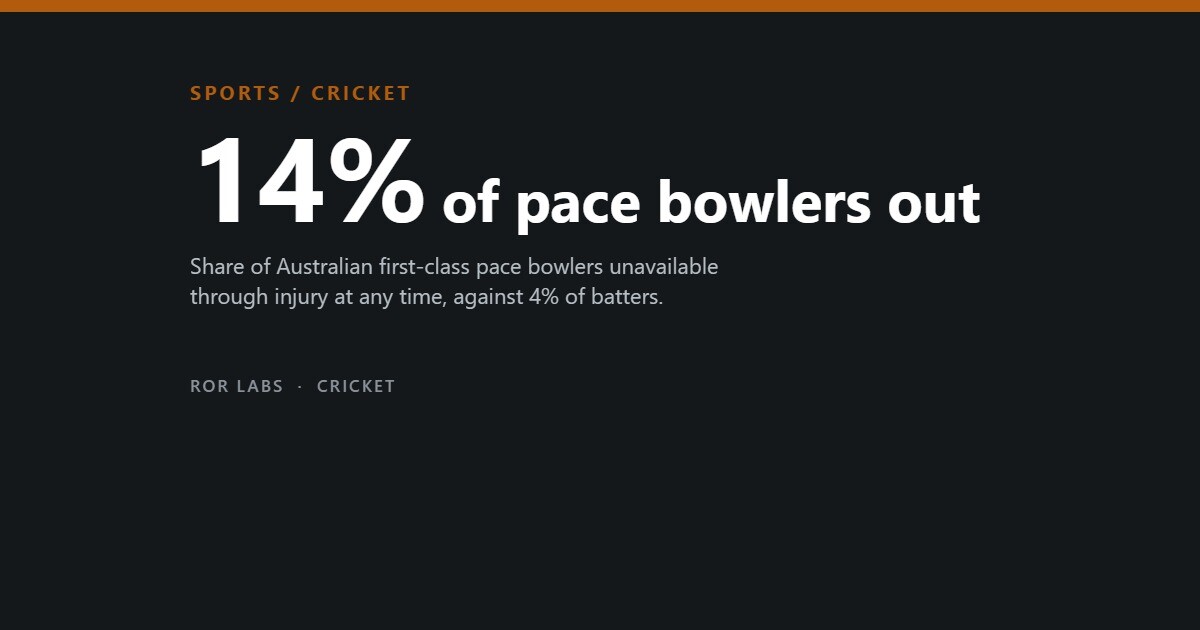
- In elite cricket, fast bowlers carry most of the injury burden: at any time about 14% are unavailable, against 4% of batters and spinners.
- Workload matters in both directions. Bowling on too many days, or after too long a break, raised injury risk in Australian cohorts.
- One in five asymptomatic teenage fast bowlers already had a lumbar bone stress injury on MRI; bowlers with a previous one were most at risk.
- Helmet rules shifted head and neck injuries away from batters. Neck guards are compulsory for elite Australian batters facing pace, but not at every level.
Phillip Hughes was 25 when a short ball struck him below the left ear at the Sydney Cricket Ground on 25 November 2014. He was wearing a helmet; the ball hit the part of his neck it did not cover, and he died two days later. In October 2025 a 17-year-old Melbourne cricketer, Ben Austin, was struck in the neck while facing a ball-throwing device in the training nets. He was wearing a helmet without a neck guard, and he also died two days later.
Deaths like these are extremely rare — an Australian news report counted three in cricket over 30 years, two of them at training — and they are not what fills cricket’s injury lists. Fast bowlers fill those: hamstrings, side strains and, most stubbornly, stress fractures in the lower backs of teenagers.
This article follows the series format: what cricket injures, where the risk concentrates, what has been measured to reduce it, and why the evidence points to playing carefully rather than not playing.
What actually gets injured
Cricket was one of the first sports to agree common injury definitions, in 2005: an injury counts if it stops a player being fully available for a major match, or stops them batting, bowling or keeping wicket during one. Under definitions like these, Australian first-class surveillance from 1998 to 2001 recorded match injuries at 19.0 per 10,000 player hours in domestic first-class games, rising to 38.5 in one-day internationals. The commonest were hamstring strains, side strains, groin injuries, wrist and hand injuries, and lumbar soft-tissue injuries.
Match injury rates in elite men’s cricket
New injuries per 10,000 player hours of match play, using the international surveillance definitions.
Sources: Orchard et al., Br J Sports Med (2002); Frost and Chalmers, Br J Sports Med (2012); Dovbysh et al., BMJ Open Sport Exerc Med 7(4) (2021).
International cricket is roughly twice as injurious per hour as domestic cricket, and the rate in New Zealand rose in the era of Twenty20. A New Zealand study of 248 elite men found that 48.7% of injuries happened while bowling and 43.5% were to the lower limb; hamstring strains were the single commonest diagnosis, but stress fractures of the lower back accounted for 22% of all match days lost. For scale, the series’ rugby article cites 76 match injuries per 1,000 player hours in English Premiership rugby, about 13 to 20 times these cricket rates, although the two sports count exposure differently.
Blows to the head and neck are a small but serious share. Over 12 seasons of elite Australian cricket, men and women, clinicians recorded 199 head and neck injury events, excluding isolated concussion, an average of 5.6 per 100 players a season. Most were bruises, and the face was the commonest site; 15% kept the player out for at least a day.
When the risk concentrates
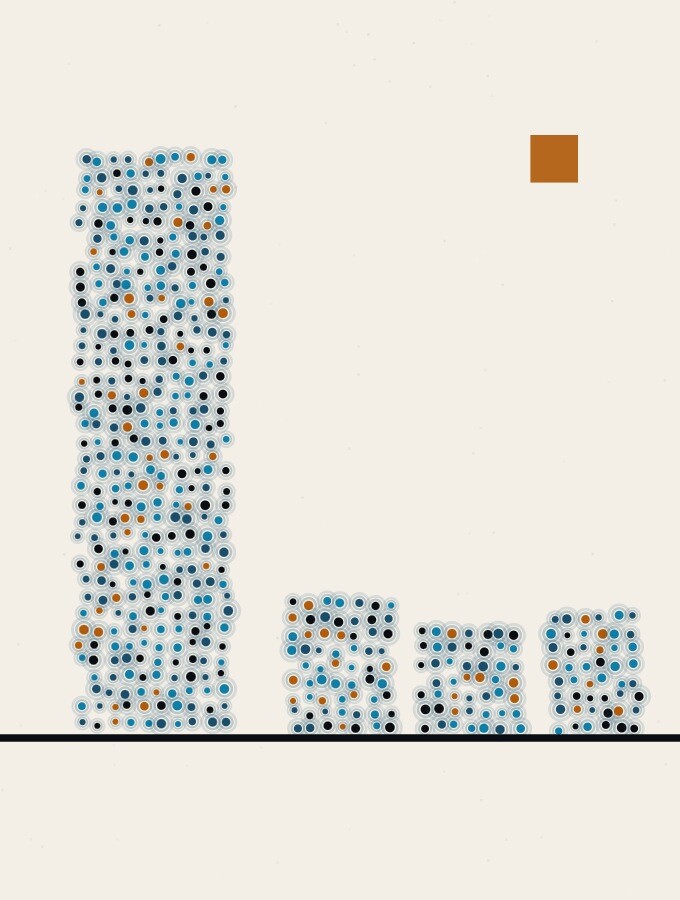
The risk concentrates in one role. In the Australian first-class data, at any given moment 14% of pace bowlers were unavailable through injury, against 4% of spin bowlers, 4% of batters and 2% of wicketkeepers. The question researchers have chased for two decades is how much bowling is too much.
The answers so far point both ways. Among 90 Australian first-class fast bowlers, those averaging fewer than two days between bowling sessions had 2.4 times the injury risk of those averaging three to four days, but bowlers averaging five or more days between sessions also had raised risk, 1.8 times. Bowling more than 50 overs in a match was followed by a higher injury rate over the next three weeks, and a 15-year follow-up found the effect differed by tissue: high recent match workload was linked to tendon injuries, while bone stress injuries were linked to high workload over the previous three months combined with a low career total. A study using the ratio of last week’s workload to the previous month’s found that a week more than double the usual brought 4.5 times the risk the following week.
Bowling workload and injury risk in fast bowlers
Relative risk of injury compared with each study’s reference group. Above 1.00 means more injuries.
Sources: Dennis et al., Br J Sports Med 39(11) (2005); Dennis et al., J Sci Med Sport (2003); Orchard et al., Am J Sports Med (2009); Hulin et al., Br J Sports Med (2014). Small cohorts; wide confidence intervals.
Teenagers carry the most worrying form of the problem. In an English study, 40 fast bowlers aged 14 to 17 with no back pain had MRI scans, and 20.5% already showed a lumbar bone stress injury; over the following year the incidence was 27.3 per 100 players. An Australian study published in 2026 followed 98 community bowlers aged 10 to 20, including 23 girls: 16.3% had a symptomatic lumbar bone stress injury during the season, at 1.1 per 10,000 deliveries overall but 3.8 among bowlers who had had one before. In both studies, the injured bowlers tended to be older or more physically mature — the stage at which young bowlers step up a level and bowl faster.
What has been measured to work
Cricket has nothing equivalent to rugby’s randomised warm-up trials. A review of prevention research found only a handful of intervention studies for fast bowlers, and the workload rules that junior players follow come from cohort studies like those above. In a 2005 study of 44 Australian junior fast bowlers, a quarter reported an overuse injury in a single season, and those averaging fewer than 3.5 rest days between bowling days had about three times the risk.
Lumbar bone stress injuries in young fast bowlers
MRI and symptom-based findings from two prospective studies.
Sources: Keylock et al., J Sports Sci (2022); Daniels, Weeks and Beck, J Sci Med Sport (2026).
Some of the reasoning behind the rules has been tested and found wanting. Spell limits were partly justified by the idea that tired bowlers change technique in ways that load the spine. When 25 junior bowlers bowled a ten-over spell in a laboratory, longer than the recommended limit, their technique and loading stayed remarkably consistent, and the authors concluded that this argument could not be used to justify spell restrictions. The acute-to-chronic workload ratio, widely used by professional teams, is also contested: a 2026 meta-analysis noted continuing debate over its predictive value and its mathematics. None of this shows that rest days are unimportant — the cohort data on rest remain the strongest signal — but it does mean the precise numbers in any guideline are judgements, not measurements.
Head and neck protection in Australian cricket
What happened to recorded head and neck injuries, excluding isolated concussion, after elite helmet regulations in 2016.
| Measure | Before or overall | After 2016 rules |
|---|---|---|
| Average incidence per 100 players a season | 5.6 (all 12 seasons) | 7.3 |
| Share of injuries sustained while batting | 54% | 38% |
| Face as the injury site | 63% overall | — |
| Neck guards for elite batters facing pace | Not required | Mandatory from 2023–24 |
Sources: Eunson et al., Indian J Orthop (2023); ABC News, 31 October 2025.
Protective equipment has the clearest record, though not from trials. After Australia’s elite helmet regulations in 2016, the share of head and neck injuries sustained while batting fell from 54% to 38%; the recorded rate of such injuries did not fall, so the gain was in where the blows landed. In a survey of English cricketers, intermittent helmet users had higher odds of concussion than those who always wore one. Cricket Australia made neck guards compulsory for elite batters facing fast or medium bowling from the 2023–24 season, but for senior players elsewhere they were only strongly recommended when Ben Austin died, and doctors quoted after his death called for neck protection at every level, including training. In England, recreational rules require under-18s to wear a helmet with a faceguard against a hard ball, bar them from operating ball-throwing devices, and recommend a neck protector.
Why the answer is not to stop
A scoping review of 219 studies of cricket and health found injury rates of 1.8 to 5.7 per 1,000 player exposures, and that 48% of former cricketers reported persistent joint pain. It also found that former cricketers reported more physical activity and better mental quality of life than the general population, and that this persisted after retirement. Heat illness and skin cancer were flagged as risks needing more research.
Where the injury burden sits
Share of players unavailable through injury at any given time, Australian first-class cricket, by role.
Source: Orchard et al., injuries in Australian cricket at first-class level, 1995/96 to 2000/01.
The pattern that emerges is a sport whose risk sits in identifiable places — the fast bowler’s back, the batter’s unguarded neck, the jump in workload after a lay-off — and each of those places has a lever. Spreading bowling across the week, building load gradually after a break, and treating back pain in a teenage bowler as a possible stress injury rather than a strain are all supported by the cohort evidence. Wearing a helmet every time, with a neck guard against pace or a throwing device, is supported by the injury data and by expert consensus, even if a death prevented can never be counted. The evidence describes a game to be played with those levers pulled, not one to be avoided, and most of those levers cost little more than a rest day or a strip of plastic.
Questions people ask
What is the most common cricket injury?
In elite cricket, hamstring strains are often the commonest single diagnosis, with side strains, groin and hand injuries close behind. Lumbar stress fractures in fast bowlers cost the most playing time.
Why do fast bowlers get stress fractures in the back?
Fast bowling loads the lower spine through repeated extension and rotation. The injuries cluster in teenagers, especially around growth and a step up in level, and in bowlers with a previous injury.
Do neck guards prevent injuries like Phillip Hughes’s?
They are designed to cover the upper back of the neck that helmets leave exposed. Such deaths are too rare for a trial; the case for them rests on mechanism and expert consensus.
How much should a junior fast bowler bowl?
National guidelines set limits by age. The best evidence concerns rest: junior bowlers averaging fewer than 3.5 rest days between bowling days had about three times the injury risk.
Is cricket a dangerous sport?
Its injury rates are well below those of contact sports such as rugby, and most of the risk sits with fast bowlers. Former players report good long-term quality of life, though many report joint pain.
The short version
- In elite cricket, fast bowlers carry most of the injury burden: at any time about 14% are unavailable, against 4% of batters and spinners.
- Workload matters in both directions. Bowling on too many days, or after too long a break, raised injury risk in Australian cohorts.
- One in five asymptomatic teenage fast bowlers already had a lumbar bone stress injury on MRI; bowlers with a previous one were most at risk.
- Helmet rules shifted head and neck injuries away from batters. Neck guards are compulsory for elite Australian batters facing pace, but not at every level.
- There are no randomised trials of bowling limits; the guidelines rest on cohort studies, and some of their reasoning has not held up in the lab.
This is a summary of published research, not medical advice. A young bowler with back pain that lasts more than a few days, or any player with symptoms after a blow to the head or neck, should be assessed by a doctor or sports physiotherapist.
Further reading: Orchard et al., British Journal of Sports Medicine (2015), for workload patterns by tissue type. Bullock et al., International Journal of Sports Medicine (2021), for cricket and long-term health. Eunson et al. (2023) for twelve seasons of head and neck injuries in elite Australian cricket.
- Crickonomics, Stefan Szymanski and Tim Wigmore (2022). An economist and a cricket writer use data to explain how the game really works. Little on injuries, but sharp on how incentives shape who plays and how much.
- Hitting Against the Spin, Nathan Leamon and Ben Jones (2021). Cricket analytics from inside professional teams. A good companion to the workload research; its focus is performance rather than medicine.
- Radical Uncertainty, John Kay and Mervyn King (2020). On deciding when the numbers cannot settle the question. Apt for workload guidelines that are judgements rather than measurements.
Sources
Orchard JW, Newman D, Stretch R, et al. Methods for injury surveillance in international cricket. British Journal of Sports Medicine 39(4):e22 (2005). — Orchard J, James T, Alcott E, Carter S, Farhart P. Injuries in Australian cricket at first class level 1995/1996 to 2000/2001. British Journal of Sports Medicine (2002). — Frost WL, Chalmers DJ. British Journal of Sports Medicine (2012), doi:10.1136/bjsports-2012-091337. — Dovbysh T, Reid D, Shackel D. BMJ Open Sport & Exercise Medicine 7(4):e001168 (2021). — Eunson TH, Saw AE, Kountouris A, Orchard J. Traumatic head and neck injuries in elite Australian cricket players. Indian Journal of Orthopaedics (2023). — Dennis R, Farhart P, Goumas C, Orchard J. Journal of Science and Medicine in Sport (2003), doi:10.1016/S1440-2440(03)80031-2. — Dennis RJ, Finch CF, Farhart PJ. British Journal of Sports Medicine 39(11):843 (2005). — Orchard JW, James T, Portus M, et al. American Journal of Sports Medicine (2009), doi:10.1177/0363546509332430. — Orchard JW, Blanch P, Paoloni J, et al. British Journal of Sports Medicine (2015), doi:10.1136/bjsports-2014-093683. — Hulin BT, Gabbett TJ, Blanch P, et al. British Journal of Sports Medicine (2014), doi:10.1136/bjsports-2013-092524. — Keylock L, Alway P, Felton P, et al. Journal of Sports Sciences (2022), doi:10.1080/02640414.2022.2080161. — Daniels AP, Weeks BK, Beck BR. Journal of Science and Medicine in Sport (2026). — Stretch RA. South African Journal of Sports Medicine (2007). — Schaefer A, O’Dwyer N, Ferdinands R, Edwards S. Journal of Sports Sciences (2018), doi:10.1080/02640414.2017.1330548. — Chelladurai A, et al. Cureus (2026). — Filbay SR, Bullock GS, Sanchez-Santos MT, et al. Clinical Journal of Sport Medicine (2021), doi:10.1097/JSM.0000000000000933. — Bullock GS, Panagodage Perera NK, Murray AD, et al. International Journal of Sports Medicine (2021), doi:10.1055/a-1686-6632. — ABC News (Australia), 31 October 2025, on the death of Ben Austin and calls for neck protection. — England and Wales Cricket Board, Recreational Cricket Safety Guidelines (2025).