Sinkholes: What the Evidence Shows
Key takeaways · 11 min read
- Natural sinkholes form in soluble rock such as limestone; urban collapses mostly come from leaking pipes.
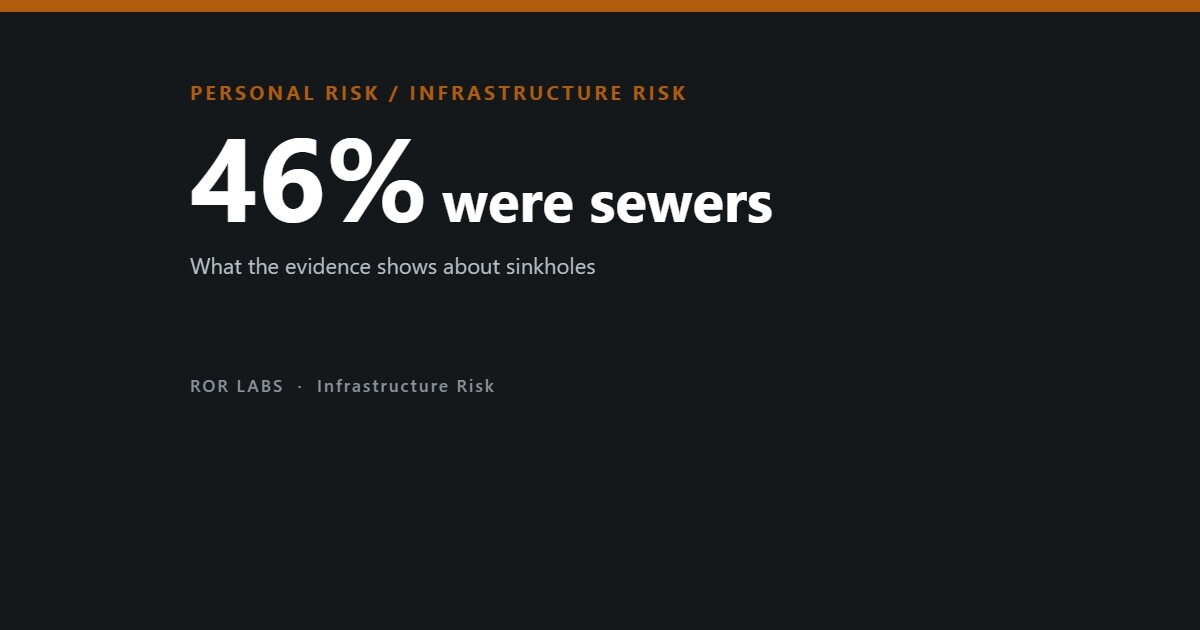
- In South Korea, damaged sewers caused 46% of ground collapses in 2019–2023.
- In the US, sinkholes are concentrated in a small share of karst land, and there is no national loss database.
- Road radar has cut the number of cavities found in Seoul, but it cannot see deep failures.
In this article
- Two different hazards with one name
- Leaking pipes are the main urban cause
- Karst sinkholes in Florida and the United States
- Can radar find the voids in time?
- What the investigations found
- What Florida’s insurance claims measured
- How big is the risk for one household?
- Questions people ask
- The short version
- Sources
On the evening of 24 March 2025, a road in Myeongil-dong, in eastern Seoul, gave way beneath traffic. The hole was about 22 metres by 18 metres and 16 metres deep. One person was injured, and a motorcyclist fell in and died. Two months earlier, near Tokyo, a lorry had dropped into a sinkhole in Yashio, and its 74-year-old driver was not recovered for three months.
Sinkholes look like acts of nature, and some are. In limestone regions such as Florida, rainwater slowly dissolves the rock until the ground above can no longer hold. But in cities, most of the holes that open under roads have a more ordinary cause: water escaping from old sewer and water pipes, carrying soil away until a void forms just under the asphalt.
This article looks at what the evidence shows about both kinds of sinkhole: how often they happen, what causes them, whether ground radar can find them in time, and why insurance claims for sinkholes in Florida turned out to measure something other than sinkholes.
Two different hazards with one name
Geologists distinguish natural sinkholes from human-induced ground collapse. Natural sinkholes form in karst, landscapes underlain by soluble rock such as limestone, dolomite or gypsum. According to the US Geological Survey, about 18% of the United States is underlain by soluble rocks, and about 25% has karst features or the potential to develop them. Florida, Kentucky, Tennessee, Missouri, Pennsylvania and Texas are among the most affected states.
Urban collapses usually have nothing to do with the rock. A crack or joint failure in a buried pipe lets soil wash into it, especially when heavy rain or high groundwater pushes water through the ground. Over months or years a cavity grows upwards until the road surface is only a thin shell. The collapse itself can be sudden, but the process behind it is slow and, in principle, detectable.
Leaking pipes are the main urban cause
The clearest data come from East Asia, where governments count road collapses. In South Korea, a National Assembly Library compilation of Ministry of Land, Infrastructure and Transport data recorded 2,119 ground subsidence incidents between 2015 and 2024, about 200 a year, with a peak of 338 in 2018 and 102 in 2024. Of 957 incidents between 2019 and 2023, 46% were attributed to damaged sewer pipes, 18% to poor compaction of soil after earlier works, and smaller shares to excavation and other underground facilities.
Seoul’s own figures are starker. A Korea Institute of Geoscience and Mineral Resources analysis, cited in later research, attributed about 85% of some 3,200 subsidence cases in the city between 2010 and mid-2015 to sewer damage. A 2026 study of 303 incidents in Gyeonggi Province found sewer damage behind 39% of them, poor backfill behind 23% and excavation behind 14%, with sewer-related collapses peaking in the summer monsoon.
What causes urban ground collapse in South Korea
Ground subsidence incidents by cause, 2019–2023 (957 incidents).
Ministry of Land, Infrastructure and Transport data as reported in 2025. Shares rounded; the remainder are other or unknown causes.
Japan records about 10,000 road sinkholes a year: 9,124 in 2020, 9,967 in 2021 and 10,548 in 2022, according to national figures cited in a 2024 engineering paper. Its most common cause is cracking or damage in buried pipes. The transport ministry attributed about 2,900 cave-ins a year to sewer and other pipeline facilities at the end of fiscal 2019, and reported that cave-ins rise once sewers pass about 30 years in service.
Road sinkholes in Japan
Road cave-ins recorded nationally each year.
National figures cited by Rodrigues Neto and colleagues, 2024. The most common cause was damage to buried pipes.
Europe shows the same mechanism. In 2016, Emilia Kuliczkowska of Kielce University of Technology analysed 100 road collapses caused by defective sewers. The average collapse covered about 49 square metres, and the smallest just 0.12. She concluded that outside limestone karst, road collapses are caused mainly by leaking water mains, storm drains and sewers.
Karst sinkholes in Florida and the United States
Natural sinkholes are concentrated rather than widespread. In 2023, Nathan Wood and colleagues at the USGS mapped sinkhole susceptibility across the conterminous United States. About 68% of karst and pseudokarst land had no mapped closed depressions and was rated very low susceptibility. The high and very high classes, 17% of that land, contained 94% to 99% of the known sinkholes in three state databases. Florida had the largest area of high or very high susceptibility, about 50,000 square kilometres.
Development makes things worse. A preliminary study in Beacon Woods, Florida, found sinkholes about ten times more common in urban areas than in undeveloped land, and pointed to leaking water, sewer and septic lines and to stormwater drainage. A projection by the same USGS team found that expected changes in climate and land use did not substantially shift the national hotspots.
Deaths are rare enough that nobody counts them nationally. The 2023 USGS paper noted that there is no national database of sinkhole occurrences or losses in the United States. The case most people remember is Seffner, Florida, where Jeff Bush was swallowed in his bedroom in February 2013; his body was never recovered, and the same site reopened in 2015 and 2023. The most quoted cost figure, at least $300 million a year in US damage, comes from a 2015 USGS conference paper by David Weary, who wrote that the true total was probably much higher and that no federal agency is required to collect it.
Where US sinkholes are
Sinkhole susceptibility across karst and pseudokarst land in the conterminous United States.
Wood, Doctor, Alder and Jones, Frontiers in Earth Science, 2023.
Can radar find the voids in time?
Because urban cavities grow slowly under the road surface, cities survey them with ground-penetrating radar mounted on vehicles. Seoul has surveyed about 33,000 kilometres of road over ten years and found about 7,760 cavities. According to city figures reported in October 2025, the rate found fell from 0.41 cavities per kilometre in 2015 to 0.08 in 2025, which the city attributes to repairs and pipe replacement. It plans to survey 18,000 kilometres a year from 2026.
The technique has limits. A study of 204 confirmed cavities in Seoul found that vehicle-mounted radar could see to about 1.5 to 2 metres, and that most of the cavities it found sat within 0.4 metres of the surface. The Myeongil-dong collapse began about 16 metres down. In Japan, national-road surveys from 2020 to 2022 found about 0.5 possible cavities per kilometre, and municipal roads in the city of Matsuyama, with denser pipe networks, about 4.8. Those are possible cavities that need confirmation, and the figures come from a paper by the system’s developers.
Prediction from pipe records is also imperfect. A 2018 study in Natural Hazards built a model of sinkhole susceptibility for Seoul’s sewers using pipe length, age, depth, size, slope and material. Its accuracy, measured by the area under the curve, was 0.75, useful for ranking pipes but far from reliable for any one street.
Cavities found by road radar in Seoul
Cavities found per kilometre of road surveyed.
Seoul Metropolitan Government figures reported in October 2025. The survey reaches about 1.5–2 m below the surface.
What the investigations found
The Korean government’s investigation committee reported on the Myeongil-dong collapse in December 2025. It found that a wedge-shaped block of weathered rock had failed where three fractures met. Contributing factors included a fall in groundwater linked to tunnel works for the Sejong–Pocheon Expressway below the road, an old sewer that had been flagged for cracks in a 2022 inspection but not repaired, and gaps in construction management.
Japan’s Yashio collapse of 28 January 2025 grew to at least 40 metres across and about 16 metres deep. About 1.2 million residents were asked to cut their water use while the damaged sewer was bypassed. An expert committee’s final report in February 2026 blamed corrosion of the sewer pipe, and said an earlier survey had failed to capture images of it, leading to the risk being underestimated.
Recovery can also be fast. When a five-lane road collapsed in Hakata, Fukuoka, on 8 November 2016, during work on a subway extension, the road reopened a week later. In Bangkok, on 24 September 2025, a hole about 30 metres across opened outside Vajira Hospital when soil flowed into a subway tunnel through a cracked joint, worsened by a broken water main. Nobody was hurt. The Guatemala City collapse of 2010, often called a sinkhole, was according to geologists a piping failure in volcanic fill, caused by a burst drain rather than dissolving rock.
What Florida’s insurance claims measured
In Florida, sinkholes became an insurance crisis. A 2010 review by the state’s Office of Insurance Regulation counted 24,671 sinkhole claims between 2006 and 2010, costing about $1.4 billion, with an average claim of $70,412. Claims rose from 2,360 in 2006 to 7,244 in 2009. Two-thirds came from just three counties, Hernando, Pasco and Hillsborough, but claims also rose in Miami-Dade and Broward, which the regulator said were generally not subject to sinkhole activity.
The most telling figure was the type of damage. Only 1.1% of closed claims involved a catastrophic ground cover collapse, the kind of sudden hole people picture. More than half were classed as subsidence, slow settling that caused cracks. In a sample of 110 paid claims, 56% of the homes had not been repaired. The regulator referred fewer than 1% of claims to its fraud division, so the report does not show how many were fraudulent, only that the payments often did not go into repairs.
In 2011 the legislature tightened the law, defining structural damage, setting a two-year limit for claims and giving weight to the insurer’s engineering report. Claims at the state-backed insurer Citizens fell to 2,386 in 2012 and were projected at about 900 in 2013, an estimated 80% drop from 2011. Basic Florida policies now need only cover catastrophic ground cover collapse; wider sinkhole cover is optional. We looked at a similar gap between what people think they are covered for and what policies pay in our article on flood insurance.
Florida sinkhole claims, 2006–2010
Claims reported to the Office of Insurance Regulation data call.
| Measure | Figure |
|---|---|
| Claims, 2006 | 2,360 |
| Claims, 2009 | 7,244 |
| Total cost, 2006–2010 | About $1.4 billion |
| Closed claims that were catastrophic collapses | 1.1% |
| Sampled paid claims where the home was not repaired | 56% |
Florida Office of Insurance Regulation, 2010 Sinkhole Data Call report. 2010 is a partial year.
How big is the risk for one household?
For most people, it is small. Most urban collapses are small too: Kuliczkowska’s average was 49 square metres, and large holes like Yashio make up only about 2% of sewer-related incidents in Japan. In the Gyeonggi study, the cause of a collapse was significantly associated with vehicle damage and season, but not with injuries. The dramatic cases that reach the news are the rare ones.
The risk is also concentrated. In karst areas, it depends on the rock under a particular neighbourhood, and on local maps that show known sinkholes. In cities, it depends on the age and condition of the pipes under the road, which is why the same aging water and sewer networks behind water main breaks also sit behind most road collapses. South Korea’s Special Act on Underground Safety Management, passed in 2016 and in force since 2018, requires underground safety assessments before large excavations and regular inspections of underground facilities, because most collapses are man-made and therefore preventable.
Questions people ask
What causes sinkholes in cities?
Mostly leaking sewer and water pipes that wash soil away, along with poorly compacted backfill and excavation. In Korea, damaged sewers caused 46% of incidents in 2019–2023.
How common are sinkholes?
South Korea recorded about 200 ground subsidence incidents a year from 2015 to 2024. Japan records about 10,000 road sinkholes a year, most of them small.
Can sinkholes be detected before they collapse?
Road radar finds many shallow cavities, and Seoul’s rate of findings has fallen sharply. But it reaches only about 1.5 to 2 metres deep, so deeper failures can be missed.
Does home insurance cover sinkholes?
It depends on the policy and country. In Florida, basic policies must cover only catastrophic ground cover collapse; wider sinkhole cover is optional.
What are the warning signs of a sinkhole?
Local authorities list signs such as new cracks in roads or walls, sagging pavement, doors that stop closing, and puddles or depressions that were not there before. Report them rather than investigating the hole yourself.
The short version
- Natural sinkholes form in soluble rock such as limestone; urban collapses mostly come from leaking pipes.
- In South Korea, damaged sewers caused 46% of ground collapses in 2019–2023.
- In the US, sinkholes are concentrated in a small share of karst land, and there is no national loss database.
- Road radar has cut the number of cavities found in Seoul, but it cannot see deep failures.
- Only 1.1% of closed Florida sinkhole claims in the 2010 review were catastrophic collapses.
This article summarises published research, government data and news reports on sinkholes and ground collapse. It is not engineering, legal or insurance advice and cannot tell you whether a particular property is at risk. If you see a new hole, depression or crack in a road or near a building, keep away from it and report it to the local authority or emergency services.
Further reading. Wood, Doctor, Alder and Jones, ‘Current and future sinkhole susceptibility in karst and pseudokarst areas of the conterminous United States’, Frontiers in Earth Science, 2023, is the best overview of natural sinkholes. Kuliczkowska, 2016, explains how leaking sewers cause road collapses.
- How Infrastructure Works, Deb Chachra (2023). An engineer on the pipes, wires and roads that cities depend on, and why maintaining them is harder than building them. Reflective rather than technical.
- Disasterology, Samantha Montano (2021). A disaster researcher on how governments prepare for and respond to hazards. Written from an emergency management perspective and critical of US policy.
- Calling Bullshit, Carl Bergstrom and Jevin West (2020). Two scientists on spotting misleading numbers, useful for reading headline cost estimates and claim statistics.
Sources
- Weary DJ, Doctor DH. Karst in the United States: A Digital Map Compilation and Database. US Geological Survey Open-File Report 2014-1156, 2014.
- Weary DJ. The cost of karst subsidence and sinkhole collapse in the United States compared with other natural hazards. Proceedings of the 14th Multidisciplinary Conference on Sinkholes, 2015:433–446. doi:10.5038/9780991000951.1062.
- Wood N, Doctor DH, Alder JR, Jones JM. Current and future sinkhole susceptibility in karst and pseudokarst areas of the conterminous United States. Frontiers in Earth Science, 2023;11:1207689. doi:10.3389/feart.2023.1207689.
- Veni G, Brashear S, Glasbrenner J. Building codes to minimize cover collapses in sinkhole-prone areas. Proceedings of the 14th Multidisciplinary Conference on Sinkholes, 2015:471–476. doi:10.5038/9780991000951.1063.
- Kuliczkowska E. An analysis of road pavement collapses and traffic safety hazards resulting from leaky sewers. Baltic Journal of Road and Bridge Engineering, 2016;11(4):251–258. doi:10.3846/bjrbe.2016.29.
- Rodrigues Neto J, Shinohara J, Kato Y, and colleagues. Advancements and applications of GMS3: a surface and subsurface unified database system. Journal of Physics: Conference Series, 2024;2887:012022. doi:10.1088/1742-6596/2887/1/012022.
- Park J, Chung Y, Hong G. Reinforcement effect of a concrete mat to prevent ground collapses due to buried pipe damage. Applied Sciences, 2020;10(16):5439.
- Kim K, Kim J, Kwak TY, Chung CK. Logistic regression model for sinkhole susceptibility due to damaged sewer pipes. Natural Hazards, 2018;93(2):765–785. doi:10.1007/s11069-018-3323-y.
- Kim J, Song K, Koo DD, Han S. Seasonal and regional patterns of ground subsidence associated with urban water and sewer infrastructure failures. Water, 2026;18(4):448.
- Yoon JS, Youm M, Park S, Kim J. Technique for detecting subsurface cavities of urban road using multichannel GPR equipment. 2020.
- National Assembly Library of Korea. Ground subsidence (sinkholes) in data. Data & Law, No. 29, May 2025.
- Florida Office of Insurance Regulation. Report on Review of the 2010 Sinkhole Data Call. November 2010.
- Florida Senate. Bill analysis, SB 408 (2011) and SB 416 (2014).
- Ministry of Land, Infrastructure and Transport, Central Underground Accident Investigation Committee. Findings on the Myeongil-dong ground collapse, as reported December 2025.