Ice hockey injuries, body checking and the rule that halved them
Key takeaways · 9 min read
- Men’s college hockey records about 9.5 injuries per 1,000 exposures, similar to football; women’s about 6.1.
- Most injuries happen in games, and body checking is behind many of them.
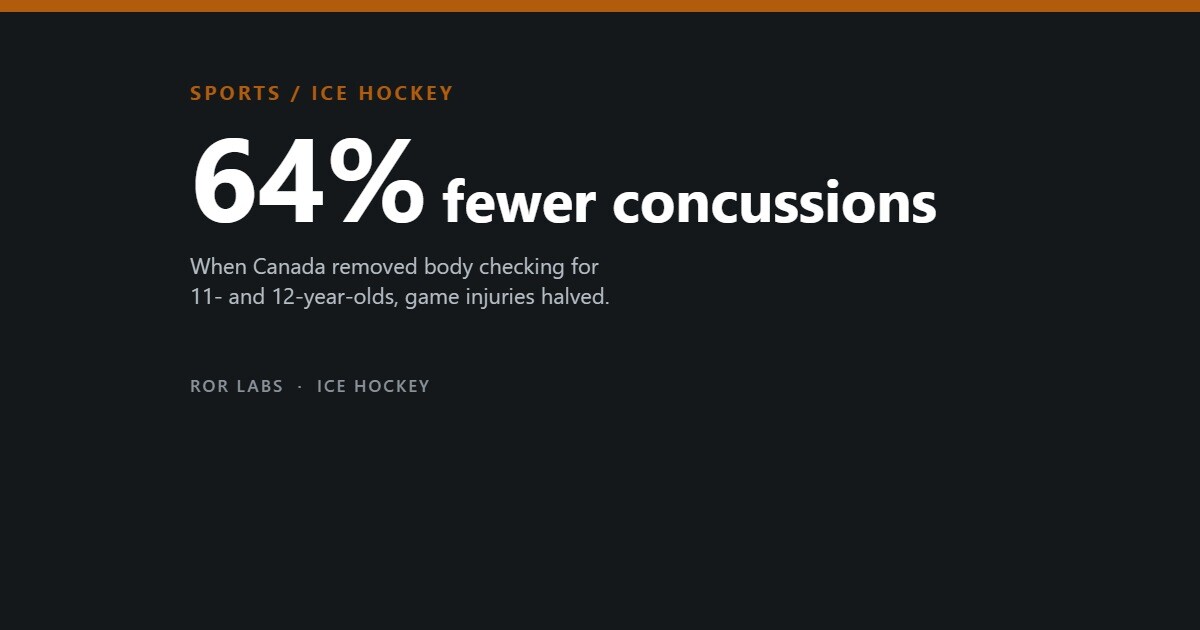
- Removing checking for ages 11–12 in Canada cut game injuries by 50% and concussions by 64%.
- Full face masks remove most facial and eye injuries but do not prevent concussion.
In 2013 Hockey Canada took body checking out of Pee Wee hockey, for players aged 11 and 12, across the country. Researchers in Calgary compared the seasons before and after. Game injuries fell from 4.37 to 2.16 per 1,000 game-hours, and concussions from 2.79 to 1.12. After adjustment, that was a 50% drop in injuries and a 64% drop in concussions.
Few sports have a result that clean. Ice hockey is a fast collision sport played on a hard surface with sticks and blades, and it is injured accordingly — at college level men’s hockey sits alongside American football. But its injuries are unusually tied to specific, changeable things: whether a league allows checking, what players wear on their faces, and, since the death of a professional player in England in 2023, what they wear on their necks.
This article follows the series format: what hockey players actually injure, where the risk concentrates, what has been measured to reduce it, and why the answer is not to hang up the skates.
What actually gets injured
The CDC’s summary of US college sport from 2009 to 2014 put men’s ice hockey at 9.5 injuries per 1,000 athlete-exposures and women’s at 6.1, against an average of 6.0 across 25 sports. Wrestling, at 13.1, and women’s gymnastics, at 10.4, were higher. Men’s hockey and baseball were the only two sports in which more injuries happened in games than in practice.
Hockey among college sports
Injuries per 1,000 athlete-exposures, NCAA, 2009–10 to 2013–14.
Source: Kerr et al., MMWR 64(48):1330–1336 (2015).
What gets hurt depends on who is playing. Among 15- to 17-year-olds in Canadian leagues that allow checking, the head and face took 32.9% of game injuries, the shoulder and collarbone 17.8%, the wrist and hand 9.9% and the knee 9.4%. Concussion was the single commonest injury. In a Swiss professional league over seven seasons, the rate was 5.93 injuries per 1,000 player-hours, and the lower limb accounted for 40.4%, led by tears of the ligament on the inside of the knee and strains of the groin and abdomen.
Adult recreational players show a different face of the sport, literally. An analysis of US emergency departments estimated 68,786 adult hockey injuries from 2007 to 2016. Lacerations were the commonest diagnosis, at 26.4%, and the face the commonest site, at 18.1%, followed by the head and the shoulder. Concussion was 7.0% of visits. Adult recreational leagues usually ban checking, so what remains is sticks, pucks, falls and the occasional collision.
When the risk concentrates
Games, and checking. Using the college counts, the injury rate in men’s games works out at roughly 26 per 1,000 exposures against about 4 in practice — the CDC report described the gap as more than five-fold. In US high school boys, games carried 7.8 times the injury rate of practice, and body checking was the mechanism in more than 46% of injuries. Among Canadian youth, game concussion rates rose with age, from 1.82 per 1,000 game-hours under 13 to 3.47 under 15 and 3.61 under 18, and girls had about 1.7 times the concussion rate of boys.

The rarest injury is also the one that changed the rules. On 28 October 2023, Adam Johnson, a 29-year-old American playing for the Nottingham Panthers, died after an opponent’s skate blade cut his neck during a game in Sheffield. In April 2025 prosecutors in England decided not to bring charges; the inquest has not yet concluded. Such injuries are extremely uncommon. A US registry of catastrophic sports injuries counted 26 serious hockey lacerations from 1982 to 2025, 24 of them from skates and 15 to the neck. In a survey of more than 26,000 USA Hockey members, 1.8% said they had ever had a neck laceration, and the cases followed up were superficial. Registry and survey counts like these cannot give a rate per game, but they show how far this risk sits below concussion, which youth leagues record every week.
Concussion by age in Canadian youth hockey
Game concussions per 1,000 game-hours, Safe2Play cohort, 2013–2018.
Source: Eliason et al., British Journal of Sports Medicine, conference abstract (2024).
The pattern is not new. Across 16 seasons of older NCAA data, from 1988 to 2004, men’s games produced 16.27 injuries per 1,000 exposures against 1.96 in practice, a rate ratio of 8.3. The commonest game injury to the lower limb was internal damage to the knee. What has changed over the decades is less the shape of the risk than the rules and equipment built around it, which is why the next section is longer than usual.
What has been measured to work
Body-checking policy has the strongest evidence of any prevention measure in youth sport, because Canada ran a series of natural experiments. In 2007–08, Carolyn Emery’s group compared Pee Wee players in Alberta, where checking was allowed, with those in Quebec, where it was not. Alberta players had 3.26 times the game injury rate and 3.88 times the concussion rate. When Ontario dropped checking a few years later, a second comparison found almost the same gap. Then Hockey Canada removed checking from Pee Wee nationally, and the before-and-after study in Calgary found the 50% and 64% falls in injuries and concussions quoted at the top.
Checking removed, older age groups
Adjusted rate ratios below 1.00 mean fewer injuries in leagues without checking. Corrected figures, 2024.
Injuries: 0.45 (0.27–0.76)
Concussions: 0.59 (0.30–1.17)
Severe injuries: 0.39
Concussion result not significant
Injuries: 0.33 (0.21–0.51)
Concussions: 0.41 (0.23–0.73)
About 8,770 injuries a year prevented
Estimate for Canada, 5,111–12,429
Source: Emery et al., British Journal of Sports Medicine 54(7):414–420 (2020) and 56(1):12 (2022), both corrected in 2024.
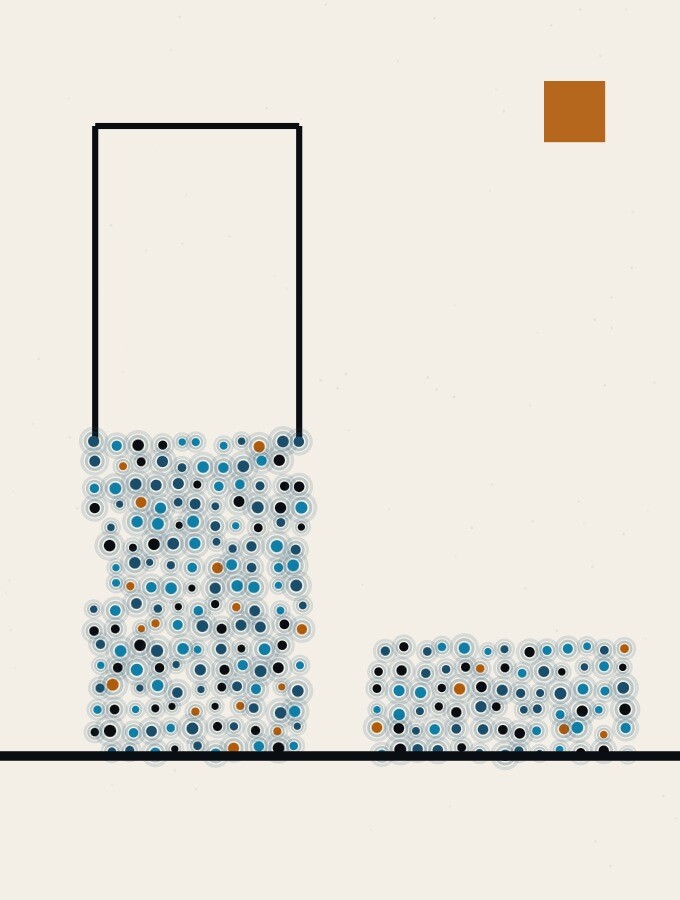
The same group then looked at older players, in leagues that allow checking and leagues that do not. Among 13- and 14-year-olds, non-checking leagues had 55% fewer injuries, though the fall in concussions did not reach significance. Among 15- to 17-year-olds, they had 67% fewer injuries and 59% fewer concussions, and the authors estimated about 8,770 injuries a year could be prevented in Canada. These papers were corrected in 2024, and the figures here are the corrected ones. One common objection — that children who never learn to check will be hurt more when they meet it later — was tested too. Players who had learned to check earlier were not protected later on, so delaying checking does not simply move the injuries to an older age.
Face protection in junior hockey
Injuries per 1,000 player-game hours by type of face protection, and a review comparing shields with full masks.
Source: Stuart et al., American Journal of Sports Medicine 30(1):39–44 (2002); Asplund et al., British Journal of Sports Medicine (2009).
Face protection is the second clear lesson. In a study of junior players, injuries ran at 158.9 per 1,000 player-game hours without face protection, 73.5 with a half shield and 23.2 with a full face mask, and there were no eye or neck injuries in the full-protection group. A systematic review found half shields carried 2.31 times the facial injuries of full masks. Neither made a difference to concussion, which comes from the brain moving inside the skull rather than a blow to the face. Mouthguards were linked to lower concussion odds in one observational study of youth players, an adjusted odds ratio of 0.36, but that design cannot prove cause. Neck guards are now mandatory in English hockey since January 2024, in US youth hockey since August 2024, and in the NHL for players who debut from the 2026–27 season. In laboratory tests, most guards resisted a skate blade at lower force but failed at higher force, and no study has yet shown they prevent deaths — a reasonable precaution adopted ahead of the evidence.
Why the answer is not to stop
Hockey’s numbers are high, but not exceptional among collision sports, and they are unusually responsive. Men’s college hockey at 9.5 injuries per 1,000 exposures sits beside football at 9.2 and below wrestling at 13.1; women’s hockey, played without checking, is at the all-sport average. More to the point, the biggest single driver of youth injuries turned out to be a rule, and the rule could be changed without changing whether children play. About half a million Canadians under 18 play hockey each year.
What the national Pee Wee change did
Calgary, seasons before and after body checking was removed for ages 11–12 in 2013.
Source: Black et al., British Journal of Sports Medicine 51(24):1767–1772 (2017).
For players and parents, that points to practical choices rather than a yes-or-no decision. Choose non-checking leagues for younger and recreational players, where the evidence shows injury rates fall by half or more. Wear a full face mask, which removes most facial and eye injuries. Wear a mouthguard and a neck guard: the evidence for both is weaker, but the cost is low. Take concussion seriously at every age, because the rates climb through the teenage years and are higher in girls. And recognise that the rarest disasters, like Adam Johnson’s death, prompted sensible changes that are still waiting for outcome data.
The broader point is the one this series keeps returning to. The risk in a sport is not a fixed property of the sport. Hockey in Quebec and hockey in Alberta were the same game on the same ice, with three times the injury rate on one side of a provincial border. That difference came from a rule, and rules can be rewritten.
Questions people ask
How common are ice hockey injuries?
College men are injured at about 9.5 per 1,000 exposures and women at 6.1, against an all-sport average of 6.0. Most injuries happen in games.
At what age is body checking allowed in youth hockey?
In Canada and the United States it was removed from the 11–12 age group, in 2013 and 2011 respectively. Removing it halved injuries and cut concussions by 64% in one study.
Do full face masks prevent concussion?
No. They greatly reduce facial, eye and dental injuries, but concussion rates were similar with half shields and full masks.
Are neck guards mandatory in hockey?
In English hockey since 2024, in US youth hockey since August 2024, and in the NHL for players debuting from 2026–27. No study has yet measured their effect on serious injuries.
Is women’s hockey safer than men’s?
Women’s college hockey, played without body checking, has a lower overall injury rate. But among youth, girls had higher concussion rates than boys.
The short version
- Men’s college hockey records about 9.5 injuries per 1,000 exposures, similar to football; women’s about 6.1.
- Most injuries happen in games, and body checking is behind many of them.
- Removing checking for ages 11–12 in Canada cut game injuries by 50% and concussions by 64%.
- Full face masks remove most facial and eye injuries but do not prevent concussion.
- Neck guards became mandatory after Adam Johnson’s 2023 death, ahead of outcome evidence.
This is a summary of published research, not medical advice. Any suspected concussion should be assessed by a doctor before returning to play, following a graded return-to-sport protocol.
Further reading: Emery et al., JAMA 303(22):2265–2272 (2010), for the Alberta–Quebec comparison. Black et al., British Journal of Sports Medicine 51(24):1767–1772 (2017), for the national policy change. Our article on American football and the kickoff rule tells a similar story.
- Upstream, Dan Heath (2020). On solving problems before they happen by changing systems rather than people — the story of the body-checking policy in general form.
- Livewired, David Eagleman (2020). A neuroscientist on how the brain rewires itself. Helpful background on why the developing brain deserves extra care.
- Noise, Daniel Kahneman, Olivier Sibony and Cass Sunstein (2021). On variability in human judgement, relevant to refereeing and to how inconsistently rules are applied.
Sources
Black AM, Macpherson AK, Hagel BE, et al. British Journal of Sports Medicine 51(24):1767–1772 (2017), doi:10.1136/bjsports-2016-097392. — Kerr ZY, Marshall SW, Dompier TP, Corlette J, Klossner DA, Gilchrist J. MMWR 64(48):1330–1336 (2015). — Emery CA, et al. British Journal of Sports Medicine 56(1):12 (2022), doi:10.1136/bjsports-2020-103757, corrected 2024. — Ornon G, et al. Journal of Experimental Orthopaedics (2020), doi:10.1186/s40634-020-00300-3. — Morrissey PJ, et al. Journal of Orthopaedics (2020), doi:10.1016/j.jor.2020.04.015. — Matic GT, et al. The Physician and Sportsmedicine (2015), doi:10.1080/00913847.2015.1035210. — Eliason P, et al. British Journal of Sports Medicine, conference abstract (2024), doi:10.1136/bjsports-2023-concussion.368. — Kucera KL, et al. (2026), doi:10.17615/x2bb-b223. — Yorkshire Post, 27 April 2026; NBC News, April 2025. — Emery CA, Kang J, Shrier I, et al. JAMA 303(22):2265–2272 (2010), doi:10.1001/jama.2010.755. — Black AM, et al. British Journal of Sports Medicine 50:55–61 (2016), doi:10.1136/bjsports-2015-095103. — Emery C, et al. British Journal of Sports Medicine 54(7):414–420 (2020), doi:10.1136/bjsports-2019-101092, corrected 2024. — Eliason P, et al. British Journal of Sports Medicine 56(23):1337 (2022). — Stuart MJ, et al. American Journal of Sports Medicine 30(1):39–44 (2002). — Asplund C, et al. British Journal of Sports Medicine (2009), doi:10.1136/bjsm.2009.060152. — Chisholm DA, et al. British Journal of Sports Medicine 54(14):866 (2020), doi:10.1136/bjsports-2019-101011. — Loyd AM, et al. Clinical Journal of Sport Medicine (2015), doi:10.1097/JSM.0000000000000121. — Morrissette CR, et al. American Journal of Sports Medicine (2026), doi:10.1177/03635465251380851. — USA Hockey, neck laceration protection rule, effective 1 August 2024. — NHL.com, new collective bargaining agreement, 21 July 2025. — Fox News, 30 October 2023, on the EIHA neck guard mandate.