Traffic Pollution Near Busy Roads: What the Evidence Shows
Key takeaways · 13 min read
- Traffic pollution is highest within the first 100 to 200 m of a busy road. Ultrafine particles and nitrogen dioxide fall with distance; fine particle mass changes much less.
- In a Californian study of 3,677 children, those living within 500 m of a freeway had 81 mL less lung growth (FEV1) between ages 10 and 18 than those 1,500 m or more away.
- Expert reviews rate links between long-term traffic pollution and asthma onset, and deaths from heart disease, with moderate-to-high or high confidence. Dementia links are small and may be confounded.
- London’s ULEZ cut nitrogen dioxide, but how much depends on the method: the official estimate is about twice an independent causal analysis, which found no detectable effect from the 2023 expansion.
In this article
- How pollution falls off with distance
- What traffic does to children’s lungs
- Asthma: what the reviews and models say
- Adults: hearts, lungs and dementia
- Ella, and the cases that reached court
- Do low emission zones work?
- School streets, idling and filters
- Practical steps near busy roads
- Questions people ask
- The short version
- Sources
Millions of people live, walk or go to school beside a busy road. What comes off it is mostly invisible: nitrogen dioxide, tiny combustion particles and dust from brakes and tyres. An earlier article covered PM2.5 and what actually helps. This one is about the road itself.
Topics here: how pollution thins with distance, what long-running studies found in children’s lungs, what reviews conclude for adults, the London girl whose death certificate names air pollution, and whether low emission zones, school streets and filters make a difference.
A clean air zone looks very different depending on what it is compared with, and most exposures in these studies are modelled at a home address rather than measured on the person.
How pollution falls off with distance
Alex Karner and colleagues pooled 41 roadside monitoring studies, with more than 700 measurements, and found that fresh exhaust thins out quickly: carbon monoxide and some ultrafine particle counts fell by at least half within about 150 m of the road edge, and nitrogen dioxide and benzene declined steadily with distance. Fine particle mass showed no clear trend.
By 115 to 570 m almost every pollutant had reached background. Downwind of a Cincinnati interstate, ultrafine particle numbers halved between 50 m and 150 m, and the US Environmental Protection Agency puts the usual reach at about 500 to 600 feet downwind.
How far the plume from a busy road reaches
Distances at which traffic pollutants fall, from roadside monitoring studies and agency reviews.
Sources: Karner et al. (2010), 41 studies; Reponen et al. (2003); US EPA (2014); HEI (2010). Fine particle mass showed no consistent gradient.
The Health Effects Institute (HEI) drew the exposure zone in 2010 at 300 to 500 m from a highway or major road, and estimated that 30 to 45% of people in large North American cities live inside it.
What traffic does to children’s lungs
In the Children’s Health Study in southern California, W. James Gauderman’s team followed 3,677 children in 12 communities from about age 10 to 18, when lungs grow fastest. Among them, the 440 living within 500 m of a freeway gained less lung function than those 1,500 m or more away.
Freeway proximity and regional pollution each harmed lung growth independently, and poor lung growth in childhood is linked with chronic lung disease and earlier death later in life.
Lung growth near a freeway
Children’s Health Study: children living within 500 m of a freeway compared with those 1,500 m or more away.
Source: Gauderman et al., The Lancet (2007); 3,677 children, 12 Californian communities. FEV1 = air blown out in one second; MMEF = mid-breath flow.
The same study later saw the reverse. As Los Angeles air cleaned up, the share of 15-year-olds with abnormally low lung function fell from nearly 8% in the 1994–98 cohort to 3.6% in 2007–11 (Gauderman et al., 2015). Children living within 75 m of a major road had about 1.5 times the odds of asthma or wheeze (McConnell et al., 2006).
Ian Mudway and colleagues tested 2,164 inner-city London children aged 8 to 9 after the first low emission zone, and each extra microgram of nitrogen dioxide went with 2.3 mL less forced vital capacity. From a straight-line assumption they project about 5% smaller lungs at average exposure; there was no unexposed control group.
Asthma: what the reviews and models say
HEI’s 2010 panel found ‘sufficient’ evidence that traffic pollution worsens children’s asthma, and only ‘suggestive’ evidence for most other outcomes. Its 2022 systematic review of 353 studies had moderate-to-high or high confidence for asthma onset in children and adults and for acute lower respiratory infections in children.
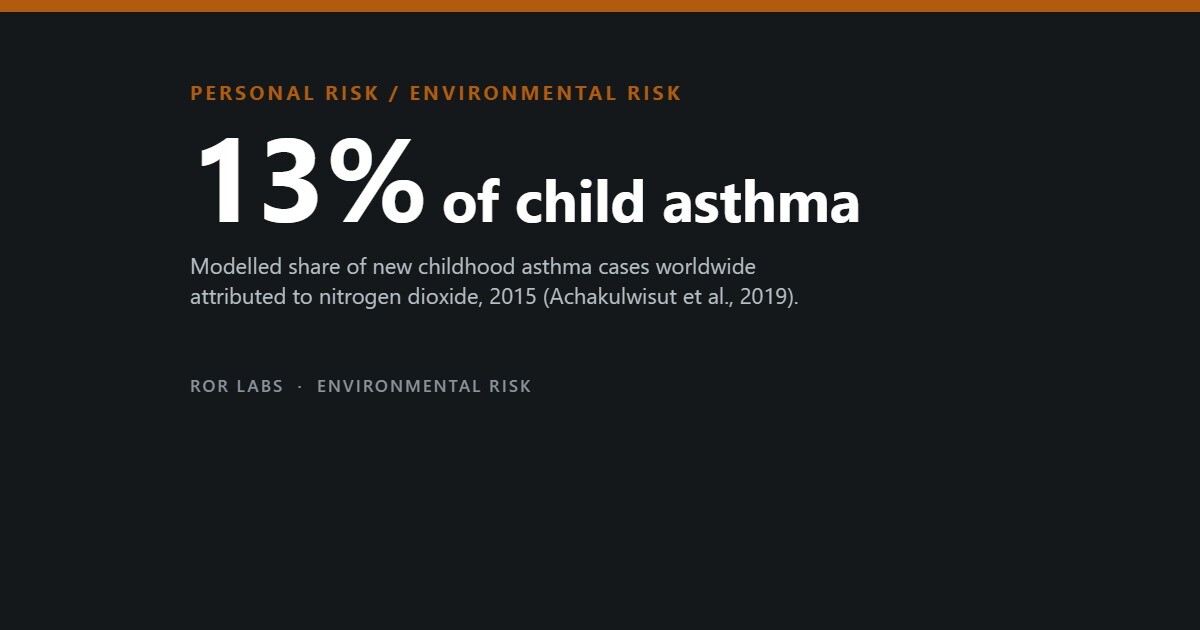
Ploy Achakulwisut and colleagues then asked how many cases that adds up to. Their model, built on land-use regression estimates of nitrogen dioxide and a meta-analysis of risk, attributes about 4.0 million new childhood asthma cases a year, around 13% of the global total, to the gas. The uncertainty range runs from 1.8 to 5.2 million.
The figure is modelled rather than a count of diagnosed children, and nitrogen dioxide partly stands in for the whole traffic mixture. The model also put 92% of these cases in places that met the old WHO value. In 2021 the World Health Organization cut its annual guideline for the gas from 40 to 10 micrograms per cubic metre.
Adults: hearts, lungs and dementia
For adults, HEI’s 2022 panel had moderate-to-high or high confidence in links between long-term traffic pollution and deaths from all causes, circulatory disease, ischaemic heart disease and lung cancer. All of this evidence is observational.
Dementia is less settled. Hong Chen and colleagues followed about 2.2 million Ontario adults aged 55 to 85 and found 243,611 new dementia diagnoses from 2001 to 2012. Living within 50 m of a major road carried a hazard ratio of 1.07 against more than 300 m, fading with distance. There was no link with Parkinson’s disease or multiple sclerosis.
Dementia and distance from a major road
Hazard ratio for a dementia diagnosis, Ontario 2001–2012, compared with living more than 300 m away (= 1).
Source: Chen et al., The Lancet (2017); about 2.2 million adults aged 55–85, 243,611 dementia cases. Address from 1996 postal codes; funded by Health Canada.
Addresses came from 1996 postal codes, and commentators noted that income, diet and healthcare access could still confound what is a small effect. Adjusting for nitrogen dioxide and fine particles weakened the link, so pollution explained only part of it; road noise and lost sleep were raised as possibilities but not tested.
Ella, and the cases that reached court
Ella Adoo-Kissi-Debrah lived 25 metres from the South Circular Road in Lewisham, south-east London. She had severe asthma and died in February 2013, aged nine. At an inquest in December 2020, assistant coroner Philip Barlow concluded that she ‘died of asthma contributed to by exposure to excessive air pollution’. It was the first time a UK death certificate listed air pollution.
He found she had been exposed to nitrogen dioxide and particulate matter above WHO guidelines, mainly from traffic, and that the failure to bring nitrogen dioxide within legal limits possibly contributed to her death, as did the fact that her mother was never told about the risks. The family was not at fault, because the information was never given.
His prevention of future deaths report in April 2021 asked government to set legally binding limits based on WHO guidelines, raise awareness of air-quality data, and make sure health professionals explain the risks. Ella’s mother, Rosamund Adoo-Kissi-Debrah, a teacher, has campaigned ever since.
She also brought a Human Rights Act claim on behalf of Ella’s estate against the environment, transport and health departments, which settled before trial at the end of October 2024 for an undisclosed sum; ministers said they were ‘truly sorry’. When a High Court group claim over diesel emissions began in October 2025, she said she hoped ‘the day of reckoning will be coming’.
In June 2023 the Paris Administrative Court ordered the French state to pay 3,000 euros and 2,000 euros to two families who had lived near the Paris ring road. One child’s asthma and another’s repeated ear infections improved after the families moved away. The court found a probable, not exclusive, link with pollution peaks the state had failed to prevent.
Do low emission zones work?
Low emission zones charge or ban older, dirtier vehicles. London’s Ultra Low Emission Zone (ULEZ) began in central London in April 2019 and covered all of Greater London from August 2023. City Hall’s 2025 report estimated roadside nitrogen dioxide in 2024 at 27% lower than without ULEZ: 54% in central, 29% in inner and 24% in outer London.
The Greater London Authority, which runs the scheme, produced those figures by comparing against a modelled world without it. Using weather-adjusted data and a synthetic control from 60 sites elsewhere in the UK, an independent team led by Chengxu Tong found smaller effects: 17.0% in central London for the first three months, against the official 34.0%.
One scheme, three estimates
Reduction in roadside nitrogen dioxide attributed to London’s ULEZ. First three rows: central London, 2019 zone.
Source: Tong et al. (2025), comparison of published evaluations; GLA and Ma et al. figures as reported there. Baselines, sites and periods differ.
After the 2023 expansion Tong’s team found no detectable change in nitrogen dioxide, and little effect on PM2.5, which has many sources and travels far. They suggest much of outer London had already switched to compliant cars, which may also explain how the official 24% and this null can coexist. Both agree pollution remains above WHO guidelines.
Health evidence is thinner. A 2023 review of 16 studies by Rosemary Chamberlain and colleagues found most low emission zone studies reported a fall in at least one cardiovascular outcome, such as a 4.6% drop in high blood pressure in German cities; respiratory benefits were seldom shown. The 2026 CHILL cohort added children’s lungs.
Children’s lungs in London and Luton
CHILL cohort, children aged 6–9 at the start, measured each year after London’s ULEZ began in 2019.
Source: Wood et al., The Lancet Public Health (2026), via AJMC and Healio. Children tested fell from 1,280 to 585 in London and 1,339 to 606 in Luton.
London children started 38 mL behind on FEV1 and ended level, though forced vital capacity had not fully caught up. Fine particles fell slightly less in London than in Luton. Fewer children were tested at the end and the comparison city was chosen rather than randomised, so the result is an encouraging association that cannot show the zone alone did it.
School streets, idling and filters
School streets close the road outside a school at drop-off and pick-up. At four Canadian schools they cut car use by 35% on active days, and a dispersion model estimated a 93% fall in the related pollution; the gain shrank to about 5% once the scheme stopped. In Warsaw, morning nitrogen dioxide outside two schools was more than 30% lower after closures.
Idling is a smaller lever. In Salt Lake County a campaign cut idling time at drop-off by 38%, but winter inversions swamped any clear change in air quality. Indoors, a 2022 review found classroom air purifiers removed up to 57% of PM2.5, depending on the technology, and filtered ventilation up to 97% of black carbon.
In Ottawa, moving school ventilation away from rush hour lowered indoor traffic pollutants at two later-starting schools, though not at two that began at 8 am. The EPA advises siting playgrounds, sports fields and classrooms as far from the road as possible.
Practical steps near busy roads
Distance helps most where gradients are steep, so walking a block back from a main road, or on the side of the street with lighter traffic, can make a real difference to ultrafine particles. A walker on quiet streets on a route to school in Auckland was exposed to half the ultrafine particles of one walking beside a busy arterial road.
Over a whole trip the gains are smaller. In a Danish modelling study, low-exposure cycling routes cut accumulated exposure to primary traffic pollutants by 10 to 30%, but made little difference to nitrogen dioxide and fine particles, which are spread more evenly across a city.
Beside a Boston-area motorway, particle numbers and nitric oxide were highest before sunrise and the morning rush, then more than halved as the wind rose. In a car, closed windows and recirculated air in heavy traffic lower particle levels inside, as long as the cabin filter works.
England’s Chief Medical Officer noted in 2022 that people spend about 80% of their time indoors. Opening windows on the side away from the road, airing rooms outside rush hour and running a suitable purifier in a bedroom are reasonable steps, though none has been tested for health outcomes in near-road homes. Many families cannot choose where they live.
What to do
Steps sorted by when they matter. Each one says how strong the evidence is: Measured Official advice Untested
Before
- When choosing a home or school and you have the choice, weigh distance from a major road: most traffic pollutants fall steeply over the first 100 to 200 m. Measured see Sources
- Plan walking routes to school along quieter streets; in one Auckland study, a quiet-street route had half the ultrafine particle exposure of a busy arterial road. Measured see Sources
- If your child has asthma, ask the doctor or asthma nurse for a written action plan and whether air pollution may be a trigger. Official advice see Sources
- Ask your child’s school whether it runs a school street, an anti-idling campaign or filtered ventilation. Untested see Sources
If it happens
- On a busy road, walk on the side with lighter traffic or a block back where you can. Measured see Sources
- In a car in heavy traffic, keep windows closed and ventilation on recirculate, with a working cabin filter. Official advice see Sources
- Air rooms on the side away from the road and outside rush hour where possible. Untested see Sources
- Do not idle the engine while waiting at the school gate. Untested see Sources
Afterwards
- If you use an air purifier at home, place it where your child sleeps and follow the maker’s guidance on filters. Untested see Sources
- Keep asthma reviews up to date and tell the doctor about symptoms that rise on high-pollution days. Untested see Sources
What not to do
- Do not blame yourself or other families for living near a main road; the coroner in Ella’s case found the risk information was never given. Official advice see Sources
- Do not assume a clean air zone has made your street safe; independent analyses found smaller effects than official estimates. Measured see Sources
- Do not rely on route choice alone; it trims peaks but makes little difference to city-wide nitrogen dioxide and fine particles. Measured see Sources
Not medical advice. If your child has asthma, follow the action plan agreed with their doctor.
Questions people ask
How close to a busy road is too close?
There is no safe line, but most traffic pollutants fall steeply over the first 100 to 200 m and are near background by about 500 m. Lung deficits in children were found within 500 m of a freeway.
Is nitrogen dioxide the problem, or particles?
They travel together: nitrogen dioxide marks fresh exhaust, ultrafine particles fall fastest with distance, and fine particle mass has many sources, so local schemes move it less.
Do electric cars solve it?
They remove exhaust, but brake, tyre and road-wear particles remain. The Chief Medical Officer called for innovation to reduce them.
Should we move house or change school?
Most families need not, and many cannot. If you are choosing, distance from a major road is worth weighing. If not, quieter routes, ventilation timing and indoor filtration help where you are.
My child has asthma. What should I ask?
Ask for a written asthma action plan and whether air pollution may be a trigger. The coroner in Ella’s case asked health professionals to raise these risks with families.
The short version
- Traffic pollution is highest within the first 100 to 200 m of a busy road. Ultrafine particles and nitrogen dioxide fall with distance; fine particle mass changes much less.
- In a Californian study of 3,677 children, those living within 500 m of a freeway had 81 mL less lung growth (FEV1) between ages 10 and 18 than those 1,500 m or more away.
- Expert reviews rate links between long-term traffic pollution and asthma onset, and deaths from heart disease, with moderate-to-high or high confidence. Dementia links are small and may be confounded.
- London’s ULEZ cut nitrogen dioxide, but how much depends on the method: the official estimate is about twice an independent causal analysis, which found no detectable effect from the 2023 expansion.
- In a 2026 London cohort, children’s lung growth caught up with a comparison town after the ULEZ began. Attrition was high and exposure was modelled.
- Quieter routes, a little distance from traffic, closed car windows in queues, and indoor ventilation and filtration lower exposure. Families who live beside a main road are not to blame.
This article summarises research, official reports and news coverage for general information. It is not medical or legal advice. If you or your child has asthma or another lung or heart condition, ask your doctor or asthma nurse how air pollution may affect you.
Further reading: Gauderman et al., The Lancet (2007), for the clearest long-term study of children’s lungs near freeways. Tong et al. (2025), for why ULEZ estimates differ by method. Wood et al., The Lancet Public Health (2026), for the first cohort to follow children’s lungs through a clean air zone.
Sources
- AJMC, 20 August 2026; Healio, 9 October 2026: reports on the CHILL study.
- Wood H, Hajmohammadi H, Dove R, et al. CHILL study of lung function growth and London’s ULEZ. Lancet Public Health (2026), doi:10.1016/S2468-2667(26)00163-5.
- Karner AA, Eisinger DS, Niemeier DA. Near-roadway air quality. Environ Sci Technol (2010), doi:10.1021/es100008x.
- Reponen T, et al. J Environ Monit (2003), doi:10.1039/b303557c.
- US EPA. Near roadway air pollution and health: frequent questions. EPA-420-F-14-044 (2014).
- HEI Panel on the Health Effects of Traffic-Related Air Pollution. HEI Special Report 17 (2010).
- Boogaard H, Patton AP, Atkinson RW, et al. Long-term exposure to traffic-related air pollution and selected health outcomes. Environ Int (2022), PMID 35569389.
- Gauderman WJ, et al. Effect of exposure to traffic on lung development from 10 to 18 years of age. Lancet (online 26 January 2007).
- Gauderman WJ, et al. Association of improved air quality with lung development in children. N Engl J Med 372(10):905 (2015).
- McConnell R, et al. Environ Health Perspect 114:766–772 (2006), summarised in doi:10.1289/ehp.114-a305.
- Mudway IS, Dundas I, Wood HE, et al. Impact of London’s low emission zone on air quality and children’s respiratory health. Lancet Public Health (2019).
- Achakulwisut P, et al. Paediatric asthma incidence attributable to ambient NO2. Lancet Planet Health (2019), PMID 30981709.
- World Health Organization. WHO global air quality guidelines (2021).
- Chen H, Kwong JC, Copes R, et al. Living near major roads and the incidence of dementia. Lancet (2017), PMID 28063597.
- Ella Roberta Family Foundation. Inquest and coroner’s report (December 2020; prevention of future deaths report, April 2021).
- ITV News, 1 November 2024; Express & Star (PA), 13 October 2025.
- Soulier Avocats, 23 August 2023, on Paris Administrative Court judgments of 16 June 2023.
- Greater London Authority. London-wide ULEZ one year report; press release, 7 March 2025.
- Tong C, Dai Y, Cole M, et al. Further improvement in London’s air quality demands more than the Ultra Low Emission Zone policy (2025), doi:10.1038/s44407-025-00030-9.
- Chamberlain RC, Fecht D, Davies B, Laverty AA. Lancet Public Health (2023), PMID 37393094.
- Lutz KL, Norton A, Adams MD. J Transp Health (2025), doi:10.1016/j.jth.2025.102190.
- Badyda AJ, Rogulski M. Sustainability 16(8):3380 (2024).
- Mendoza DL, et al. Atmosphere 13(5):706 (2022).
- Rawat N, Kumar P. Sci Total Environ (2022), doi:10.1016/j.scitotenv.2022.159813.
- MacNeill M, et al. Indoor Air (2016), doi:10.1111/ina.12252.
- Rafiepourgatabi M, Woodward AJ, Salmond JA, Dirks KN. Int J Environ Res Public Health 18(15):7808 (2021).
- Hertel O, et al. Sci Total Environ (2008), doi:10.1016/j.scitotenv.2007.08.058.
- Durant JL, et al. Atmos Chem Phys 10:8341 (2010).
- Chief Medical Officer for England. Annual report 2022: air pollution (8 December 2022).