Stalkerware and Hidden Trackers: What the Evidence Shows
Key takeaways · 13 min read
- Stalkerware is hidden software that passes a phone’s messages, photos and location to someone else. Bluetooth trackers such as AirTags were built to find keys but can be hidden in a bag or car.
- In the latest US national survey, from 2019, 80% of stalking victims said technology was involved, and 14% of those were tracked with an electronic device. That survey predates AirTags.
- Much of this happens inside relationships. Abusers rarely need hacking skills: they rely on physical access, known passcodes and ready-made apps.
- Detection has improved, notably with the 2024 Apple–Google alert standard, but tests show alerts can take hours or never arrive, and security apps still miss some stalkerware.
A text arrives quoting something you said only in private. An ex turns up at a café you chose on a whim. For many people the first sign of covert tracking is not a warning on a screen but a feeling that someone knows too much. Sometimes the explanation is a shared account. Sometimes it is software hidden on a phone, or a small Bluetooth tracker slipped into a bag or a car.
We look here at person-to-person surveillance: how common it is, what research with survivors shows, how well tracker alerts work, three documented cases and what the law has done. Earlier articles covered data breaches and location-data brokers, whereas this one concerns surveillance by someone you know.
Almost every number comes from a slice of people: one vendor’s customers, one app’s users, one clinic’s clients, a self-selected online survey. The only population survey is from 2019, before AirTags went on sale, so nobody can yet say how many people are being tracked, even though the evidence of tracking is real.
What stalkerware and trackers are
Stalkerware is software that runs hidden on a phone or computer and passes its contents to someone else: messages, photos, call logs, browsing and location. The Coalition Against Stalkerware, founded in November 2019, stresses that it works without the person’s knowledge or consent.
Researchers distinguish overt spyware, sold for covert monitoring, from dual-use apps, which have a legitimate purpose such as finding a lost phone or a child but work just as well against a partner. Bluetooth item trackers are a third route. AirTags, launched in April 2021, and rivals such as Tile report their position through nearby phones, so a hidden tracker can be followed across a city.
The monitoring is only part of the harm: in a survey of 152 advocates and 46 victims, technology gave abusers a sense of being everywhere at once (Woodlock, 2017). Spyware is also often poorly secured, so the data it collects can leak to strangers.

How common it is
The best US population measure is the Bureau of Justice Statistics’ supplement to the National Crime Victimization Survey. It estimated that 3.4 million people aged 16 and over, about 1.3%, were stalked in 2019. As summarised by the Congressional Research Service, 80% of victims said technology was involved, and 14% of those said their whereabouts were tracked with an electronic device.
Technology runs through most stalking
US residents aged 16 and over who were stalked in 2019, about 3.4 million people.
Sources: BJS, Stalking Victimization, 2019 (2022); technology and tracking shares via the Congressional Research Service (2022). Collected before AirTags.
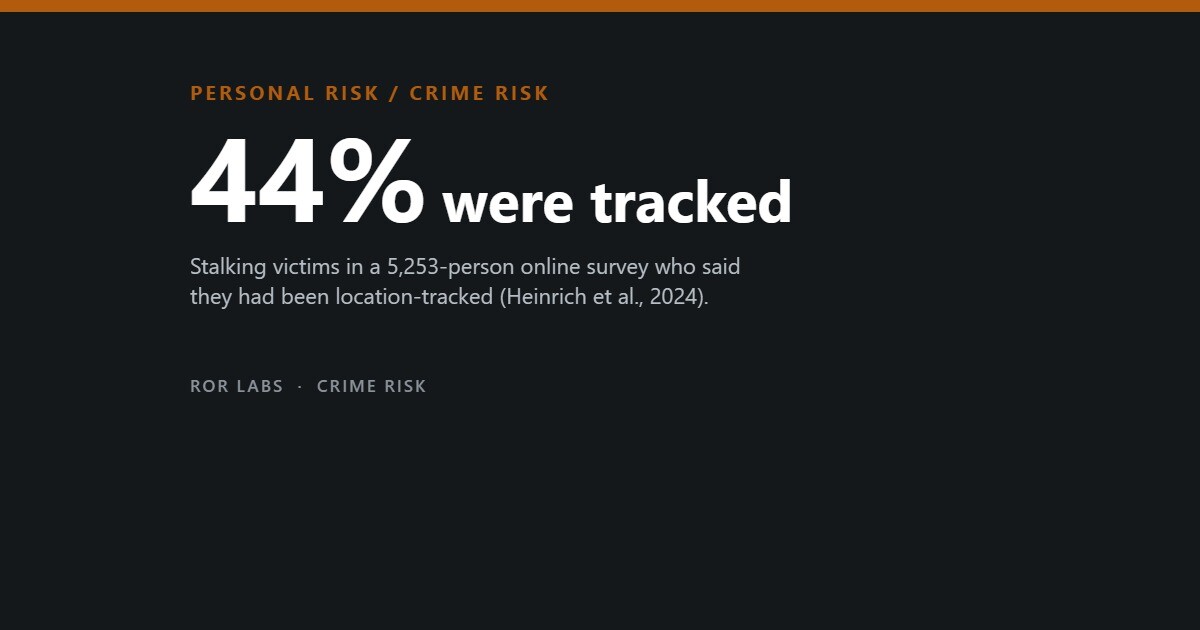
Newer figures come from narrower samples. Alexander Heinrich and colleagues at TU Darmstadt analysed data from AirGuard, a free Android app that warns of unknown trackers; with over 200,000 active installations, it was sending about 1,400 alarms a day. In their online survey of 5,253 people, 44% of those who had been stalked said they had been location-tracked. Cars were the commonest hiding place, then backpacks and purses.
For stalkerware, the most quoted counts come from the security company Kaspersky, which reports detections on its own customers’ phones. These are vendor data. It counted 31,031 affected users worldwide in 2023, up from 29,312 in 2022, and says the true number is higher because it sees only its own users.
Stalkerware detections, vendor data
Unique users of one company’s mobile security products with stalkerware detected.
Source: Kaspersky, The State of Stalkerware in 2023 (2024). Vendor data, own customers only.
The link with intimate-partner abuse
The academic picture comes mostly from computer-security researchers working with domestic-violence services. In a 2018 CHI paper, Diana Freed and colleagues at Cornell reported a qualitative study with 89 survivors and professionals. Many attacks were technically simple: the abuser often knew the passcode or owned the account, or installed a ready-made app.
A companion paper at IEEE Security & Privacy, led by Rahul Chatterjee, crawled app stores and the web and found several hundred apps relevant to partner surveillance, most of them dual-use. Some developers encouraged partner spying in their advertising and customer support, and the antivirus tools tested at the time failed to flag dual-use apps as a threat.
Later work widened the lens. Majed Almansoori and colleagues searched Google Play in 15 languages with phrases such as ‘track wife’s location’. Enze Liu and colleagues at UC San Diego took apart 14 leading off-store Android spyware apps, which typically cost $30 to $100 a month and need only brief physical access to install.
What researchers found in the app trade
Apps that can be used to spy on a partner, from two peer-reviewed studies. Bars on a rough log scale.
Sources: Almansoori et al., Proceedings on Privacy Enhancing Technologies (2022); Liu et al., Proceedings on Privacy Enhancing Technologies (2023).
A later paper from the Cornell team, on face-to-face technology consultations with 31 survivors, took a survivor’s question as its title: ‘Is my phone hacked?’. The weak points they found were made worse by the relationship itself, such as shared accounts, so checking for apps covers only part of the problem.
Three cases on the record
The cases below come from court filings and established outlets, and unresolved claims are allegations.
In December 2022 Lauren Hughes of Travis County, Texas, became a lead plaintiff in a proposed class action against Apple in federal court in San Francisco. According to the complaint, as reported by The Washington Post, an ex-boyfriend harassed her after their break-up in 2021. After a stay in a hotel, her phone warned of an unknown AirTag, which she found hidden in a wheel well of her car.
In March 2024 Judge Vince Chhabria let three plaintiffs’ negligence and product-liability claims proceed, noting that Apple ‘may ultimately be right’ that the law required no more. In March 2026 he declined to certify a class, and Hughes and others refiled individually. Apple has argued that AirTag was designed with ‘industry-first’ safety measures; the claims are untested at trial.
The second case shows detection working. In April 2023 a woman in Leavenworth County, Kansas, noticed her ex-partner following her as she drove home; then her phone alerted her to an AirTag. An officer found it in her car and Apple’s records linked it to Aaron Barber, 33. In November 2023 a jury found him guilty of misdemeanour stalking.
The third concerns a seller. On 6 January 2026 Bryan Fleming, founder of the stalkerware pcTattletale, pleaded guilty in federal court in San Diego to selling software designed to intercept communications. According to court documents, he had advertised it since 2017 to people wanting to spy on spouses or partners. In April 2026 he was fined $5,000 and given supervised release, with no prison time beyond a day already served.
What detection actually catches
In May 2024 Apple and Google shipped a shared ‘Detecting Unwanted Location Trackers’ specification in iOS 17.5 and Android 6.0 and later, so an ‘[Item] Found Moving With You’ alert can appear whatever phone the tracker is paired with.
Independent tests are less reassuring. In 2022 Heinrich’s team compared the iPhone’s built-in detection with AirGuard in three scenarios. The iPhone took 1 hour 45 minutes and 4 hours 14 minutes in the first two and gave no alert in a car test. AirGuard alerted in all three. Both tests predate the 2024 standard.
How long until the warning?
Time until a phone alerted its user to an unknown tracker travelling with them. Tests from 2022–23, before the 2024 standard.
Sources: Heinrich et al., ACM WiSec (2022), as summarised by Turk & Hutchings (2023), who ran the Cambridge test. Single runs, not rates.
Kieron Ivy Turk and Alice Hutchings at Cambridge handed out 40 trackers in an eight-week student game in which 91 players knew they might be tracked and were rewarded for finding trackers. Only one tried any maker’s anti-stalking tool. The authors judged the features rarely used and not useful, though only four trackers were planted successfully.
Spyware detection has the same gap. In a 2025 test by AV-Comparatives with the Electronic Frontier Foundation, using 17 stalkerware samples, the best Android security app caught all of them and four more missed one. Android’s built-in Play Protect caught 53%; the EFF notes that some stalkerware tells the installer to switch it off.
Antivirus catches most stalkerware, not all
Share of 17 Android stalkerware samples detected in a 2025 test of mobile security apps.
Source: AV-Comparatives with the Electronic Frontier Foundation, as reported by the EFF (6 November 2025). One test, one set of samples.
What the law has done
In the US, regulators moved first. In October 2019 the Federal Trade Commission brought its first case against a stalking-app developer, Retina-X Studios, which had sold more than 15,000 subscriptions. In September 2021 the FTC banned SpyFone’s maker, Support King, and its chief executive, Scott Zuckerman, from the surveillance business.
Criminal cases against sellers remain rare. Fleming’s plea was only the second successful US prosecution of a consumer spyware vendor since 2014, when the maker of StealthGenie pleaded guilty. Homeland Security Investigations began investigating more than 100 stalkerware companies in June 2021, The Record reported.
For the person doing the tracking, existing law usually applies. The Congressional Research Service judged that tracker stalking appears to fall within the federal stalking statute, 18 U.S.C. § 2261A, and many states have laws on electronic tracking devices. In England and Wales, stalking has been an offence under sections 2A and 4A of the Protection from Harassment Act 1997 since 2012.
Safer steps if you are worried
The central advice is also the least intuitive. If you think a partner or ex is tracking you, removing the tracker or app may alert them and can make things more dangerous. The FTC and the Coalition Against Stalkerware both say to talk first to a domestic-violence advocate, using a device the other person has not had access to, and to make a safety plan.

Removal also destroys evidence, so the Coalition says that if you may report the abuse, you should speak to the police before deleting anything and keep a log of what you notice: unexplained knowledge of your movements, a battery that drains fast, settings you did not change. Some stalkerware shows no signs at all.
When it is safe, the established options are to change important passwords from a clean device and turn on two-step verification. A new phone is the most reliable fix for stalkerware, with a factory reset close behind. Take unknown-tracker alerts seriously rather than dismissing them; if you find a tracker, a support service or the police can help you decide what to do next.
Where the evidence is thin
On prevalence, the BJS survey is the only US population estimate that asks about electronic tracking, and its 2019 data predate AirTags. Kaspersky counts only its own users, AirGuard only Android users who installed a detector, and Heinrich’s survey recruited online, so none can be scaled up to a national rate.
The detection tests are small: a handful of test runs, one game with four trackers planted, 17 spyware samples. They show that alerts can fail but not how often, and phone makers have changed their systems since. The figure of more than 40,000 stalking reports to Apple between 2021 and 2024 is an allegation in the lawsuits rather than a published statistic.
Research with survivors is mostly qualitative and comes from a few US teams, so it explains how abuse works better than it counts it. A new national survey asking about trackers and spyware separately would help most.
What to do
Steps sorted by when they matter. Each one says how strong the evidence is: Measured Official advice Untested
Before
- Set your phone to lock quickly and use a passcode that is hard to guess; do not share it with anyone you think may monitor you. Official advice see Sources
- Use strong, unique passwords and two-step verification on your main accounts. Official advice see Sources
- Keep unknown-tracker alerts switched on and keep your phone’s software up to date, so it can use the 2024 cross-platform alert standard. Untested see Sources
If it happens
- If you suspect a partner or ex is tracking you, contact a domestic-abuse advocate first, from a device they have never had access to, and make a safety plan. Official advice see Sources
- Do not remove a tracker or stalkerware yet: removal can alert the abuser and make things more dangerous. Official advice see Sources
- Keep a written log of what you notice, such as unexplained knowledge of your movements or settings you did not change. Official advice see Sources
- Take an unknown-tracker alert seriously: in tests, alerts took hours or did not come at all, so one alert may mean the tracker has been there a while. Measured see Sources
- If you are in immediate danger, call 999 in the UK or 911 in the US. Official advice see Sources
Afterwards
- If you may report the abuse, talk to the police before deleting anything, because removal destroys evidence. Official advice see Sources
- When it is safe, a new phone is the most reliable fix for stalkerware, with a factory reset close behind. Official advice see Sources
- Change passwords from a clean device and check which accounts and devices are linked to yours. Official advice see Sources
What not to do
- Do not rely on an antivirus scan alone: in a 2025 test, Android’s built-in scanner caught only 53% of stalkerware samples. Measured see Sources
- Do not assume no alert means no tracker: one car test produced no iPhone alert at all. Measured see Sources
- Do not blame yourself: abusers usually rely on physical access and known passcodes, not hacking skill. Measured see Sources
Not legal advice. If you are in danger, call 999 or 911. A domestic-abuse helpline can help you plan safely before you remove anything.
Questions people ask
How can I tell if there is stalkerware on my phone?
There may be no obvious sign. Clues include someone knowing things only your phone could tell them, fast battery drain or settings you did not change. A reputable security app helps but is not perfect. If you suspect a partner, talk to an advocate before acting.
Will my phone warn me about an AirTag or other tracker?
Recent iPhones and Android phones show alerts for unknown trackers that support the 2024 standard. Tests found alerts can take hours, and not every tracker supports it. Treat an alert seriously, and get advice before acting if you think you know who placed it.
Is it legal to track a partner’s phone or car?
Generally not without consent. In the US, federal and state stalking, wiretap and tracking laws can apply, and selling apps for covert interception is a federal crime. In England and Wales, covert tracking can form part of stalking. The details vary by place, so ask a lawyer or advocate.
Should I just throw the tracker away?
Not before thinking it through. Disabling it can tell the person you found it, and it is evidence. A domestic-abuse service or the police can help you plan; in an emergency call 999 in the UK or 911 in the US.
Do parental-control apps count as stalkerware?
Many are dual-use: legitimate for young children, but easily repurposed to spy on a partner, researchers found. Used covertly on an adult, the same app becomes a tool of abuse.
The short version
- Stalkerware is hidden software that passes a phone’s messages, photos and location to someone else. Bluetooth trackers such as AirTags were built to find keys but can be hidden in a bag or car.
- In the latest US national survey, from 2019, 80% of stalking victims said technology was involved, and 14% of those were tracked with an electronic device. That survey predates AirTags.
- Much of this happens inside relationships. Abusers rarely need hacking skills: they rely on physical access, known passcodes and ready-made apps.
- Detection has improved, notably with the 2024 Apple–Google alert standard, but tests show alerts can take hours or never arrive, and security apps still miss some stalkerware.
- Prosecutions of sellers are rare. A US stalkerware maker who pleaded guilty in 2026 was fined $5,000 and avoided prison.
- If you suspect a partner or ex is tracking you, talk to a domestic-abuse advocate before removing anything: removal can alert the abuser and destroys evidence.
This article summarises research, official documents and news reports for general information. It is not legal or safety advice. If you are worried about being tracked by a partner or ex, contact a domestic-abuse service before removing anything: in the UK, the National Domestic Abuse Helpline (0808 2000 247); in the US, the National Domestic Violence Hotline (1-800-799-7233). In an emergency, call 999 or 911.
Further reading: Freed et al., CHI (2018), for how abusers use everyday technology against partners. Heinrich, Janzen & Hollick, Proceedings on Privacy Enhancing Technologies (2024), for the largest data set on tracker stalking. The Coalition Against Stalkerware’s guidance for survivors, for safe next steps.
Sources
- Freed D, Palmer J, Minchala D, et al. ‘A stalker’s paradise’: how intimate partner abusers exploit technology. Proceedings of CHI 2018, doi:10.1145/3173574.3174241.
- Woodlock D. The abuse of technology in domestic violence and stalking. Violence Against Women (2017), doi:10.1177/1077801216646277.
- Chatterjee R, Doerfler P, Orgad H, et al. The spyware used in intimate partner violence. IEEE Symposium on Security and Privacy (2018), doi:10.1109/SP.2018.00061.
- Freed D, Havron S, Tseng E, et al. ‘Is my phone hacked?’ Analyzing clinical computer security interventions with survivors of intimate partner violence. CSCW (2019), doi:10.1145/3359304.
- Almansoori M, Gallardo A, Poveda J, Ahmed A, Chatterjee R. A global survey of Android dual-use applications used in intimate partner surveillance. Proceedings on Privacy Enhancing Technologies (2022).
- Liu E, Rao S, Havron S, et al. No privacy among spies: assessing the functionality and insecurity of consumer Android spyware apps. Proceedings on Privacy Enhancing Technologies (2023).
- Heinrich A, Bittner N, Hollick M. AirGuard: protecting Android users from stalking attacks by Apple Find My devices. ACM WiSec (2022), doi:10.1145/3507657.3528546.
- Heinrich A, Janzen L, Hollick M. Please unstalk me: understanding stalking with Bluetooth trackers and democratizing anti-stalking protection. Proceedings on Privacy Enhancing Technologies (2024).
- Turk KI, Hutchings A. Stop following me! Evaluating the malicious uses of personal item tracking devices and their anti-stalking features (2024), doi:10.1145/3688459.3688477; preprint arXiv:2312.07157 (2023).
- Morgan RE, Truman JL. Stalking Victimization, 2019. Bureau of Justice Statistics, NCJ 301735 (February 2022).
- Congressional Research Service. Stalking concerns raised by Bluetooth tracking technologies: in brief. R47035 (15 February 2022).
- Kaspersky. The State of Stalkerware in 2023. Securelist (March 2024).
- Coalition Against Stalkerware. Information for survivors (accessed November 2026).
- Federal Trade Commission. FTC brings first case against developers of ‘stalking’ apps (Retina-X Studios), press release (22 October 2019).
- Federal Trade Commission. FTC bans SpyFone and CEO from surveillance business, press release (1 September 2021).
- Federal Trade Commission. Consumer advice on stalking apps, consumer.ftc.gov (accessed November 2026).
- Apple Newsroom. Apple and Google deliver support for unwanted tracking alerts in iOS and Android (13 May 2024).
- Electronic Frontier Foundation. EFF teams up with AV-Comparatives to test Android stalkerware detection by major antivirus apps (6 November 2025).
- Somasundaram P. Two women sue Apple, saying stalkers used AirTags to track them. The Washington Post (7 December 2022).
- Judge allows AirTag stalking claims to proceed against Apple. Insurance Journal (18 March 2024). Hughes v. Apple Inc., No. 3:22-cv-07668 (N.D. Cal.).
- Mealey’s, report on class-certification denial in the AirTag case (11 March 2026); Top Class Actions (3 June 2026).
- Apple faces dozens of lawsuits over AirTag stalking after class action denied. MacRumors (1 May 2026).
- Dulle B. Leavenworth man found guilty of using Apple AirTag to stalk ex. WDAF-TV FOX4 (16 November 2023).
- Stalkerware slinger pleads guilty for selling snooper software to suspicious spouses. The Register (7 January 2026).
- Stalkerware maker receives no jail time. The Record (6 April 2026); Starks T. CyberScoop (6 April 2026).
- 18 U.S.C. § 2261A (stalking); 18 U.S.C. § 2512 (manufacture, distribution or advertising of interception devices); Protection from Harassment Act 1997, ss. 2A and 4A (England and Wales).