Heat at Concerts, Festivals and Mass Gatherings: What the Evidence Shows
Key takeaways · 13 min read
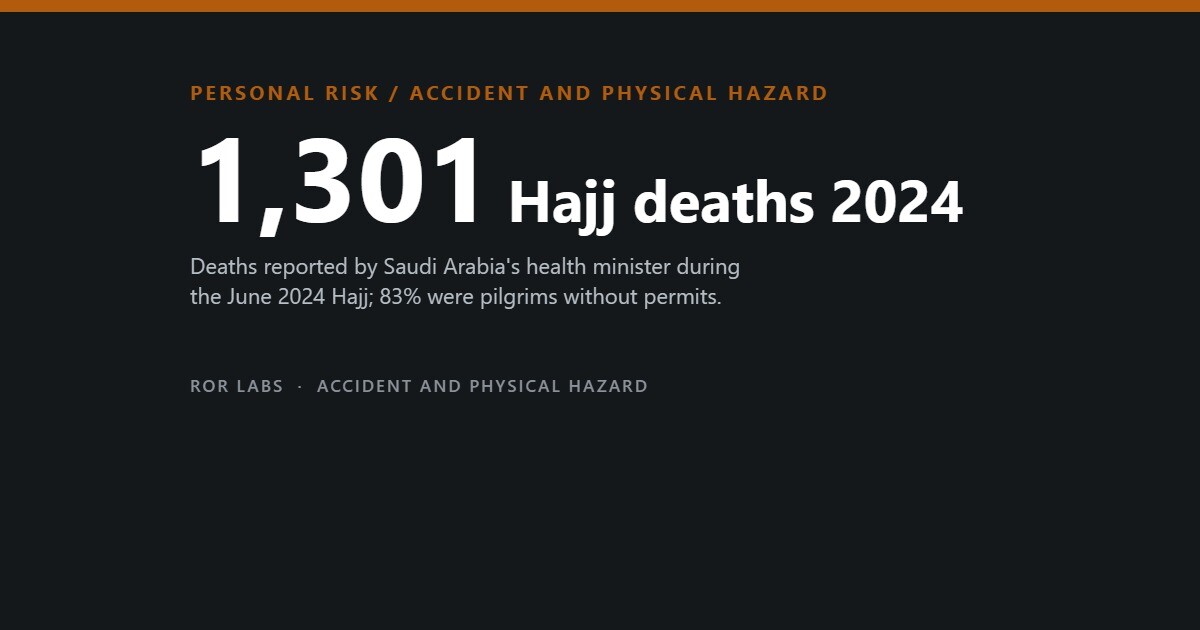
- At the 2024 Hajj, Saudi Arabia reported 1,301 deaths during a heatwave that reached 51.8°C, 83% of them among pilgrims without permits. The total includes deaths from all causes.
- In four decades of Hajj records, the share of heatstroke patients who died fell from 19.1% in the hot years of 1982–1995 to 10.0% in 2015–2019, even though Mecca has grown hotter.
- Event studies link more patients to heat, outdoor venues, no air conditioning and no free water. After a fan died at a Rio concert in 2023, Brazil allowed personal water bottles at events.
- Patient rates at events vary widely because counting methods and attendance figures differ, so they show patterns within one event better than differences between events.
In this article
- Why crowds make heat more dangerous
- Hajj 2024: what the death count includes
- Forty years of Hajj heat records
- Concerts and the water rule
- What event medical data can and cannot show
- Alcohol, drugs and dancing in the heat
- WBGT, wet-bulb and who the limits fit
- Cooling: what saves people who collapse
- Questions people ask
- The short version
- Sources
Every summer, somewhere, a large crowd stands in the sun for hours: pilgrims between holy sites, fans outside a stadium, runners at a start line. Most go home tired and fine. A few collapse, and some die. The questions afterwards are usually the same. Was there water, was there shade, did anyone see it coming?
Below we look at the 2024 Hajj, four decades of Saudi heat-illness records, a fan’s death at a concert in Rio de Janeiro, an Australian inquest into festival deaths, event medical records and the evidence on cooling. An earlier article covered crowd crush and density.
Hajj death tolls mix heat with other causes, and many of the dead had no permit. Event medical data are counts without a consistent denominator, and the heat thresholds people quote were built for athletes and soldiers rather than for older pilgrims or standing fans.
Why crowds make heat more dangerous
Heat exhaustion brings fatigue, dizziness, headache, nausea and a core temperature up to about 40°C, but the brain is not affected (Yezli et al., 2023). Heatstroke means a core temperature of 40°C or more with confusion, collapse, seizures or coma. It is an emergency.
A crowd adds to the weather: a 2025 review of Hajj risks notes that dense crowds add heat of their own, and that mountains, asphalt and concrete hold it. People packed together lose the breeze, cannot easily reach shade or water, and may not want to give up their place.
Saudi researchers list older age, chronic disease, many medicines, low fitness and lack of acclimatisation as the main Hajj risk factors (Yezli, 2021). At festivals the crowd is younger, but dancing, alcohol and drugs add their own heat.

Hajj 2024: what the death count includes
The 2024 Hajj ran from 14 to 19 June and drew about 1.8 million pilgrims, Saudi authorities said. The weather service recorded 51.8°C at the Grand Mosque on 17 June. On one day the health ministry reported 2,764 cases of heat exhaustion.
On 23 June the health minister, Fahad Al Jalajel, gave the total: 1,301 deaths, 83% of them among people without authorisation to perform Hajj. He did not break the figure down by cause, and reports said the dead included several elderly and chronically ill people. Arab diplomats told AFP that 658 Egyptians had died, 630 of them unregistered.
Hajj 2024: the deaths as reported
Deaths reported during the June 2024 Hajj, by source. Counts are not broken down by cause and come from different days.
Sources: The National, 24 June 2024; Oman Observer, 17 June 2024. 83% of all deaths were among people without Hajj permits.
The figure is not a heat death count, since it covers every death during the pilgrimage and many pilgrims are old and unwell. The share without permits does point to the setting: registered pilgrims have air-conditioned tents, a metro and air-conditioned buses (Yezli et al., 2024), while those outside the system often walk and go without.
Among the dead were Alieu Wurie, 71, and his wife Isatu, 65, from Bowie, Maryland. Their daughter Saida told FOX 5 DC they paid $23,000 for a package, but the agency failed to provide proper credentials, transport or regular food. Saudi authorities told her they had suffered heatstroke; a US consular letter said both died in Mecca on 15 June. The New Arab, citing her BBC interview, reported they had walked for over two hours in extreme heat.
Forty years of Hajj heat records
The Hajj follows the lunar calendar, so it moves through the seasons. Saber Yezli and colleagues used Saudi health ministry reports from 1980 to 2019 to compare two ‘hot cycles’, when the pilgrimage fell between May and September, with the cooler years between. In 1987, during the earlier hot cycle, about 1,000 people died of heatstroke within a few days.
Rates peaked in August 1985 at 134.2 heatstroke and 858.8 heat exhaustion cases per 100,000 pilgrims. Over the four decades Mecca’s average air temperature rose by 0.4°C a decade. Daily wet-bulb temperature during Hajj passed the US National Weather Service danger level of 24.6°C on 38 days, almost half in the first five years of the current hot cycle.
Fewer heatstroke patients die than in the 1980s
Pooled case fatality rate of heatstroke during Hajj, by period. Saudi health ministry annual reports.
Source: Yezli et al., Journal of Travel Medicine (2024). Aggregate data; the study could not link the change to any single measure.
The current hot cycle is hotter than the last, yet it has had fewer cases and a lower fatality rate. The authors credit tents, shade, mist sprays, cooling units, transport and a heatwave plan, but rates remain above the cooler years, which suggests the heat may be outpacing the measures. With aggregate counts, they could not say which measure worked.
Of 1,576 heat-illness patients at nine facilities during the 2024 Hajj, 74.3% were men, 49.2% were aged 60 or over and 90% were not Saudi (Elfaki et al., 2026).
Concerts and the water rule
On 17 November 2023 Ana Clara Benevides, 23, travelled from Brazil’s centre-west to see Taylor Swift at the Nilton Santos stadium in Rio de Janeiro. The temperature was about 40°C. She collapsed during the second song and died hours later in hospital, the Associated Press reported.

In December, Rio’s Forensic Medical Institute attributed her death to heat exposure leading to cardiorespiratory arrest, with serious damage to her lungs. It found no pre-existing condition or substance use. Fans said they had not been allowed to bring their own water in, and that organisers did not supply enough. Prosecutors opened a criminal investigation.
Brazil’s justice minister, Flávio Dino, announced emergency rules within a day of her death: people could bring their own water bottles to concerts and other events, and producers had to provide free, easy-to-reach drinking water. The organiser said it would change its protocols for extreme heat.
Event research points the same way, though it cannot prove cause. In a US study of 79 university-town events with 917,307 attendees, patient presentation rates were higher where there was no free water, no air conditioning, an outdoor or unfenced venue, or a higher heat index (Locoh-Donou et al., 2016). Alcohol on sale was not significantly linked.
What raised the patient rate at US events
Rate ratios for patients per 10,000 attendees, by event feature (univariate).
Source: Locoh-Donou et al., Internal and Emergency Medicine (2016). One US university community, 2009–2011.
What event medical data can and cannot show
Mass-gathering medicine measures demand with the patient presentation rate: patients seen per 10,000 (or 1,000) attendees. A 2010 review found that most studies agree on a positive link between heat and humidity and the number of patients (Baird et al., 2010).
The newest data come from Expo 2025 in Osaka, where the median rate was 7.5 presentations per 10,000 visitors. On days at the 75th percentile of maximum temperature (34.9°C), the cumulative risk of heat-related presentations was 4.23 times that on median days (31.2°C) (Seino et al., 2026).
Same measure, very different numbers
Patients seen per 10,000 attendees at different events. Definitions of a ‘presentation’ and of attendance differ.
Sources: Maleczek et al. (2021); Wing et al. (2020); Goldberg et al. (2018); Seino et al. (2026); Grant et al. (2010). Festival figures converted from per 1,000 and per cent.
The Austrian team noted that published rates range from 0.7 to 72 per 1,000 visitors, because services may count every plaster or only doctor visits and attendance is often an organiser’s estimate. Comparing a festival with a stadium therefore says more about record-keeping than about risk.
Within one event the signal is clearer. Over seven years at the Frequency Festival, average temperature was linked with the share of heat-related emergencies, while visitor numbers did not predict patient numbers (Maleczek et al., 2021).
Alcohol, drugs and dancing in the heat
In November 2019 the New South Wales deputy state coroner, Harriet Grahame, delivered findings on six young people who died after attending music festivals in the state. MDMA toxicity was the major cause in all six, yet the weather was a common thread: hot, at times extreme, with people dancing hard.
At Defqon.1 on 15 September 2018, it was 31.9°C at midday and about 30,000 people were on site by early evening. In another case, one young man reached hospital at 41°C. The coroner noted that some people remembered to drink water and others did not, and that water, shade and chill-out spaces should be monitored at such events.
At 15 Australian music events, 33.0% of patients reported taking MDMA that day, and they were more likely to have a raised temperature. Eight per cent arrived above 38°C, and those patients more often needed hospital (Wing et al., 2020). At the Austrian festival only 5% of presentations were intoxications, 86% of them alcohol.
WBGT, wet-bulb and who the limits fit
Two measures dominate: wet-bulb temperature combines heat and humidity, and the wet-bulb globe temperature (WBGT) adds sun and wind and is the standard in sport and military training. Race guidance based on the American College of Sports Medicine flag system advises cancelling or withdrawing above a WBGT of 28°C.
Those limits come from runners and recruits. Several marathons with a start WBGT above 21°C ended in a mass-casualty incident or were stopped (Roberts, 2010). At the Boston Marathon from 2015 to 2019, every case of exertional heatstroke happened on race days with average WBGT of 17–20°C (Breslow et al., 2021).
Six numbers people call a limit
Heat-stress values in °C. Wet-bulb and WBGT are different measures and cannot be compared directly.
Sources: Vecellio et al. (2022); ACSM race flag guidance; Yezli et al. (2024); Roberts (2010); Breslow et al. (2021).
The famous 35°C wet-bulb survival limit is a theoretical figure. When young, healthy adults doing light activity were tested, none reached it: in humid heat they lost control at an average wet-bulb of 30.55°C, and lower in hot, dry air (Vecellio et al., 2022). A physiological model by Jennifer Vanos and colleagues put survival limits for older adults as low as 21.9°C wet-bulb in dry heat.
No threshold has been tested on a standing crowd of mixed ages. Yezli’s team cites projections that heatstroke risk among pilgrims could rise five-fold with 1.5°C of global warming and ten-fold with 2°C; that is modelling, but Mecca is already warming.

Cooling: what saves people who collapse
For heatstroke, the time spent hot decides the outcome. At the Falmouth Road Race in Massachusetts, 274 runners with exertional heatstroke were treated in cold-water tubs over 18 years and all survived, cooling at an average 0.22°C a minute (DeMartini et al., 2015). More on that in an earlier article on running in the heat.
A 2020 review of 63 studies found that immersion in water of 1 to 17°C cooled people faster than passive cooling, and recommended it as first-line treatment where possible, though the certainty of evidence was low to very low (Douma et al., 2020).
Pilgrims and older fans are a different group. A review found a zero fatality rate with ice-water immersion in large case series of young, fit patients, but noted that large controlled trials are lacking (Gaudio and Grissom, 2015). Hajj clinics have their own cooling units.
What to do
Steps sorted by when they matter. Each one says how strong the evidence is: Measured Official advice Untested
Before
- If you are older, have a chronic illness or take several medicines, ask a doctor about the heat before a pilgrimage, festival or long outdoor event. Measured see Sources
- For Hajj, go only with an authorised permit and package: 83% of the 2024 deaths were among pilgrims without authorisation, outside the system of air-conditioned tents and transport. Measured see Sources
- Check the venue’s water rules before you go and find out where free drinking water is available. Untested see Sources
If it happens
- If someone is confused, collapses or stops sweating in the heat, get event medical staff or emergency services and start cooling them at once. Measured see Sources
- Drink enough water, use an umbrella or shade, and avoid long spells in direct sun, as the Saudi health ministry advises pilgrims. Official advice see Sources
- Take breaks in shade or chill-out spaces, especially if you are dancing hard in hot weather. Official advice see Sources
Afterwards
- If dizziness, nausea or exhaustion do not settle after rest somewhere cool, get medical help. Untested see Sources
- Tell organisers if water points ran dry or there was nowhere to get out of the sun. Untested see Sources
What not to do
- Do not assume heat is safe below a wet-bulb of 35°C: young adults in the lab lost control of body temperature at about 31°C. Measured see Sources
- Do not wait for transport before cooling someone with heatstroke: at one US race, all 274 runners cooled on site in cold water survived. Measured see Sources
- Do not combine MDMA with hours of dancing in the heat: at Australian music events, patients who had taken it more often had a raised temperature. Measured see Sources
Not medical advice. Follow event organisers’ and medical staff’s instructions in hot weather.
Questions people ask
What is the difference between heat exhaustion and heatstroke?
Heat exhaustion brings tiredness, dizziness and nausea with a clear mind. Heatstroke means a core temperature of 40°C or more with confusion, collapse or seizures, and needs cooling and emergency help at once.
Can I bring my own water to a concert?
It depends on the venue and the country. Brazil announced rules in 2023 allowing personal water bottles and requiring free drinking water. Elsewhere, check the venue’s policy before you go.
Why are older pilgrims at higher risk?
Older age, chronic disease and many medicines are the main risk factors Saudi researchers list. Almost half the heat-illness patients at the 2024 Hajj were 60 or over. Ask a doctor about your medicines before travel.
If the wet-bulb temperature is below 35°C, am I safe?
No. In the lab, young adults lost control of core temperature at about 31°C wet-bulb, lower in dry heat, and runners get heatstroke at WBGT values under 20°C.
Does an umbrella help?
Shade cuts radiant heat, which is why the Saudi health ministry advises pilgrims to carry one. No study here measured its effect on illness.
The short version
- At the 2024 Hajj, Saudi Arabia reported 1,301 deaths during a heatwave that reached 51.8°C, 83% of them among pilgrims without permits. The total includes deaths from all causes.
- In four decades of Hajj records, the share of heatstroke patients who died fell from 19.1% in the hot years of 1982–1995 to 10.0% in 2015–2019, even though Mecca has grown hotter.
- Event studies link more patients to heat, outdoor venues, no air conditioning and no free water. After a fan died at a Rio concert in 2023, Brazil allowed personal water bottles at events.
- Patient rates at events vary widely because counting methods and attendance figures differ, so they show patterns within one event better than differences between events.
- Common heat limits, such as WBGT race flags and the 35°C wet-bulb limit, come from athletes, soldiers and theory. Young adults in the lab lost heat control at about 31°C wet-bulb.
- Cold-water immersion is the best-supported treatment for exertional heatstroke: all 274 runners treated this way at one US race survived. The evidence in older people is thinner.
This article summarises research, official reports and news coverage for general information. It is not medical advice. If you have a heart condition, take regular medicines or are older, ask a doctor about heat before a pilgrimage, festival or long outdoor event; if someone collapses in the heat, call for medical help.
Further reading: Yezli et al., Journal of Travel Medicine (2024), for four decades of Hajj heat data. Locoh-Donou et al., Internal and Emergency Medicine (2016), for what venue features predict patient numbers. The NSW coroner’s findings on music festival deaths (2019), for how heat, crowds and drugs combine.
Sources
- AFP. With ice cream and giant fans, Hajj pilgrims battle searing heat. The Peninsula (25 May 2026).
- More than 1,300 pilgrims died during Hajj, says Saudi Arabia. The National (24 June 2024).
- Haj pilgrimage ends amid deadly Saudi heat spike. Oman Observer (17 June 2024).
- Ramirez S. Maryland couple among those who died on pilgrimage to Mecca during extreme heat. FOX 5 DC (24 June 2024).
- US couple walked for hours before dying in Hajj heat. The New Arab (25 June 2024).
- Jeantet D. Taylor Swift fan dies at Rio concert as fans complain about high temperatures and lack of water. Associated Press (18 November 2023).
- Heat exhaustion killed Taylor Swift fan attending Rio concert, forensics report shows. ITV News/Associated Press (27 December 2023).
- Grahame H, Deputy State Coroner. Inquest into deaths arising at music festivals: findings. Coroners Court of New South Wales (8 November 2019).
- Yezli S et al. Escalating climate-related health risks for Hajj pilgrims to Mecca. J Travel Med (2024), doi:10.1093/jtm/taae042.
- Yezli S. Risk factors for heat-related illnesses during the Hajj mass gathering: an expert review. Rev Environ Health (2021), doi:10.1515/reveh-2021-0097.
- Yezli S et al. Diagnosing and managing heat exhaustion: insights from a systematic review of cases in the desert climate of Mecca. Rev Environ Health (2023), doi:10.1515/reveh-2023-0059.
- Almuzaini Y et al. Critical determinants of morbidity and adverse outcomes during the Hajj using the Haddon matrix and the combined model. Sci Rep (2025).
- Elfaki EAA et al. Prevalence and risk factors of heat-related illness among pilgrims during the Hajj season 2024: a cross-sectional study. J Epidemiol Glob Health (2026), doi:10.1007/s44197-026-00550-x.
- Locoh-Donou S et al. Mass gathering medicine: event factors predicting patient presentation rates. Intern Emerg Med (2016), doi:10.1007/s11739-015-1387-1.
- Baird MB et al. The impact of warm weather on mass event medical need: a review of the literature. Am J Emerg Med (2010), doi:10.1016/j.ajem.2008.10.034.
- Seino K et al. Medical service utilization under heat stress at Expo 2025 Osaka, Kansai, Japan: a 6-month time series study (2026).
- Maleczek M et al. Medical care at a mass gathering music festival. Wien Klin Wochenschr (2021), doi:10.1007/s00508-021-01856-5.
- Wing S et al. Moshpit medicine: the experience of an Australian event resuscitation team. Prehosp Disaster Med (2020), doi:10.1017/s1049023x20000266.
- Goldberg SA et al. The Gillette Stadium experience: a retrospective review of mass gathering events from 2010 to 2015. Disaster Med Public Health Prep (2018), doi:10.1017/dmp.2018.7.
- Grant WD et al. Mass-gathering medical care: retrospective analysis of patient presentations over five years at a multi-day mass gathering. Prehosp Disaster Med (2010), doi:10.1017/s1049023x00007950.
- American College of Sports Medicine. Position stand: exertional heat illness during training and competition. Med Sci Sports Exerc (March 2007).
- Roberts WO. Determining a ‘do not start’ temperature for a marathon on the basis of adverse outcomes. Med Sci Sports Exerc (2010), doi:10.1249/mss.0b013e3181b1cdcf.
- Breslow RG et al. Exertional heat stroke at the Boston Marathon: demographics and the environment. Med Sci Sports Exerc (2021), doi:10.1249/mss.0000000000002652.
- Vecellio DJ et al. Evaluating the 35°C wet-bulb temperature adaptability threshold for young, healthy adults (PSU HEAT). J Appl Physiol (2022), doi:10.1152/japplphysiol.00738.2021.
- Vanos J et al. A physiological approach for assessing human survivability and liveability to heat in a changing climate. Nat Commun (2023).
- DeMartini JK et al. Effectiveness of cold water immersion in the treatment of exertional heat stroke at the Falmouth Road Race. Med Sci Sports Exerc (2015), doi:10.1249/mss.0000000000000409.
- Douma MJ et al. First aid cooling techniques for heat stroke and exertional hyperthermia: a systematic review and meta-analysis. Resuscitation (2020), doi:10.1016/j.resuscitation.2020.01.007.
- Gaudio FG, Grissom CK. Cooling methods in heat stroke. J Emerg Med (2015), doi:10.1016/j.jemermed.2015.09.014.