Horse handling injuries, and the hind-leg kick behind half of vets’ worst injuries
Key takeaways · 9 min read
- In a 2013 survey, 620 UK equine vets reported one injury every three and a half years; half named a hind-leg kick as their worst, and a third of those ended in hospital.
- Most measured kicks lasted under three hundredths of a second and peaked below 1,924 newtons; in laboratory tests on horse bones, a shod hoof broke bone far more often than a bare one.
- The risk concentrates in the first years of work, under the horse for farriers, and on the trailer ramp: loading and unloading caused nearly two thirds of transport injuries.
- Little has been tested. Sedation for painful procedures, early handling of young horses and hard hats are sensible, but direct evidence for each is thin.
In May 2025 CVS Equine, which runs 21 equine veterinary sites in the UK, told every vet, nurse and technician to wear a hard hat whenever they are near a horse, pony or donkey. The rule followed a University of Liverpool survey of 740 veterinary staff. The company summarised the finding bluntly: 49% of equine vets are injured each year, and more than a quarter of those injuries end in a hospital visit.
Injuries like these rarely involve a fall. They happen beside the horse, while someone examines a foot, checks teeth or passes a stomach tube. In Australia, Safe Work Australia counted 11,635 hospital admissions for horse-related incidents between 2008 and 2011; 24% of the patients had been bitten or struck by a horse rather than hurt while riding. Its guidance puts the working toll at about one worker in hospital every day.
This article covers injuries on the ground: grooming, leading, loading, shoeing and veterinary work. It looks at what a kick actually does, which people and jobs carry most of the risk, the little that has been measured to reduce it, and why the answer is to handle carefully rather than walk away.
What actually happens on the ground
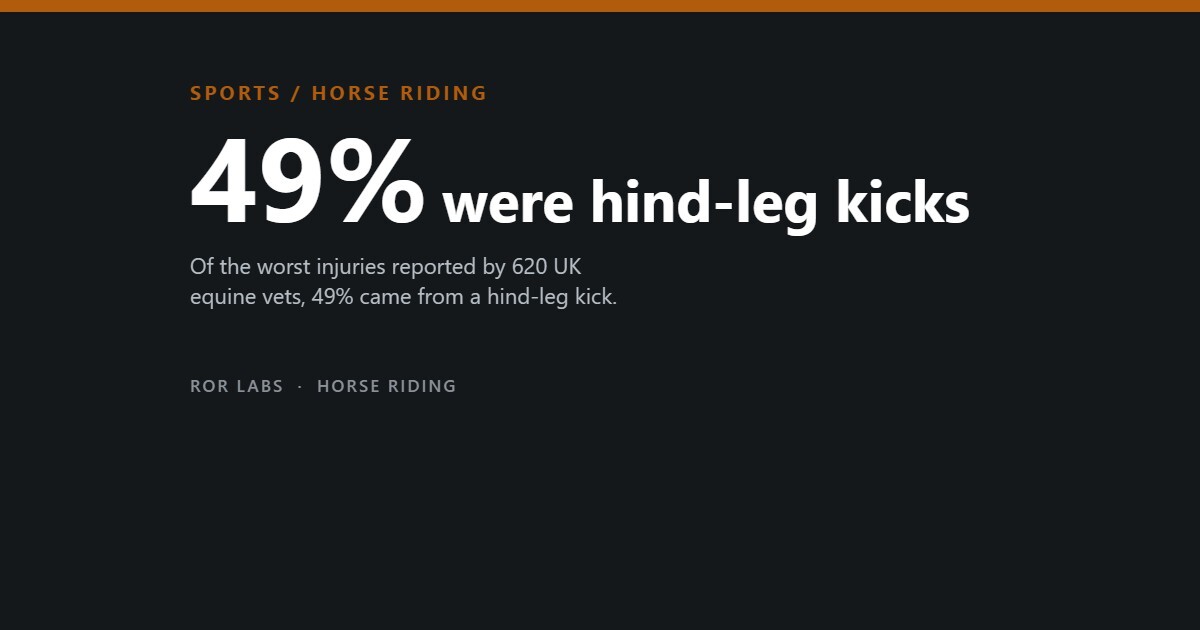
The largest picture comes from vets, because they were asked. In 2013 the British Equine Veterinary Association surveyed its members, and 620 practising equine vets reported 2,292 injuries across 8,204 working years, about one injury every three and a half years. Asked about their worst injury, half named a kick from a hind leg. A third of those worst injuries ended in hospital admission, and 7% in loss of consciousness.
The worst injury of 620 UK equine vets
Share of respondents’ self-reported worst career injury, by cause and by outcome. Survey of British Equine Veterinary Association members, 2013.
Source: Parkin, Brown and Macdonald, Equine Veterinary Education (2018). Self-reported; no comparison group of uninjured vets.
A kick is fast rather than enormous. Engineers who fitted a measuring wall inside horse boxes found most impacts lasted under three hundredths of a second, and 90% peaked below 1,924 newtons, roughly the weight of 196 kilograms. The hardest single kick reached 8,722 newtons. A hoof concentrates that load on a small area, which is why Japanese surgeons reviewing kick cases found the jaw and upper abdomen hit most often, and two in three of the patients needed surgery.
What a shoe adds to a kick
Probability of fracture when a hoof-shaped impactor struck horse leg bones in a laboratory drop test, by shoe material and impact speed. No human bones were tested.
Source: Sprick, Fürst, Baschnagel, et al., Veterinary and Comparative Orthopaedics and Traumatology (2017), 64 equine radii and tibiae.
Where the hoof lands decides the injury. Of 49 people treated for horse-related facial fractures at Christchurch Hospital in New Zealand, 71% were on the ground at the time; kicks caused 69% and head-butts 26%, and 60% needed an operation. In a Japanese thoroughbred stabling area, kicks caused 39.2% of 637 injuries to stable and stud workers, including eleven serious and one fatal injury to internal organs.
Where the risk concentrates
Inexperience is the clearest pattern. In the British vet survey, people in their first five years of equine practice reported 0.83 injuries a year, against about 0.2 for those with fifteen years or more. A two-year study of 55 handlers in Lagos stables found 29.1% were kicked, and named being a farrier and having less than five years’ experience as risk factors. A Swiss survey of 216 vets linked kicks to the procedure, the location and whether the horse was sedated.
Farriers spend their working day under the horse, and their faces show it. In a nationwide Swiss survey answered by 278 farriers and hoof care practitioners, 60.6% of farriers had suffered a head or face injury at work, against 20.7% of hoof care practitioners. Dental injuries, mostly from kicks, affected 11.1% of farriers. More than a third of respondents admitted not wearing the eye protection they were supposed to wear.
How equine vets compare with other jobs
Injuries per 100,000 workers a year. The vet figures are survey estimates; the others are UK Labour Force Survey figures quoted by the same authors.
Source: Parkin, Brown and Macdonald, Equine Veterinary Education (2018), comparing with HSE Labour Force Survey rates.
Loading is the other hot spot. A New Zealand survey asked 1,067 owners and carers about road transport, and 112 (10.5%) had been hurt preparing, loading, travelling or unloading a horse. Hands were injured most often, in 45.8% of those who gave details, followed by feet at 25% and the head or face at 15.3%. Half of those who had recovered did so within a week; four were still injured when they answered.
When horse transport injures people
Phase of transport in which 112 New Zealand owners and carers were injured.
Source: Riley, Padalino, Rogers and Thompson, Animals 13(10):1594 (2023).
Children around horses are a separate worry. A large paediatric trauma centre reviewed 505 children admitted over 16 years; 23% were hurt while not riding, and the authors’ title states their conclusion: unmounted injuries were more severe. Workplaces keep their own count. WorkSafe Queensland accepted 439 compensation claims from people struck by a horse between July 2015 and February 2020.
What has been measured to work
Very little has been tested. The Swiss vet survey points to the obvious levers: sedation for painful procedures and a safe place to work. Handling young horses early seems to help. In a study of Konik horses, foals handled for ten minutes five days a week, including picking up their feet, scored better for manageability than unhandled foals when caught, led and examined.
Head protection is the measure with most momentum and least direct proof. In a Hamburg study of 24 people kicked while grooming or handling, only two wore a helmet and two thirds suffered fractures of the eye socket, midface or jaw. A riding helmet would not cover most of those. The Liverpool team found most injured equine vets were not wearing hard hats, and CVS said none of the riding or emergency-service helmets on offer had been engineered for veterinary work.
Training is the comfortable answer, and the New Zealand transport survey complicates it. Compared with people whose highest qualification came from the Pony Club, holders of national equestrian or industry certificates had two to three times the odds of being injured, while people with no formal training were not significantly different. The authors note that people most engaged with the industry are probably the ones who took the courses. The survey cannot separate skill from exposure, and nor can most of this literature.
Who was injured moving horses
Odds of injury during road transport compared with people whose highest qualification came from the Pony Club, adjusted for driving experience. Ranges are 95% confidence intervals.
Source: Riley, Padalino, Rogers and Thompson, Animals (2023). Observational; qualification may stand for hours of exposure.
The denominators are shaky too. The British vet figure of 27,000 injuries per 100,000 vets a year assumes respondents represent everyone; if every vet who ignored the survey had never been hurt, it falls to 5,400. Even that sits above construction and farm work, but it shows how much the headline depends on who answered. A 2010 review found protective gear may have softened some injuries while the number of incidents had not changed.
Why the answer is not to stop handling horses
The risk is not spread evenly; it gathers in identifiable moments: the hindquarters, the first years, the trailer ramp, the painful procedure. Falls from the saddle are a different problem, covered in our earlier article on riding injuries. On the ground, safety guidance from Safe Work Australia is practical: approach where the horse can see you, stay out of the kicking zone, and if you must pass behind, keep close with a hand on the rump.
The same guidance says never wrap a lead rope around your hand, never duck under the neck of a tied horse, and never squat or sit near one. WorkSafe Queensland adds a helmet, suitable footwear and clothing without loose ends. Teach horses to accept the vet and farrier before the day they are needed, sedate for painful work, and report near misses: only 14% of the worst vet injuries in the British survey were reported to the regulator.
What to do
Steps sorted by when they matter. Each one says how strong the evidence is: Measured Official advice Untested
Before
- Get the horse used to being handled, including having its feet picked up, before the vet or farrier comes. Measured see Sources
- Wear a helmet, sturdy footwear and clothing with nothing loose or hanging. Official advice see Sources
If it happens
- Approach where the horse can see you, and stay out of kicking range. Official advice see Sources
- If you must pass behind, keep a hand on the hindquarters and stay close. Official advice see Sources
- Use sedation for painful procedures and work in a safe place; take extra care at the trailer ramp, where most transport injuries happened. Measured see Sources
Afterwards
- Report near misses as well as injuries. In a British survey only 14% of vets' worst injuries were reported to the authorities. Official advice see Sources
What not to do
- Do not wrap the lead rope around your hand, duck under a tied horse's neck, or squat or sit close to a horse. Official advice see Sources
Not medical advice. If you are kicked in the head, chest or belly, see a doctor straight away even if you feel fine.
Questions people ask
Where is it safest to stand near a horse’s back legs?
Safe Work Australia advises staying out of the kicking zone and, if you must pass behind, keeping close with a hand on the horse. That advice is widely taught, but it has not been tested in a controlled study.
Should I wear a helmet when grooming or leading?
Many kicks to handlers hit the head and face, and one large veterinary group now requires hard hats around horses. A helmet protects the skull but not most of the face, and no trial has measured its effect for ground work.
Do shoes make a kick worse?
In laboratory tests on horse leg bones, steel and aluminium shoes caused fractures at speeds where a bare hoof or a polyurethane shoe did not. Nobody has tested human bones, but a shod hoof is harder.
What should I do after being kicked?
Get urgent medical care after any kick to the head, chest or abdomen, even if you feel fine. Injuries to solid organs such as the liver or spleen can take hours to show, and kicks to the face often fracture bone.
The short version
- In a 2013 survey, 620 UK equine vets reported one injury every three and a half years; half named a hind-leg kick as their worst, and a third of those ended in hospital.
- Most measured kicks lasted under three hundredths of a second and peaked below 1,924 newtons; in laboratory tests on horse bones, a shod hoof broke bone far more often than a bare one.
- The risk concentrates in the first years of work, under the horse for farriers, and on the trailer ramp: loading and unloading caused nearly two thirds of transport injuries.
- Little has been tested. Sedation for painful procedures, early handling of young horses and hard hats are sensible, but direct evidence for each is thin.
- Handle carefully: approach where the horse can see you, avoid the kicking zone, never wrap a lead rope around your hand, and seek care after any kick to the head or body.
This is a summary of published research, not medical advice. A kick to the head, chest or abdomen needs urgent medical assessment even if you feel fine, because internal and head injuries can be delayed. For lasting pain or recovery from an injury, see a doctor or physiotherapist.
Further reading: Parkin, Brown and Macdonald, Equine Veterinary Education (2018), for the British equine vet injury survey. Riley et al., Animals (2023), for injuries during horse transport. Safe Work Australia, Guide to managing risks when new and inexperienced persons interact with horses (2014).
Sources
- CVS Group. CVS Equine asks all veterinary colleagues to wear PPE. Press release, 19 May 2025; Vet Times, Group introduces mandatory PPE for equine vets after study, 23 May 2025.
- Tulloch JSP, Schofield I, Jackson R, Whiting MC. ‘It’s only a flesh wound’: understanding the safety culture in equine, production animal and mixed veterinary practices. Preventive Veterinary Medicine (2025), 106541, doi:10.1016/j.prevetmed.2025.106541.
- Safe Work Australia. Guide to managing risks when new and inexperienced persons interact with horses (June 2014), including Appendix A.
- Parkin TDH, Brown JE, Macdonald EB. Occupational risks of working with horses: a questionnaire survey of equine veterinary surgeons. Equine Veterinary Education (2018), doi:10.1111/eve.12891.
- von Wachenfelt H, Nilsson C, Ventorp M. Measurement of kick loads from horses on stable fittings and building elements. Biosystems Engineering (2013), doi:10.1016/j.biosystemseng.2013.10.013.
- Oode Y, Maruyama T, Kimura M, et al. Horse kick injury mimicking a handle bar injury or a hidden speared injury. Acute Medicine & Surgery (2016), doi:10.1002/ams2.118.
- Sprick M, Fürst A, Baschnagel F, Michel S, Piskoty G, Hartnack S. The influence of aluminium, steel and polyurethane shoeing systems and of the unshod hoof on the injury risk of a horse kick: an ex vivo experimental study. Veterinary and Comparative Orthopaedics and Traumatology (2017), doi:10.3415/VCOT-17-01-0003.
- Antoun JS, Steenberg LJ, Lee KH. Maxillofacial fractures sustained by unmounted equestrians. British Journal of Oral and Maxillofacial Surgery (2010), doi:10.1016/j.bjoms.2010.03.005.
- Iba K, Wada T, Kawaguchi S, Fujisaki T, Yamashita T, Ishii S. Horse-related injuries in a thoroughbred stabling area in Japan (2001), doi:10.1007/s004020100278.
- Akinniyi OO, Lawal T, Mshelia P, Edeh R, Rufai N. Incidence and risk factors of horse kicks in horses and their handlers in selected stables in Lagos State, Nigeria: a two-year prospective study (2021–2023). (2024), veterinaria.unsa.ba.
- Jäggin S, Fürst AE, Hässig M, Auer J. Schlagverletzungen an Tierärzten während der Untersuchung und Behandlung von Pferden. Schweizer Archiv für Tierheilkunde 147(7):289–295 (2005).
- Fuhrer Y, Eggmann F, Reichardt E, Filippi A. Head and dental injuries among farriers and hoof care practitioners: a nationwide survey in Switzerland. Dental Traumatology (2022), doi:10.1111/edt.12794.
- Riley CB, Padalino B, Rogers CW, Thompson KR. Human injuries associated with the transport of horses by road. Animals 13(10):1594 (2023), doi:10.3390/ani13101594.
- Wolyncewicz GEL, Palmer CS, Jowett H, Hutson JM, King SK, Teague WJ. Horse-related injuries in children: unmounted injuries are more severe. Injury (2017), doi:10.1016/j.injury.2017.12.003.
- WorkSafe Queensland. Horse handling fatality. Incident alert, 2 April 2020.
- Jezierski T, Jaworski Z, Górecka-Bruzda A. Effects of handling on behaviour and heart rate in Konik horses: comparison of stable and forest reared youngstock. Applied Animal Behaviour Science (1999), doi:10.1016/S0168-1591(98)00209-3.
- Eckert, Lockemann U, Püschel K, Meenen NM, Hessler C. Equestrian injuries caused by horse kicks: first results of a prospective multicenter study. Clinical Journal of Sport Medicine (2011), doi:10.1097/JSM.0b013e318221840f.
- CVS Group. Key stakeholders unite to advance helmet design for equine veterinary professionals. Press release, September 2025.
- Hawson L, McLean AN, McGreevy P. The roles of equine ethology and applied learning theory in horse-related human injuries. Journal of Veterinary Behavior (2010), doi:10.1016/j.jveb.2010.06.001.
- Simpson C. CVS Equine launches health and safety programme. Vet Times, 17 June 2026.