Your Home Insurance Almost Certainly Does Not Cover Flooding
In This Series: Personal Finance & Investing
- Why Most Stock Investors Lose Money: What the Evidence Actually Shows
- Options and Futures: Where Retail Money Actually Goes
- Two Retirees, the Same Returns, Only One Runs Out. The Difference Is the Order.
- Deposit Insurance Stops at $250,000. Since 2008, Uninsured Depositors Have Actually Lost Money in Six Per Cent of Failures.
- Courts Resolve More Than Seventy Per Cent of Debt Suits Without a Defence. Fewer Than One Defendant in Ten Has a Lawyer.
- The Median Forfeiture Is $1,678. A Lawyer to Contest It Costs About Twice That.
Key takeaways · 7 min read
- Most homeowners insurance excludes flood damage entirely. It is bought separately or not at all.
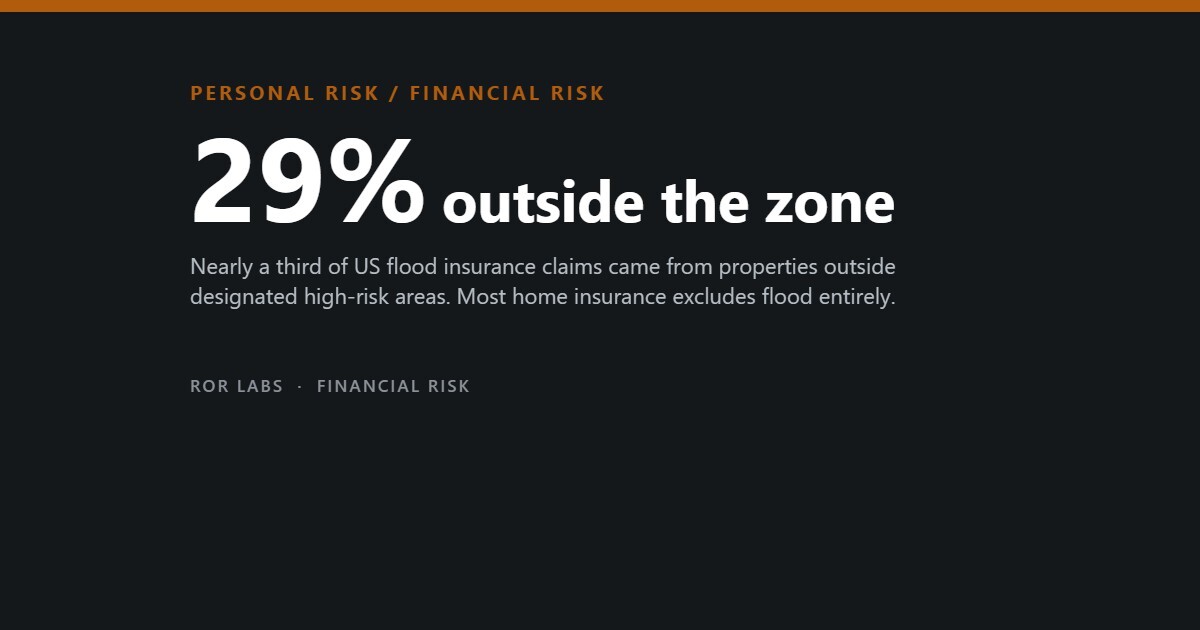
- 29% of NFIP flood claims between 2014 and 2024 came from outside designated high-risk areas.
- 99% of U.S. counties have had a flood event in the past twenty years. A flood map is a regulatory boundary, not a safety guarantee.
- Flood cover has a waiting period — commonly 30 days. You cannot buy it once the forecast turns.
A particular kind of bad day arrives twice: once when the water comes in, and again three weeks later when someone explains that the policy you have been paying for does not cover this.
Flood is the largest of these gaps and the least understood. Most homeowners insurance excludes flood damage entirely. It does not limit it; it excludes it. The people most likely to be caught out are the ones who were told they did not need to worry.

The zone map is not a risk map
Where the flood claims actually came from
National Flood Insurance Program claims, 2014–2024.
Source: FEMA, National Flood Insurance Program, “What is my flood risk” (floodsmart.gov), claims data 2014–2024.
Here is the context for that number: 99% of U.S. counties have experienced a flood event in the past twenty years. Flood maps show where flooding is likely enough to regulate, and they never listed the only places it happens. Treating a low-risk designation as an all-clear is the most common way people end up uninsured for the thing that actually hits them.
The gaps that recur

Flood is the biggest gap, but not the only one. These are the exclusions and limits that people discover at the worst possible moment. Policies vary enormously by insurer and by country, so treat this as a list of questions and not as a description of your cover.
Six things worth checking before you need to
Each is a common source of denied or reduced claims.
Sources: FEMA/NFIP flood insurance guidance; National Association of Insurance Commissioners consumer information on flood insurance.
Water damage: which pot does it come from?
The same puddle on the same floor, three different answers.
Sources: NFIP definitions of flood; NAIC consumer guidance on water damage coverage.
The two-hour job worth doing once
What actually improves your position
None of this costs anything except the premium decisions at the end.
Sources: FEMA flood insurance guidance including waiting periods; NAIC consumer guidance on home inventories and claims.
The waiting period most reliably catches people. Flood cover bought while a storm is forecast will not respond to that storm. The decision has to be made on an ordinary day, about a day that has not happened yet, which is the hardest kind of decision to make and the reason so many people are uninsured for it.
What happens after a flood claim is filed
Most guides stop at “buy the policy”. The claim itself is a process with deadlines, and people lose money by missing them. What follows describes the US National Flood Insurance Program (NFIP), because it writes most US flood policies; private flood policies and other countries work differently, so read your own wording.
First, notice. FEMA’s claims manual says the policyholder must give written notice of the loss to the NFIP or the insurer “as soon as practicable”. Then, a sworn Proof of Loss. FEMA’s policyholder form states that it must be submitted within 60 days of the date of the loss, or within any extension granted in writing by FEMA’s Federal Insurance Administrator. The form is signed and sworn under penalty of perjury, so the figures on it need to be ones you can support.
The proof needs paper behind it. For a building claim the form asks for repair specifications and detailed estimates, for a contents claim a detailed inventory of damaged personal property, and for both all bills, invoices and receipts. That is why the video inventory in the last section matters: for contents, the inventory is the claim.
The adjuster helps, but does not decide. According to the manual, the adjuster may supply the Proof of Loss form and help you fill it in. An independent adjuster cannot approve or deny a claim, though; NFIP or insurer staff review the recommendation. An adjuster’s visit is therefore not the verdict.
If you disagree. The manual describes a ladder: raise it with the adjuster, then the adjuster’s supervisor, then the insurer’s claims representative, and finally a written appeal to FEMA, which must be filed within 60 days of the insurer’s denial letter. Suing is a separate route, with a one-year limit counted from the written denial. The appeal does not extend that year, and filing suit bars the appeal. Put the dates in a calendar the day a denial arrives.
What we could not confirm: the manual we used is the 2008 edition, so figures in it, such as a waiver for small claims, may have changed. The policy form sets how building and contents are valued (replacement cost versus actual cash value), and the documents we read do not, so we have not stated it here. Ask your insurer for the current policy and Proof of Loss form.
What the official pages say about flood insurance
FEMA’s own pages set out the flood policy limits, the waiting period and what is excluded, and say that standard homeowners policies generally do not cover flooding. The pages we could read do not settle whether the programme is currently funded. This section sets out what each source says.
| Source | What it says |
|---|---|
| FEMA, National Flood Insurance Program (US government), Buy a Flood Insurance Policy (no date shown) | Coverage starts 30 days after purchase, with exceptions for a mortgage transaction, a change at renewal, a newly mapped high-risk zone (one day if bought within 12 months) and federal-land wildfire (bought within 60 days of containment). Limits: homeowner building up to $250,000 and contents up to $100,000; renters contents $100,000. Not covered: currency and valuable papers, cars, property in basements, landscaping, septic systems, decks, fences, pools, temporary housing and additional living expenses, and business interruption. |
| FEMA NFIP brochure (US government), Why Do I Need Flood Insurance? (September 2024) | Repeats the same limits. The average claim was $52,000 for 2019–2023. Losses from a flood that happened before the policy took effect are not covered, and standard homeowners policies generally do not cover flooding. |
| NAIC, an association of state insurance regulators (non-government), Flood Insurance (no date shown) | Flood is not typically covered by most homeowners and renters policies. It repeats the $250,000 and $100,000 limits and the 30-day wait and says over 20% of NFIP claims come from outside high-risk areas. NFIP cover is typically about $700 a year in high-risk areas, and private insurers may offer higher limits. |
| Insurance Journal (non-government), NFIP Reauthorized With Passage of Funding Bill to End Government Shutdown (November 13, 2025) | Reports that the programme lapsed on October 1, 2025 and that a funding bill extended it to January 30, 2026, retroactive to October 1, with no new policies sold or renewed during the lapse. FEMA pages we fetched do not mention the lapse. |
| Our comparison | The FEMA, NAIC and brochure figures agree on the limits and the 30-day wait. The pages do not agree on whether the programme is running without interruption, because only the news item describes the 2025 lapse. |
We could not confirm the programme’s expiry date after January 30, 2026 (the FEMA reauthorization page failed to load and a Congress.gov page was blocked), any Risk Rating 2.0 facts, or claim statistics beyond the $52,000 average. Figures were read through automated page fetches, so confirm exact numbers on the live pages.
What to do
These are checks, not product recommendations. Steps sorted by when they matter. Each one says how strong the evidence is: Measured Official advice Untested
Before
- Video every room, narrating and opening cupboards. Store the file off-site, in the cloud or emailed to yourself. Official advice see Sources
- Read the exclusions page and the schedule of sub-limits. That is where the unpleasant surprises live. Untested see Sources
- Check flood cover on an ordinary day. In the NFIP the waiting period is commonly 30 days, so you cannot buy it when the forecast turns. Official advice see Sources
- Check whether you have replacement cost or actual cash value, and whether sewer and drain backup needs a separate endorsement. Official advice see Sources
- Recheck the rebuild figure against current construction costs. Underinsurance can reduce every payout. Official advice see Sources
- Photograph receipts for anything big. Official advice see Sources
Afterwards
- After water damage, photograph it before anything is moved. Where the water came from decides which policy pays. Official advice see Sources
Not insurance advice. Policies vary enormously by insurer and country.
Questions people ask
Is flood insurance worth it if I am not near water?
That depends on your circumstances, and we are not going to tell you what to buy. The data supports asking the question instead of assuming: 29% of claims came from outside high-risk areas, and premiums there are correspondingly lower because the assessed risk is lower. The mistake is never having considered it because a map said low risk.
Does renters insurance cover flooding?
Generally the same exclusion applies to your belongings. Renters can buy contents-only flood cover, considerably cheaper than a building policy because you are not insuring the structure. Ground-floor and basement flats are exactly where this matters, and exactly where people assume the landlord’s policy covers their possessions. It does not.
The federal programme makes the renter’s version concrete. FEMA says plainly that a standard renters policy does not cover flood damage, even though it covers theft, wind and fire. Under the National Flood Insurance Program a renter can buy a contents-only policy covering up to $100,000 of their own belongings. Like other NFIP policies it normally takes effect only after a 30-day waiting period, so it has to be bought before the forecast, not after it. Belongings kept in a basement are covered only for a short list of items, which is worth knowing before you store anything valuable below ground. (Source: FEMA, National Flood Insurance Program, “Flood Insurance for Renters,” 2025.)
Will claiming raise my premium?
Often yes, which is a real consideration for small claims near your excess. For a significant loss it is not a close call, because that is what the policy is for. Avoid a pattern of small claims, since frequency affects pricing and renewal more than a single large event does.
My claim was denied. Is that the end?
No. Ask for the denial in writing with the specific policy wording relied on; that alone resolves some disputes, because it forces the reasoning to be stated. Insurers have internal complaints processes, and most countries have an independent ombudsman or regulator that reviews disputes free of charge. Denials are sometimes wrong, and sometimes rest on a factual misunderstanding you can correct.
The short version
- Most homeowners insurance excludes flood damage entirely. It is bought separately or not at all.
- 29% of NFIP flood claims between 2014 and 2024 came from outside designated high-risk areas.
- 99% of U.S. counties have had a flood event in the past twenty years. A flood map is a regulatory boundary, not a safety guarantee.
- Flood cover has a waiting period — commonly 30 days. You cannot buy it once the forecast turns.
- Water from above is usually covered; from the drains needs an endorsement; from the ground needs flood cover.
- Check whether you are on replacement cost or actual cash value, the largest single difference in what you receive.
- Recheck your rebuild figure against current construction costs, not what you paid.
- Do the fifteen-minute video inventory and store it off-site. It is free and it decides contents claims.
This article describes how these policies are commonly structured and is not financial or insurance advice. Cover varies enormously between insurers and countries, and the only description of your position that counts is your own policy wording. We are not licensed advisers and this is not a recommendation to buy or decline any product.
Further reading: California Against the Sea — Rosanna Xia (Heyday, 2023). A Los Angeles Times reporter on sea-level rise and the policy fights it is already causing on one coastline — narrower geographically than Goodell’s global account, but closer to the ground and to who actually pays. Find it on Amazon (paid link)
On the links above: some are affiliate links, marked (paid link). If you buy through one we may earn a commission at no additional cost to you. As an Amazon Associate I earn from qualifying purchases. We link to product searches rather than specific items so that recommendations do not break as models change, and we say plainly when we are choosing not to link something. Full policy: Affiliate Disclosure.
Sources
- Federal Emergency Management Agency, National Flood Insurance Program. “What is My Flood Risk” (floodsmart.gov), claims data 2014–2024.
- Federal Emergency Management Agency. Flood Insurance programme guidance, including policy waiting periods.
- National Association of Insurance Commissioners. Consumer information on flood insurance and water damage coverage.
- FEMA. Proof of Loss, Building and Contents, policyholder-prepared form (FF-206-FY-21-108): 60-day submission, sworn statement, supporting documents.
- FEMA. NFIP Flood Insurance Manual, Claims chapter (May 2008 edition): notice of loss, role of adjusters, appeals and suit limits.
- FEMA: Buy a flood insurance policy; FEMA: Why do I need flood insurance?; NAIC: Flood insurance; Insurance Journal: NFIP reauthorized.