Working 55 Hours a Week Has a Body Count
Further reading: The End of Burnout — Jonathan Malesic (University of California Press, 2022). A former professor’s more academic treatment of burnout research and why workplace fixes so often fail. Denser and less narrative-driven than the book it replaces, and correspondingly harder going. Find it on Amazon (paid link)
Disclosure: this article contains affiliate links, marked (paid link). If you buy through one we may earn a commission, at no extra cost to you. As an Amazon Associate I earn from qualifying purchases. It costs you nothing and it does not change what we recommend.
Key takeaways · 8 min read
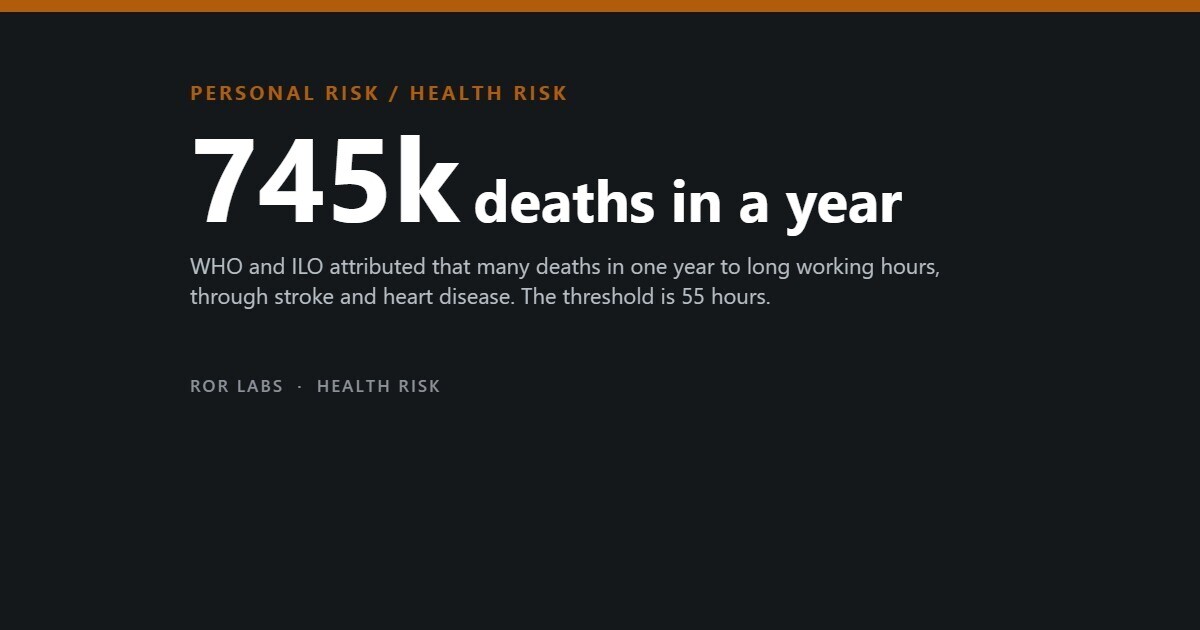
- Long working hours were linked to an estimated 745,000 deaths in 2016 — 398,000 from stroke, 347,000 from heart disease. Up 29% since 2000.
- The threshold is 55 hours a week. Against a 35–40 hour week that carried a 35% higher stroke risk and a 17% higher risk of dying from ischaemic heart disease.
- Deaths peaked at ages 60–79 among people who worked those hours between 45 and 74. The bill is decades late.
- 72% were men, and about 9% of the world’s population now works these hours.
Overwork is discussed almost entirely as a feelings problem — stress, tiredness, work-life balance. In 2021 the World Health Organization and the International Labour Organization published something that reframes it as a mortality problem, with a number attached.
Long working hours killed an estimated 745,000 people in a single year, through stroke and heart disease. It is the largest occupational disease burden those two agencies have ever quantified, and it is not caused by machinery, chemicals or dust. It is caused by hours.
The threshold is 55 hours
Risk at 55+ hours a week, versus a 35–40 hour week
Pooled from 37 heart disease studies (768,000+ participants) and 22 stroke studies (839,000+ participants), across 154 countries.
Source: World Health Organization and International Labour Organization, “Long working hours increasing deaths from heart disease and stroke,” 17 May 2021; WHO/ILO Joint Estimates, Environment International.
Two details underneath that number change who should pay attention.
The first is timing. The deaths peaked in people aged 60 to 79 who had worked 55-hour weeks between the ages of 45 and 74. The bill arrives decades after the hours are worked. Anyone in their forties or fifties reading this is in the exposure window rather than the consequence window — which is the only reason the finding is useful rather than simply grim.
The second is who. 72% of these deaths were men, concentrated in middle-aged and older workers. About 9% of the world’s population now works these hours, and that share has been rising.
The shape of the finding
Worth being precise about, because the number is easy to over-apply.
Source: WHO/ILO Joint Estimates of the Work-related Burden of Disease and Injury (2021).
Burnout is a workplace diagnosis, not a personal failing
The word burnout now covers any kind of tiredness. It has an official definition, and the definition is unusually precise about where the problem is located.
The WHO’s three dimensions
ICD-11: a syndrome resulting from chronic workplace stress that has not been successfully managed.
Source: World Health Organization, “Burn-out an occupational phenomenon: International Classification of Diseases,” 28 May 2019.
That classification is doing real work. Burnout is defined as arising from chronic workplace stress that has not been successfully managed. The thing that failed is the management of the workplace stress — not the resilience of the person carrying it. Which explains why the meditation-app response so often lands badly on the people it is aimed at: it answers a question nobody asked, and quietly relocates the fault.
What is actually within reach
The uncomfortable part of this evidence is that the largest lever — how many hours the job demands — is often not the worker’s to pull. Pretending otherwise is how this topic turns into blame. So it is worth separating what an individual controls from what only an employer or a regulator can change.
Two different lists
Confusing them is the reason most workplace wellbeing programmes fail.
Sources: WHO/ILO joint estimates (2021); WHO ICD-11 burn-out classification (2019).
Start by measuring the exposure
Almost nobody knows their real number. Most people guess low.
Sources: WHO/ILO (2021); WHO ICD-11 (2019).
The two things worth owning (paid link)
Both aimed at the measurable pathway — blood pressure and sleep — rather than at your attitude.
Browse on Amazon →
Browse on Amazon →
We are not linking meditation subscriptions, “burnout recovery” supplements or resilience courses. The WHO definition places the failure in unmanaged workplace stress, and selling an individual a product to absorb a structural problem is the exact move that makes people cynical about workplace wellbeing. Nothing on a shelf shortens a 60-hour week.
Questions people ask
Is 50 hours a week dangerous?
The WHO/ILO analysis set its threshold at 55 and does not support treating 50 as equivalent. Risk of this kind rarely switches on at a round number, so 50 is not a safe harbour either — but the honest answer is that the evidence is about 55 and above, and stretching it further would be overselling.
Does it count if I enjoy my work?
The cardiovascular findings are about hours, not enjoyment. Enjoying the work plausibly protects against the burnout syndrome — which is defined by exhaustion and cynicism — while doing nothing about the physiological load of the hours themselves. People who love their jobs are, if anything, more exposed, because they volunteer for the hours.
I am self-employed. Is this relevant?
The hours count the same, and the structural protections — a manager noticing, a contracted week, statutory limits — are absent. Self-employment removes the boss who imposes the hours and also the one who could cap them. The measurement step matters more here, not less.
Is burnout the same as depression?
No, and the WHO is deliberate about this — burn-out is not classified as a medical condition, and the classification tells clinicians to rule out mood and anxiety disorders before applying it. They overlap and can occur together. If low mood, hopelessness or loss of interest extends beyond work into the rest of life, that is a reason to talk to a doctor rather than to redesign your calendar.
The short version
- Long working hours were linked to an estimated 745,000 deaths in 2016 — 398,000 from stroke, 347,000 from heart disease. Up 29% since 2000.
- The threshold is 55 hours a week. Against a 35–40 hour week that carried a 35% higher stroke risk and a 17% higher risk of dying from ischaemic heart disease.
- Deaths peaked at ages 60–79 among people who worked those hours between 45 and 74. The bill is decades late.
- 72% were men, and about 9% of the world’s population now works these hours.
- This is observational evidence. The direction is well supported; the precision is not.
- The WHO defines burn-out as arising from chronic workplace stress that has not been successfully managed — and explicitly not as a medical condition.
- That places the failure in the workplace, not in the worker’s resilience.
- What you can do now: count your real hours, protect sleep, and get your blood pressure checked.
This article summarises published population research and is not medical advice. Chest pain, sudden weakness or numbness on one side, difficulty speaking, or a sudden severe headache are emergency symptoms — call emergency services rather than waiting.
On the links above: some are affiliate links, marked (paid link). If you buy through one we may earn a commission at no additional cost to you. As an Amazon Associate I earn from qualifying purchases. We link to product searches rather than specific items so recommendations do not break as models change, and we say plainly when we are choosing not to link something. Full policy: Affiliate Disclosure.
Sources
- World Health Organization and International Labour Organization. “Long working hours increasing deaths from heart disease and stroke: WHO, ILO.” 17 May 2021.
- Pega F, Náfrádi B, Momen NC, et al. WHO/ILO Joint Estimates of the Work-related Burden of Disease and Injury — exposure to long working hours and burden of ischaemic heart disease and stroke. Environment International, 2021.
- World Health Organization. “Burn-out an occupational phenomenon: International Classification of Diseases.” 28 May 2019.