Boxing injuries, headguards and the fights that add up
Key takeaways · 10 min read
- Most boxing injuries are bruises, cuts and hand injuries, and about one in eight is a concussion.
- The brain effects grow with the number of fights and knockouts, and no safe threshold has been found.
- Olympic injury rates tripled and cuts increased once headguards were removed, but headguards do not prevent concussion.
- Almost all professionals cut weight rapidly before weigh-in, and the practice is linked to injury.
Two Japanese boxers fought on the same card at Korakuen Hall in Tokyo on 2 August 2025. Shigetoshi Kotari, 28, boxed twelve rounds to a draw in a regional title fight; Hiromasa Urakawa, also 28, was knocked out. Both underwent surgery for bleeding on the brain, and both died within a week. Japan’s boxing commission responded by cutting regional title fights from twelve rounds to ten.
Deaths like these are why people point to boxing when they talk about brain injury, and the concern is justified. Yet most people who box never step into a ring: in a 2025 survey of 583 Portuguese boxers, 70.5% had never competed. The risk is unevenly spread among everyone who wraps their hands. It rises with the number of fights, with knockouts, and with how a fighter prepares for the scales, and the sport can measure and change all three.
This article covers what boxers actually injure, where the risk concentrates, what has been measured to reduce it, and why the answer is not simply to walk away from the gym.
What actually gets injured
A 2023 meta-analysis of studies from this century, covering 733,113 participants and 10,567 injuries, estimated 223.9 injuries per 1,000 boxers overall, 270.8 among amateurs and 399.8 among professionals. Bruises were the commonest type at 30.2%, followed by cuts and skin injuries at 21.4%, sprains and strains, concussion at 12.3% and fractures at 11.4%. Amateur injury rates had fallen over the previous decade while professional rates stayed high, the authors found, with more concussion in the professional ranks.
What boxing injuries are
Share of injuries by type, pooled from 14 studies of 21st-century boxing.
Source: Mao et al., Orthopaedic Journal of Sports Medicine (2023).
Fight records from ringside show the same picture for professionals. In 524 professional bouts in Nevada from 2001 to 2003, there were 17.1 injuries per 100 boxer-matches; half were cuts to the face, 17% hand injuries and 14% eye injuries. In training the hand matters more than in the ring. In Britain’s elite amateur squad from 2005 to 2009, the hand was the most injured body part and more injuries happened in training than in competition. In US emergency departments from 1990 to 2008, the hand accounted for a third of boxing injuries, and punching bags caused 36.8% of them, the injury many recreational boxers are most likely to meet.
How you count changes the comparison between combat sports. At three Olympic Games from 2008 to 2016, boxing recorded 76.6 injuries per 1,000 athlete-exposures, against 46.4 for taekwondo, 34.0 for judo and 22.7 for wrestling. Measured per minute of actual fighting, judo came out slightly ahead of boxing, 9.6 against 9.2, and the difference was not significant.
When the risk concentrates
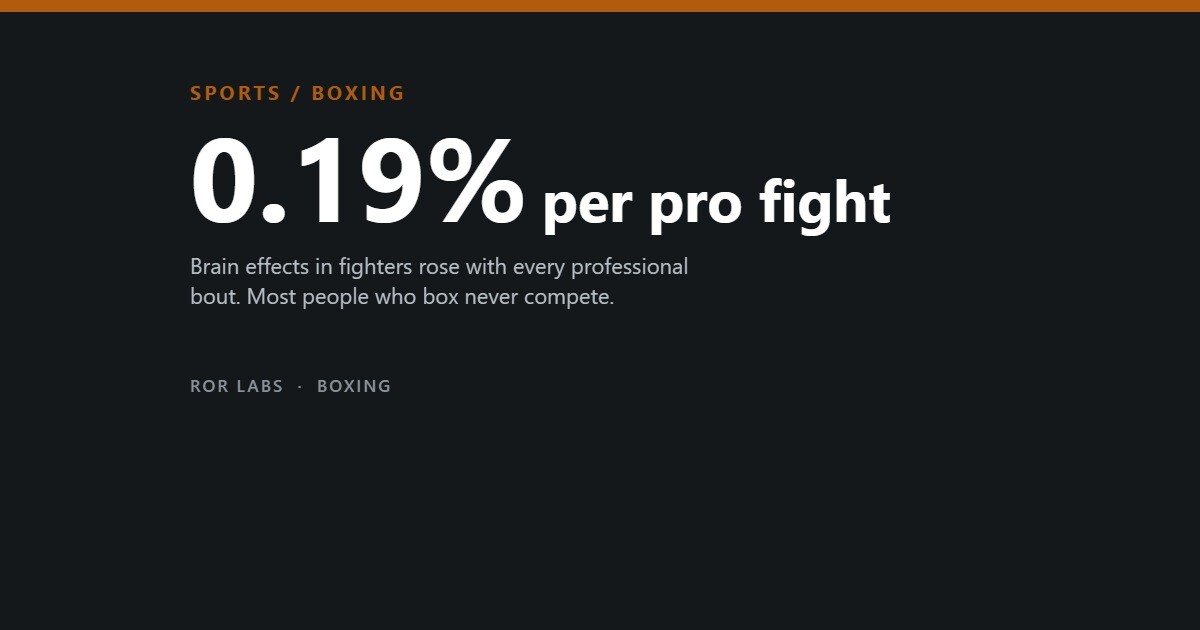
The Professional Fighters Brain Health Study, run at the Cleveland Clinic, gives the clearest evidence on the brain. It has followed hundreds of professional boxers and mixed martial artists with scans and cognitive tests. In its 2015 analysis of 224 fighters, each additional professional fight was linked to 0.19% slower processing speed, and each step up a combined fight-exposure score to smaller volumes in deep brain structures. Fighters at the top of that score processed information 8.8% more slowly than those at the bottom, and about one in four had impaired verbal memory, against about one in ten. Boxers fared worse than mixed martial artists on both scans and tests.
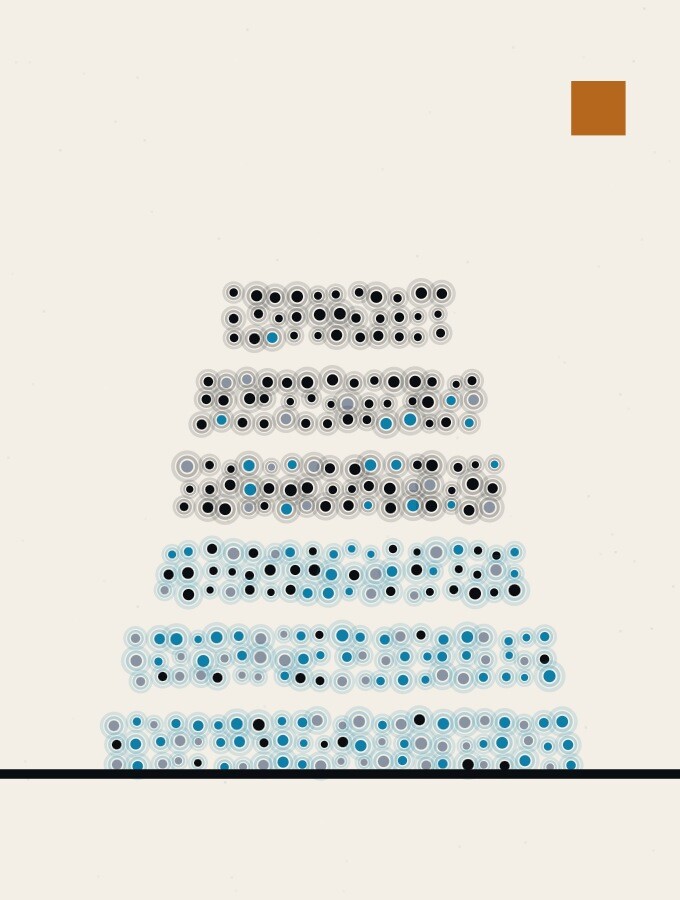
The fights counted from the first one: no threshold appeared, and the relationship was a slope. Later analyses from the same study found that starting to fight younger was linked to smaller volumes in memory-related regions, and that heavyweights lost more function per year. A separate study of 104 elite mixed martial artists found that fighters with three or more previous knockout losses were concussed in 65% of their most recent fights, so a brain that has been knocked out before is more easily knocked out again. The same slope shows up in ordinary injuries: in a prospective German study, competitive boxers who fought more than three bouts a year were injured more often.
The fights add up
Findings from the Professional Fighters Brain Health Study, 224 fighters, 2015.
Source: Bernick et al., British Journal of Sports Medicine 49(15):1007 (2015).
Preparing for the scales is the other place risk concentrates. Nearly all professional combat athletes lose weight deliberately before weigh-in and regain it before the fight. In a study of 399 professional boxers in California, 97.5% gained weight between weigh-in and fight, 7.2% of body weight on average, and one in five gained 10% or more. In a study of 155 combat athletes, men who lost more weight in the 24 hours before weigh-in had higher odds of reporting an injury. Rapid weight loss is a health risk in its own right; anyone doing it should be supervised by a doctor and a registered dietitian instead of following gym folklore.
What has been measured to work
Headguards are the most argued-over equipment in the sport, and the evidence cuts both ways. Amateur boxing removed headguards for elite men in 2013, and across the Olympic Games before and after, the overall injury rate per minute of fighting for male boxers tripled, a rate ratio of 3.00. A study of 28,802 rounds found that without headguards, cuts rose sharply while stoppages from blows to the head fell. The Association of Ringside Physicians concluded in 2023 that headguards are highly effective against cuts and should be used, especially in sparring, but that they should not be relied on to prevent concussion, and that riskier behaviour while wearing them may cancel out part of their benefit.
Headguards: what changed when they came off
Elite men’s amateur boxing, before and after headguards were removed in 2013.
Injury rate per minute of fighting
After removal: 3.00 times the rate
(95% CI 2.07–4.36)
Lystad et al., 2020
Cuts: rose sharply
Stoppages from head blows: fell
Concussion benefit of headguards: unproven
Loosemore et al., 2017
Source: Lystad et al., British Journal of Sports Medicine (2020); Loosemore et al., Clinical Journal of Sport Medicine (2017); Association of Ringside Physicians position statement (2023).
Rules act more directly. After the South Korean boxer Duk Koo Kim died following a world title fight, the World Boxing Association cut championship bouts from fifteen rounds to twelve in 1987, and Japan’s move to ten-round regional title fights in 2025 follows the same logic. Olympic-style boxing today uses three rounds of three minutes for adults and two-minute rounds for under-17s. World Boxing’s rules require boxers to make weight on the morning of each competition day, which limits how much can be lost and regained. Weigh-in timing changes behaviour: British combat athletes weighed in 24 hours or more before competing cut more weight than those weighed in on the day, 9.7% against 5.2% of body weight.
The weight swing before a fight
Deliberate weight loss before weigh-in and regain before the bout, in professional and elite combat athletes.
Source: Murugappan et al., The Physician and Sportsmedicine (2021); Campbell et al. (2025).
Medical suspensions address the knockout curve. Under the International Boxing Association’s rules, a boxer knocked out by blows to the head is suspended for at least 30 days and must complete a graded return-to-play protocol, and a third such knockout within twelve months brings a year out of the ring. None of these measures has been tested in a trial, and several are recent, but they target the right variables: the number of rounds, the number of knockouts, and the weight swing before a fight. The strongest evidence points to something simpler. The brain study found damage rose with exposure, so the most effective protection is fewer head blows (less hard sparring, fewer fights and longer breaks after a knockout).
Why the answer is not to stop
Most boxing involves no blows to the head. The Portuguese survey found seven in ten boxers had never competed, and sparring caused about a third of their injuries. A growing share of people take boxing classes that involve bags, pads and conditioning but no contact at all. For them the risks are the hand, the wrist and the shoulder, and a punching bag is the likeliest cause of an emergency visit. US emergency data from 2000 to 2023 estimated 362,869 boxing injuries, with fractures at 24.6% and concussion or closed head injury at 6.9%, though the head injuries were four times as likely to lead to admission.
Most boxers never fight
Selected findings on recreational boxing.
Source: SottoMayor et al. (2025); Potter, Snyder and Smith, American Journal of Preventive Medicine (2011).
Boxing-based exercise has also been tried for Parkinson’s disease, with unconvincing results. Programmes such as Rock Steady Boxing have reported improvements in balance and mobility in small studies without control groups, but a 2024 meta-analysis of 13 studies found no significant pooled effect on mobility, balance, motor symptoms or fitness, and a double-blind randomised trial of 40 patients found a sensory-focused exercise programme did better than boxing training. Boxing training may help people with Parkinson’s as one form of exercise among several; it has not been shown to be special.
The evidence separates two activities that share a name. Non-contact boxing training is vigorous exercise with the injury profile of other gym work: wrap your hands, build up bag work gradually and treat a sore wrist early. Competitive boxing and hard sparring carry a dose-dependent risk to the brain that no equipment removes. For anyone who chooses them, the levers are known: keep hard sparring rare, wear a headguard in training to avoid cuts without assuming it prevents concussion, take knockouts seriously and rest for longer afterwards, make weight gradually under medical supervision, and keep count of the fights.
What the official pages say about boxing and head injury
Government pages explain concussion and the repeated-impact debate in general terms and say little about boxing itself. This section sets out what they say. It is general information, not medical advice.
| Source | What it says |
|---|---|
| NHS (UK government), Concussion (reviewed May 29, 2025) | Concussion is a temporary brain injury lasting a few weeks. Symptoms can last up to 2 weeks, and a GP should be seen if they last longer. Avoid contact sports for at least 3 weeks, and an adult should stay with the person for at least 24 hours. The page does not cover repeated head injury or long-term effects. |
| MedlinePlus (US government), Concussion (modified Nov. 24, 2025) | Concussions are often called mild but can be serious, and most people recover fully. It does not discuss repeated concussions and links out to CTE resources. |
| NHS 111 Wales (Welsh NHS), Chronic traumatic encephalopathy (updated Sept. 25, 2025) | Names boxing, martial arts, football, rugby and American football as higher-risk activities. Symptoms often start about a decade after repeated head injuries, a definitive diagnosis is only possible after death, there is no cure, and care mirrors dementia care. Avoiding repeated head injuries is the main known way to lower risk. |
| CDC (US government), Repeated head impacts (reviewed May 16, 2024) | CTE is linked to long-term exposure to repeated head impacts. The page says there is no strong evidence that one or more concussions or occasional hits cause it, that CTE is likely very rare, and that confirmation needs an autopsy. It discusses football, not boxing. |
| NIH Research Matters (US government), Repeated head trauma in young athletes (Nov. 19, 2025) | Reports a Boston University study (Nature, Aug. 2025) of 28 men: contact-sport players had 56% fewer neurons in the examined brain grooves, even without CTE. Small sample, and the authors say more study is needed. Boxing is not mentioned. |
| GOV.UK, Department for Culture, Media and Sport (UK government), Grassroots sport concussion guidance (Apr. 28, 2023) | “If in doubt, sit them out.” Nobody should return to sport within 24 hours of a suspected concussion; call NHS 111 within 24 hours, rest for 24–48 hours, then return in graduated stages, and see a professional if symptoms last more than 4 weeks. It covers grassroots sport generally, not boxing. |
| Vice (news article), Olympic boxing headgear (Mar. 3, 2016) | Says the IOC would not block the international boxing federation’s 2013 decision to drop headguards for male boxers, citing federation data on 15,000 boxers with concussion rates of 0.38% with headgear and 0.17% without. That is the article’s report of the study, not read from the study itself. |
| Tjønndal et al., systematic review (journal, non-government), European Journal of Sport Science (2021) | Review of 39 studies: headguards appear to protect against cuts and skull fractures, but evidence on concussion protection is weaker and mostly indirect. The authors urge caution about the 2013 removal. |
| British Medical Association (non-government), Policy Book 2023–24 | Boxing motions from 1995 and 1998 reaffirm opposition to amateur and professional boxing and call for a ban. The book does not mention headguards. |
| Medical Xpress (news article on a Macquarie University study), Boxing deaths in Australia (Feb. 22, 2022) | 162 boxing deaths in Australia from 1832 to 2020 (122 professional, 40 amateur). A historical count with no rate per bout. |
| Our comparison | The headguard sources disagree: the federation data reported by Vice say concussions were lower without headgear, while the systematic review says concussion evidence is weak and urges caution. We have not resolved this, and no government page covers headguards. |
We could not confirm any government page on amateur headguards, any government boxing injury or death count, an NHS or MedlinePlus page on boxers and CTE other than the Welsh one, or UK Sport or Sport England concussion pages. The CDC CTE page and the GOV.UK concussion-in-sport page were blocked, and a PubMed Central article hit a CAPTCHA, so none was used. Figures were read through automated page fetches, so confirm exact numbers on the live pages.
What to do
Steps sorted by when they matter. Each one says how strong the evidence is: Measured Official advice Untested
Before
- If you only train, choose non-contact boxing, wrap your hands and build up bag work gradually. The brain risk comes from being hit. Official advice see Sources
- Wear a headguard in sparring. Ringside physicians say it is highly effective against cuts. Official advice see Sources
- Make weight gradually, with a doctor and a registered dietitian. Athletes weighed in 24 hours or more before competing cut 9.7% of body weight, against 5.2% when weighed in on the day. Measured see Sources
If it happens
- Keep hard sparring rare and count the fights. Brain damage rose with exposure, with no safe threshold found. Measured see Sources
Afterwards
- After a knockout or signs of concussion, get medical assessment and do not return to sparring until cleared. Rest longer than you think you need. Official advice see Sources
What not to do
- Do not assume a headguard prevents concussion. It has not been shown to. Official advice see Sources
Questions people ask
How dangerous is boxing?
A 2023 meta-analysis estimated about 224 injuries per 1,000 boxers, higher in professionals. Most are bruises and cuts; concussion was about 12% of injuries.
Is boxing bad for your brain?
For fighters who take head blows, yes, in proportion to exposure: each professional fight was linked to slightly slower processing speed, with no safe threshold identified.
Do boxing headguards prevent concussion?
They greatly reduce cuts but have not been shown to prevent concussion. Ringside physicians recommend them for sparring on that basis.
Is non-contact boxing safe?
It has the injury profile of other vigorous gym exercise, mainly hand, wrist and shoulder problems. The brain risk comes from being hit.
Does boxing help Parkinson’s disease?
Small studies report benefits, but a 2024 meta-analysis found no significant pooled effect. It is one reasonable form of exercise, not a proven treatment.
The short version
- Most boxing injuries are bruises, cuts and hand injuries, and about one in eight is a concussion.
- The brain effects grow with the number of fights and knockouts, and no safe threshold has been found.
- Olympic injury rates tripled and cuts increased once headguards were removed, but headguards do not prevent concussion.
- Almost all professionals cut weight rapidly before weigh-in, and the practice is linked to injury.
- Most people who box never compete; non-contact training carries far lower risk.
This is a summary of published research, not medical advice. Anyone knocked out or showing signs of concussion needs medical assessment and should not return to sparring or competition until cleared. Rapid weight loss can be dangerous; if weight is a concern, work with a doctor and a registered dietitian.
Further reading: Bernick et al., British Journal of Sports Medicine 49(15):1007 (2015), for the dose-response brain findings. Association of Ringside Physicians, The Physician and Sportsmedicine (2023), on headguards. Our article on wrestling and weight cutting covers a rule change that reduced it.
Sources
- Al Jazeera, 10 August 2025, on the deaths of Shigetoshi Kotari and Hiromasa Urakawa.
- SottoMayor R, et al. Portuguese boxing injury survey (2025).
- Mao Y, Zhao D, Li JH, Fu W. Orthopaedic Journal of Sports Medicine (2023), doi:10.1177/23259671221127669.
- Bledsoe GH, Li G, Levy F. Southern Medical Journal (2005), doi:10.1097/01.smj.0000182498.19288.e2.
- Loosemore M, et al. British Journal of Sports Medicine (2015), doi:10.1136/bjsports-2015-094755.
- Potter MR, Snyder AJ, Smith GA. American Journal of Preventive Medicine (2011), doi:10.1016/j.amepre.2010.12.018.
- Lystad RP, et al. British Journal of Sports Medicine (2020), doi:10.1136/bjsports-2020-102958.
- Bernick C, Banks SJ, Shin W, et al. British Journal of Sports Medicine 49(15):1007 (2015).
- Bryant BR, et al. International Review of Psychiatry (2020), doi:10.1080/09540261.2019.1665501.
- Bray MJC, et al. Neurotrauma Reports (2021), doi:10.1089/neur.2020.0057.
- Hada S, et al. Journal of Physical Fitness and Sports Medicine 11(4):255 (2022).
- Murugappan KR, et al. The Physician and Sportsmedicine (2021), doi:10.1080/00913847.2021.1960780.
- Hillier M, et al. International Journal of Sport Nutrition and Exercise Metabolism (2019), doi:10.1123/ijsnem.2018-0393.
- Doherty CS, Barley OR, Fortington LV. Journal of Science and Medicine in Sport (2025).
- Loosemore MP, et al. Clinical Journal of Sport Medicine (2017), doi:10.1097/JSM.0000000000000322.
- deWeber K, et al. Association of Ringside Physicians position statement. The Physician and Sportsmedicine (2023), doi:10.1080/00913847.2023.2242415.
- Donnelly RR, et al. Clinical Journal of Sport Medicine 33(6) (2023).
- World Boxing Competition Rules (November 2024).
- International Boxing Association Technical & Competition Rules (March 2024).
- Campbell P, et al. (2025), doi:10.1016/j.peh.2025.100395.
- Tsuzaki J, et al. The Physician and Sportsmedicine (2026), doi:10.1080/00913847.2026.2661569.
- González-Devesa D, et al. Revista de Neurología (2024).
- Sangarapillai K, Norman BM, Almeida QJ. Neurorehabilitation and Neural Repair (2021), doi:10.1177/15459683211023197.
- Dawson RA, et al. Topics in Geriatric Rehabilitation (2020).
- NHS, concussion; NHS 111 Wales, CTE; CDC, repeated head impacts; NIH Research Matters, repeated head trauma; GOV.UK, grassroots concussion guidance; Boxing headguard review (journal, non-government).