Coercive Control: What the Evidence Shows
Key takeaways · 11 min read
- Coercive control is a pattern of domination through isolation, monitoring, threats and control of money and daily life.
- Controlling behaviour is one of the strongest risk factors for intimate partner homicide in a meta-analysis of 17 studies.
- England and Wales made it a crime in 2015; Ireland and Scotland followed with their own laws.
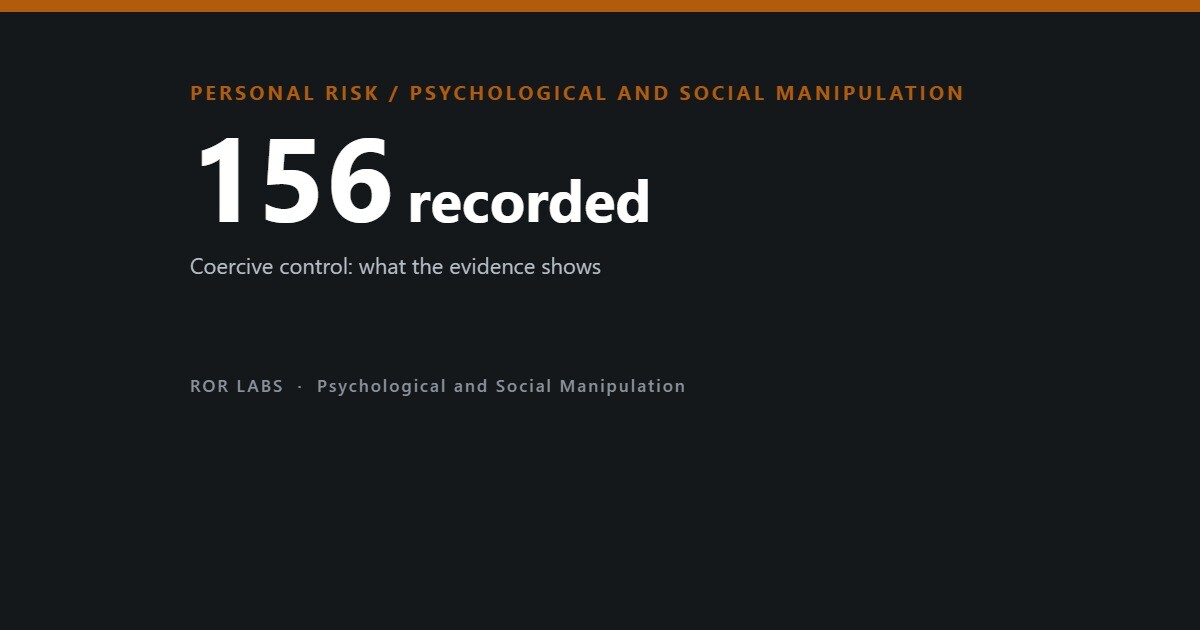
- In one police force, only 156 of 18,978 domestic abuse crimes were recorded as coercive control; prosecutions remain hard.
For most of the history of criminal law, domestic abuse meant violence: a punch, a push, an injury a doctor could see. Anything short of that, however frightening or controlling, was a private matter. A partner who checked every message, controlled every pound, cut someone off from friends and dictated what they wore could not be prosecuted unless they also hit them.
That began to change with the idea of coercive control, developed by the American sociologist and social worker Evan Stark. His argument was that for many victims the core of the abuse is not individual assaults but an ongoing pattern of domination that removes their freedom, a ‘liberty crime’. Since 2015, England and Wales, Ireland, Scotland and several Australian states have created specific offences to capture it.
This article looks at what the research shows about coercive control: how it is defined and measured, what it predicts, what happened when it became a crime, and where researchers disagree. It sits alongside our article on gaslighting, which covers one of its common tactics.
What coercive control means
Stark described coercive control as a strategic course of conduct combining coercion and control. Coercion includes violence, intimidation, threats and degradation. Control includes isolation from friends and family, exploitation and deprivation of money or resources, and micro-regulation of everyday life, such as what someone eats, wears, who they speak to and when they sleep.
Individually, many of these acts look minor or are not crimes at all. Their effect comes from repetition and combination, which can leave a person feeling that they have no room to act without permission. Stark and Marianne Hester, reviewing the evidence in 2019, argued that coercive control ‘is not a type of violence’, and that the level of control in a relationship predicts a range of harms previously associated with physical abuse.
Researchers do not agree on a single definition. In a 2017 review, Kevin Hamberger, Sadie Larsen and Amy Lehrner found widespread inconsistency in how studies defined and measured coercive control, and proposed three facets that should be present: intention or goal-directed behaviour by the abuser, a negative perception of the behaviour by the victim, and the abuser’s ability to enforce control through a credible threat.
Three facets of coercive control
A proposed framework for defining and measuring coercive control in research.
| Facet | What it means |
|---|---|
| Intentionality | The behaviour is goal-directed, aimed at gaining control |
| Negative perception | The victim experiences the behaviour as controlling or harmful |
| Credible threat | The abuser can back control with a real threat of consequences |
Hamberger LK, Larsen SE, Lehrner A, Aggression and Violent Behavior, 2017;37:1–11.

How common it is
Measuring coercive control is harder than measuring assaults, because it is a pattern rather than an event. Most large surveys therefore measure related behaviours. The US Centers for Disease Control and Prevention’s National Intimate Partner and Sexual Violence Survey asks about psychological aggression by a partner, including expressive aggression such as insults and coercive control such as monitoring and threats. In its 2016 to 2017 data, about half of women and slightly fewer men reported such psychological aggression at some point in their lives.
These figures cover a very wide range of experiences, from occasional hurtful behaviour to sustained domination, and they do not show how often the behaviours formed the kind of pattern Stark described. Andy Myhill tried to separate these in 2015 using the Crime Survey for England and Wales. As Sylvia Walby and Jude Towers later noted, he concluded that coercive control could not yet be measured robustly with existing survey data. The honest answer to how common it is remains: common enough to matter, but not precisely known.
Psychological aggression by an intimate partner, United States
Lifetime prevalence, National Intimate Partner and Sexual Violence Survey, 2016–2017.
US Centers for Disease Control and Prevention, NISVS 2016/2017 Report on Intimate Partner Violence, 2022. Includes coercive control and expressive aggression; not a measure of sustained patterns.
What it predicts
The strongest evidence for taking coercive control seriously comes from studies of the most severe outcome. In 2018, Chelsea Spencer and Sandra Stith published a meta-analysis of 17 studies of risk factors for intimate partner homicide in Trauma, Violence, & Abuse. The strongest risk factors included the perpetrator’s direct access to a gun, previous non-fatal strangulation, previous rape of the victim, previous threats with a weapon, controlling behaviours, and previous threats to harm the victim.

The criminologist Jane Monckton Smith, a former police officer, analysed intimate partner homicides in the United Kingdom and proposed in 2019 an eight-stage progression from the start of a controlling relationship to homicide, with escalation of control, often triggered by separation, as a key warning point. Her model has been widely adopted in training. It is a descriptive, qualitative model built from cases that ended in homicide; it has not been validated as a tool for predicting which relationships will become fatal, and most controlling relationships do not.
Stark and Hester also reviewed evidence that the level of control in a relationship predicts post-separation violence and sexual assault. The practical message for professionals is that the absence of injuries should not be read as the absence of danger.
Strongest risk factors for intimate partner homicide
Meta-analysis of 17 studies of male perpetration and female victimisation.
| Risk factor |
|---|
| Perpetrator’s direct access to a gun |
| Previous non-fatal strangulation |
| Previous rape of the victim |
| Previous threat with a weapon |
| Controlling behaviours |
| Previous threats to harm the victim |
Spencer CM, Stith SM, Trauma, Violence, & Abuse, 2020;21(3):527–540.
When it became a crime
England and Wales created the offence of controlling or coercive behaviour in an intimate or family relationship in section 76 of the Serious Crime Act 2015, in force from 29 December 2015, with a maximum sentence of five years. At first it applied only to people who were living together or still in a relationship; the Domestic Abuse Act 2021 extended it to former partners and family members who no longer live together, from April 2023.
Ireland followed with section 39 of the Domestic Violence Act 2018. Scotland took a different approach in the Domestic Abuse (Scotland) Act 2018, in force from April 2019, which created a broader offence of a course of abusive behaviour, covering both physical and psychological abuse, with a maximum sentence of 14 years.
Coercive control offences in the UK and Ireland
Main legislation and maximum sentences.
| Jurisdiction | Law | Maximum sentence |
|---|---|---|
| England and Wales | Serious Crime Act 2015, s. 76 | 5 years |
| Ireland | Domestic Violence Act 2018, s. 39 | 5 years |
| Scotland | Domestic Abuse (Scotland) Act 2018 | 14 years |
Legislation as enacted. The Domestic Abuse Act 2021 extended the England and Wales offence to partners not living together from April 2023.
What happened in practice
Early research found that the new offence was used rarely and unevenly. Charlotte Barlow, Kelly Johnson, Sandra Walklate and Les Humphreys studied one English police force and found that of 18,978 domestic abuse crimes recorded between January 2016 and June 2017, only 156, under 1%, were recorded as coercive control. Many cases ended with no further action because of evidential difficulties.
Iain Brennan and Andy Myhill, analysing national police data and freedom of information requests in the British Journal of Criminology in 2022, found that recorded crimes and arrests for coercive control rose steadily, but with large differences between police forces. Coercive control crimes faced greater evidential challenges and were far less likely to result in a prosecution than domestic abuse crimes in general.
The cases that did lead to a charge usually had evidence beyond the victim’s account: previous convictions, admissions, physical evidence, surveillance devices found in cars or phones, or police body-worn camera footage. That reflects a real tension. The offence was created to recognise abuse that leaves no visible marks, but prosecutions still depend on proof that a court will accept.
How often the new offence was used
Domestic abuse crimes recorded by one English police force, January 2016 to June 2017.
Barlow C, Johnson K, Walklate S, Humphreys L, British Journal of Criminology, 2020. Under 1% of recorded domestic abuse crimes.

The critics
Not everyone agrees that coercive control is the right frame. Sylvia Walby and Jude Towers, in Criminology & Criminal Justice in 2018, argued that the concept is hard to measure robustly, that Stark lacked strong quantitative evidence that coercive control was increasing while physical violence fell, and that a focus on domestic violent crime, treating all physical violence in relationships as coercive and controlling, explains more of the variation in harm.
Other concerns are practical. Because the offence depends on patterns and perceptions, some lawyers have worried that it could be misused in bitter separations, or that abusers could make counter-allegations. The laws are written in gender-neutral terms, while most research finds coercive control to be highly gendered, with women far more often the victims. None of these criticisms denies that coercive control exists; they are arguments about how best to measure and prosecute it.
Money as a tool of control
Economic abuse is one of the most common and least visible parts of coercive control. It can include preventing a partner from working or studying, taking their wages, giving an allowance and demanding receipts, running up debts in their name, or refusing to contribute to household costs. Because money shapes every other option, from moving out to paying a lawyer, economic control can keep someone in a relationship long after they want to leave.
The effects can outlast the relationship. Debts, damaged credit records and gaps in employment follow survivors for years. Banks in some countries now train staff to recognise signs of economic abuse, and the 2021 Act in England and Wales explicitly includes economic abuse in its definition of domestic abuse.
Children and technology
Coercive control rarely affects only one person. The sociologist Emma Katz, interviewing mothers and children in the UK, found that children were often directly targeted: their contact with relatives restricted, their activities controlled, their relationship with the non-abusive parent deliberately undermined. The Domestic Abuse Act 2021 in England and Wales now recognises children who see, hear or experience the effects of domestic abuse as victims in their own right.
Technology has added new tools. Location sharing, shared accounts, smart home devices and spyware installed on phones allow a partner to monitor movements and messages continuously, including after separation. In Barlow’s study, surveillance technology found in cars or on phones was one of the types of evidence that helped cases reach a charge. Checking which apps and devices share your location, and who has access to your accounts, is a practical first step for anyone who is worried.
Separation is often described as the most dangerous period. It is when the controlling partner loses the most control, and it is the stage at which Monckton Smith’s model places a common trigger for escalation. That is why specialist services emphasise planning before leaving rather than leaving suddenly, where it is safe to do so, and why the 2021 extension of the offence to former partners matters.
Recognising the signs
Organisations that support victims describe common patterns: monitoring phones, messages or location; controlling money, including access to bank accounts or wages; isolating someone from friends and family; making threats, including to children, pets or to share private images; constant criticism and humiliation; and rules about everyday behaviour, with punishment for breaking them. The sign that matters most is the pattern and its effect: a growing sense of fear and of needing permission.
If you are worried about your own relationship or someone else’s, specialist domestic abuse services can talk through options confidentially, including safety planning around separation, which research identifies as a period of heightened risk. Keeping a dated record of incidents, stored somewhere the other person cannot access, can help later with police, courts or protection orders.
Questions people ask
What is coercive control?
A pattern of behaviour that dominates a partner or family member through threats, isolation, monitoring, control of money and daily rules, removing their freedom over time.
Is coercive control a crime?
In England and Wales since December 2015, and in Ireland and Scotland since 2019, among other places. Many countries still have no specific offence.
How is it different from gaslighting?
Gaslighting, making someone doubt their memory or perception, is one tactic. Coercive control is the broader pattern of domination it can serve.
Does coercive control lead to violence?
Controlling behaviour is among the strongest risk factors for intimate partner homicide, though most controlling relationships do not end in homicide.
Can men be victims of coercive control?
Yes, and the laws are gender-neutral. Most research finds that women are far more often the victims, especially of severe patterns.
Why are there so few prosecutions?
Evidence is hard to gather; studies found coercive control crimes far less likely to be prosecuted than other domestic abuse crimes.
The short version
- Coercive control is a pattern of domination through isolation, monitoring, threats and control of money and daily life.
- Controlling behaviour is one of the strongest risk factors for intimate partner homicide in a meta-analysis of 17 studies.
- England and Wales made it a crime in 2015; Ireland and Scotland followed with their own laws.
- In one police force, only 156 of 18,978 domestic abuse crimes were recorded as coercive control; prosecutions remain hard.
- Researchers still disagree on how to define and measure it, but not on the harm it can cause.
This article summarises published research and legislation on coercive control. It is not legal advice and is not a tool for assessing any particular relationship. If you are in immediate danger, call the emergency services. If you are worried about your safety or someone else’s, contact a specialist domestic abuse service in your country, or speak to a doctor or a lawyer.
Further reading. Stark and Hester, ‘Coercive Control: Update and Review’, Violence Against Women, 2019, and Brennan and Myhill, British Journal of Criminology, 2022, give the case for and the practical record of the new offence.
- In Control, Jane Monckton Smith (2021). A criminologist and former police officer on the patterns she found in cases of domestic homicide.
- Coercive Control and the Criminal Law, Cassandra Wiener (2022). A legal scholar on how England, Wales and Scotland made coercive control a crime, and why prosecuting it is hard.
- Coercive Control in Children’s and Mothers’ Lives, Emma Katz (2022). A sociologist on how coercive control affects children as well as the partner it targets.
Sources
- Stark E, Hester M. Coercive control: update and review. Violence Against Women, 2019;25(1):81–104. doi:10.1177/1077801218816191.
- Hamberger LK, Larsen SE, Lehrner A. Coercive control in intimate partner violence. Aggression and Violent Behavior, 2017;37:1–11. doi:10.1016/j.avb.2017.08.003.
- Spencer CM, Stith SM. Risk factors for male perpetration and female victimization of intimate partner homicide: a meta-analysis. Trauma, Violence, & Abuse, 2020;21(3):527–540. doi:10.1177/1524838018781101.
- Monckton Smith J. Intimate partner femicide: using Foucauldian analysis to track an eight stage progression to homicide. Violence Against Women, 2020;26(11):1267–1285. doi:10.1177/1077801219863876.
- Barlow C, Johnson K, Walklate S, Humphreys L. Putting coercive control into practice: problems and possibilities. British Journal of Criminology, 2020. doi:10.1093/bjc/azz041.
- Brennan IR, Myhill A. Coercive control: patterns in crimes, arrests and outcomes for a new domestic abuse offence. British Journal of Criminology, 2022;62(2):468–483. doi:10.1093/bjc/azab072.
- Walby S, Towers J. Untangling the concept of coercive control: theorizing domestic violent crime. Criminology & Criminal Justice, 2018;18(1):7–28. doi:10.1177/1748895817743541.
- Katz E. Coercive Control in Children’s and Mothers’ Lives. Oxford University Press, 2022.
- Serious Crime Act 2015 (England and Wales), section 76; Domestic Abuse Act 2021, including section 3.
- Domestic Violence Act 2018 (Ireland), section 39; Domestic Abuse (Scotland) Act 2018.
- US Centers for Disease Control and Prevention. The National Intimate Partner and Sexual Violence Survey: 2016/2017 Report on Intimate Partner Violence. 2022.