Repeating a Statement Twenty-Seven Times Raised Belief No More Than Nine Did. Almost All of It Arrived on the Second Showing.
Key takeaways · 11 min read
- Repeated statements are rated truer than new ones. In one experiment, 4.66 against 3.64 on a 7-point scale a week later — about one standard deviation.
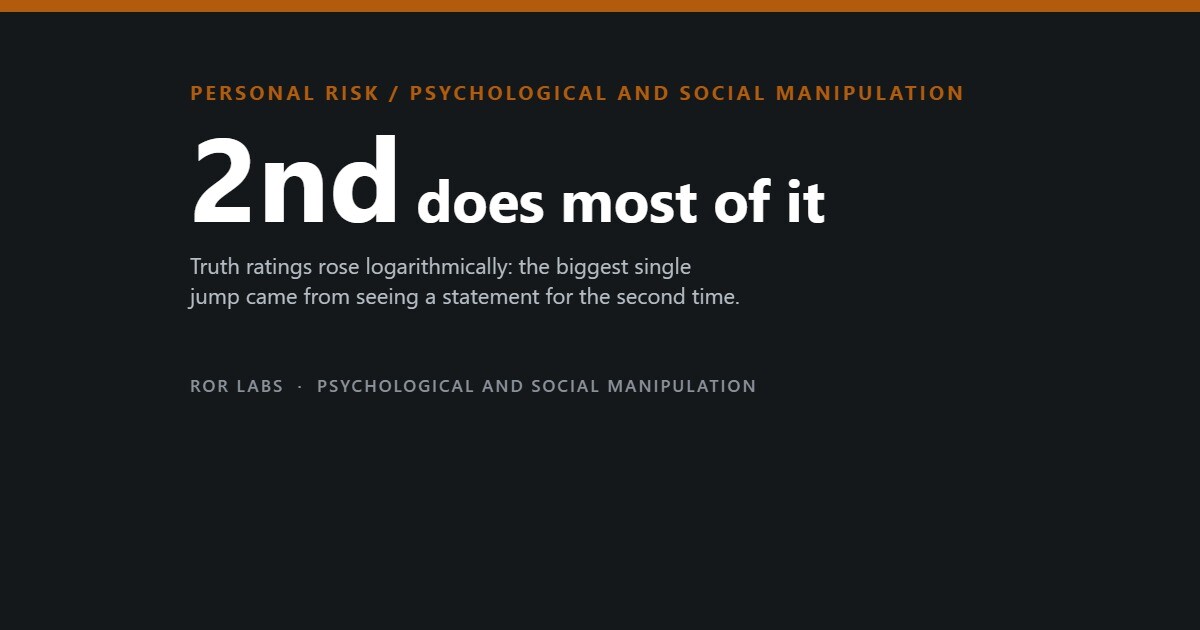
- The relationship is logarithmic. The second encounter produces the biggest jump; past nine repetitions the increases stopped being statistically significant.
- Measuring what people knew before the experiment, rather than after, does not rescue them: repetition still raised belief in statements contradicting their own knowledge.
- People who endorse climate science rated repeated climate-sceptical claims truer, by roughly as much as claims they agreed with.
In this article
Fifty-seven people were shown trivia statements up to twenty-seven times each. A week later they rated how true each one seemed, alongside statements they had never seen. The repeated ones scored 4.66 out of 7. The new ones scored 3.64.
That much is the famous finding, and it has been replicated for forty years. The less famous part is the shape of the curve. Almost the whole effect arrives on the second encounter. Going from nine repetitions to twenty-seven bought no reliable additional belief at all.
This article is about what repetition actually does to a claim — how large the effect is, where it stops growing, whether knowing better protects you, and the two places where researchers have looked hard and found nothing.
The second time does most of the work
The experiment above was run twice. In the first version, statements appeared one, three, five, seven or nine times; repeated items were rated 4.49 against 3.76 for new ones, a difference of about one standard deviation. In the second version the researchers pushed the repetition count to twenty-seven, because almost every previous study had used three or fewer.
Perceived truth did keep rising with repetition. But it rose logarithmically, not in a straight line: the largest single increase came from seeing a statement for the second time, and each further repetition added incrementally less. Beyond nine repetitions the increases were no longer statistically significant.
What repeating a statement buys you
Mean truth ratings on a 7-point scale, one week after exposure. Two experiments, 51 and 57 participants.
Hassan and Barber, Cognitive Research: Principles and Implications, 2021. The one-showing figure is read from their repetition-condition table; the effect against new statements was d = 1.09 in this experiment and d = 1.00 in the first.
That shape matters more than the headline. A claim you have met twice has already collected most of the advantage repetition can give it. The hundredth billboard is not doing what the first two did.
Which number you quote depends on how you measure
A meta-analysis of fifty-one studies of the effect found something that is rarely mentioned when the finding is cited. There are two ways to measure it. You can compare how a statement was rated the first time against how the same statement was rated the second time. Or you can compare repeated statements against different statements the participant has never seen.
The second method produces the larger effect, and the moderators behave differently in each — which the authors read as two distinct psychological comparisons. The practical point for a reader is narrower: a single quoted effect size for “the illusory truth effect” is underdetermined until you know which comparison produced it.
Two ways to measure, two different sizes
The same 51 studies, split by how the comparison was made.
Dechêne, Stahl, Hansen and Wänke, Personality and Social Psychology Review, 2010.
Knowing better does not seem to protect you
The intuitive defence is that repetition can only work on claims you have no view about. If you already know the answer, surely a false statement stays false however often you meet it.
Earlier studies that tested this had a design flaw: they measured what participants knew after the repetition, which conditions the result on something the treatment may itself have changed. One study fixed that by measuring prior knowledge first, before any exposure. Repeated false statements were still rated more true than new ones, including statements that contradicted what the participant had demonstrably known beforehand.
The same pattern shows up outside the laboratory. In two experiments with people who explicitly endorse climate science, repeated exposure raised the perceived truth of climate-sceptical claims and climate-science claims to a similar degree. Prior belief mattered a great deal for the overall ratings. It did not stop repetition from moving them.
Three defences that did not hold
Fazio, 2020; Jiang and colleagues, PLOS ONE, 2024; Lacassagne, Béna and Corneille, 2021.
That last caveat is worth keeping. In the implausibility study, repetition moved the ratings and the ratings stayed below the midpoint. Something can be reliably shifted without being shifted far enough to change what anyone believes. The experiments measure the push, not the destination.
How big is the disagreement about implausible claims
This is the one live dispute in the field, and it is instructive because the same researchers are on both sides of it.
One study of 503 participants found repeated statements rated true 52 per cent of the time against 48 per cent for new ones — a modest effect, d = 0.41. It also found that the effect looked largest for statements of middling plausibility, and argued that this is an artefact: at the extremes of a rating scale there is simply less room to move, the same way a test item that everyone passes cannot discriminate. On that reading, repetition works uniformly and the apparent pattern is measurement.
A later experiment by an overlapping group of authors, with 974 participants, measured each individual’s prior belief in each specific statement rather than using group averages. It reported the opposite: the effect was not merely present for statements the participant found implausible, it was stronger for them. That paper is a preprint and has not been peer reviewed, and it is cited here because it disagrees with the published account, not because it settles anything.
Two teams, overlapping authors, opposite answers
Fazio, Rand and Pennycook, 2019; Orchinik, Rand, Pennycook and Fazio, 2024.
What repetition does besides belief
Belief is the outcome the effect is named after, but it is not the only thing that moves, and the others may matter more.
In two experiments with 260 participants, people were more willing to share statements they had seen before, and the relationship between repetition and sharing ran through perceived accuracy — repetition made the claim feel truer, and the feeling of truth drove the sharing. In a naturalistic study, headlines describing wrongdoing were rated not only truer after repeated exposure but also less unethical.
Four preregistered experiments with 773 participants in total found something stranger still. Asked not whether a statement was true but whether they had known it before the experiment, participants said yes more often for repeated statements — including for repeated false statements, where they reported having known it was false. Recent exposure and long-standing knowledge are not reliably distinguishable from the inside.
What else moved after repetition
Vellani and colleagues, Cognition, 2023; Pillai, Fazio and Effron, Psychological Science, 2023; Speckmann and Unkelbach, Cognition, 2024; Jalbert and Pillai, Collabra, 2024.
What the evidence does not show
Three things cut against the summary above, and the first is the largest.
Opinions do not behave like facts. When researchers ran the standard paradigm on evaluative statements — the kind of social and political opinion that dominates the arguments people actually have — the effect vanished. In one study of 185 participants, repeated factual statements were rated truer than new ones, as expected. Repeated opinion statements were not: 4.39 against 4.46, a difference in the wrong direction and not distinguishable from zero. Equivalence testing supported the absence rather than merely failing to find presence. A later pair of preregistered experiments with 457 participants reported the same null, across statements participants agreed with, disagreed with and felt neutral about. That work is a preprint. Taken together, the two findings suggest the effect is strongest exactly where the stakes are lowest.
Facts moved, opinions did not
Mean truth ratings, repeated versus new statements, same 185 participants, same session.
Riesthuis and Woods, Psychological Research, 2023.
The setting is doing work. A 2026 review argues that the effect depends on an informational ecology of assertion, and that shifting the same material from affirmation to interrogation substantially weakens it. Awareness of the effect and instructions to focus on accuracy also reduce it. None of these makes it disappear, but they place it a long way from an inescapable feature of human memory.
Almost all of it is trivia. The canonical stimulus is a statement about the gestation period of a giraffe, rated by an undergraduate or a paid online participant who has no stake in the answer. The naturalistic studies — text messages across fifteen days, headlines encountered in daily life — are the best available bridge and there are only a handful of them. And a point the same literature makes about itself: people underestimate how much repetition moves them, particularly when asked about themselves rather than others. That applies to readers of this article.
Questions people ask
Does the effect wear off?
It survives a week in the standard design, which is how the experiments above were run, and a longitudinal study tracking it across intervals found it persisting rather than decaying immediately. How long it lasts beyond that is not well established.
Is it worse for older people?
In one of the experiments above, the gap between repeated and new statements widened with age. That is a single finding within a small sample, and the researchers restricted their second experiment to 18- to 35-year-olds partly to reduce that variability.
Does denying a false claim repeat it?
This is the mechanism behind the familiar advice not to restate a myth in order to debunk it. The research above does not test debunking directly. What it does show is that the interrogative framing of a claim behaves differently from the assertive framing, which is some evidence that how you repeat something is not incidental.
Does it work on advertising?
Advertising is the applied case usually cited, and the logarithmic shape is the relevant finding: the second exposure is worth far more than the twentieth. No study here measured purchases.
Can I train myself out of it?
Being told the effect exists reduces it, and being asked to focus on accuracy reduces it. Neither eliminates it, and neither has been tested outside short laboratory sessions.
The short version
- Repeated statements are rated truer than new ones. In one experiment, 4.66 against 3.64 on a 7-point scale a week later — about one standard deviation.
- The relationship is logarithmic. The second encounter produces the biggest jump; past nine repetitions the increases stopped being statistically significant.
- Measuring what people knew before the experiment, rather than after, does not rescue them: repetition still raised belief in statements contradicting their own knowledge.
- People who endorse climate science rated repeated climate-sceptical claims truer, by roughly as much as claims they agreed with.
- Blatantly implausible claims moved upward too — but stayed on the false side of the scale. The push is real; the destination is not established.
- Repetition also raised sharing, lowered moral condemnation of described wrongdoing, and made people report they had known the claim all along.
- On social and political opinions, two studies found no effect at all, with equivalence testing supporting the null. The effect is best demonstrated where the stakes are lowest.
- Almost the entire literature uses trivia statements and paid participants. The handful of naturalistic studies agree, and they are a handful.
This describes what published experiments have found about repetition and perceived truth. It is not a guide to evaluating any particular claim, and the research is not a diagnostic tool for deciding what is true. Effect sizes come from the studies named below and reflect the conditions those studies used — mostly trivia statements, short intervals and paid participants. Two of the findings cited here are preprints and have not been peer reviewed; they are flagged where they appear. Where the evidence cannot settle a question — whether any of this changes what people actually do — that is said rather than resolved.
Further reading: the 2021 repetition-frequency paper is open access, short, and its two tables are the clearest picture of the logarithmic shape anywhere. The 2023 review in Current Opinion in Psychology is four pages and covers the interventions that reduce the effect. The opinion-statement paper is the one to read if you want to see a careful null.
- Foolproof, Sander van der Linden (2023). The closest thing to a general-audience treatment of this literature by someone inside it. Strongest on the inoculation research; take the confidence about interventions as the author’s own position.
- Not Born Yesterday, Hugo Mercier (2020). The counterweight. Argues that people are far harder to influence than the gullibility literature implies, and makes the case with the same kind of evidence. Read it against the article above, not with it.
- How Minds Change, David McRaney (2022). A journalist’s tour of the research on why beliefs shift or hold, including repetition and familiarity. Readable rather than rigorous, so treat its stories as illustrations, not evidence.
Sources
- Hassan, A. and Barber, S.J., “The effects of repetition frequency on the illusory truth effect”, Cognitive Research: Principles and Implications, 6:38, 2021. (Two experiments, 51 and 57 participants, one-week delay. Experiment 1, repetitions of 1, 3, 5, 7 and 9: repeated M = 4.49 against new M = 3.76; t(50) = 7.16, d = 1.00. Experiment 2, repetitions of 1, 9, 18 and 27, ages 18–35: repeated M = 4.66 against new M = 3.64; t(56) = 8.22, d = 1.09. Increases logarithmic; largest jump at the second encounter; not statistically significant beyond 9 repetitions. In Experiment 1 the effect grew with age, F(1,49) = 7.05, p = .011.)
- Dechêne, A., Stahl, C., Hansen, J. and Wänke, M., “The truth about the truth: a meta-analytic review of the truth effect”, Personality and Social Psychology Review, 2010. (51 studies. The between-items effect — repeated statements against different new statements — is larger than the within-items effect, and several moderators act differently on the two, which the authors read as evidence of two distinct comparison processes.)
- Fazio, L.K., “Repetition increases perceived truth even for known falsehoods”, 2020. (Prior knowledge measured before the experimental manipulation rather than after, correcting a design flaw shared by earlier studies. Repeated false statements were rated more true than novel ones even when they contradicted participants’ demonstrated prior knowledge.)
- Fazio, L.K., Rand, D.G. and Pennycook, G., “Repetition increases perceived truth equally for plausible and implausible statements”, 2019. (Repeated M = .52 against novel M = .48, t(502) = 9.19, p < .001, d = 0.41. Argues the apparent concentration of the effect at middling plausibility is a psychometric artefact of restricted variance at the extremes rather than a psychological boundary.)
- Orchinik, R., Rand, D.G., Pennycook, G. and Fazio, L.K., “Repetition increases belief in implausible statements more than for plausible statements”, 2024. (N = 974, with prior belief measured for each individual statement rather than averaged across participants. Reports the effect is stronger for initially implausible statements — the opposite of the 2019 account. Preprint; not peer reviewed.)
- Lacassagne, D., Béna, J. and Corneille, O., “Is Earth a perfect square? Repetition increases the perceived truth of highly implausible statements”, 2021. (Preregistered. Highly implausible statements rated on a 100-point scale, new against five prior showings. Repeated statements judged more true — but all judgments fell below the scale midpoint.)
- Jiang, Y., Schwarz, N., Reynolds, K.J. and Newman, E.J., “Repetition increases belief in climate-skeptical claims, even for climate science endorsers”, PLOS ONE, 2024. (Two experiments. Prior belief strongly predicted ratings, but repeated exposure raised perceived truth for climate-science and climate-sceptical claims to a similar extent.)
- Fazio, L.K., Pillai, R.M. and Patel, D., “The effects of repetition on belief in naturalistic settings”, Journal of Experimental Psychology: General, 2022. (435 US participants texted true and false trivia across 15 days, seen 1, 2, 4, 8 or 16 times. Initial repetitions produced the largest increase, but belief continued to rise with additional repetitions — a pattern the authors say current accounts do not fully explain.)
- Pillai, R.M., Fazio, L.K. and Effron, D.A., “Repeatedly encountered descriptions of wrongdoing seem more true but less unethical”, Psychological Science, 2023. (Naturalistic setting. Truth ratings rose logarithmically with the number of views; one log-unit increase in views was associated with about a 1.49-point increase in perceived truth, SE 0.39, t(20.18) = 3.79, p < .001. Repeated wrongdoing was also judged less unethical.)
- Vellani, V., Zheng, S., Erçelik, D.F. and Sharot, T., “The illusory truth effect leads to the spread of misinformation”, Cognition, 2023. (Two experiments, N = 260. Participants were more likely to share previously seen statements, and the relationship between repetition and sharing was mediated by perceived accuracy. Observed for health claims and general-knowledge claims.)
- Speckmann, F. and Unkelbach, C., “Illusions of knowledge due to mere repetition”, Cognition, 2024. (Four preregistered experiments, total N = 773. Asked whether they had known each statement before the study, participants said yes more often for repeated statements, including repeated false statements they reported having known to be false.)
- Jalbert, M. and Pillai, R.M., “An illusory consensus effect”, Collabra: Psychology, 2024. (Two experiments with unattributed trivia claims. Repetition significantly increased estimates of how many other people would believe, or already knew, the claim.)
- Riesthuis, P. and Woods, J.W., “That’s just like, your opinion, man: the illusory truth effect on opinions”, Psychological Research, 2023. (Same participants, same session. Factual statements: repeated M = 5.71, SD 1.09 against new M = 5.55, SD 1.14; t(184) = 4.21, p < .001, dz = 0.31. General opinion statements: repeated M = 4.39 against new M = 4.46; t(184) = −1.42, p = .16, dz = −0.08, with equivalence testing significant against the lower bound.)
- Woods, J.A. and Riesthuis, P., “Limits of the illusory truth effect for social-political opinions”, 2026. (Two preregistered experiments, N = 457. Repetition did not reliably increase truth judgments for social and political opinion statements, and equivalence tests indicated any effects were smaller than the predefined smallest effect size of interest, across statements participants agreed with, disagreed with or rated neutral. Preprint; not peer reviewed.)
- Udry, J. and Barber, S.J., “The illusory truth effect: a review of how repetition increases belief in misinformation”, Current Opinion in Psychology, 2023. (Review. Covers extensions beyond trivia to fake-news headlines and conspiracy beliefs, and the interventions that reduce the effect — instruction to focus on accuracy, and awareness that the effect exists.)
- Mattavelli, S., “New insights on the illusory truth effect: societal reach, cognitive foundations, and mitigation strategies”, European Review of Social Psychology, 2026. (Review. Reports that repetition strengthens stereotypical beliefs and lends credibility to communicators, that people underestimate its influence on themselves in particular, and that moving the informational ecology from affirmation to interrogation substantially weakens the effect.)
- Henderson, E.L., Simons, D.J. and Barr, D.J., “The trajectory of truth: a longitudinal study of the illusory truth effect”, Journal of Cognition, 2021. (Tracks the effect across intervals rather than at a single delay.)
- Unkelbach, C. and Rom, S.C., “A referential theory of the repetition-induced truth effect”, Cognition, 2017. (Five experiments. Proposes coherent references in memory rather than processing fluency as the mechanism, and constructs conditions under which repetition should not affect judged truth — useful as a statement of where the effect is predicted to fail.)