Flood Warnings at Night: What the Evidence Shows
Key takeaways · 13 min read
- Night-time warnings reach fewer people. In a Tennessee survey, over 80% expected to get a daytime tornado warning but fewer than half a night-time one.
- Most recorded US flood deaths happen in vehicles or in water people walk into. Deaths in camps are rare in the record, but one night can exceed decades of them.
- On 4 July 2025 a flash flood warning reached Kerr County phones at 1:14 a.m. The river at Hunt rose more than 20 feet in about two hours; more than 130 people died.
- A federal review estimated the warning gave Hunt 106 minutes but Kerrville 26. A Texas legislative inquiry found failures in camp emergency planning and county coordination.
At 1:14 on the morning of 4 July 2025, the National Weather Service sent a flash flood warning to phones in central Kerr County, Texas. Most people there were asleep. Within four hours the South Fork of the Guadalupe River had risen more than 20 feet at Hunt. By the end of the day more than 130 people in the region had died, among them 25 campers and two counselors at a girls’ summer camp.
This article asks why warnings, sometimes issued with time to spare, so often fail to reach or move people. It draws on research on night-time storms and flood deaths, the 2026 official reviews of the Kerr County flood and the laws Texas passed afterwards. An earlier article covered deaths in vehicles during flash floods; this one is about people at home, in cabins and in tents.
The short answer is that a warning is a chain, and at night most links are weaker. Phones are on silent, sirens are built for people outdoors, neighbours are asleep, and those who wake look for confirmation before they move. On a river that can rise several feet in minutes, small delays add up.
How a flood warning reaches you
In the United States the warning starts at a National Weather Service forecast office. A flood watch means conditions could produce flooding. A flash flood warning means flooding is happening or about to. The worst cases become a ‘flash flood emergency’, tagged ‘catastrophic’.
What matters at 1 a.m. is which of these make a phone sound. According to the Commerce Department’s inspector general, the Kerr County flood watch of 3 July did not trigger Wireless Emergency Alerts (WEA) or the Emergency Alert System. Neither did the river flood warnings issued after 3 a.m. The flash flood warning and the flash flood emergencies did.
WEA messages need no sign-up, but the report notes the limits: a phone that has opted out, is in airplane mode or has no signal will not get them. NOAA Weather Radio is the oldest layer. A receiver with a SAME decoder can be set to the codes for chosen counties and switches itself on with a 10-second, 1050-hertz alarm tone. A transmitter reaches about 40 miles on level ground, less in hills. Outdoor sirens are the third layer, and in July 2025 the upper Guadalupe had none.

Why night is different
The best evidence on night-time warnings comes from tornadoes. Walker Ashley and colleagues examined US tornadoes from 1950 to 2005. Only 27.3% happened between sunset and sunrise, yet those tornadoes caused 39.3% of deaths. Tornadoes between midnight and sunrise were 2.5 times as likely to kill as daytime ones.
Tornadoes at night kill out of proportion
Share of US tornadoes, deaths and killer events that were nocturnal (between sunset and sunrise), 1950–2005.
Source: Ashley, Krmenec and Schwantes, Weather and Forecasting (2008). Tornadoes only.
A 2022 follow-up by Stephen Strader and colleagues found night-time tornadoes still nearly twice as deadly as daytime ones, despite better radar. Much of the gap is human: people are asleep, and the usual ways of hearing about danger are off.
Surveys show the gap directly. Lisa Reyes Mason and colleagues gave 1,804 randomly sampled Tennessee residents a day or a night version of the same tornado scenario. Over 80% of the day group rated their chance of getting the warning high or very high, against fewer than half of the night group.
The night-time reception gap
How likely people say they are to get a tornado warning, and when they actually learned of an overnight tornado.
Sources: Mason et al. (2018), 1,804 Tennessee residents; Porter et al. (2024), 221 Nashville adults. Self-reports, not measured receipt.
After an overnight tornado in Nashville, Megan Porter and colleagues found that about half of 221 Black and Latinx adults learned of it only as it hit. Sleep, their own and their contacts’, was the commonest barrier.
Who dies in floods, and where
Flood fatality databases tell a different story. Sharon and Walker Ashley’s US database for 1959 to 2005 found that most deaths came from flash floods and that 63% of deaths with a known circumstance were in vehicles. The Balcones Escarpment of south-central Texas, which includes the Guadalupe, was a hotspot.
Zhongyu Han and Hatim Sharif extended the record to 2019 and counted 6,478 flood deaths in the contiguous states, 1,069 of them in Texas. Of the deaths with a known circumstance, 57.8% involved vehicles and 28.3% people who walked into water. People dying in their own homes made up 5.7%, and camping 1.2%: 45 deaths in 61 years.
Where US flood deaths happened, 1959–2019
Share of flood deaths in the contiguous US with a recorded circumstance, by setting.
Source: Han and Sharif, Water (2021), from NOAA Storm Data; 59% of 6,478 deaths had a recorded circumstance.
Here the denominators matter. Storm Data records a circumstance for only 59% of deaths and a time for 38%, and the authors call it underreported. Of deaths with a time, about half came at night. A record built from thousands of single deaths on roads says little about rare nights when a river reaches people asleep who never chose to go near the water.
Galateia Terti and colleagues, studying 1,075 US flash-flood deaths from 1996 to 2014, found most campsite deaths came in very fast-responding floods. That is the Hill Country’s signature: thin soils over limestone send rain to the rivers quickly, hence the name Flash Flood Alley.
The Guadalupe River on 4 July 2025
Thomas Galarneau and colleagues, in the Bulletin of the American Meteorological Society, describe a near-stationary supercell that dropped more than 250 millimetres, mostly within three hours, over the Guadalupe headwaters. They count 137 deaths in South Texas, 119 in Kerr County, with two people missing; other tallies differ slightly.
One night on the upper Guadalupe
Key times, 3–4 July 2025 (Central Daylight Time). Bar length shows hours elapsed since the flood watch.
Sources: Commerce Department inspector general, OIG-26-017-I (2026); CodeRED time from Sharif and Bose (2026). Times are approximate.
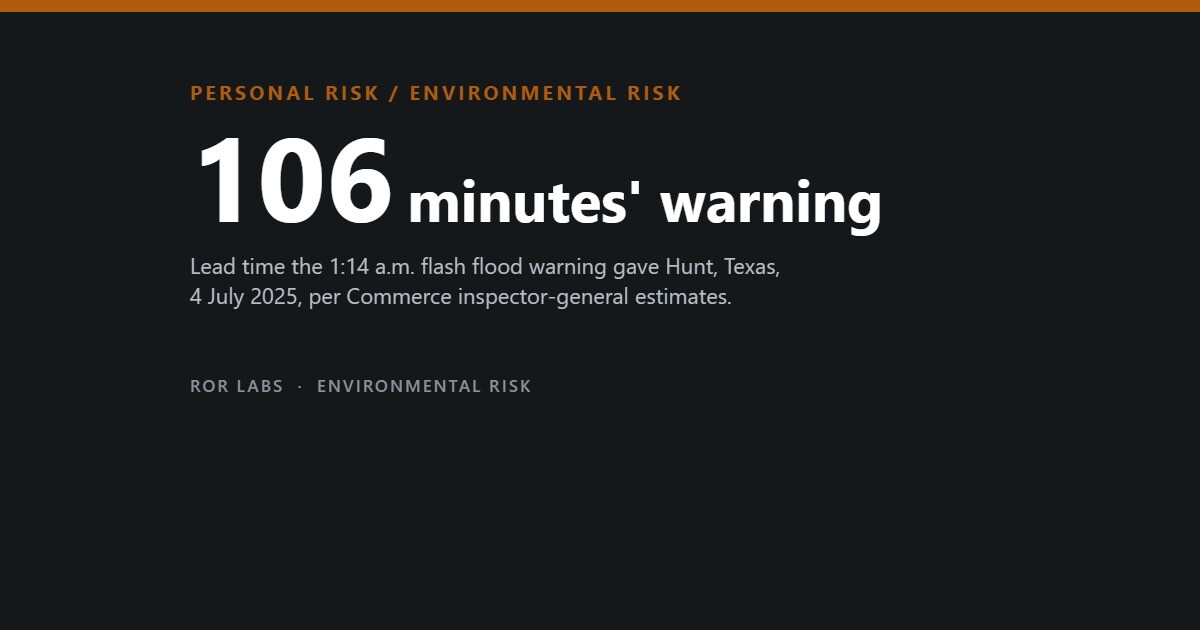
The inspector general estimated that the 1:14 a.m. warning gave Hunt 106 minutes of lead time, above the agency’s 65-minute goal, and Kerrville, downstream, 26 minutes. It did not test whether that goal is long enough for people asleep beside a river.
Richard ‘Dick’ Eastland, 70, owned and directed Camp Mystic with his wife, Tweety; his family had run it for decades. He died that morning; former campers and family said he had been trying to reach girls in the cabins. Legislative investigators later found he was probably the only person at the camp watching conditions, and that shortly after 3 a.m. he told his son and the night watchman to evacuate.
Elsewhere along the river in Kerr County, Taylor Bergmann, 19, woke to flickering lights. He told NPR he had seen a flash flood warning in the forecast before bed. The river was already inside. Before he could get Erin Burgess, 42, who had taken him in as a teenager, onto the roof, the current carried them into a tree. They held on in the dark for about an hour.
What the official reviews found
Two official reviews had appeared by mid-2026. The inspector general reported in April that the Austin/San Antonio forecast office had six of 27 posts vacant; staff said this did not affect their warnings. Forecasters tried to call the county emergency management coordinator from about 3:38 a.m. and got through at 6:19 a.m.
The review made no recommendations, called itself a snapshot and did not examine sirens or what local officials sent out. NOAA argued that the 65-minute goal is an average across warnings; the inspector general replied that averages hide communities that get far less.
In June 2026 a joint committee of the Texas Legislature released a 115-page report by investigators it had hired. It found that Camp Mystic lacked written emergency plans meeting state requirements, that cabin instructions covered only sheltering in place, and that counselors’ phones had been collected with no radios in their place. There had been time, it judged, to move campers to higher ground.
It also found that county officials had not coordinated with summer camps before the storm and were not on watch as the flood began. These are a legislative inquiry’s findings, not a court’s.
The gap between warning and action
A warning that arrives still has to be acted on. People first look for confirmation: they check another source, call a relative, look outside. Dennis Mileti and John Sorensen’s 1990 review of more than 200 studies found that the source, content and consistency of a warning shape whether people heed it. Later work named the search for confirmation milling.

A 2018 experiment by Michele Wood, Mileti and colleagues tested this with mock phone alerts. Longer messages, saying what was happening, where, what to do and by when, reduced the urge to seek confirmation compared with short ones.
Germany’s July 2021 floods show the gap in a modern system. In an online survey of 1,315 affected residents by Annegret Thieken and colleagues, 35% in North Rhine-Westphalia and 29% in Rhineland-Palatinate said they got no warning. Of those who were warned, 85% did not expect very severe flooding, and 46% said they did not know how to protect themselves. Residents had to subscribe to warning apps; a cell broadcast system was introduced in 2022.
In Sinzig, on the Ahr, 12 residents of a home for people with intellectual disabilities drowned in the early hours of 15 July 2021. The charity’s head said the one night staff member, in a neighbouring house, could not reach them as the water rose; 24 residents were rescued from upper floors.
Warned, but not ready
Results from an online survey of residents affected by the July 2021 floods in western Germany.
Source: Thieken et al. (2023); 1,315 respondents recruited online, so the very old are under-represented.
In 2024 prosecutors dropped a negligent-homicide inquiry into the district’s former head, citing too little evidence that quicker action would have saved lives. The design lesson is plain: people who need help to move cannot act on a warning alone, least of all when the only person awake is elsewhere.
What changed in Texas
On 5 September 2025 Texas enacted three bills. Senate Bill 1, the Heaven’s 27 Camp Safety Act, bars licensing youth camps with cabins in FEMA-designated floodplains, with limited exceptions, and extends safety standards to campgrounds and RV parks. House Bill 1 requires annual emergency plans, staff training and signed parental acknowledgment of floodplain risk. Senate Bill 3 funds flood sirens.
In May 2026 the Upper Guadalupe River Authority began testing eight sirens west of Ingram, the first phase of a system with rain and water-level sensors. Its own description is modest: the sirens supplement phone alerts.
In the first real test, in mid-July 2026, the AP reported that three of the six new Kerr County sirens told people to seek high ground, and a fire chief in nearby Comfort said some residents still would not leave. At least two people died. A siren adds a link to the chain without replacing the others.
A plan for a night by the river
The research points to redundancy: meteorologists urge more than one way to get a warning at night. A battery-backed weather radio set to your county and those upstream does not depend on phone settings or towers. Keep emergency alerts on, the phone charged and out of airplane mode, and check whether alerts sound through silent mode.
Know where you are sleeping. Before booking a riverside cabin, campsite or RV pitch, check FEMA’s flood maps and ask who watches the weather overnight and what the evacuation plan is. An afternoon flood watch is the time to decide where you would go.
Then decide before you need to. A simple rule helps: if a flash flood warning arrives at night near a river or creek, move to higher ground first and look for confirmation once there. Never walk or drive into moving water.
What to do
Steps sorted by when they matter. Each one says how strong the evidence is: Measured Official advice Untested
Before
- Set up more than one way to be warned at night, such as phone alerts plus a battery-backed weather radio. Measured see Sources
- Program a weather radio with the SAME codes for your county and the counties upstream of you. Official advice see Sources
- Before booking a riverside cabin, campsite or RV pitch, check FEMA’s flood maps and ask about the evacuation plan. Untested see Sources
- If your child attends a Texas youth camp, read the camp’s emergency plan and floodplain notice; the law now requires both. Official advice see Sources
If it happens
- When a flood watch is issued, decide where you would go and charge your phone before you sleep. Untested see Sources
- Keep emergency alerts on and the phone out of airplane mode; alerts do not reach phones that opted out or have no signal. Official advice see Sources
- If a flash flood warning arrives at night near a river or creek, move to higher ground first and check details once there. Measured see Sources
Afterwards
- Ask your camp, campground or council how warnings will reach people asleep, and who watches the weather overnight. Untested see Sources
- Find out whether your area has outdoor sirens and when they are tested, remembering they supplement phone alerts. Official advice see Sources
What not to do
- Do not rely on outdoor sirens to wake you indoors; walls greatly reduce their sound. Measured see Sources
- Do not wait for neighbours or a second source to confirm a flash flood warning before moving. Measured see Sources
- Do not walk or drive into moving floodwater. Measured see Sources
Not official guidance. Follow instructions from local emergency services; if water is rising, move to higher ground first.
Questions people ask
Will a flood watch wake me up?
Usually not. In Kerr County the watch went out on NOAA Weather Radio but not to phones. Use a watch to plan your route; the flash flood warning is what triggers a phone alert.
Do outdoor sirens work for people asleep indoors?
Not reliably. Walls greatly reduce siren sound, and the river authority describes its new sirens as a supplement to phone alerts. In the Nashville study, people relying on sirens tended to learn of the tornado only as it arrived.
How can I tell if a campsite is in a flood zone?
Check FEMA’s flood maps and ask the operator. Treat the map as a floor, not a ceiling: the 2025 flood beat the 1932 peak-flow record at Hunt. Any pitch beside a river in a narrow valley is exposed.
Why don’t people leave when they are warned?
Most people seek confirmation first, which takes longer at night, and few picture how fast a river can rise. Clear messages and a plan made in daylight shorten the delay.
The short version
- Night-time warnings reach fewer people. In a Tennessee survey, over 80% expected to get a daytime tornado warning but fewer than half a night-time one.
- Most recorded US flood deaths happen in vehicles or in water people walk into. Deaths in camps are rare in the record, but one night can exceed decades of them.
- On 4 July 2025 a flash flood warning reached Kerr County phones at 1:14 a.m. The river at Hunt rose more than 20 feet in about two hours; more than 130 people died.
- A federal review estimated the warning gave Hunt 106 minutes but Kerrville 26. A Texas legislative inquiry found failures in camp emergency planning and county coordination.
- Texas now bars licensing youth camp cabins in floodplains, requires emergency plans and funds sirens. Sirens helped in July 2026, but gaps remained.
- At night by a river, have two ways to be woken, know your route to high ground, and move first when a flash flood warning arrives.
This article summarises research, official reports and news for general information. It is not professional safety or legal advice. Follow your local emergency managers and the National Weather Service, and call emergency services if you are in danger.
Further reading: Ashley et al., Weather and Forecasting (2008), on why night-time storms kill more people. Thieken et al., NHESS (2023), on a modern warning system meeting a fast flood. The inspector general’s review OIG-26-017-I (2026), for the hour-by-hour Kerr County record.
Sources
- US Department of Commerce, Office of Inspector General. Review of the National Weather Service’s Actions to Support Kerr County During the Catastrophic Flash Flood in Texas. Report OIG-26-017-I (9 April 2026).
- Texas Tribune. Texas lawmakers issue final Camp Mystic investigative report (18 June 2026); Spectrum News, Report on Camp Mystic details multiple failures in planning, response to floods (19 June 2026).
- Associated Press (via PBS NewsHour). Texas Hill Country floods test new warning systems after last year’s deadly disaster (18 July 2026).
- Office of the Texas Governor. Governor Abbott signs Texas summer camp safety bills into law (5 September 2025).
- Texas Public Radio. Flood warning siren testing underway along Guadalupe River in Kerr County (10 May 2026).
- Texas Public Radio. Camp Mystic director among the dead in Guadalupe River flood (5 July 2025).
- NPR (Martínez-Beltrán S). Clinging to a tree and praying: how a family survived the Texas flash floods (9 July 2025).
- Galarneau TJ, Carlin JT, Clark R, et al. Hydrometeorological analysis of the July 2025 Texas Hill Country flash flood disaster. Bull Am Meteorol Soc (2026), doi:10.1175/BAMS-D-25-0227.1.
- Sharif HO, Bose AR. Flash flood mortality in Texas’ flash flood alley: compound hazards, evolving challenges, and the imperative for impact-based risk governance. Front Water (2026), doi:10.3389/frwa.2026.1832344 (Perspective).
- Ashley WS, Krmenec AJ, Schwantes R. Vulnerability due to nocturnal tornadoes. Weather Forecast 23(5) (2008).
- Strader SM, Ashley WS, Haberlie AM, et al. Revisiting U.S. nocturnal tornado vulnerability and its influence on tornado impacts. Weather Clim Soc (2022), doi:10.1175/WCAS-D-22-0020.1.
- Mason LR, Ellis KN, Winchester B, et al. Tornado warnings at night: who gets the message? Weather Clim Soc (2018), doi:10.1175/WCAS-D-17-0114.1.
- Krocak MJ, Allan JN, Ripberger JT, et al. An analysis of tornado warning reception and response across time: leveraging respondent’s confidence and a nocturnal tornado climatology. Weather Forecast (2021), doi:10.1175/WAF-D-20-0207.1.
- Porter MS, Ellis KN, First JM, et al. When Black and Latinx Nashville residents became aware of a nocturnal tornado threat in Middle Tennessee. Prof Geogr (2024), doi:10.1080/00330124.2024.2390530.
- Ashley ST, Ashley WS. Flood fatalities in the United States. J Appl Meteorol Climatol 47(3) (2008).
- Han Z, Sharif HO. Analysis of flood fatalities in the United States, 1959–2019. Water 13(13):1871 (2021).
- Terti G, Ruin I, Anquetin S, et al. A situation-based analysis of flash flood fatalities in the United States. Bull Am Meteorol Soc 98(2) (2017).
- Mileti DS, Sorensen JH. Communication of emergency public warnings: a social science perspective and state-of-the-art assessment. Oak Ridge National Laboratory (1990), doi:10.2172/6137387.
- Wood MM, Mileti DS, Bean H, et al. Milling and public warnings. Environ Behav (2018), doi:10.1177/0013916517709561.
- Thieken AH, Bubeck P, Heidenreich A, et al. Performance of the flood warning system in Germany in July 2021: insights from affected residents. Nat Hazards Earth Syst Sci 23:973 (2023).
- Keast DN. Outdoor sirens: how do they work for people indoors? J Acoust Soc Am (1987), doi:10.1121/1.2024832 (conference abstract).
- National Weather Service. NOAA Weather Radio: warning alarm and SAME (weather.gov/nwr).
- Times of Oman (dpa). German prosecutors drop probe over 2021 deadly flooding (18 April 2024); carehome.co.uk, Disabled care home residents drown in Germany’s floods (20 July 2021).