Wildfire Evacuation: What the Evidence Shows
Key takeaways · 13 min read
- Wildfire deaths fall heavily on older, ill and disabled people. Identified Camp Fire victims had a mean age of 72.
- Australian records show the danger of being caught outside or leaving late. After Black Saturday, the royal commission concluded that leaving early is the safest option.
- Lahaina’s sirens were not used and mobile service was down at times. In west Altadena, where 18 of the Eaton fire’s 19 victims died, most orders came at 3:25 a.m. or later.
- In the Camp Fire, 17 burnovers caught evacuating civilians, five in stopped traffic. A 2026 US study found deaths concentrated where towns had fewer than about six exit roads.
In this article
On the morning of 8 November 2018, the Camp Fire spread more than 12 kilometres in its first two hours and reached Paradise, California, before many residents knew it was coming. Eighty-five people died. Lahaina burned in 2023, and Los Angeles in January 2025. Each time the question was the same: why did people who might have got out still die?
This article is about the escape itself: who dies, how warnings worked or failed, and what traffic studies say about moving thousands of cars down a few roads. Making the house harder to ignite is a separate subject, covered in our article on home ignition in the first five feet.
A caution: fatal fires are rare, numbers are small, and most studies describe the dead without comparing them with survivors. Where a finding comes from a model, a conference abstract or an early count, the text says so.
Who dies in fast wildfires
For much of the twentieth century, the people wildfire killed in the United States were mainly firefighters. In a 2025 conference abstract, Crystal Kolden and John Abatzoglou describe a shift to fires that kill many civilians at once, driven by downslope winds in drought at the edge of towns. Social vulnerability was a key driver: older residents with limited mobility struggled to escape.
Direct deaths in five recent fast fires
Official counts of people killed by the fire itself.
Sources: Victorian Bushfires Royal Commission (2010); NIST Technical Note 2252 (2023); FSRI report for the Hawaii Attorney General (2024); Associated Press (January 2026).
Age stands out. In a conference abstract on the 83 identified Camp Fire victims, Samuel Mijal and P. Willey reported a mean age of 72; no children died. In Victoria’s Black Saturday fires, the royal commission found that nearly half of the 173 dead were ‘vulnerable’: under 12, over 70, or living with an acute or chronic illness or disability.
The direct counts are also incomplete. Using weekly death records, Eugenio Paglino and colleagues estimated at least 440 excess deaths in Los Angeles County between 5 January and 1 February 2025, against 31 deaths counted as caused by the fires. A similar analysis for Maui found 82 excess deaths in August 2023.

Australia: stay, go, or leave too late
Australia keeps the longest record. Katharine Haynes and colleagues compiled 552 civilian bushfire deaths from 1901 to 2008 from coroners’ files and newspapers. The pattern was split by sex. Men were most often killed outside while trying to protect property; most women and children died sheltering in a house or trying to flee.
A wider dataset compiled by Raphaële Blanchi and colleagues covered 674 civilian deaths from 1901 to 2011. The ten worst fire days accounted for 64% of them. That clustering shaped the policy of ‘prepare, stay and defend, or leave early’: decide in advance, and avoid the late drive through smoke.
Black Saturday, 7 February 2009, tested the policy. The royal commission found its central ideas still sound but said it had not allowed for fires of that ferocity. Its summary put one line at the centre: leaving early is still the safest option. It also called for refuges and assisted evacuation for vulnerable people.
Interview studies show where plans fray. Of 223 householders who stayed to defend on Black Saturday, 79% saved the house. Of 216 who left, only 39% had planned to leave, and 36% left under hazardous conditions (McLennan et al., 2013). A 2021 review found that 26% of the 172 civilian dead had been waiting to see what the fire would do.
Black Saturday, 2009: plans and what happened
From interview studies and fatality records; each row has its own denominator.
Sources: Strahan and Gilbert (2021), review of Black Saturday studies; McLennan et al. (2013), interviews with 223 people who stayed and 216 who left.
One of the few comparisons of the dead with survivors, by John Handmer and colleagues, found older people and men over-represented among the dead; most survivors said they had done what they intended. It rests on one fire day and a postal survey.
Paradise, 2018: when the roads closed
The Camp Fire forced about 40,000 people out of Concow, Paradise and Magalia. A case study by the US National Institute of Standards and Technology (NIST) counted 31 temporary refuge areas, from car parks to road junctions, sheltering more than 1,200 civilians, and 198 rescue or assisted-evacuation events involving at least 1,000 people.
The roads became a hazard of their own. NIST engineers Eric Link and Alexander Maranghides identified 23 burnover events, in which fire trapped or overran people. Seventeen caught evacuating civilians, an estimated 300 to 500 of them, and twelve were on main exit roads. In five, traffic had already stopped in gridlock or behind an obstruction before the fire front arrived. On one 1.6-kilometre stretch of the Skyway, 85 vehicles were abandoned.
Camp Fire, 2018: burnovers on the way out
Events in which fire trapped or overran people during the first 26 hours.
Source: Link and Maranghides (2022), NIST case study data, Advances in Forest Fire Research.
The Sacramento Bee reported that the county’s CodeRed alerts reached only people who had signed up, and the system was overwhelmed early. About a quarter of the Paradise-area population, roughly 9,500 people, had a disability, more than double the state rate.
Margaret Newsum, 93, was in her wheelchair in Magalia as the fire came. Dane Cummings, a garbage truck driver, got her out of the chair and drove her to safety, the paper reported. She lived because someone happened to be there, which is no plan at all.
Lahaina, 2023: warnings that never arrived
On 8 August 2023, wind-driven fire burned through Lahaina on Maui. At least 102 people died and about 17,000 survived. The Fire Safety Research Institute (FSRI) reviewed the response for Hawaii’s attorney general in three reports. The first, in April 2024, found that the outdoor siren network was not used to warn Lahaina and that, with mobile service down at times, residents and visitors could not receive emergency alerts.
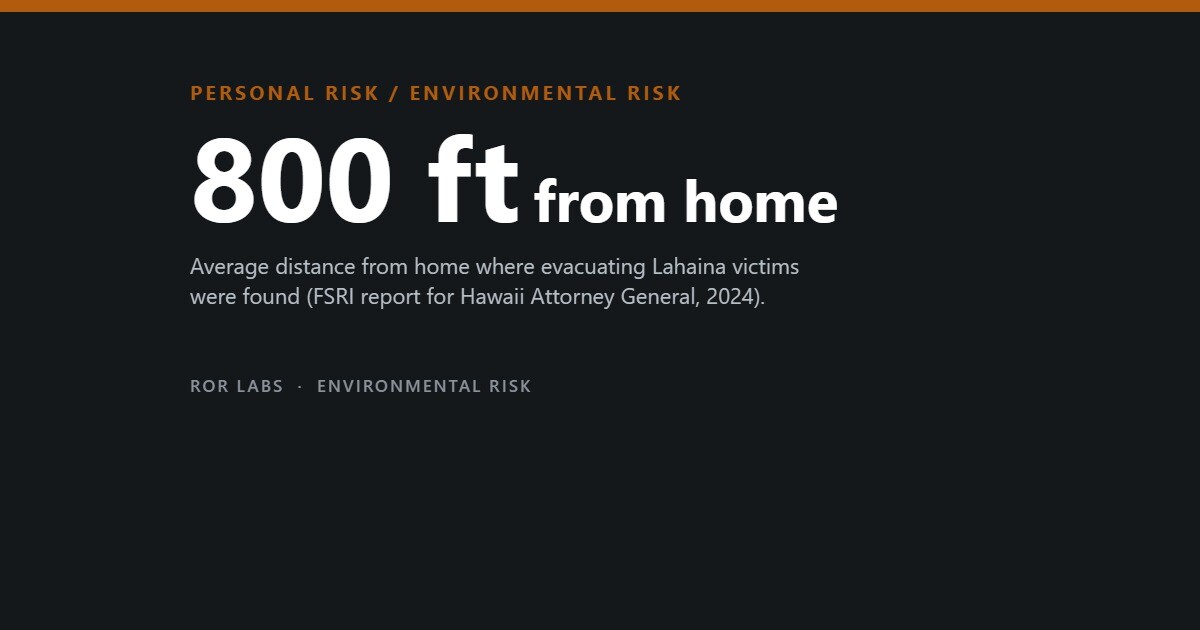
The second, in September 2024, followed the victims. More than 60% had tried to flee. Nearly 80% died in central Lahaina, and those who were evacuating were found on average about 800 feet from home. Downed poles, crashes, dead signals and smoke jammed traffic; some back roads were blocked by locked gates. Six residents of one independent-living complex, average age 86, died in their apartments.
Joseph Lara, 86, was found beside his pickup truck in a parking structure. The report suggests he may have been trying to head north on Front Street when traffic stopped him. ‘He was alone,’ his daughter, Misty Lara, told the Associated Press. ‘He didn’t have anyone to tell him he should go here, here, here.’
The same report found ‘no evidence’ that officials had prepared for the fire, despite days of warnings about critical fire weather. A third report, in January 2025, set out priorities for the state. None reduces the deaths to one cause.
Altadena, 2025: the line at Lake Avenue
The Eaton fire started on the evening of 7 January 2025 in Eaton Canyon. Residents east of North Lake Avenue in Altadena were ordered out at 7:25 p.m. Thousands west of it got their first electronic orders at around 3:30 a.m., the Los Angeles Times found. All but one of the 19 people the fire killed died west of Lake.
Anthony Mitchell, an amputee who used a wheelchair, lived in Altadena with his son Justin, who had cerebral palsy. On the morning of 8 January he called his children to say he was waiting for help to evacuate the two of them. Both died. ‘There was no way my father was going to leave him,’ his son Anthony Jr. told NPR.
Priscilla Shurney, 73, had had a stroke and relied on medical devices. Her family did not realise they needed to flee until nearly 6 a.m. and had to lift her into a wheelchair. She died two days later and is not in the official toll.
Three reviews of that night do not fully agree. A county review by the McChrystal Group, in September 2025, called alert practices ‘outdated, unclear and contradictory’ but found no single point of failure. A Citygate Associates investigation in May 2026 found ‘no failure’ to request orders sooner; with aircraft grounded, commanders learned of the westward spread at about 2:18 a.m.
Eaton fire: the night in west Altadena
Times on 7 and 8 January 2025. Bar length shows hours since the fire began that evening.
Sources: Los Angeles Times (26 January 2025); Citygate Associates for LA County (May 2026); UL Research Institutes report via Los Angeles Times (October 2026).
The state review by UL Research Institutes, in October 2026, adds what commanders did not see. The first 911 call from west of Lake came more than four hours before the 3:25 a.m. order. Some people, it found, may not have known how close the fire was or what their evacuation status was. Whatever the verdict, an order can arrive after the danger.
What traffic models can and cannot tell us
Roads set a hard limit. Writing in PNAS in 2026, Caitlin Fong and colleagues matched 342 US wildfire deaths from 2008 to 2024 to the road networks of communities of under 50,000 people. Deaths were concentrated where there were few exit roads and fell steeply up to about six; beyond that, more roads added little. Paradise had six and still lost 66 people. The study is observational (funded by the Gordon and Betty Moore Foundation) and cannot show that a new road would save a given town.
In a simulation of a hypothetical fire in the Berkeley hills, informed by surveys of people who fled California fires in 2017 and 2018, Bingyu Zhao and Stephen Wong found that limiting each household to one vehicle and having half of drivers use GPS rerouting cut the number of vehicles exposed at the fire front by more than half.
Real evacuees do not behave like model drivers. Using phone location data for 5,338 residents during the 2019 Kincade Fire in Sonoma County, Xilei Zhao and colleagues found that a third of evacuees left before any instruction. Among residents inside warning and order zones whose behaviour could be classified, 46% evacuated. Phone data have biases, the authors note; a survey of the same fire put the share higher.
Kincade Fire, 2019: who left, and when
Evacuees inferred from phone location data for 5,338 residents, Sonoma County, California.
Source: Zhao et al. (2021), arXiv preprint. First four rows: shares of all identified evacuees.
Early departures from outside the danger zone, so-called shadow evacuees, can load the roads. For households, models and field data agree: go early, in one car if you can, before the surge.
Leaving early, in practice
CAL FIRE says that if officials suggest evacuating it is best to leave right away, and that you should not wait for a mandatory order if you feel at risk. Keep a kit packed in the car with water, food, a first-aid kit and important papers, and park facing out.
Do not rely on one channel. In a telephone survey after the 2007 San Diego fires, 78% of people who received warnings from more than one source evacuated, and 80% of those who got a reverse-911 call (Strawderman et al., 2012). Sign up for county alerts, keep phone emergency alerts on, and treat a neighbour’s knock or a column of smoke as a warning.
The hardest part is the person who cannot leave alone. Decide now who will drive a relative without a car, who holds a spare key and how a wheelchair or oxygen supply travels with them. In the cases above, much depended on whether another person was there in time.
If you are trapped, CAL FIRE advises staying inside the house, away from outside walls and windows, or, in a car, parking clear of vegetation, shutting windows and vents, lying on the floor under a wool blanket or jacket, and calling 911. These are last resorts.
What to do
Steps sorted by when they matter. Each one says how strong the evidence is: Measured Official advice Untested
Before
- Pack a go bag with water, food, a first-aid kit and important papers, and keep it in the car. Official advice see Sources
- Sign up for your county’s emergency alerts and keep phone emergency alerts switched on; use more than one channel. Measured see Sources
- Agree now who will drive a relative without a car, who holds a spare key, and how a wheelchair or oxygen supply will travel. Untested see Sources
- Learn at least two routes out of your area and drive them once. Untested see Sources
If it happens
- Leave as soon as officials suggest evacuating, or earlier if you feel at risk; do not wait for a mandatory order. Official advice see Sources
- Treat a neighbour’s knock, a column of smoke or falling embers as a warning in its own right. Untested see Sources
- Take one car per household if you can, to keep the roads moving. Measured see Sources
- If you are trapped, call the emergency number; in a car, park clear of vegetation, shut windows and vents and lie on the floor under a wool blanket. Official advice see Sources
Afterwards
- Do not return home until fire officials say it is safe. Official advice see Sources
- Check on older or disabled neighbours who may not have been able to leave, and report anyone unaccounted for. Untested see Sources
What not to do
- Do not wait to see what the fire does; waiting was common among Black Saturday victims. Measured see Sources
- Do not rely on a single alert system; phone networks failed in Lahaina and opt-in alerts reached only those enrolled in Paradise. Measured see Sources
- Do not blame people who did not get out; the documented cases show late warnings, blocked roads and people who could not move alone. Untested see Sources
Not official guidance. Follow evacuation orders from local fire and emergency services; leave early if you are unsure.
Questions people ask
Should I wait for an official evacuation order?
No. Agencies advise leaving whenever you feel at risk. In Altadena, reviews disagree about whether orders could have come sooner, but the state review found that some people did not know how close the fire was.
Is staying to defend the house ever sensible?
Australian policy still allows it for well-prepared, able-bodied people in less severe fires. On extreme days, leaving early is the safest option.
Why are older and disabled people over-represented?
Slower movement, illness, living alone and needing others for transport all delay leaving. Studies describe the pattern but rarely separate the factors.
Do sirens work better than phone alerts?
Each fails differently. Phone alerts fail when networks go down, as in Lahaina; sirens help only if they are sounded and understood. Survey evidence favours several channels at once.
How many exit roads does a town need?
A 2026 national study found deaths levelled off at about six exit roads. It is observational, and Paradise had six. Know at least two routes out and practise them.
The short version
- Wildfire deaths fall heavily on older, ill and disabled people. Identified Camp Fire victims had a mean age of 72.
- Australian records show the danger of being caught outside or leaving late. After Black Saturday, the royal commission concluded that leaving early is the safest option.
- Lahaina’s sirens were not used and mobile service was down at times. In west Altadena, where 18 of the Eaton fire’s 19 victims died, most orders came at 3:25 a.m. or later.
- In the Camp Fire, 17 burnovers caught evacuating civilians, five in stopped traffic. A 2026 US study found deaths concentrated where towns had fewer than about six exit roads.
- Traffic models suggest fewer cars per household cut exposure at the fire front, but they are models. In real fires many leave without an order, and many under an order stay.
- Leave on the first credible sign, keep a bag in the car, use more than one alert channel, and agree in advance who will move anyone who cannot drive or walk.
This article summarises research, official reviews and news reports for general information. It is not emergency, legal or medical advice. In a wildfire, follow local fire and emergency services and call the emergency number if you are in danger. If someone depends on medical equipment, ask a doctor or the local emergency office about an evacuation plan.
Further reading: Haynes et al., Environmental Science & Policy (2010), for a century of Australian bushfire deaths. Link and Maranghides (2022), on burnovers along Camp Fire evacuation roads. Fong et al., PNAS (2026), on exit roads and wildfire deaths.
Sources
- Haynes K, Handmer J, McAneney J, et al. Australian bushfire fatalities 1900–2008. Environ Sci Policy (2010), doi:10.1016/j.envsci.2010.03.002.
- Blanchi R, Leonard J, Haynes K, et al. Environmental circumstances surrounding bushfire fatalities in Australia 1901–2011. Environ Sci Policy (2014), doi:10.1016/j.envsci.2013.09.013.
- Handmer J, Van der Merwe M, O’Neill S. The risk of dying in bushfires. Progress in Disaster Science (2019).
- McLennan J, Elliott G, Omodei M, Whittaker J. Householders’ safety-related decisions during the 7 February 2009 Victorian wildfires. Fire Saf J 61:175–184 (2013).
- Strahan K, Gilbert J. Protective decision-making in bushfire, part 1: the ‘wait and see’ literature. Fire 4(1):4 (2021).
- Kolden CA, Abatzoglou JT. Who dies in wildfires? Common denominators of fatal wildfires in the US. EGU General Assembly 2025, conference abstract, doi:10.5194/egusphere-egu25-14597.
- Mijal SA, Willey P. Abstract A40 on the demography of Camp Fire victims. American Academy of Forensic Sciences annual meeting 2020, conference abstract.
- Paglino E, Raquib R, Stokes AC. Excess deaths attributable to the Los Angeles wildfires, January–February 2025. JAMA (2025), doi:10.1001/jama.2025.10556.
- Nakatsuka M, Taparra K, et al. All-cause excess mortality associated with the Lāhainā, Maui fires. Front Clim (2025), doi:10.3389/fclim.2025.1611198.
- Maranghides A, Link E, Mell W, et al. A case study of the Camp Fire: notification, evacuation, traffic and temporary refuge areas. NIST Technical Note 2252 (2023), doi:10.6028/NIST.TN.2252.
- Link E, Maranghides A. Burnover events identified during the 2018 Camp Fire. In: Advances in Forest Fire Research 2022, Coimbra University Press (2022).
- Fong CR, Broderick CW, Moritz MA, Halpern BS. Egress thresholds and wildfire fatalities. PNAS (2026), doi:10.1073/pnas.2535081123.
- Zhao B, Wong SD. Transportation response strategies for wildfire evacuations: a traffic simulation of Berkeley, California. UC Institute of Transportation Studies (2021), escholarship.org/uc/item/70p6k4rf.
- Zhao X, Xu Y, Lovreglio R, et al. Estimating wildfire evacuation decision and departure timing using large-scale GPS data. arXiv:2109.07745 (2021).
- Strawderman LJ, Salehi A, Babski-Reeves KL, et al. Reverse 911 as a complementary evacuation warning system. Nat Hazards Rev (2012), doi:10.1061/(ASCE)NH.1527-6996.0000059.
- 2009 Victorian Bushfires Royal Commission. Final report, summary (July 2010).
- Fire Safety Research Institute, for the Hawaii Attorney General. Lahaina fire reports, phases 1–3 (April 2024, September 2024, January 2025).
- McChrystal Group, for Los Angeles County. After-action review, Eaton and Palisades fires (September 2025).
- Citygate Associates, for Los Angeles County. Investigation of the Eaton Fire evacuation alerts (May 2026).
- Alkonis D, Gorham DJ, Horn GP, et al. Southern California Fires Incident Analysis Report. UL Research Institutes (2026), doi:10.60752/102376.31982232.
- CAL FIRE. Go! Evacuation guide, readyforwildfire.org (accessed November 2026).
- Associated Press, via Civil Beat. Lahaina victims made it just blocks before becoming trapped (15 September 2024).
- Sacramento Bee. Many of the dead in Camp Fire were disabled (4 December 2018).
- Los Angeles Times. They waited and waited for an evacuation order (26 January 2025).
- NPR. A father died alongside his son waiting for help in LA fire (13 January 2025).
- LAist. After-action report on Eaton fire alerts (26 September 2025).
- LAist. Eaton fire alerts report finds no failure by officials (18 May 2026).
- Los Angeles Times, via Fire Engineering. Delayed evacuations, command failures hampered LA fire response (5 October 2026).
- UC Santa Barbara news release. Six roads to safety (June 2026).
- Associated Press. A year after the LA wildfire disaster, key numbers (6 January 2026).