Phone Snatching: What the Evidence Shows
Key takeaways · 13 min read
- Police-recorded theft from the person in England and Wales tripled from a pandemic low of 49,666 offences to 151,220 in the year to March 2025, then fell 20%. London accounts for much of it.
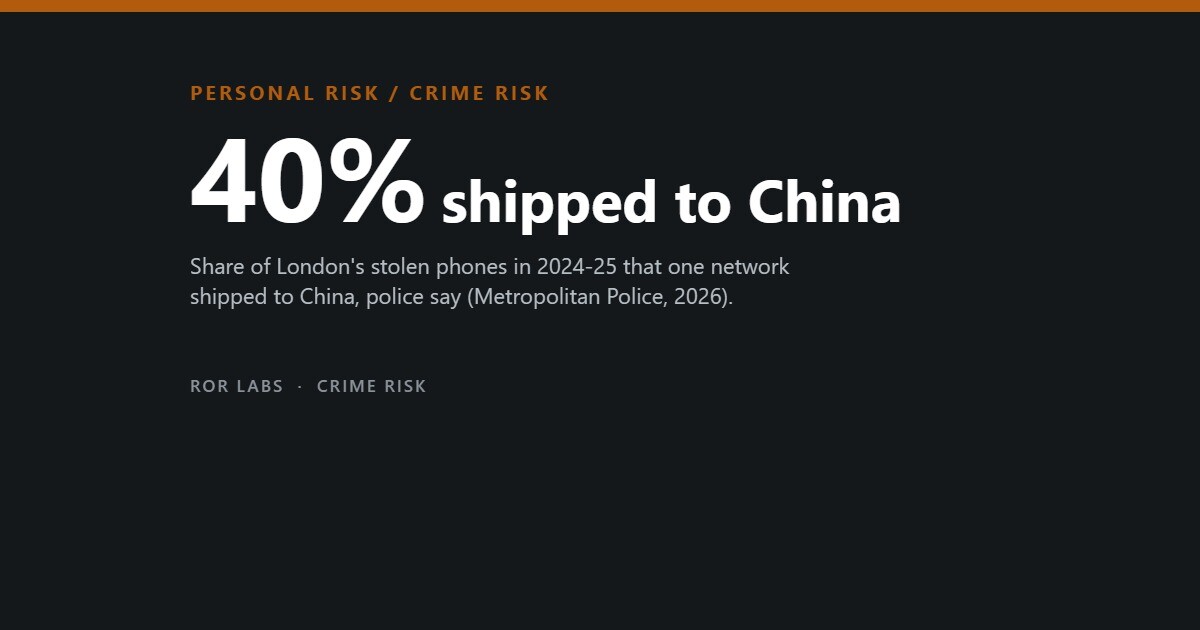
- Phones are a classic ‘hot product’: small, valuable and easy to sell. Police say one network alone shipped up to 40,000 stolen phones to China, around 40% of those stolen in London in 2024 and 2025.
- A snatched phone can lead to a second, larger theft. Thieves who see or force the passcode can drain bank apps and take out loans within minutes.
- Kill switches such as Apple’s Activation Lock were followed by falls in iPhone theft in 2014, but that evidence came from campaigning prosecutors and had no controls. No peer-reviewed trial has measured the effect.
Early one Saturday in April 2024, Akara Etteh was checking his iPhone as he walked out of Holborn Tube station in central London. A rider on an electric bike pulled it from his hand. He chased, lost them, and an hour later put the phone into lost mode. A month after that, he told the BBC, it showed up on his laptop map in Shenzhen, China.
Stories like his became common enough that ministers called a summit with phone makers and the Metropolitan Police launched its largest-ever crackdowns. The sections below cover how often street theft of phones happens, where, what happens to the phone and the owner’s accounts afterwards, and which measures have been shown to reduce it.
Phone theft follows the money: phones are stolen because they can be sold, often abroad, and the most promising fixes make a stolen handset worthless. The evidence for those fixes is thinner than the headlines suggest, though, and much of it comes from the people who argued for them.
How common phone snatching is
In England and Wales, a phone taken from your hand or pocket without force is recorded as ‘theft from the person’; if force or threat is used, it is robbery. The Office for National Statistics (ONS) reports that police-recorded theft from the person rose from 49,666 offences in the year to March 2021, when lockdowns emptied the streets, to 151,220 in the year to March 2025, the highest level since current recording began in 2003.
A tripling, then a fall
Police-recorded theft from the person, England and Wales, offences per year ending March.
Source: ONS, Crime in England and Wales, years ending March 2025 and March 2026. Includes all items taken from the person, not only phones.
The latest year brought a 20% fall to 121,161 offences. The household survey is noisier: the Crime Survey for England and Wales estimated 78,000 snatch thefts of phones or bags in the year to March 2024, up from 31,000 a year earlier, a 153% rise that the government quoted when it promised a crackdown. Yet in the following year the survey found no statistically significant change in theft from the person.
London dominates: the Met recorded 81,439 phone thefts and robberies in 2024 and 71,867 in 2025. In the first eight months of 2026 the count was 39,793, about a fifth lower than a year earlier. Behind the numbers sat a poor rate of justice: when the snatch surge was announced in 2024, only 0.8% of theft-from-the-person cases had led to a charge, according to figures reported at the time.
London’s phone theft count is falling
Phone theft and robbery offences recorded by the Metropolitan Police.
Source: Mayor of London and Metropolitan Police, 8 October 2026. Recorded offences only; unreported thefts are missing.

Where and how it happens
Criminologists explain the pattern with Ronald Clarke’s idea of ‘hot products’, summed up in the acronym CRAVED: concealable, removable, available, valuable, enjoyable and disposable. Rebecca Thompson analysed fourteen sweeps of the Crime Survey from 1994 to 2010/11. Phones were stolen in 35% of thefts from the person and robberies at their peak in early 2004, joining cash, wallets and bank cards as the four hot products.
Thieves are choosy. In Jen Mailley’s interviews with 40 phone thieves, offenders picked particular models at the moment of theft, and the designs that deterred them most were those that cut a handset’s resale value. That fits what police describe today: Met detectives said the network they broke up in 2025 deliberately targeted high-value brands for resale overseas.
The places are busy ones: Tube exits, bus stops, nightlife streets and shopping districts. The Met has concentrated officers in Westminster, Lambeth and Newham, and in 2024 the government’s Operation Calibre targeted more than 1,250 hotspot areas across England and Wales. The methods vary. Riders on e-bikes or mopeds grab phones from people on the pavement, a pattern Ian Brown and colleagues tied to road layout in two London boroughs.
When a snatch causes injury
Most snatches end with a lost phone and a shock rather than an injury, but a grab from a moving bike, or a tug on a bag strap, can pull someone over. Little recent research measures this; the clearest data come from an older Danish hospital study of bag-snatching.
Christian Færgemann and colleagues counted every resident of Odense aged 60 or over treated at the city’s university hospital after a bag-snatching between 1996 and 2000. There were 95. Their average age was 78 and 95% were women. Most were hurt by falling as the bag was wrenched away rather than by blows.
The fall does the harm
95 people aged 60 and over treated in hospital after a bag-snatching, Odense, Denmark, 1996–2000.
Source: Færgemann et al. (2002), PMID 12051050 (in Danish; abstract read). A small, old study of bag-snatching, not phone theft.
Those admitted stayed a median of 15 days, and one patient died. The study is small, more than twenty years old and about handbags, so it cannot tell us how often phone snatches cause injury. It does show the mechanism: the danger is mostly in being pulled over. Thompson notes that the harm of these crimes also includes lost personal data, much of it sentimental and impossible to replace.
Where stolen phones go
In December 2024 a theft victim tracked their phone to a warehouse near Heathrow Airport. Inside, police found a box of about 1,000 iPhones bound for Hong Kong, almost all of them stolen. That find started Operation Echosteep. Police say the network behind it trafficked up to 40,000 stolen phones from Britain to China in 2024 and 2025, around 40% of all phones stolen in London in that period.
Three men pleaded guilty at Southwark Crown Court in April 2026 to conspiracy to handle stolen goods and taking part in an organised crime group; two also admitted conspiracy to remove stolen goods. On 25 September 2026 Amir Khadikhel, 35, was jailed for nine and a half years, Ismat Miakhel, 33, for nine years and Mansoor Mohammed, 30, for six and a half years, LBC reported. The court heard street thieves were paid up to £300 a handset.
Graham Farrell argued in 2015 that blocking stolen handsets on national networks had existed for 20 years but was undermined by reprogramming, easy fencing and international trafficking. Recovery is rare: of 587,498 phones reported stolen in London from 2017 to February 2024, 13,998 were recovered, ITV reported.
The second theft: your accounts
To a thief, an unlocked phone is worth far more than the handset. In the early hours of 9 September 2023, Kush Chaudary was approached by a group of men outside a bar in Soho. They chatted to him and waited until he unlocked his phone before taking it. Within minutes they had changed his passcode. The Met later used his case to warn Londoners.

They moved £5,000 out of his cryptocurrency wallet, took several thousand pounds more from his bank accounts, took out loans totalling £22,000 and spent about £8,000 through Apple Pay on designer clothes and electronics. ‘This was hard-earned savings I had that was being spent by strangers,’ he said. The Met linked the gang to up to 60 other thefts and robberies in central London, worth £225,000 in all.
Four gang members were sentenced, the longest to 33 months in prison. This is why thieves watch for the passcode: a phone that is open when taken opens email, banking apps and the password resets for almost everything else. Thompson notes that misuse of such data can turn one theft into further crime, such as identity fraud.
What kill switches did
A kill switch lets an owner disable a stolen phone so that it cannot be wiped and reused. Apple’s Activation Lock arrived on 18 September 2013 with iOS 7: after a reset, the phone asks for the owner’s Apple account.
The best-known evidence came in a June 2014 report by the New York State Attorney General, prepared with the San Francisco District Attorney and the Mayor of London. Comparing periods before and after Activation Lock, it found iPhone thefts falling while thefts of Samsung phones, which lacked a comparable feature for most of the period, held steady or rose.
iPhones down, Samsungs not
Change in theft or robbery of each brand after Activation Lock (September 2013), as reported by the Secure Our Smartphones initiative.
Source: New York State Attorney General, Secure Our Smartphones Initiative: One Year Later (June 2014). Preliminary police data, no statistical controls. Bar length shows the size of each change.
A follow-up in February 2015 reported that iPhone thefts and robberies in San Francisco fell 40% from 2013 to 2014, and 25% in New York. The brand comparison is a sensible check, but the data were described as preliminary, the executive summary and body of the 2014 report give slightly different New York figures, and nothing controls for other changes in policing or the phone market.
The protections have grown since. Apple’s Stolen Device Protection, available from iOS 17.3, requires Face ID or Touch ID, with no passcode fallback, for actions such as using saved passwords or erasing the phone away from familiar places, and adds a one-hour delay before the Apple account password can be changed. Google’s October 2024 Android update added Theft Detection Lock, which locks the screen if the phone senses a snatch, plus Offline Device Lock and Remote Lock.
In June 2026, after the Met Commissioner Sir Mark Rowley gave phone makers a deadline to ‘design out’ theft, Apple agreed to tell the Met whether phones reported stolen later try to reconnect or be reactivated, and tightened Stolen Device Protection in iOS 26.4. ‘If stolen phones cannot be reactivated, their value collapses, and so does the incentive to steal them,’ Rowley said.
What policing can and cannot do
Street theft clusters in small places, which is what hot spots policing exploits. A 2019 systematic review by Anthony Braga and colleagues pooled 65 studies with 78 tests. It found a small but statistically significant reduction in crime at targeted places, and where displacement was measured, crime was more likely to fall in surrounding streets than to move there.
A London experiment adds a caveat. Barak Ariel and Henry Partridge randomly assigned the city’s 102 ‘hottest’ bus stops to extra patrols or none. Pairs of officers arrived by bus three times per shift for 15 minutes, five days a week, for six months. Disorder reported by bus drivers fell, but crimes reported by victims rose, which the authors put down to patrols so regular that offenders could predict them.
Predictable patrols backfired on crime
Change compared with control bus stops after six months of fixed-schedule patrols, London randomised trial.
Source: Ariel and Partridge, Journal of Quantitative Criminology (2016), 102 bus stops. Some changes were only marginally significant.
The Met’s recent campaign mixes patrols, arrests of repeat offenders, raids on phone shops and the export inquiry. It reports that theft from the person in the West End fell 40% in the 2025/26 financial year and that Westminster offences have fallen by almost half. These are the force’s own before-and-after figures, released alongside the Apple deal and a falling national trend, so no single cause can be credited.

Where the evidence is weak
The strongest claim in this field, that kill switches cut phone theft, rests mainly on before-and-after counts released by prosecutors and a mayor who were campaigning for kill switches. The brand comparison helps but is not a controlled study, and searches for this article found no peer-reviewed evaluation of Activation Lock’s effect on street theft. Farrell warned that non-permanent kill switches might go the way of network blocking.
Police data depend on people reporting thefts they know will rarely be solved, and survey estimates of snatch theft swing from year to year and rest on small numbers of victims. The best academic analysis of what is taken from the person ends in 2011, before modern smartphones, and the injury evidence is a single small study of handbags.
The recent falls arrived together: a policing surge, prosecutions of exporters and stronger phone security. Removing resale value is the most plausible lever and focused policing helps when it is unpredictable, but nobody has measured how much each contributed.
What to do
Steps sorted by when they matter. Each one says how strong the evidence is: Measured Official advice Untested
Before
- Turn on Stolen Device Protection on an iPhone, or Theft Detection Lock, Offline Device Lock and Remote Lock on Android, before anything happens. Official advice see Sources
- Use strong, separate passwords for banking, email and other high-value apps, so one unlocked phone does not open everything. Official advice see Sources
- Know how to lock your phone from another device, such as Find My or android.com/lock, and keep your bank’s emergency number somewhere other than your phone. Untested see Sources
If it happens
- In public, watch for people looking over your shoulder when you type your passcode; thieves often wait until a phone is unlocked before grabbing it. Official advice see Sources
- Take extra care at Tube exits, bus stops and busy nightlife streets, where snatches cluster, especially near the kerb where riders pass. Measured see Sources
Afterwards
- Lock or erase the phone remotely and call your bank and mobile network at once, so they can freeze apps, cards and the SIM. Untested see Sources
- Report the theft to the police and keep the crime reference; recovery is rare, but the report helps with banks and insurers. Measured see Sources
What not to do
- Do not chase the thief or go alone to the address where your phone shows up on the map. Untested see Sources
- Do not assume Face ID alone protects your money if the passcode has been seen; Apple Pay can still be used with a passcode. Official advice see Sources
Not legal advice. If your phone has just been stolen, call your bank first, then report it to the police and your network.
Questions people ask
Should I chase a phone thief?
Chasing can put you in danger, and the evidence on fighting back in a robbery is mixed; our article on resisting robbery covers it. Akara Etteh went to two of the addresses where his phone pinged and later said he would not recommend it.
Will the police get my phone back?
Probably not. About 2.4% of phones reported stolen in London from 2017 to early 2024 were recovered. Report it anyway: the crime reference helps with your bank and insurer, and the Met now shares stolen-phone identifiers with Apple.
Does Stolen Device Protection stop thieves emptying my bank?
It blocks many of the routes, such as reading saved passwords or changing the Apple account password quickly, when you are away from familiar places. Apple says Apple Pay can still be used with the passcode, so keeping your passcode private still matters. It works only if switched on before the theft.
Why are stolen phones sent abroad?
Because they are worth more there and harder to trace. Reports say stolen London phones fetch higher prices abroad, especially in China, where restrictions are fewer. That is why the Met wants manufacturers to block stolen handsets everywhere, not only in Britain.
The short version
- Police-recorded theft from the person in England and Wales tripled from a pandemic low of 49,666 offences to 151,220 in the year to March 2025, then fell 20%. London accounts for much of it.
- Phones are a classic ‘hot product’: small, valuable and easy to sell. Police say one network alone shipped up to 40,000 stolen phones to China, around 40% of those stolen in London in 2024 and 2025.
- A snatched phone can lead to a second, larger theft. Thieves who see or force the passcode can drain bank apps and take out loans within minutes.
- Kill switches such as Apple’s Activation Lock were followed by falls in iPhone theft in 2014, but that evidence came from campaigning prosecutors and had no controls. No peer-reviewed trial has measured the effect.
- Hot spots policing reduces crime on average, but a London trial found that predictable patrols at bus stops were followed by more crime, not less.
- Turn on Stolen Device Protection or Android’s theft protection, guard your passcode in public, and use separate strong passwords for banking and email.
This article summarises research, official statistics and news reports for general information. It is not legal, financial or security advice. If your phone is stolen, report it to the police and contact your bank and mobile network straight away.
Further reading: Thompson, Journal of Research in Crime and Delinquency (2017), for how phones became a hot product. Ariel and Partridge, Journal of Quantitative Criminology (2016), for a trial where hot spots policing backfired. Farrell, Crime Science (2015), for why blocking stolen handsets has struggled.
Sources
- Mayor of London and Metropolitan Police. Met seizes hundreds of stolen phones as thefts hit four-year low (8 October 2026).
- ITV News London. UK’s biggest police force arrests hundreds of suspects over phone thefts (8 October 2026).
- Office for National Statistics. Crime in England and Wales: year ending March 2025 (July 2025).
- Office for National Statistics. Crime in England and Wales: year ending March 2026 (23 July 2026).
- Press Association, via Express & Star. Government pledges crackdown on phone theft after 150% spike in incidents (3 September 2024).
- BBC News. Thieves snatched his phone in London. It was in China a month later (September 2024; read via a syndicated copy).
- Thompson R. Portable electronics and trends in goods stolen from the person. J Res Crime Delinq (2017), doi:10.1177/0022427816660743.
- Clarke RV. Hot products: understanding, anticipating and reducing demand for stolen goods. Home Office Police Research Series Paper 112 (1999).
- Mailley J. The prevention of mobile phone theft: a case study of crime as pollution; rational choices and consumer demand. PhD thesis, Loughborough University (2011).
- Brown I, Knight Thompson A, Pepper I, Ryan M. Moped enabled mobile phone snatches. European Law Enforcement Research Bulletin (2019).
- Færgemann C, Beck Mikkelsen J, Wedderkopp N, Skov O. Injured elderly victims of bag-snatching treated at Odense University Hospital 1996–2000 (in Danish). PMID 12051050 (2002).
- Metropolitan Police. Three plead guilty following major Met mobile phone theft investigation (29 April 2026).
- LBC. Three members of UK’s largest mobile smuggling network jailed (25 September 2026).
- Farrell G. Preventing phone theft and robbery: the need for government action and international coordination. Crime Science 4 (2015), doi:10.1186/s40163-014-0015-0.
- Metropolitan Police. Met urges Londoners to protect their phones from financial fraudsters (May 2025).
- Office of the New York State Attorney General, with the San Francisco District Attorney and the Mayor of London. Secure Our Smartphones Initiative: One Year Later (19 June 2014).
- Computerworld. Thefts and robberies of smartphones fell in three big cities with iPhones leading the pack (11 February 2015).
- Apple. About Stolen Device Protection for iPhone. Apple Support, article 120340 (accessed November 2026).
- Google Security Blog. Android theft protection (15 October 2024).
- The National. Apple global security change protects phones from being stolen (10 June 2026).
- Malwarebytes Labs. Stolen iPhones could soon be worth a lot less to thieves (12 June 2026).
- Braga AA, Turchan B, Papachristos AV, Hureau DM. Hot spots policing and crime reduction: an update of an ongoing systematic review and meta-analysis. J Exp Criminol (2019), doi:10.1007/s11292-019-09372-3.
- Ariel B, Partridge H. Predictable policing: measuring the crime control benefits of hotspots policing at bus stops. J Quant Criminol (2016), doi:10.1007/s10940-016-9312-y.