Space Heater Fires: What the Evidence Shows
Key takeaways · 13 min read
- Heating equipment is the second leading cause of US home fires after cooking. The NFPA estimates an average of 38,881 home heating fires a year in 2019–2023, with 432 deaths.
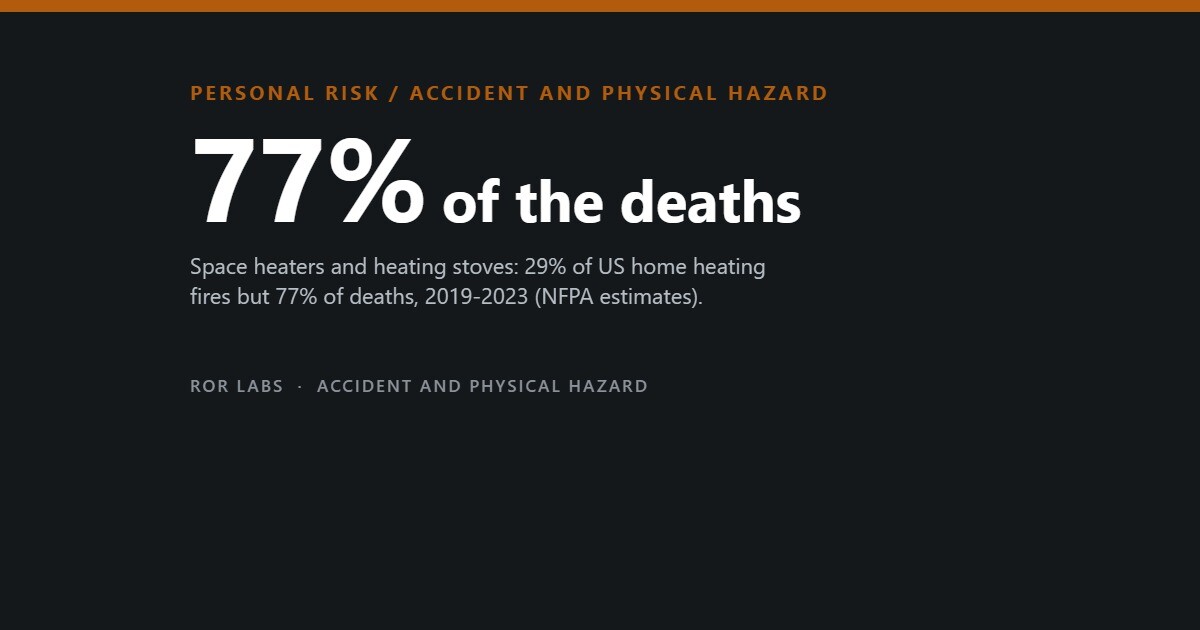
- Space heaters and heating stoves were involved in 29% of those fires but 77% of the deaths. Per fire, a heater fire is far deadlier than a cooking fire.
- The commonest fatal pattern is a heater too close to something that burns, such as bedding, a sofa, clothing or curtains. In an earlier NFPA analysis that factor lay behind 54% of heating fire deaths.
- Deaths cluster in winter, at night and among older adults: people aged 85 and over are 3.4 times as likely as the general population to die in a fire.
In this article
- How much of the home fire toll is heating?
- Why space heaters dominate the deaths
- Things too close: the main mechanism
- Cords, tip-overs and older heaters
- Kerosene, gas and carbon monoxide
- Who dies, and when
- What ‘unknown cause’ does to the numbers
- Setting up a heater, step by step
- What works
- Questions people ask
- The short version
- Sources
Every winter, local news carries the same short story: a cold night, a heater in the bedroom, and a fire that started while someone slept. Measured by the number of fires it causes, the space heater is a minor hazard. Measured by the number of people who die, it is not.
This article looks at what the numbers show: estimates from the National Fire Protection Association (NFPA), reports from the US Fire Administration (USFA) and the Consumer Product Safety Commission (CPSC), and peer-reviewed studies from the US, Sweden and Australia. Earlier articles here covered unattended cooking and smoke alarms and lithium-ion battery fires.
The pattern is clear. Heaters start far fewer fires than cooking does, but their fires kill far more often. The caveat is just as clear. Nearly all of the evidence comes from fire department reports, and for most fire deaths the box for the cause is empty.
How much of the home fire toll is heating?
Heating equipment is the second leading cause of US home fires, after cooking. The NFPA’s latest analysis estimates an average of 38,881 home heating equipment fires a year in 2019–2023, causing 432 civilian deaths, 1,352 injuries and $1.1 billion in property damage. Its earlier report, for 2012–2016, put heating at 15% of home fires and 19% of home fire deaths.
The long-term trend is downward. The USFA’s series shows residential building heating fires down 31% and deaths down 44% between 2014 and 2023, although 11 multi-death heating fires inflated the 2014 figure.
Agencies count differently, which matters later. For 2023 the USFA estimated 115 deaths in residential building heating fires; the CPSC, counting unintentional fires involving heating and cooling equipment, averaged 210 a year for 2021–2023.
Why space heaters dominate the deaths
Most heating fires are not heater fires. In the NFPA’s 2012–2016 data, fireplaces and chimneys caused 32% of them. Space heaters caused 44% of heating fires but 86% of the deaths and 78% of the injuries. The 2019–2023 update tells the same story with a slightly different grouping.
Few of the fires, most of the deaths
Share of US home heating equipment fires, deaths and injuries involving space heaters and heating stoves, annual average 2019–2023.
Source: National Fire Protection Association, home heating fires news release (January 2025). Estimates based on fire department reports.
The difference is clearest per fire. A USFA report on portable heater fires in homes in 2017–2019 found 29.3 deaths per 1,000 fires, against 1.5 per 1,000 for other residential heating fires. In the USFA’s coding, portable heaters made up only 3% of heating fires but were involved in 41% of fatal ones.
The CPSC’s newest estimates, published in October 2026, agree. Portable and fixed local heaters (wall, floor and baseboard units) averaged about 6,400 fires and 140 deaths a year in 2021–2023; cooking equipment, about 147,800 fires and 210 deaths. Cooking starts some 23 times as many fires, yet the death tolls are similar.
Deaths per 1,000 fires
Civilian deaths per 1,000 residential fires, by equipment involved. CPSC rates are calculated here from the agency’s rounded annual averages.
Sources: USFA, Portable Heater Fires in Residential Buildings (2021); CPSC, 2021–2023 Residential Fire Loss Estimates (2026), tables 1a–1b.
Why the gap? A cooking fire usually starts with someone awake nearby. A heater often sits in a bedroom or living room, close to a mattress, a sofa or a pile of clothes. In Swedish national data for 1999–2007, whatever the cause, fires that began in a bed or in clothing ended in a death in about 359 of every 1,000 fires attended by the rescue services.
Things too close: the main mechanism
Heaters rarely fail in a dramatic way. More often, something that can burn ends up too near the heat for too long. The NFPA calls this a heat source too close to combustibles. In 2012–2016 it lay behind only 15% of home heating fires but 54% of the deaths, 30% of injuries and 31% of the property damage. Equipment left unattended added 7% of fires and 13% of deaths.
The factor behind most heating fire deaths
Share of US home heating fires, deaths, injuries and direct property damage where the heat source was too close to things that can burn, annual average 2012–2016.
Source: Campbell, Home Fires Involving Heating Equipment, NFPA (December 2018). Unattended equipment: 7% of fires, 13% of deaths.
The USFA’s portable heater report found the same leading factor: a heat source too close to combustible objects, in 48% of fires where a factor was recorded. The fires most often started in bedrooms (34%). In bedroom fires, bedding was the first item to ignite in 16% and clothing in 12%; in living rooms, upholstered sofas and chairs were first to burn in 20%.
The details are ordinary. Of 136 space heater fires logged by the Massachusetts State Fire Marshal in 2009–2018, 16% began with bedding, clothing or furniture too close and 9% with rugs or mats. In 2019 an 85-year-old woman in New Bedford died after a towel on a gas room heater caught fire; in December 2023 a 91-year-old Springfield man died in a fire that began at a heater at the foot of his bed.
Hence the three-foot rule, about one metre, used by the NFPA, the CPSC and state fire marshals. The danger is rarely the heater itself; it is ordinary things drifting towards it, such as a blanket slipping off a bed or a towel put down to dry.
Cords, tip-overs and older heaters
Electric heaters account for most heating deaths. In the NFPA’s 2012–2016 figures, electrically powered equipment caused 35% of home heating fires but 55% of heating fire deaths and 59% of injuries. Solid fuel, mainly wood stoves and fireplaces, caused more fires (41%) but fewer deaths (23%).

On power, agencies agree: plug an electric space heater directly into a wall outlet, never into an extension cord or power strip. The CPSC repeated this in January 2026, as did Springfield’s fire commissioner after the death there. The national reports do not count cord-related heater fires separately, so this advice rests on how heaters are built and used, not on a published tally.
Design has improved. By 2003, the CPSC noted, electric and kerosene heaters had to have an automatic cut-off if they tipped over, and more guarding around coils and burners. It warned that older heaters may not meet newer standards.
Tip-overs still happen: in February 2025 two people died in a garage fire in St Paul, Minnesota, which investigators believed began when a heater tipped over. But a switch cannot help an upright heater running next to a duvet, the commoner fatal pattern.
Kerosene, gas and carbon monoxide
Fuel-burning heaters add a second hazard. Unvented kerosene and gas heaters release their combustion products into the room, including carbon monoxide (CO). In a US Environmental Protection Agency study of eight mobile homes using unvented kerosene heaters, seven showed a significant rise in CO while the heater ran. Three had eight-hour averages above or near the US standard of 9 ppm, and one routinely reached 30–50 ppm.
Upkeep matters too. In French laboratory tests of recent kerosene heaters, CO came mainly in the first minutes of use, at up to 3 mg per gram of fuel, but soot on a wick heater pushed it up to 16 mg per gram.
Liquid fuels caused just 6% of home heating fires and 6% of deaths in the NFPA’s 2012–2016 data, but some states restrict them anyway: Massachusetts bans kerosene and portable propane space heaters in homes. The CPSC advises a CO alarm outside each sleeping area and, with unvented fuel heaters, keeping doors open to the rest of the house. CO is covered in more depth in this site’s carbon monoxide article.
Who dies, and when
Heating deaths follow the calendar and the clock. In the NFPA’s 2012–2016 data, December, January and February accounted for 48% of home heating fires and 57% of the deaths. The hours from midnight to 8 a.m., when most people are asleep, saw only 19% of fires but 48% of deaths.
Winter nights carry the deaths
Share of US home heating fires and deaths by season and time of day, annual average 2012–2016.
Source: Campbell, Home Fires Involving Heating Equipment, NFPA (December 2018).
Age is the strongest personal factor. The USFA estimates that in 2023 adults aged 65 and over were 2.5 times as likely as the general population to die in a fire, rising to 2.9 times at 75–84 and 3.4 times at 85 and over. An Australian comparison of 177 fatal and 183 survived accidental house fires found that being over 70, living alone, being asleep and being in the room where the fire began were among the factors most strongly linked with death.
Income and housing matter too. A 2017 systematic review linked low income, non-working households, homes not privately owned and buildings in poor condition with more fires, injuries or deaths, though none of its studies was of high quality. A national study of emergency department visits estimated 53,636 burns from portable heaters in 2003–2013, with the highest rates in young children, older adults, men and Black Americans.
Two cautions. In Runyan and colleagues’ 1992 North Carolina study, heating was the leading cause of house fires, but fatal fires were more often started by smoking (31% against 6%). And in Sweden the risk of death per 1,000 fires showed no seasonal difference: winter brings more fires, not necessarily deadlier ones.
What ‘unknown cause’ does to the numbers
Almost every figure above comes from the National Fire Incident Reporting System (NFIRS), filled in by local fire departments. Taking part is voluntary. The CPSC estimates that NFIRS captured about 63% of residential fires and 49% of deaths in 2021–2023; the USFA’s portable heater report put coverage at 68% of fires in 2017–2019.
Even in the reports that arrive, the cause is often blank. For residential fire deaths, the CPSC found the cause of ignition missing in 60% of cases in 2021, 62% in 2022 and 67% in 2023, and the equipment involved missing in 54–58%. For fires overall it was missing in 34–36%. Fatal fires tend to be large, and a large fire can destroy the evidence of where it began.
The missing cause
Share of records where the cause of ignition was missing or unknown.
Sources: CPSC, 2021–2023 Residential Fire Loss Estimates (2026), tables 10a–10b; Jönsson et al., Journal of Safety Research (2017), table 3.
For national estimates, the CPSC spreads the unknowns in proportion to the known cases, a method it calls raking, on the stated assumption that unknown values follow the same distribution as known ones. If heater fires are easier to recognise afterwards than other causes, that inflates the heater share; if harder, it shrinks it. Nobody can check which.
This also helps explain why agency figures differ so widely. The USFA keeps ‘cause under investigation’ as a separate category, with 560 residential fire deaths in 2023. Even Swedish researchers with linked fire, forensic and death records could not assign a cause to 30% of fatal fires. Treat every share here as an estimate, not a count.
Setting up a heater, step by step
The research above tells us what goes wrong. This section is the order of operations on the day you plug one in. It follows the National Fire Protection Association (NFPA) safety tips for portable space heaters.
Step 1: choose the right heater. NFPA says to pick one that shuts off automatically if it tips over, has a thermostat and overheat protection, and carries the seal of an independent testing laboratory.
Step 2: pick the spot. Put it on a solid, flat surface, at least 3 feet (1 metre) from anything that can burn, people included. Keep it out of foot traffic, never block an exit, and keep children away from it.
Step 3: plug it in the right way. NFPA says to plug the heater directly into a wall outlet and not to use an extension cord.
Step 4: switch it off when you stop watching. NFPA says to turn it off and unplug it when you leave the room or go to bed.
What we could not confirm. The NFPA sheet we read is a 2018 copy hosted by a city fire service, so check nfpa.org for the current version. It says nearly half of all space heater fires involve electric heaters, which fits the pattern in the earlier sections but does not tell you which model is safest. We did not find a rule on how long a heater can safely run in one session, so we have not given one.
What works
Smoke alarms are the best-supported measure. In Runyan’s case-control study of 151 fatal house fires, the absence of a smoke detector carried an odds ratio of 3.4 for a death, and a mobile home 1.7. The NFPA estimates that working smoke alarms cut the risk of dying in a home fire by 60%. Yet in the USFA’s portable heater data, alarms were present in only 41% of fires in occupied homes.
The rest of the advice comes from agencies rather than trials: three feet of clearance, a wall outlet, heaters off at bedtime, a certified heater with a tip-over shut-off, a yearly check for fuel-burning heaters and a CO alarm. It matches the mechanisms in the data, but no study has measured how much each step lowers the death rate.
If a fire does start, get out, close the door behind you if you can, and call the fire service from outside. In Mississippi, 55% of the state’s 74 fire deaths in 2025 happened where no working smoke alarm was present.
What to do
Steps sorted by when they matter. Each one says how strong the evidence is: Measured Official advice Untested
Before
- Keep bedding, furniture, curtains, clothing and anything else that can burn at least three feet from every heater. Official advice see Sources
- Fit smoke alarms on every level of the home and inside each bedroom, and a CO alarm outside sleeping areas if you use fuel-burning heaters. Official advice see Sources
- Choose a heater certified by a recognised testing laboratory with an automatic tip-over shut-off; older heaters may not meet newer standards. Official advice see Sources
- Have gas and kerosene heaters inspected every year. Official advice see Sources
If it happens
- If a fire starts, get out, close the door behind you if you can, and call the fire service from outside. Untested see Sources
- Plug an electric heater directly into a wall outlet, not an extension cord or power strip. Official advice see Sources
- Turn the heater off when you go to sleep or leave the room; nearly half of heating fire deaths happened between midnight and 8 a.m. Measured see Sources
- With an unvented fuel-burning heater, keep doors open to the rest of the house. Official advice see Sources
Afterwards
- Test smoke alarms regularly; in US portable heater fires, alarms were present in only 41% of occupied homes. Measured see Sources
- Recheck the clearance around the heater through the winter, as blankets, towels and laundry drift closer. Untested see Sources
What not to do
- Do not dry towels or clothes on or next to a heater. Measured see Sources
- Do not run an electric heater from an extension cord or power strip. Official advice see Sources
- Do not rely on a tip-over switch alone; most fatal heater fires involve an upright heater too close to something that burns. Measured see Sources
Not professional advice. Follow your local fire service’s guidance.
Questions people ask
Is it safe to leave a space heater on overnight?
Agencies say no. The CPSC advises turning heaters off when you sleep; in the NFPA’s data, nearly half of heating fire deaths happened between midnight and 8 a.m.
Are oil-filled heaters safer than other electric heaters?
The data cannot say. Oil-filled heaters made up 11.6% of portable heater fires in the USFA’s 2017–2019 report, but there are no national figures on how many homes use each type, so the risk per heater cannot be compared. The three-foot rule applies to all of them.
Can I use a heavy-duty extension cord?
The CPSC and state fire marshals say to plug space heaters directly into a wall outlet, not into any extension cord or power strip. There is consistent advice here but no national count of cord-related heater fires.
Does a tip-over switch make a heater safe?
It removes one way a heater can start a fire. It does nothing about a blanket, a towel or a curtain sitting too close to an upright heater, which was the leading factor in heating fire deaths in the NFPA’s data.
Can I use a kerosene heater indoors?
That depends on where you live; Massachusetts bans them in homes. Where they are allowed, the CPSC advises open doors for unvented models, a yearly inspection and a CO alarm outside sleeping areas.
The short version
- Heating equipment is the second leading cause of US home fires after cooking. The NFPA estimates an average of 38,881 home heating fires a year in 2019–2023, with 432 deaths.
- Space heaters and heating stoves were involved in 29% of those fires but 77% of the deaths. Per fire, a heater fire is far deadlier than a cooking fire.
- The commonest fatal pattern is a heater too close to something that burns, such as bedding, a sofa, clothing or curtains. In an earlier NFPA analysis that factor lay behind 54% of heating fire deaths.
- Deaths cluster in winter, at night and among older adults: people aged 85 and over are 3.4 times as likely as the general population to die in a fire.
- Most figures come from fire department reports in which the cause is missing for 60–67% of fire deaths, so every share is partly an estimate built on an assumption.
- Official advice is consistent: keep heaters three feet from anything that can burn, plug them into a wall, switch them off at bedtime and fit smoke alarms.
This article summarises research, agency reports and news for general information. It is not professional fire safety, legal or medical advice. Follow your heater’s instructions and local fire codes, and ask your local fire department about smoke alarms. If you suspect carbon monoxide poisoning, get into fresh air and seek medical help.
Further reading: the CPSC’s 2021–2023 Residential Fire Loss Estimates (2026), for national counts and a candid table of missing data. The USFA’s Portable Heater Fires in Residential Buildings (2021), for where heater fires start. Jönsson et al., Journal of Safety Research (2017), for what linked national records can and cannot tell us.
Sources
- Mississippi Emergency Management Agency. Multiple fire deaths reported as state faces extreme cold (28 January 2026).
- National Fire Protection Association. News release on US home heating fires, 2019–2023 (January 2025), as republished by FCAM, 23 January 2025.
- Campbell R. Home Fires Involving Heating Equipment. National Fire Protection Association (December 2018).
- U.S. Fire Administration. Portable Heater Fires in Residential Buildings (2017–2019). Topical Fire Report Series 21(11) (December 2021).
- U.S. Fire Administration. Residential Building Heating Fire Trends (2014–2023) (page reviewed 14 February 2025).
- U.S. Fire Administration. Residential building cause-under-investigation fire trends (2014–2023).
- U.S. Fire Administration. Older Adult Fire Death Risk (2014–2023) (page reviewed 3 April 2025).
- Miller D. 2021–2023 Residential Fire Loss Estimates: U.S. National Estimates of Fires, Deaths, Injuries, and Property Loss from Unintentional Fires. U.S. Consumer Product Safety Commission (October 2026).
- U.S. Consumer Product Safety Commission. Keep Warm and Safe This Winter: Tips for Using Generators, Furnaces and Space Heaters (news release, 23 January 2026).
- U.S. Consumer Product Safety Commission. CPSC Offers Tips to Prevent Home Fires From Space Heaters (news release, 16 December 2003).
- Massachusetts Department of Fire Services. Space heater causes fatal fire in Springfield (15 December 2023).
- Massachusetts Department of Fire Services. Fatal Brimfield fire started with space heater (29 December 2022).
- Roy L. Fatal Mass. fire started by towel on space heater. The Standard-Times, republished by FireRescue1 (7 November 2019).
- CBS Minnesota. Minnesota officials warn of space heater safety after fatal fires (10 February 2025).
- Fire & Safety Journal Americas. NFPA highlights importance of working smoke alarms in U.S. homes (26 September 2024).
- Jönsson A, Bonander C, Nilson F, Huss F. The state of the residential fire fatality problem in Sweden: epidemiology, risk factors, and event typologies. J Safety Res (2017), doi:10.1016/j.jsr.2017.06.008.
- Runyan CW, Bangdiwala SI, Linzer MA, Sacks JJ, Butts JD. Risk factors for fatal residential fires. N Engl J Med 327 (1992), doi:10.1056/NEJM199209173271207.
- Xiong L, Bruck D, Ball M. Comparative investigation of ‘survival’ and fatality factors in accidental residential fires. Fire Safety Journal (2015), doi:10.1016/j.firesaf.2015.02.003.
- Turner S, Johnson RD, Weightman AL, et al. Risk factors associated with unintentional house fire incidents, injuries and deaths in high-income countries: a systematic review. Inj Prev (2017), doi:10.1136/injuryprev-2016-042174.
- Brooks RD, McGwin G. The epidemiology of emergency department-treated burn injuries associated with portable heaters in the United States, 2003–2013. J Burn Care Res (2016), doi:10.1097/BCR.0000000000000376.
- Williams RW, Walsh D, White JB, Jackson MD, Mumford JL. Effect on carbon monoxide levels in mobile homes using unvented kerosene heaters for residential heating. Indoor Built Environ (1992), doi:10.1177/1420326X9200100504.
- Carteret M, Pauwels JF, Hanoune B. Emission factors of gaseous pollutants from recent kerosene space heaters and fuels available in France in 2010. Indoor Air (2012), doi:10.1111/j.1600-0668.2011.00763.x.
- NFPA. Portable space heater safety tips (copy hosted by Mississauga Fire and Emergency Services, 2018). mississauga.ca.