Nobody Is Trampled. They Suffocate Standing Up, and It Begins at Six People to a Square Metre.
Further reading: Doom: The Politics of Catastrophe — Niall Ferguson (Penguin Press, 2021). No trade book has yet been written specifically on crowd-crush disasters; this is the closest available account of why institutions fail to prevent a catastrophe once the warning signs are already there. Find it on Amazon (paid link)
Disclosure: this article contains affiliate links, marked (paid link). If you buy through one we may earn a commission, at no extra cost to you. As an Amazon Associate I earn from qualifying purchases. It costs you nothing and it does not change what we recommend.
Key takeaways · 13 min read
- It is not a stampede. Virtually all crowd deaths are compressive asphyxia, standing up.
- “People do not die because they panic. They panic because they are dying.”
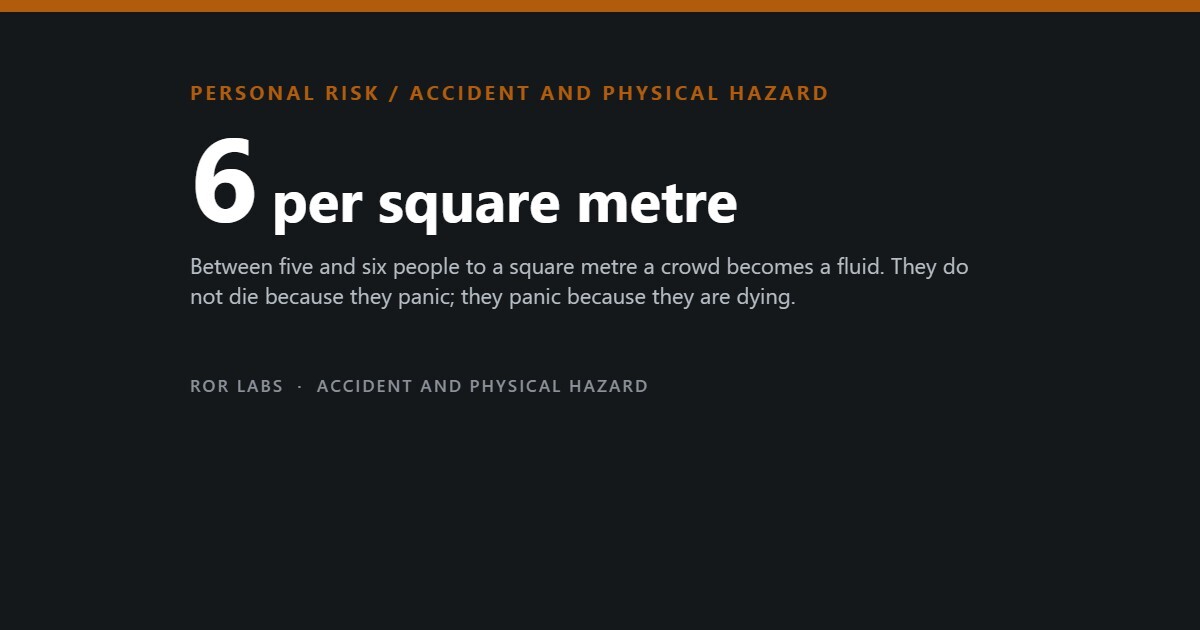
- Risk rises sharply between 5 and 6 people per square metre; above 8 breathing is prevented.
- At 6–7 the crowd behaves like a fluid, and pressure waves travel through it.
The word almost every report uses is “stampede,” and it is wrong in a way that costs lives. A stampede is a crowd running. What actually kills people in these events is a crowd that cannot move at all, compressed until the chest cannot expand, dying upright and often without a mark. Professor Keith Still, who has spent a career modelling this, puts it in one sentence: people do not die because they panic; they panic because they are dying.
The distinction matters because it decides who gets blamed and what gets fixed. If the cause is panic, the failure belongs to the crowd. If the cause is density, the failure belongs to whoever decided how many people could be in that space and by which route — and it is preventable by arithmetic done in advance.
This is not a rare event. In September 2025 a political rally in Karur, in Tamil Nadu, killed 41 people including nine children: permission had been granted for 10,000 attendees, somewhere between 27,000 and 50,000 arrived, police deployed 500 officers, and the main speaker arrived seven hours late to a crowd that had been standing since morning without adequate water. Every one of those is an organisational number, not a behavioural one.
The density ladder
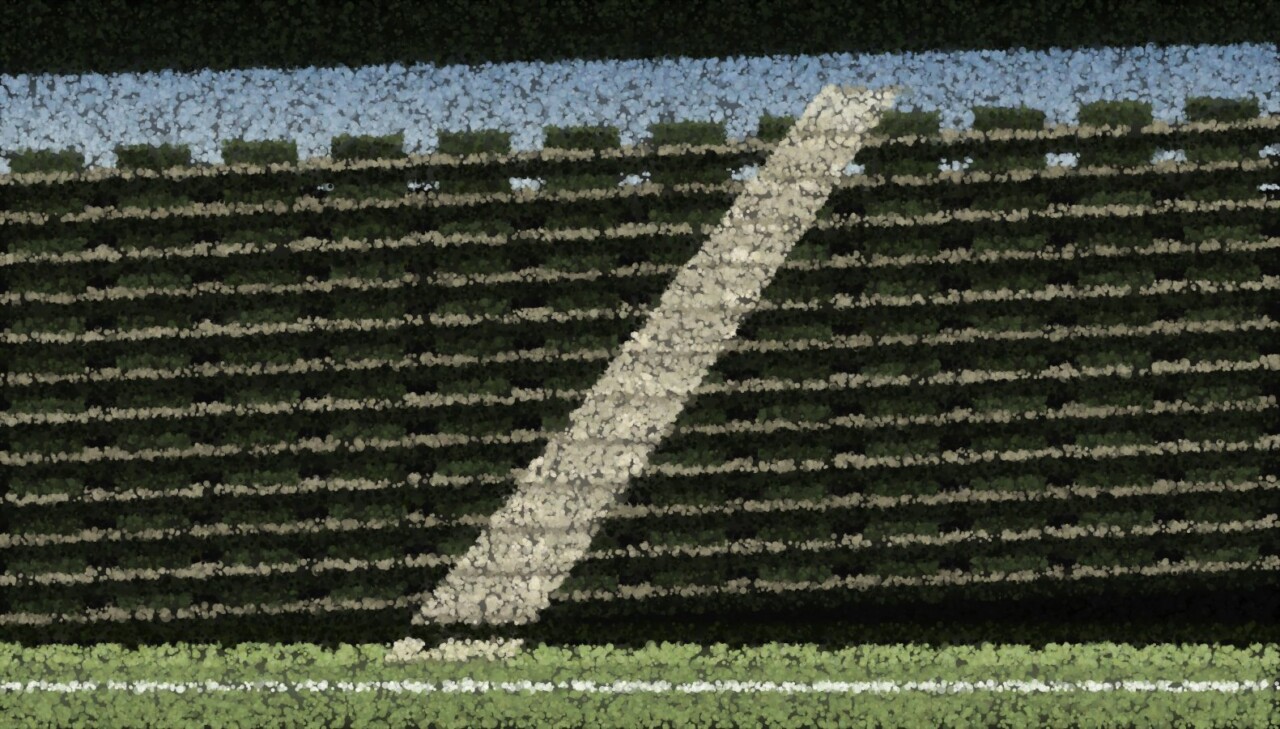
Crowd safety is measured in people per square metre, and the transitions are sharp. Below a certain point a crowd is a group of individuals. Above it, it is a fluid, and you are no longer in control of where your body goes.
What each density feels like, and what it does
People per square metre. The dangerous transition happens between 5 and 6.
Sources: crowd density classifications following Fruin and Still; summarised in the crowd safety literature.
Two distinct failures happen up there, and they are worth telling apart.
Collapse and crush are different events
Both are fatal. Neither involves anyone running.
Source: Prof. Dr. G. Keith Still, crowd risk analysis and progressive crowd collapse modelling.
The forces are larger than people imagine
The reason an individual cannot resist is arithmetic. A person leaning is not pushing hard; a hundred people leaning are a structural load, and pressure accumulates along the direction of the crowd rather than dissipating.
What the crowd can generate, and what a body can take
Forces in newtons, from crowd pressure research.
Source: Prof. Dr. G. Keith Still, crowd pressure analysis.
The four-to-six minute figure is the one to hold on to, because it defines the rescue window. It is also why the Itaewon findings published in July 2026 matter beyond that one event. A special investigation committee reviewing the 159 deaths of 29 October 2022 concluded that around 10% — about 15 people — may have died of causes other than suffocation, including internal bleeding and organ damage from sustained pressure, and that those victims could have survived for hours or even days with more active rescue.
The committee was explicit that its conclusions rested on external examinations rather than autopsies, which limits how firmly they can be stated. But the direction is important and it is not comfortable: some of the people counted as unsaveable were not.
Why the word matters
“Stampede” puts the cause inside the crowd. It implies people behaving badly, and it points every subsequent conversation at crowd control — at containing an unruly mass — rather than at capacity, flow and exits.
The failures that actually recur
These are the variables that appear again and again in post-event investigations.
Sources: 2025 Karur crowd crush investigation; Itaewon special investigation committee, July 2026; crowd safety literature.
What to notice, and when to leave
None of what follows makes a dangerous crowd safe. It buys you the chance to be somewhere else before the density arrives, which is the only reliable protection an individual has. The signals are physical and they come earlier than most people realise.
The warning signs, in the order they appear
By the time the last one is present, leaving is no longer your decision.
Sources: crowd safety guidance following Still and Fruin; survivor accounts documented in post-event investigations.
If you are already in it
These are the standard survival recommendations. They are mitigation, not protection.
Before you arrive, one habit is worth more than all of the above: find the exits when you walk in, while the space is still empty, and note more than one. Almost everybody leaves by the door they entered through, which is precisely why that door becomes the constriction. Agree a meeting point outside the venue with whoever you came with, because phone networks fail at exactly the moment large numbers of people try to use them.
There is nothing to buy here
This is the shortest commercial section on this site, and the shortness is the finding rather than an omission.
Two small things, and a long list of things we will not link (paid link)
Both of these exist only to support one instruction: never bend down.
Browse on Amazon →
Browse on Amazon →
What we are deliberately not linking. Personal alarms and whistles sold as crowd safety. In a crowd loud enough to be dangerous, nobody can hear you, and even if they could, the people around you cannot move. Noise does not create space. “Anti-crush” vests, chest guards and rib protectors. There is no consumer product with evidence behind it for compressive asphyxia, and the failure mode of believing there is one is that you stay in a crowd you should have left. Event safety and crowd-density apps. Some are interesting and none of them can see the pinch point forty metres ahead of you; your own body, touched on four sides, is a better and faster sensor than any of them. The honest summary of this article is that the protective measures are a decision to leave early and a habit of finding the exits, and neither has a price.
Questions people ask
Does being tall or strong help?
Height helps a little with breathing, because the air is marginally less compressed higher up and you can sometimes get your head above shoulder level. Strength helps far less than people expect. The forces a dense crowd generates are several times what any individual can resist, and pushing back adds to the total pressure in the system rather than relieving it. Children and shorter adults are at higher risk for exactly this reason, which is worth remembering before taking a child into a crowd.
Is this only a problem at huge events?
No, and that is the most common misreading. Density is local. A modest crowd funnelling into an alley, a staircase or a single gate reaches lethal density in that small volume regardless of how many people are at the event overall. Several of the worst incidents on record happened in spaces of a few dozen square metres.
Why do the people at the back keep pushing?
Because they do not know. Information does not travel backwards through a dense crowd — sound is drowned, sightlines are blocked, and the physical sensation at the back is simply that things are slow. People at the rear are not being callous; they are pushing gently into what feels like a queue. This is precisely why the responsibility sits with organisers who can see the whole system rather than with individuals who can see two metres.
Should I go to crowded events at all?
Yes. Concerts, festivals, matches and processions are attended by billions of people every year without incident, and the base rate of catastrophe at a well-run event is very low. The point of this article is not avoidance — it is that the small number of signals above are worth recognising, because the people who got out of the bad ones were usually the ones who left early and could not later explain exactly why.
What should I do if I am with children?
Set your threshold much lower and act on it much earlier — at the point where the crowd merely feels busy rather than at the point where you are touched on all sides. A small child in a dense crowd cannot keep their feet, cannot be seen, and is breathing air at the level where compression is worst. Carrying them is better than holding a hand, and leaving before it gets to either is better than both.
The short version
- It is not a stampede. Virtually all crowd deaths are compressive asphyxia, standing up.
- “People do not die because they panic. They panic because they are dying.”
- Risk rises sharply between 5 and 6 people per square metre; above 8 breathing is prevented.
- At 6–7 the crowd behaves like a fluid, and pressure waves travel through it.
- Collapse is a chain of falls into voids. Crush is compression with nowhere to fall.
- Five people pushing generate about 3,430 N; a body tolerates roughly 623–800 N.
- Crush asphyxia can occur in about four to six minutes — that is the whole rescue window.
- The Itaewon committee found about 10% of the 159 deaths may not have been suffocation, and those victims might have survived with faster rescue.
- Leave when you are touched on all four sides. That is much earlier than instinct says.
- Arms up. Move diagonally with the surge. Stay off barriers. Never bend down.
- The recurring causes are capacity, funnels, counterflow, slope, delay and blocked access — all decided before anyone arrived.
This article summarises crowd science and published investigations. It is not event safety consultancy, and nothing in it shifts responsibility onto people who are killed in these events — the causes are overwhelmingly organisational, and the individual measures described here exist only because those failures keep happening. If you have been affected by an incident like this, the emotional aftermath is a normal response to an abnormal event and is worth talking to someone about.
On the links above: some are affiliate links, marked (paid link). If you buy through one we may earn a commission at no additional cost to you. As an Amazon Associate I earn from qualifying purchases. We link to product searches rather than specific items so that recommendations do not break as models change, and we say plainly when we are choosing not to link something. Full policy: Affiliate Disclosure.
Sources
- Still, G.K. (Prof. Dr.). Crowd risk analysis, progressive crowd collapse and crowd pressure modelling. (Compressive asphyxia rather than trampling as the cause of virtually all crowd deaths; tolerable force of about 623 N rising to about 800 N when pushing back; about 3,430 N generated by five people pushing; crush asphyxia at sustained force around 1,112 N over four to six minutes.)
- Crowd density classifications following J.J. Fruin’s levels of service and subsequent crowd safety literature. (1–2, 3–4, 5, 6–7 and 8–10 people per square metre.)
- Special investigation committee on the Itaewon crowd crush, medical review reported 21 July 2026. (159 deaths on 29 October 2022; approximately 10% possibly attributable to causes other than suffocation, including intra-abdominal bleeding and pressure injury to muscles and organs; conclusion that those victims could have survived for hours or days with more active rescue; findings based on external examination rather than autopsy.)
- Reporting and official investigation into the Karur crowd crush, Tamil Nadu, 27 September 2025. (41 deaths including nine children; permission for 10,000 attendees against estimates of 27,000–50,000; 500 officers deployed; seven-hour delay to the main arrival; obstruction of ambulances during rescue.)