Protest Violence and Policing: What the Evidence Shows
Key takeaways · 13 min read
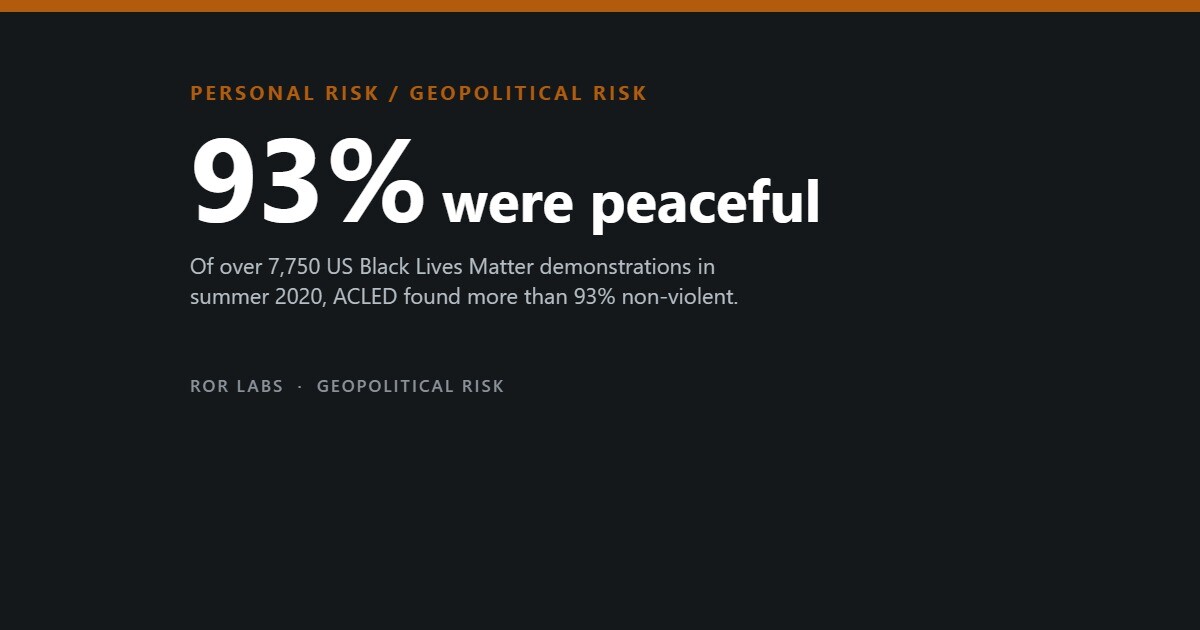
- Most protests pass off peacefully: ACLED found more than 93% of US Black Lives Matter demonstrations in summer 2020 involved only non-violent demonstrators, and 97% of 2023–24 campus protests stayed peaceful.
- Injuries are uncommon per event: of nearly 12,000 US anti-racism events in 2020, 2.4% recorded injured protesters and 1.4% injured police.
- Journalists and bystanders get hurt too; in the US in 2020, more than 80% of 640 documented assaults on journalists were by officers.
- Crowd psychology research finds that force used against a whole crowd can turn a mostly peaceful crowd against police, while dialogue and liaison officers are linked to less disorder.
Television makes protests look dangerous. The pictures that travel are the burning car, the line of riot shields, the cloud of gas. Anyone thinking of joining a march, or who lives near where one will pass, may reasonably ask how likely it is to turn violent, and who gets hurt when it does.
This article looks at what event databases, social psychologists and inquiries have found: how often protests involve violence, who is injured, and how the style of policing changes the risk. It covers the move from ‘escalated force’ to negotiated policing, the social identity research behind dialogue and liaison officers, the evidence on kettling, and the old idea that crowds panic.
It does not take sides on any cause. Whether protests achieve their aims is covered in a separate article on protest effectiveness. Events are named by place and year, and every number is tied to the source that reported it.
How often do protests turn violent?
The best counts come from event databases that code news and local reports. ACLED, a non-profit that tracks political violence worldwide, recorded over 7,750 demonstrations linked to Black Lives Matter in the US between late May and late August 2020. In more than 93% of them, demonstrators were non-violent. ACLED says the share would be higher if other social justice protests were included.
Most protests stay peaceful, whoever counts
Share of US protest events with no violence or damage, by dataset and definition.
Sources: ACLED (31 August 2020; 10 May 2024); Ulfelder, Crowd Counting Consortium, Harvard Ash Center (15 February 2021).
A second project, the Crowd Counting Consortium at Harvard and the University of Connecticut, counted nearly 12,000 anti-racism events from 25 May 2020. More than 96% involved no reported property damage. For student demonstrations about the Israel–Palestine conflict between October 2023 and May 2024, ACLED found 97% stayed peaceful.
These numbers measure events, not people, and that matters. A single violent night in a large city can involve more people than hundreds of small vigils. Both projects rely on reports, so they miss events nobody wrote about, and the consortium’s author says its totals are probably undercounts. Even so, the pattern is consistent: violence is the exception at protests, not the rule.
Who gets hurt
The Crowd Counting Consortium also recorded injuries. Protesters were reported injured at 288 events, 2.4% of the total, and police at 172 events, or 1.4%. Most events with injured protesters, 212 of 288, had no injured officers, which suggests that harm was often one-sided. Arrests happened at nearly 7% of events, and chemical irritants were used at about 2.5%.
What went wrong at 2020 US anti-racism events
Share of nearly 12,000 events from 25 May 2020 with each reported outcome.
Source: Ulfelder, ‘Contours of the George Floyd uprising’, Crowd Counting Consortium, Harvard Ash Center (15 February 2021). Shares of events, not of people; likely undercounts.
Journalists are a group apart, because their job keeps them between the lines. The US Press Freedom Tracker counted nearly 500 journalists assaulted between 25 May and 25 August 2020, and more than 100 arrested or detained. Of 640 assaults it documented after the killing of George Floyd, more than 80% were by local, state or federal officers. Injuries from rubber bullets and other weapons are covered in our article on crowd-control weapons.
Journalists at US protests in 2020
Incidents recorded by the US Press Freedom Tracker.
Source: US Press Freedom Tracker, ‘BLM and unprecedented aggressions against media’. Counts are documented incidents only.
Bystanders are hard to count because databases record events, not who was standing nearby. Police get hurt too: officers were injured at about one event in 70 in the consortium data, and in the news report above a police chief suffered serious injuries. In Kenya in 2025, the oversight body described below also reported attacks on pedestrians by groups that infiltrated protests.
Two models of protest policing
Sociologists describe two broad styles. Under ‘escalated force’, common in the US in the 1960s, police treated demonstrations as threats, used force early and arrested widely. Under ‘negotiated management’, which became dominant in later decades, police agree routes and conditions with organisers in advance, tolerate some disruption and treat arrest as a last resort.
The shift is real but uneven. A study of 15,965 US protests between 1960 and 1995, by Patrick Rafail, Sarah Soule and John McCarthy, confirmed an overall decline in arrests and force, but found the change was not steady, and that police responses still varied with who was protesting and against whom. A 2025 study of Black Lives Matter protests likewise found that police reactions varied widely even between protests with similar messages and tactics.
Where escalated force is the default, the toll can be heavy. Kenya’s Independent Policing Oversight Authority monitored protests in June and July 2025 and concluded that police had treated them as riots in every monitored county but one, using tear gas, rubber bullets and live ammunition. It also found officers without name tags or service numbers.
Kenya’s 2025 protests: the oversight body’s count
Protests of 12 June to 7 July 2025, as recorded by the Independent Policing Oversight Authority to 23 July 2025.
Source: IPOA findings as reported by The Eastleigh Voice (24 July 2025). Bystanders and journalists were not counted separately.
How policing changes a crowd
The older view of crowds, going back to the nineteenth century, held that people in a mass lose their judgement and follow the most violent among them. Policing built on that view treats the whole crowd as a threat. The Elaborated Social Identity Model, developed by Stephen Reicher, Clifford Stott, John Drury and colleagues, argues the opposite: crowds have shared norms, and conflict grows out of how groups treat each other.

In this account, when police use force against everyone because of what a few did, people who had no intention of fighting come to see the police as hostile and illegitimate. They begin to identify with those who are confronting the police, and conflict spreads. Studies of English and Scottish football fans at the 1998 World Cup and of an environmental protest fit this pattern; so did an analysis of Hong Kong in 2019, which linked dispersal tactics to protests that spread and hardened.
Officers’ own beliefs are part of the picture. In a survey of 80 UK officers, police saw crowds as mixed but feared a powerful minority could sway the rest, favoured quick intervention, and denied that such tactics could feed conflict. Among 352 Italian officers, exposure to crowd conflict went with classical views of crowds, and those views went with tougher practices. Observers are affected too: in a 2025 survey experiment, people were more likely to call protesters violent when they saw a heavy police presence.
Dialogue and liaison officers
The most cited test came at Euro 2004 in Portugal. England fans had a violent reputation, yet in the match cities, policed by the civilian PSP in a low-profile, friendly style, researchers recorded incidents that fizzled out because fans policed themselves or officers stepped in against specific individuals. The two riots involving England fans took place in the Algarve, where the paramilitary GNR was in charge.
Euro 2004: two police forces, two outcomes
Disorder involving England fans at the 2004 European Championship in Portugal, by police force.
Sources: Stott, Adang, Livingstone and Schreiber, Eur J Soc Psychol (2007); Times Higher Education (12 March 2009); Scientific American 300(3) (2009). Observational comparison, not a trial.
Sweden reached a similar point by another route. At the 2001 EU summit in Gothenburg, three demonstrators were shot and about 150 people injured. The police then created a national Special Police Tactic with ‘dialogue police’, officers who meet groups before events, stay in contact during them and report the crowd’s mood to commanders. A three-year study of Swedish football policing found communication and facilitation went with better outcomes, though national coordination was patchy.
British forces followed after criticism of the 2009 G20 protests in London. During a party conference in Sheffield in 2011, police liaison teams in light-blue vests mingled with a crowd of about 4,000. When protesters read safety gates as a sign they would be contained, liaison officers passed this to commanders, who let protest stewards help decide when the gates were shut. Researchers watched the crowd regulate itself.
A later study of six protests in two English cities found liaison worked where it helped police solve problems, set limits and mediate. In the US, after a 2021 federal court order barred Columbus police from using tear gas, pepper spray and batons against non-violent protesters, Columbus police introduced a dialogue-led model shaped by this research, studied across more than 60 events in a paper published in 2026.
The limits of the evidence
This is where the research needs a careful reading. Almost all of it is case studies and observation. There are no randomised trials, and comparisons such as Portugal’s two police forces cannot rule out differences in place, fans or timing. A study of 30 protests in the US and Germany by Anne Nassauer found that violence followed particular combinations of interactions, not any single one, which makes simple rules hard to test.
Many key studies were written by researchers who helped design the operations they describe. In Sheffield, Clifford Stott was a consultant to police during planning, which the authors disclose and discuss. The Columbus study used participatory action research inside the police department. That access is valuable, but it is not independent evaluation.
Critics also question what dialogue is for. A study of the same Sheffield protest argued that liaison officers were also gathering intelligence and steering organisers towards police-preferred routes, much as specialist officers in London had in the early 1990s. A Swedish researcher wondered whether dialogue would make policing more democratic or merely more subtle. And at the 2014 G20 in Brisbane, protesters who identified strongly with protesters in general were more likely to see police as a threat, despite a well-regarded community-based approach.

Kettling and containment
‘Kettling’ means holding a crowd inside a police cordon for hours instead of dispersing it. On 1 May 2001 at Oxford Circus in London, police held up to 2,000 people, some for up to seven hours, without food, water or toilets. In 2012 the Grand Chamber of the European Court of Human Rights ruled that, on those exceptional facts, this was not a deprivation of liberty, but warned that such measures must not be used to stifle or discourage protest.
Researchers in the social identity tradition argue that containing everyone because of a few is exactly the kind of undifferentiated action that turns a crowd against police. A qualitative study drawing on police manuals, media coverage, activist accounts and expert interviews described kettling as working partly through fear and boredom. During the 2009 G20 protests, a passer-by caught up in the policing died; video later suggested he had been struck by an officer. The inspectorate of constabulary then urged forces to adopt an approach that facilitated protest.
We found no study that measures, across many events, whether kettling reduces or increases injuries. The evidence is legal rulings, inquiries and case studies, and they point in different directions: courts have accepted containment as a last resort in dangerous conditions, while crowd researchers see it as a likely source of escalation.
The myth of the panicking mob
The belief that crowds panic in emergencies, trampling one another to escape, is old and persistent. Disaster researchers have long found the opposite: in a 2002 essay the sociologist Lee Clarke called group panic relatively rare, and later reviews by John Drury and colleagues concluded that people in emergencies more often help each other and cooperate, though some evacuations do break down into individual scrambles.
The myth still shapes practice. In a survey of police officers, civilian safety professionals, event stewards and members of the public, Drury, David Novelli and Stott found that respondents endorsed the ideas of ‘mass panic’ and ‘civil disorder’, and that those beliefs went with a coercive, controlling view of crowd management. Drury’s later recommendations for emergency planners stress clear communication with crowds and support for their ability to help themselves.
What to do
Steps sorted by when they matter. Each one says how strong the evidence is: Measured Official advice Untested
Before
- Know the baseline before you go. In US event data, 93–97% of protests were recorded as peaceful, and injuries were reported at a small share of events. Measured see Sources
- Find out whether police liaison or dialogue officers will be present. Their role is to talk with organisers and participants before and during the event. Official advice see Sources
If it happens
- Take a safety concern to a liaison officer in a marked vest. In Sheffield in 2011, that route helped settle a dispute about safety gates. Measured see Sources
- In an emergency, help the people around you and expect help back. Studies of emergencies find mutual help is the norm and mass panic is rare. Measured see Sources
Afterwards
- If you are hurt at or after a protest, get medical care. Untested see Sources
- Complaints about police conduct go to independent oversight bodies or the courts. The rules differ by country. Official advice see Sources
What not to do
- Do not judge a protest as violent from the size of the police presence. In a 2025 experiment, heavy policing alone made observers more likely to call protesters violent. Measured see Sources
General information, not legal or safety advice.
Questions people ask
Are most protests violent?
No. In US data for 2020 and for 2023–24 campus protests, between 93% and 97% of events were recorded as peaceful, although one large violent event can involve many people.
Who is most often injured at protests?
The data count events, not people. In 2020 US data, protesters were reported injured at more events than police, and most events with injured protesters had no injured officers. Journalists were also frequent targets.
Do police liaison officers reduce violence?
Case studies from Portugal, Sweden, England and the US link dialogue and liaison to less disorder, but there are no trials and many studies were written by researchers involved in the operations.
Is kettling legal?
It depends on the country and the facts. In 2012 the European Court of Human Rights accepted one containment in London as lawful on exceptional facts, while warning it must not be used to discourage protest.
Do crowds panic in emergencies?
Rarely. Research on disasters and emergencies finds that people in crowds usually help each other, and that the ‘panic’ idea can lead to worse crowd management.
The short version
- Most protests pass off peacefully: ACLED found more than 93% of US Black Lives Matter demonstrations in summer 2020 involved only non-violent demonstrators, and 97% of 2023–24 campus protests stayed peaceful.
- Injuries are uncommon per event: of nearly 12,000 US anti-racism events in 2020, 2.4% recorded injured protesters and 1.4% injured police.
- Journalists and bystanders get hurt too; in the US in 2020, more than 80% of 640 documented assaults on journalists were by officers.
- Crowd psychology research finds that force used against a whole crowd can turn a mostly peaceful crowd against police, while dialogue and liaison officers are linked to less disorder.
- That evidence comes mostly from case studies, often by researchers who helped plan the operations, and protesters sometimes distrust liaison as intelligence gathering.
- Mass ‘panic’ is rare: in emergencies, people in crowds mostly help one another.
This article summarises research, inquiries and news reports for general information. It is not legal or safety advice, and laws on protest and policing differ between countries. If you are hurt at or after a protest, seek medical care.
Further reading: Reicher, Stott, Cronin and Adang, Policing: An International Journal (2004), for how crowd psychology was turned into police guidance. Gorringe, Stott and Rosie, Journal of Investigative Psychology and Offender Profiling 9(2) (2012), for liaison policing in practice. Drury et al., Frontiers in Public Health (2019), for the evidence against mass panic.
Sources
- ACLED. US Crisis Monitor releases full data for summer 2020 (31 August 2020).
- ACLED. US student pro-Palestine demonstrations remain overwhelmingly peaceful (10 May 2024).
- Ulfelder J. Crowd Counting Consortium: contours of the George Floyd uprising. Ash Center, Harvard Kennedy School (15 February 2021).
- US Press Freedom Tracker. BLM and unprecedented aggressions against media (blog).
- Independent Policing Oversight Authority (Kenya), findings on June–July 2025 protests, as reported by The Eastleigh Voice (24 July 2025).
- Rafail P, Soule SA, McCarthy JD. J Conflict Resolut 56(4):736 (2012), doi:10.1177/0022002711431793.
- English J, White AR, Eckhouse L. Perspectives on Politics (2025), doi:10.1017/s1537592724002731.
- Reicher S, Stott C, Cronin P, Adang O. Policing: An International Journal (2004), doi:10.1108/13639510410566271.
- Drury J, Reicher S. Br J Soc Psychol (2000), doi:10.1348/014466600164642.
- Stott C, Hutchison P, Drury J. Br J Soc Psychol (2001), doi:10.1348/014466601164876.
- Stott C, Ho LK, Radburn M et al. Policing (2020), doi:10.1093/police/paaa073.
- Drury J, Stott C, Farsides T. J Appl Soc Psychol (2003), doi:10.1111/j.1559-1816.2003.tb01959.x.
- Prati G, Pietrantoni L. Eur J Soc Psychol (2009), doi:10.1002/ejsp.603.
- Stott C, Adang O, Livingstone A, Schreiber M. Eur J Soc Psychol (2007), doi:10.1002/ejsp.338.
- Newman M. Softly, softly is the way to defuse the madding crowd. Times Higher Education (12 March 2009).
- Stix G. Taming the madness of crowds. Scientific American 300(3) (2009).
- Gorringe H, Stott C, Rosie M. J Investig Psychol Offender Profil 9(2):111–125 (2012), doi:10.1002/jip.1359.
- Stott C, Havelund J, Williams N. Policing football crowds in Sweden (2018), doi:10.1080/14043858.2018.1513679.
- Stott C, Scothern M, Gorringe H. Policing (2013), doi:10.1093/police/pat007.
- Stott C, Hassan S, Mabry D, Dyer S, Straub K. Policing and Society (2026), doi:10.1080/10439463.2025.2532546.
- NBC News. Federal judge finds Columbus police ran ‘amok’ during peaceful protests (2021).
- Nassauer A. Policing: An International Journal (2015), doi:10.1108/pijpsm-06-2014-0065.
- Waddington DP. From ‘iron fists’ to ‘bunches of fives’: a critical reflection on dialogue (or liaison) approaches to policing political protest (2016).
- Gorringe et al. (2012), citing Wahlström M (2007), on the aims of dialogue policing.
- Ferris LJ, Radke HRM, Walter ZC, Crimston CR. Aust J Psychol (2019), doi:10.1111/ajpy.12249.
- European Court of Human Rights (Grand Chamber). Austin and Others v United Kingdom (15 March 2012); case summary by the Human Rights Law Centre.
- Neal AW, Opitz S, Zebrowski C. Environ Plan D (2019), doi:10.1177/0263775819841912.
- Waddington DP. Contemporary Social Science (2011), doi:10.1080/21582041.2011.619878.
- Clarke L. Contexts 1(3):21 (2002), doi:10.1525/ctx.2002.1.3.21.
- Drury J, Carter H, Cocking C, Ntontis E, Tekin S, Amlôt R. Front Public Health 7:141 (2019), doi:10.3389/fpubh.2019.00141.
- Drury J, Novelli D, Stott C. J Appl Soc Psychol (2013), doi:10.1111/jasp.12176.
- Drury J. Annu Rev Psychol (2025), doi:10.1146/annurev-psych-012125-121447.
- 6abc Action News (17 April 2026).