Toxic Algae in Drinking Water: What the Evidence Shows
Key takeaways · 10 min read
- Cyanobacteria can produce toxins that damage the liver and nervous system.
- The worst documented case was a Brazilian dialysis clinic in 1996, with 52 deaths attributed to microcystins.
- In Toledo in 2014, about 400,000 people lost their tap water; boiling does not remove the toxins.
- US advisories set microcystin levels at 0.3 micrograms per litre for young children and 1.6 for others.
In this article
- What the toxins are
- The worst case: Caruaru, 1996
- Toledo and the first US outbreaks through tap water
- What the safety limits are based on
- Salem, 2018
- Are blooms getting worse?
- Swimming, pets and what the surveillance shows
- The long-term question
- What the evidence does not show
- Questions people ask
- The short version
- Sources
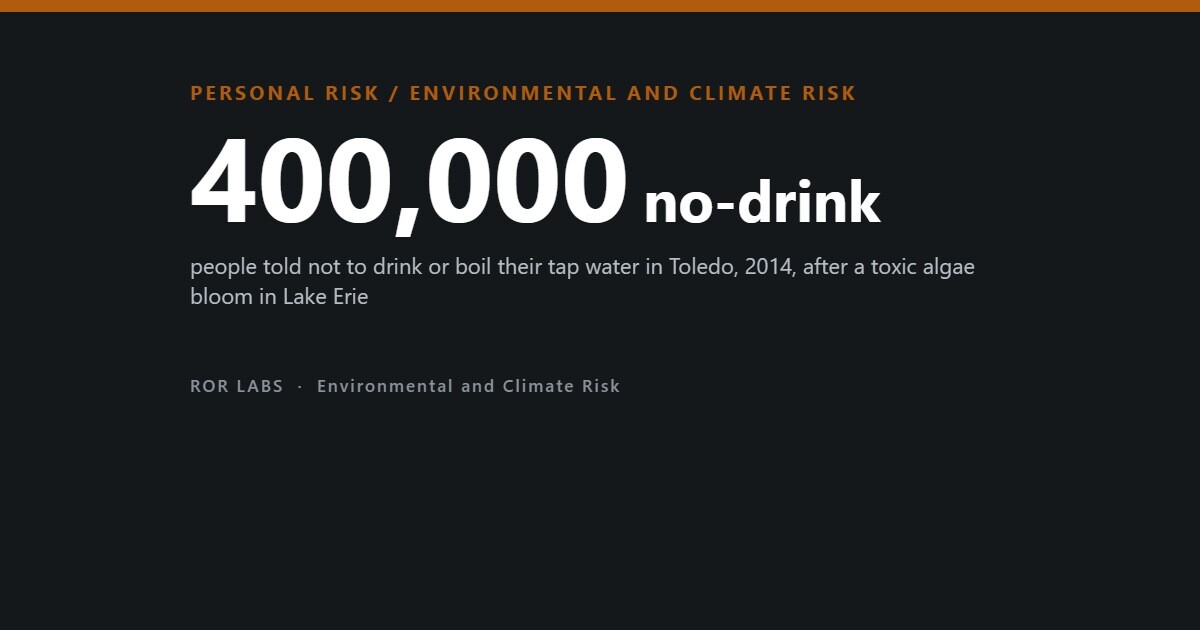
On the morning of 2 August 2014, about 400,000 people in and around Toledo, Ohio, woke up to an unusual instruction: do not drink the tap water, do not boil it, and do not give it to pets. A bloom of cyanobacteria in Lake Erie, the city’s source, had pushed a liver toxin called microcystin into the treated water supply. Shops ran out of bottled water within hours. The advisory lasted until 4 August.
Cyanobacteria, often called blue-green algae, are ancient microorganisms that live in almost every lake and river. When water is warm, still and rich in nutrients from farms and sewage, they can multiply into dense green scums. Some species produce toxins that affect the liver, the nervous system or the skin.
This article looks at what the evidence shows about the risk these toxins pose through drinking water, how often people have actually been harmed, what the safety limits are based on, and why most of the uncertainty concerns long-term exposure rather than dramatic outbreaks. The most serious documented case remains a dialysis clinic in Brazil in 1996, where contaminated water was linked to 52 deaths.
What the toxins are
Cyanobacteria produce several families of toxins. The best studied are the microcystins, a group of more than a hundred related compounds that damage liver cells. Cylindrospermopsin also mainly affects the liver and kidneys. Anatoxin-a and saxitoxins affect the nervous system and can kill animals within minutes of drinking from a bloom.
Not every bloom is toxic, and the same species can produce toxins in one lake and not in another. That makes blooms hard to manage: a green scum is a warning sign, but only testing shows whether toxins are present and at what level.
In 2010, the International Agency for Research on Cancer classified microcystin-LR, the most common form, as possibly carcinogenic to humans, its Group 2B, based largely on evidence that it promotes liver tumours in animals.
The worst case: Caruaru, 1996
The clearest evidence that cyanotoxins can kill people comes from a haemodialysis clinic in Caruaru, in north-eastern Brazil. In February 1996, water for the clinic was brought by truck from a reservoir with a cyanobacterial bloom and inadequately treated before use in dialysis.
Dialysis patients are exposed to huge volumes of water, which passes directly into the blood across a membrane. Of 131 patients treated that month, 116 developed symptoms such as visual disturbances, nausea, vomiting and muscle weakness. One hundred developed acute liver failure and 76 died. Investigators, led by Wayne Carmichael and Sandra Azevedo, found microcystins in patients’ blood and liver tissue and attributed 52 of the deaths to what became known as Caruaru syndrome.
The Caruaru case is extreme because the route of exposure was intravenous, bypassing the gut and liver defences that protect people who drink contaminated water. But it showed beyond doubt that the toxins can be lethal to humans, and it led Brazil to add cyanotoxins to its drinking water regulations in 2000.
The Caruaru dialysis outbreak, Brazil, 1996
Patients treated at one haemodialysis clinic in February 1996.
Carmichael WW and colleagues, Environmental Health Perspectives, 2001; Azevedo SMFO and colleagues, Toxicology, 2002. 76 patients died in total.

Toledo and the first US outbreaks through tap water
Most documented human illness from cyanobacteria has come from swimming or other recreation in bloom-affected water, not from treated tap water. Water treatment removes cells and most toxins most of the time.
The first outbreaks linked to US drinking water were reported only in 2017. The US Centers for Disease Control and Prevention, reviewing waterborne disease in 2013 and 2014, recorded two in Ohio, both drawing water from Lake Erie. In Carroll Township in September 2013, microcystin in treated water affected about 2,000 residents and 6 people reported gastrointestinal illness. In Toledo in August 2014, about 400,000 people lost the use of their tap water and 110 people reported illness.
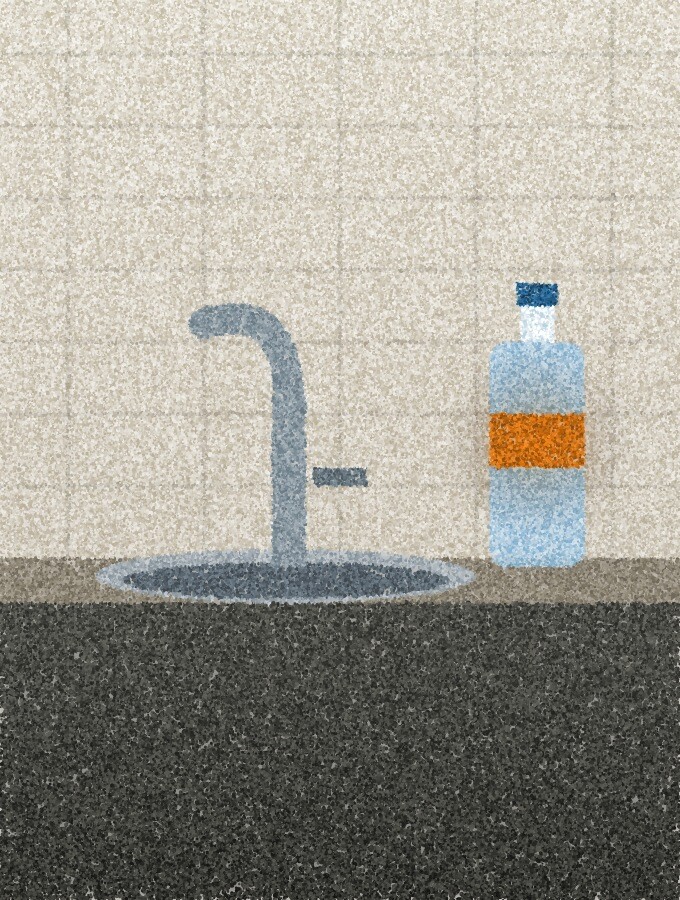
The Toledo case showed a detail that surprises many people. Unlike a bacterial contamination, a toxin problem cannot be solved by boiling water. Boiling does not destroy microcystins, and by evaporating water it can increase their concentration. That is why the advisory told residents not to boil the water, and why it caused such disruption. Hospitals, dialysis units and restaurants had to switch to bottled supplies, and the National Guard helped distribute water across the city. Some residents who had already boiled water for infant formula were told to throw it away.
The city’s treatment plant had struggled with a bloom that sat directly over its intake. After 2014, Toledo invested heavily in upgrades, and Ohio introduced a statewide monitoring and response programme for public water systems.
Cyanotoxin outbreaks through US tap water, 2013–2014
The first two drinking water outbreaks linked to cyanotoxins reported to the CDC.
| Place | Date | People affected | Illnesses reported |
|---|---|---|---|
| Carroll Township, Ohio | Sept 2013 | About 2,000 | 6 |
| Toledo, Ohio | Aug 2014 | About 400,000 | 110 |
Benedict KM and colleagues, CDC Morbidity and Mortality Weekly Report, 2017; as reported by NPR.
What the safety limits are based on
The World Health Organization first set a provisional guideline of 1 microgram per litre for microcystin-LR in drinking water in 1998. In its 2020 update, it kept that value for lifetime exposure and added a short-term value of 12 micrograms per litre for exposures of about two weeks.
WHO guideline values for microcystin-LR
Drinking water, micrograms per litre.
World Health Organization, background document for the Guidelines for Drinking-water Quality, 2020.
In 2015, the US Environmental Protection Agency issued ten-day health advisories rather than binding limits. For microcystins, it advised levels at or below 0.3 micrograms per litre for bottle-fed infants and children under six, and 1.6 micrograms per litre for older children and adults. For cylindrospermopsin, the figures are 0.7 and 3.0.
The lower figures for young children reflect the fact that they drink more water for their body weight. They are also the basis for advisories aimed at vulnerable groups, as in Salem, Oregon, in 2018.
These values are derived mainly from animal studies, with large safety factors to account for differences between species and between people. Joseph Cotruvo, reviewing the approaches of the WHO, the EPA and Health Canada in 2022, noted that they rest on different assumptions and produce somewhat different numbers, but that all of them provide appropriate protection.
US ten-day health advisories for cyanotoxins
Micrograms per litre of drinking water.
| Toxin | Infants and children under 6 | Older children and adults |
|---|---|---|
| Microcystins | 0.3 | 1.6 |
| Cylindrospermopsin | 0.7 | 3.0 |
US Environmental Protection Agency, Drinking Water Health Advisories, 2015. The WHO lifetime guideline for microcystin-LR is 1 microgram per litre.
Salem, 2018
In late May 2018, the city of Salem, the capital of Oregon, issued an advisory warning vulnerable people, including infants, young children, the elderly and people with compromised immune systems, not to drink the tap water. Cyanotoxins from a bloom in Detroit Lake, upstream on the North Santiam River, had reached the treated supply at levels above the EPA’s advisory for young children.
The governor declared an emergency, and bottled water was distributed. Advisories were issued again during the summer as levels rose and fell. Research published in 2022 by Theo Dreher at Oregon State University identified the species responsible, showing that two different types of cyanobacteria in the lake were producing the two toxins found in Salem’s water, microcystin and cylindrospermopsin.
Salem’s experience was a reminder that the problem is not limited to large, heavily farmed lakes such as Lake Erie. A reservoir in a forested mountain valley can also produce toxic blooms in warm, dry summers.
Are blooms getting worse?
Cyanobacteria thrive in warm water, and they grow fastest when water is still and full of phosphorus and nitrogen from fertiliser, manure and wastewater. Hans Paerl and Jef Huisman, in a widely cited 2008 paper in Science titled ‘Blooms like it hot’, argued that climate warming would favour cyanobacteria over other algae.
Satellite data support the concern. Jeff Ho, Anna Michalak and Nima Pahlevan, in Nature in 2019, analysed nearly three decades of images of 71 large lakes around the world. Peak summer bloom intensity had increased in 68% of them since the 1980s. Only a few lakes showed a significant decline.
The link to temperature was less direct than expected. Lakes that warmed less were not always the ones with fewer blooms, which suggests that nutrients, rainfall and lake management matter at least as much as temperature. That is also why reducing nutrient run-off is the main long-term response.
Trends in lake blooms since the 1980s
Peak summer bloom intensity in 71 large lakes, from satellite data.
Ho JC, Michalak AM, Pahlevan N, Nature, 2019.

Swimming, pets and what the surveillance shows
Most harm from cyanobacteria in the United States does not come from tap water at all. It comes from contact with bloom-affected lakes and rivers during recreation.
The CDC’s One Health Harmful Algal Bloom System collects reports from states on blooms and on people and animals that fall ill. From 2016 to 2018, 18 states reported 421 bloom events, 389 human illnesses and 413 animal illnesses. There were no reported human deaths, but 369 of the animals died. Almost all the affected pets were dogs, which swim in blooms, drink the water and lick scum from their fur.
Among people, gastrointestinal symptoms were the most common, followed by headache, fever and skin rashes. About 39% of cases were in people under 18. Only 8% of those who fell ill had any clinical testing, so the true number of cases is likely to be much higher.
Public health agencies’ advice for recreation is simple: if water looks like spilled green paint, has a scum, or smells unusual, stay out of it and keep pets out too.
The long-term question
The acute risks from drinking water are now fairly well understood and, in most countries with modern treatment, rare. The harder question is whether low levels of exposure over years cause disease.
The main evidence comes from China. In the 1980s and 1990s, researchers noticed high rates of primary liver cancer in areas such as Haimen, where many people drank water from ponds and ditches rather than wells. Yoshio Ueno and colleagues, in 1996, found microcystins in a large share of pond and ditch water samples in these areas. But hepatitis B infection and aflatoxin from mouldy food, both major causes of liver cancer, were also common, and the studies could not separate these factors.
A separate hypothesis links a cyanobacterial compound called BMAA to neurodegenerative diseases such as ALS, based partly on research in Guam. It remains contested, and the evidence for a causal link in humans is weak.
Taken together, the long-term evidence is suggestive but not conclusive. That uncertainty is one reason regulators use large safety margins.
What the evidence does not show
It does not show that ordinary treated tap water is a common source of cyanotoxin poisoning. Documented drinking water outbreaks are rare, and most illness comes from recreational contact.
It does not show that small long-term exposures cause cancer or neurological disease. Studies suggesting this are few and heavily confounded.
It does not show that boiling helps. For toxins, boiling does not destroy them and may concentrate them.
And it does not settle how much climate change, as opposed to nutrient pollution, is driving the rise in blooms.
Questions people ask
Can toxic algae get into tap water?
Yes, occasionally. In Toledo in 2014, microcystin passed through treatment and about 400,000 people were told not to drink their water.
Does boiling water remove algal toxins?
No. Boiling does not destroy microcystins and can concentrate them. That is why toxin advisories tell people not to boil their water.
What is the safe level of microcystin in drinking water?
The WHO lifetime guideline is 1 microgram per litre. The US EPA ten-day advisory is 0.3 for young children and 1.6 for older children and adults.
Have people died from cyanotoxins?
The best-documented deaths occurred at a dialysis clinic in Caruaru, Brazil, in 1996, where 52 deaths were attributed to microcystins in water used for dialysis.
Are algal blooms increasing?
Satellite data show peak summer bloom intensity increased in 68% of 71 large lakes worldwide since the 1980s.
The short version
- Cyanobacteria can produce toxins that damage the liver and nervous system.
- The worst documented case was a Brazilian dialysis clinic in 1996, with 52 deaths attributed to microcystins.
- In Toledo in 2014, about 400,000 people lost their tap water; boiling does not remove the toxins.
- US advisories set microcystin levels at 0.3 micrograms per litre for young children and 1.6 for others.
- Blooms intensified in 68% of 71 large lakes studied, but long-term health effects of low exposure are uncertain.
This article summarises published research and public health guidance on cyanobacterial toxins. It is not medical advice. If your water utility issues an advisory, follow its instructions, and keep children and pets out of water with visible scums or discoloration.
Further reading. Falconer and Humpage, ‘Health Risk Assessment of Cyanobacterial (Blue-green Algal) Toxins in Drinking Water’, International Journal of Environmental Research and Public Health, 2005, is an open-access overview. Ho, Michalak and Pahlevan, Nature, 2019, is the key study of global trends.
- The Devil’s Element, Dan Egan (2023). A journalist on phosphorus, the fertiliser behind most toxic blooms, including the Lake Erie crisis that shut down Toledo’s water.
- The Story of More, Hope Jahren (2020). A scientist’s short account of how human demand for food and energy has changed the planet, including fertiliser run-off.
- Water Always Wins, Erica Gies (2022). A journalist on how rivers, lakes and wetlands work, and why engineering against them often backfires.
Sources
- Carmichael WW, Azevedo SMFO, An JS, and colleagues. Human fatalities from cyanobacteria: chemical and biological evidence for cyanotoxins. Environmental Health Perspectives, 2001;109(7):663–668. doi:10.1289/ehp.01109663.
- Azevedo SMFO, Carmichael WW, Jochimsen EM, and colleagues. Human intoxication by microcystins during renal dialysis treatment in Caruaru, Brazil. Toxicology, 2002;181–182:441–446. doi:10.1016/S0300-483X(02)00491-2.
- Drobac D, Tokodi N, Simeunović J, and colleagues. Human exposure to cyanotoxins and their effects on health. Archives of Industrial Hygiene and Toxicology, 2013;64(2):305–316.
- Benedict KM, Reses H, Vigar M, and colleagues. Surveillance for waterborne disease outbreaks associated with drinking water, United States, 2013–2014. Morbidity and Mortality Weekly Report, 2017;66(44):1216–1221. doi:10.15585/mmwr.mm6644a3.
- US Environmental Protection Agency. 2015 Drinking water health advisories for two cyanobacterial toxins. Fact sheet 820F15003, June 2015.
- World Health Organization. Cyanobacterial toxins: microcystins. Background document for development of WHO Guidelines for Drinking-water Quality. 2020.
- Cotruvo JA. Algal toxins in drinking water: standards and guidelines. Journal AWWA, 2022. doi:10.1002/awwa.1997.
- Falconer IR, Humpage AR. Health risk assessment of cyanobacterial (blue-green algal) toxins in drinking water. International Journal of Environmental Research and Public Health, 2005;2(1):43–50.
- International Agency for Research on Cancer. IARC Monographs Volume 94: Ingested Nitrate and Nitrite, and Cyanobacterial Peptide Toxins. 2010.
- Ueno Y, Nagata S, Tsutsumi T, and colleagues. Detection of microcystins, a blue-green algal hepatotoxin, in drinking water sampled in Haimen and Fusui, endemic areas of primary liver cancer in China. Carcinogenesis, 1996;17(6):1317–1321.
- Roberts VA, Vigar M, Backer L, and colleagues. Surveillance for harmful algal bloom events and associated human and animal illnesses: One Health Harmful Algal Bloom System, United States, 2016–2018. Morbidity and Mortality Weekly Report, 2020;69(50):1889–1894. doi:10.15585/mmwr.mm6950a2.
- Paerl HW, Huisman J. Blooms like it hot. Science, 2008;320(5872):57–58. doi:10.1126/science.1155398.
- Ho JC, Michalak AM, Pahlevan N. Widespread global increase in intense lake phytoplankton blooms since the 1980s. Nature, 2019;574(7780):667–670. doi:10.1038/s41586-019-1648-7.
- Oregon Public Broadcasting. Researchers identify toxin that tainted Salem’s drinking water in 2018. June 2022.
- NPR. Algae toxins in drinking water sickened people in 2 outbreaks. November 2017.