Basketball Injuries: Ankles, Knees, and the Two Things That Work
Key takeaways · 9 min read
- Ankle injuries lead basketball’s list: 1.35 per 1,000 athlete-exposures in college play, and 80 to 83.5% of them were lateral ligament tears.
- Most cost under a week (63–65% cost fewer than seven days), but about one in five happened to an ankle that was already injured.
- Knee ligament tears are rarer but cost months, and most happen without contact, which is why training can reach them.
- Two of the best-tested precautions in team sport are cheap, and most teams do not use them.
Basketball is the sport where the evidence on prevention is unusually good, and unusually ignored. Two of the best-tested precautions in all of team sport belong to it. One is a randomised trial of nearly 1,500 high school players. The other is a body of work showing that a fifteen-minute warm-up cuts serious knee injuries by most of their rate. Both are cheap, neither is controversial, and most teams do not use them.
This page is about what actually gets injured on a basketball court, when, and what happens when somebody takes the two known precautions seriously. It is the second entry in the sports branch of this appendix.
What actually gets injured
The answer is the ankle, and it is not close. Across ten seasons of college basketball, 2,248 ankle injuries were recorded over 1,652,255 athlete-exposures — a rate of 1.35 per 1,000, which is 1.49 for men and 1.21 for women. Ankle injury on its own accounts for a substantial share of a basketball injury rate that is 8.5 per 1,000 for everything combined.
Most of those are one specific injury. Between 80 and 83.5 per cent of them were tears of the lateral ligament complex — the outside of the ankle, the classic inversion sprain that happens when a foot lands on somebody else’s. Between 50 and 58 per cent involved contact with another player, and 30 to 36 per cent did not. Landing on a crowded floor is what basketball is; the ankle is where the crowd gets settled.
The severity picture is reassuring and the recurrence picture is not. Between 63 and 65 per cent of those ankle injuries cost fewer than seven days, and in around 42 per cent the player was back within three. But somewhere between 18.6 and 19.9 per cent were recurrences — roughly one in five ankle injuries in college basketball happened to an ankle that had already been injured.
Ten seasons of ankle injuries in collegiate basketball
2,248 injuries across 1,652,255 athlete-exposures, men’s and women’s programmes.
Source: Tummala, S.V. et al., Orthopaedic Journal of Sports Medicine 6(11), 2018.
One asymmetry is worth flagging before the prevention section, because it shapes the evidence there. The ankle injury rate was slightly higher in men’s basketball than women’s, 1.49 against 1.21. The knee literature runs the other way: almost all of the trial work on preventing anterior cruciate ligament injury has been done in female athletes, and the pooled estimates below are from that population. Whether they transfer at the same size to men’s basketball is a reasonable question that the trials were not built to answer.
The knee is the other story, and it is the opposite shape. Anterior cruciate ligament tears are far rarer than ankle sprains, and the cost of one is measured in months and sometimes in the end of a playing career rather than in days. Most of them in basketball happen without contact: a landing, a cut, a deceleration. That matters, because a mechanism that does not involve another player is a mechanism that training can reach.
The distinction between contact and non-contact mechanisms is the most practically useful line in basketball injury data. A ligament torn because an opponent fell across a leg is an accident in the ordinary sense. A ligament torn while landing from a jump, alone, is a movement pattern — and movement patterns can be trained. The prevention evidence further down exists almost entirely on the second side of that line, which is also why it has an upper limit.
When the risk concentrates
Basketball’s competition injury rate is 15.0 per 1,000 athlete-exposures and its practice rate is 6.7. A game hour is roughly two and a quarter times as costly as a practice hour. That ratio is much flatter than football’s, where the same comparison is closer to seven, and it tells you something about the sport: basketball practice looks a great deal like basketball.
Injury rate per 1,000 athlete-exposures, NCAA sports
Overall rate across practices and competitions, 2009–10 through 2013–14. One athlete-exposure is one athlete in one practice or one game.
Source: CDC, MMWR 64(48), 2015, college sports-related injuries, NCAA Injury Surveillance Program.
Competition against practice, per 1,000 athlete-exposures
How much more costly a game hour is than a practice hour, in three sports.
| Sport | Competition | Practice | Ratio |
|---|---|---|---|
| Men’s football | 39.9 | 5.9 | 6.8x |
| Men’s basketball | 15.0 | 6.7 | 2.2x |
| Men’s baseball | 6.8 | 3.5 | 1.9x |
Source: CDC, MMWR 64(48), 2015. Ratios are calculated from the published rates.
Which means the exposure is spread out rather than concentrated. There is no equivalent of the kickoff here — no single play that carries a disproportionate share of the harm and can be legislated away. The risk in basketball arrives in ordinary volume, a few hundred landings at a time, which is why the interventions that work in basketball are the ones a player carries onto the floor rather than the ones a rules committee writes.
The one concentration that does show up is the previous injury. One in five ankle injuries is a recurrence, and the trial evidence below found that bracing helped players with a history of sprains and players without one to a similar degree. That is worth stating plainly: a first sprain raises the odds of a second, and the thing that reduces the second is the same thing that would have reduced the first.
What has been measured to work
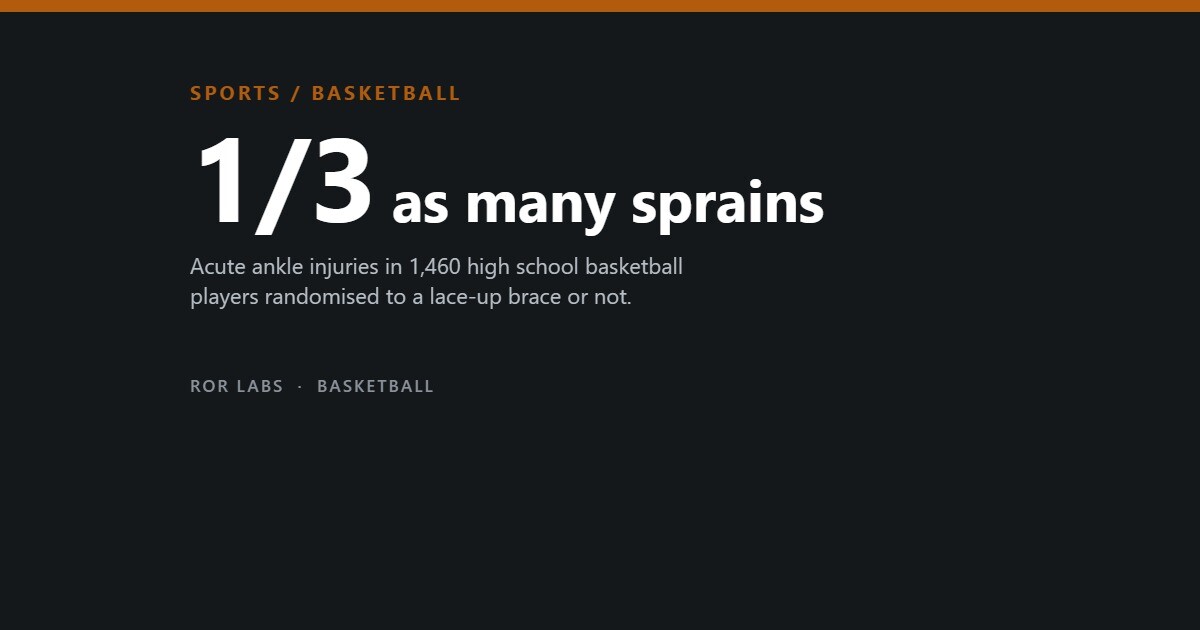
In 2011, 1,460 male and female basketball players across 46 high schools were randomly assigned to wear a lace-up ankle brace or not, and followed through a season. This is a real randomised trial in a real season, which is rare in sports injury research, and the result was not subtle.
Acute ankle injury, braced against unbraced
1,460 high school basketball players randomised across 46 schools, one season.
Source: McGuine, T.A., Brooks, A. and Hetzel, S., American Journal of Sports Medicine 39(9), 2011, 1840–1848.
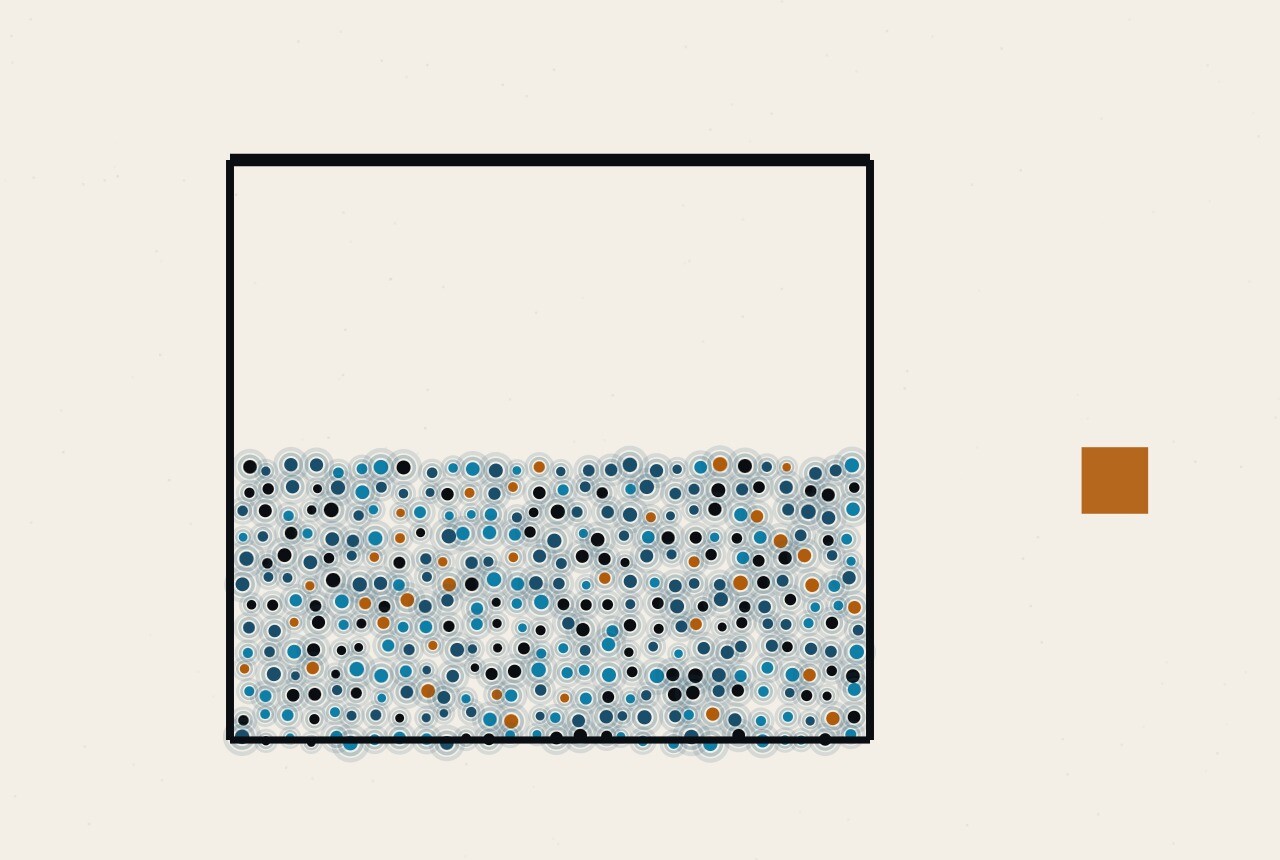
Braced players had about a third the rate of acute ankle injury, and the effect held whether or not they had sprained an ankle before. Then comes the caveat, and it is the part that gets dropped when this trial is quoted. Severity did not change: the median time lost was six days in the braced group and seven in the control group, a difference that was nowhere near significant. Braces changed how often, not how bad. That is still an excellent result. It is just a different result from the one people assume.
The knee intervention is neuromuscular training — structured warm-up programmes that drill landing mechanics, balance, and deceleration, typically for ten to twenty minutes before training. Pooled across trials in female athletes, these programmes reduced non-contact anterior cruciate ligament injuries by about 73 per cent and all anterior cruciate ligament injuries by about 44 per cent.
Those are large numbers, and the interesting finding is what happens when you sort the same trials by how faithfully the programme was actually done. In a compliance meta-analysis, teams with high adherence — more than two-thirds of sessions — saw an 82 per cent reduction. Moderate adherence gave 44 per cent. Low adherence, under a third of sessions, gave 12 per cent.
The same programme, sorted by how much of it was done
Reduction in anterior cruciate ligament injury, pooled across trials of neuromuscular training in female athletes.
Source: Sugimoto, D. et al., compliance meta-analysis of neuromuscular training and anterior cruciate ligament injury risk in female athletes.
That gradient is the whole practical lesson of basketball injury prevention. The programme is not the variable. Doing the programme is the variable. A review of how these programmes fare outside trials found the bottleneck sitting exactly where you would expect: athlete compliance ran at 87.8 per cent when sessions were actually delivered, while coach compliance with delivering them ran at 52.5 per cent. Three years after one implementation trial, only 23 to 26 per cent of users were still running the programme without modifying it.
One more figure from the same body of work is worth keeping. A high-quality study found that delivering the programme at least twice a week reduced anterior cruciate ligament risk by 85 per cent, with a hazard ratio of 0.15 and an interval of 0.03 to 0.73. That interval is wide because these injuries are rare and the trials are small, and the threshold itself still needs checking in other settings. But twice a week is the dose that keeps appearing.
So the honest summary is that basketball has two precautions with good evidence behind them, one of which costs about the price of a pair of socks and the other of which costs fifteen minutes twice a week, and the failure mode for both is not doing them.
Why the answer is not to stop
Basketball’s overall rate of 8.5 per 1,000 exposures sits below football’s 9.2 and well below wrestling’s 13.1, and the injury that makes up most of it puts a player out for three days. The catastrophic knee injury that dominates the conversation is genuinely serious and genuinely uncommon, and the best available evidence says a large share of it is preventable by a warm-up.
The two interventions also sit at different points on the evidence scale, and it is worth being clear about which is which. The brace result is a randomised trial: players were assigned, followed and counted, and the comparison is as clean as sports research gets. The warm-up result is a pooled estimate across trials that differed in programme, population and adherence, with the adherence gradient doing a lot of the explaining. Both are good evidence. Only one of them is the kind that settles an argument.
There is a particular trap in reading numbers like these, which is to treat the existence of a risk as a verdict. Every sport on that chart has a rate above zero, including swimming. What separates them is not whether something can go wrong but how much of the going-wrong is in anybody’s hands, and basketball happens to score unusually well on that second question.
It is also worth saying what the ankle numbers mean in a season rather than per exposure. At 1.35 ankle injuries per 1,000 athlete-exposures, a player who practises and plays around 200 times in a year is looking at roughly a one-in-four chance of an ankle injury across that year, and about two chances in three that it costs under a week if it happens. That is arithmetic from the published rate rather than a measured season figure, but it puts the decision about a brace in the right frame: not a career, but a handful of days and a meaningfully worse ankle for the next season.
A brace is a decision made once a season. A landing-mechanics warm-up is a decision made by whoever writes the practice plan. Neither requires anyone to give up the sport, and the evidence says that between them they would remove a large fraction of what actually happens to basketball players. The problem has never been that the answer is unknown.
This is a reference page, not medical advice. An ankle or knee that keeps giving way is a reason to see a clinician rather than to buy more equipment.
Further reading: The McGuine trial is short and unusually readable for a randomised study, and the compliance meta-analysis is the more useful companion to it — the two together are a small lesson in the gap between efficacy and effect.
- How to Talk to a Science Denier, Lee McIntyre (2021). On engaging contested claims without either dismissing or overselling them.
- The Age of Diagnosis, Suzanne O’Sullivan (2025). A neurologist on overdiagnosis and medicalization — relevant wherever a label changes how an injury gets treated.
- The Data Detective, Tim Harford (2020). Ten rules for reading numbers in the news skeptically, from the FT’s Undercover Economist.
Sources
- CDC, “College Sports-Related Injuries — United States, 2009–10 Through 2013–14 Academic Years”, MMWR 64(48), 2015. (Men’s basketball 8.5 per 1,000 athlete-exposures overall, 15.0 in competition and 6.7 in practice; football 9.2, baseball 4.7, all sports 6.0, wrestling 13.1, swimming and diving 1.7.)
- Tummala, S.V., Hartigan, D.E., Makovicka, J.L., Patel, K.A. and Chhabra, A., “10-year epidemiology of ankle injuries in men’s and women’s collegiate basketball”, Orthopaedic Journal of Sports Medicine 6(11), 2018. (2,248 ankle injuries over 1,652,255 athlete-exposures; 1.35 per 1,000 overall, 1.49 men and 1.21 women; 80.0–83.5 per cent lateral ligament complex tears; 50.4–57.6 per cent contact; 18.6–19.9 per cent recurrences; 62.7–65.2 per cent costing under seven days.)
- McGuine, T.A., Brooks, A. and Hetzel, S., “The effect of lace-up ankle braces on injury rates in high school basketball players”, American Journal of Sports Medicine 39(9), 2011, 1840–1848. (1,460 players at 46 schools randomised; 0.47 against 1.41 acute ankle injuries per 1,000 exposures; hazard ratio 0.32, 0.20–0.52; median days lost 6 against 7, P=0.23; effect present with and without prior sprain.)
- Sugimoto, D. et al., meta-analyses of neuromuscular training and anterior cruciate ligament injury in female athletes. (About 73 per cent reduction in non-contact and 44 per cent in overall anterior cruciate ligament injury; by compliance, 82 per cent at high adherence, 44 per cent at moderate and 12 per cent at low.)
- Systematic review of implementation of neuromuscular training programmes for anterior cruciate ligament prevention in female athletes, Frontiers in Public Health, 2026. (Athlete compliance 87.8 per cent where programmes were delivered against coach compliance of 52.5 per cent; 23 to 26 per cent still running programmes unmodified three years after one trial.)