One Thousand and Seventeen People Agreed to the Recruitment Weekend. Two Years Later, Four Per Cent Were Still Members.
Key takeaways · 12 min read
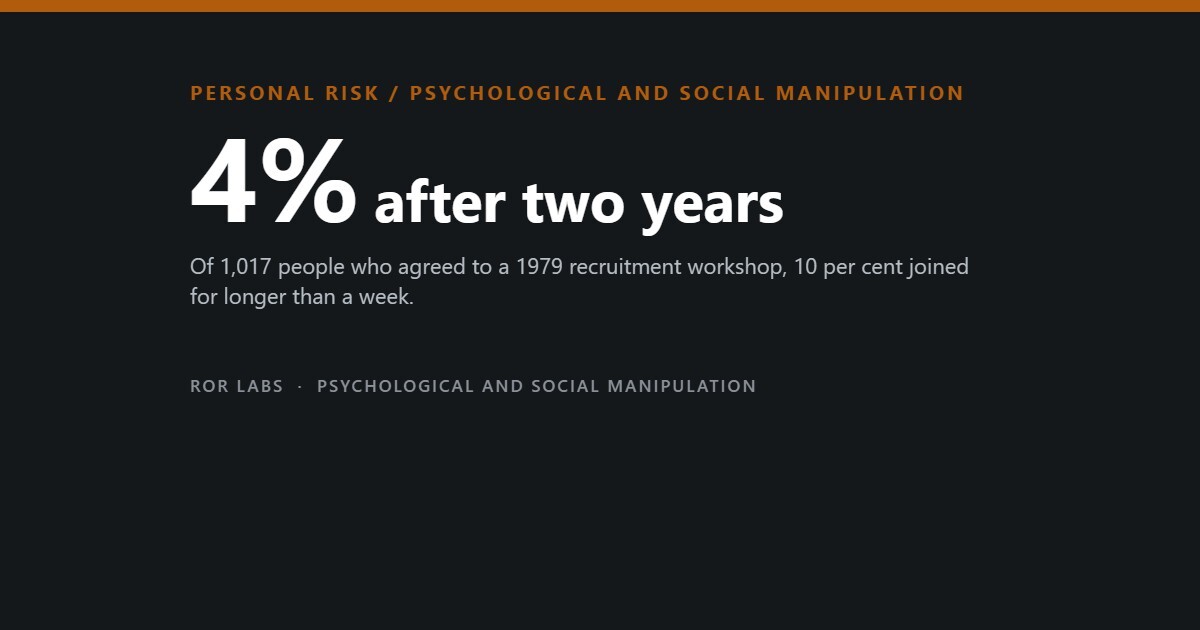
- Of 1,017 people who agreed to attend a recruitment workshop in 1979, 10 per cent joined for more than a week and 4 per cent were still members two years later.
- An independent study of the same movement’s induction sequence found 71 per cent dropped out after the opening two-day workshop and 9 per cent ultimately joined.
- Those who continued differed from those who left in already agreeing more, not in having been worked on harder.
- In 1987 the American Psychological Association declined to accept the report of its own task force on the subject, finding it lacked the scientific rigour necessary for the association’s imprimatur. In 1990 related expert testimony was excluded in a federal case.
In 1979 a sociologist obtained something researchers almost never get: the full list of people who had agreed to attend a religious movement’s residential recruitment workshop in London. Not the list of members. The list of everyone who walked in the door. It ran to 1,017 names.
Ten per cent of them joined the movement full-time for longer than a week. Half of those who joined had left within a year. Two years after the workshops, 4 per cent of the original 1,017 were still full-time members. The movement in question was the one that had given the English language the word most associated with irresistible psychological control, and its recruitment programme, running at full strength and studied from the inside, converted about one person in twenty-five for two years.
This article is about what the evidence actually shows on how people enter and leave high-control groups, and about a word that has outrun it by four decades. It is not an argument that these groups are harmless. The harm literature is real and this article covers it. It is an argument that the mechanism most people assume — a technique applied at the door that overrides the will — is the part with the least support, and that the interesting question lies somewhere else entirely.
The numbers at the door
The London study is not a lone result. In the same period a psychiatrist ran a battery of psychological tests through the same movement’s 21-day induction sequence in the United States, measuring participants at each stage rather than reconstructing their experience afterwards. After the opening two-day workshop, 71 per cent had dropped out. Twenty-nine per cent chose to continue, and they differed from the early leavers in having warmer feelings toward the group and more acceptance of its creed — not in having been worked on harder. Nine per cent ultimately joined.
What happened to 1,017 people who agreed to the workshop
Eileen Barker’s study of Unification Church recruitment, reported in her 2018 review of the movement.
Two independent studies, two countries, the same movement at its peak, and the same shape: a wide funnel with a very narrow neck. Whatever was happening in those workshops, most people who walked in walked out again, and the ones who stayed were distinguishable beforehand by how much they already agreed.
The general pattern holds across the field. High turnover is the single most consistent finding in the study of new religious movements, and it is inconvenient for everybody: movements do not advertise how many members have found them wanting, and the people arguing that members are held by irresistible techniques do not advertise that the members leave of their own accord in large numbers. One consequence is that published membership figures are often cumulative — the count of everyone who has ever passed through, including people who have not been in contact for years and some who are now the movement’s loudest critics.
The 21-day induction sequence, measured at each stage
Galanter, American Journal of Psychiatry 137(12), 1980. Those who continued differed from early leavers in affiliative feeling and creed acceptance; those who joined differed from later leavers in having weaker outside personal ties.

What the profession actually decided
The word “brainwashing” entered English in 1950 as a translation of a Chinese phrase, and the serious research behind it — on American prisoners held by Chinese forces — described something specific: confinement, physical control, no exit, and outcomes that mostly did not survive release. Transferring that to a workshop somebody drove themselves to is a large step, and in the 1980s the American Psychological Association was asked to take it.
In 1983 the association established a task force on deceptive and indirect methods of persuasion and control, chaired by Margaret Singer. What happened over the next four years is a clean record of a professional body declining to certify a concept.
A concept goes to the profession and comes back
BSERP memorandum of 11 May 1987 and contemporaneous filings; United States v. Fishman, 1990.
It is worth reading the 1987 wording carefully, because it is narrower than either side usually makes it. The board did not rule that coercive persuasion does not exist. It ruled that the report in front of it was not good enough to carry the association’s name, and asked its authors to stop implying otherwise. That is a statement about evidence, not about reality — which is exactly the distinction the popular version of this story loses in both directions.

The strongest version of the other case
The best objection to everything above does not come from the anti-cult movement. It comes from a sociologist who spent years arguing that his own discipline had handled the question badly.
Benjamin Zablocki’s case, made across two long papers in 1997 and 1998, has two parts. The first is that a majority faction within the sociology of religion succeeded in blocking the concept from getting a fair scientific trial, so that its rejection was partly a political outcome rather than purely an empirical one. The second matters more. He argued that the whole debate had been fought on the wrong ground: the concept was being tested against recruitment, where it plainly fails, when its historically consistent meaning concerns the manipulation of exit costs for veteran members — what it costs someone to leave after years inside, in relationships, livelihood, identity and belief.
Two different questions that get the same name
Zablocki, Nova Religio 1(1), 1997 and 1(2), 1998, reframing the concept within rational action theory.
This is the honest shape of the disagreement, and it survives the recruitment numbers intact. A 96 per cent attrition rate at the door tells you nothing whatever about the 4 per cent who are still there two years later, or about what the twentieth year looks like. The strongest finding in the field addresses the question fewest people are actually asking.
What the harm research measures, and on whom
There is a separate literature, largely built since the 1990s, that does not argue about mechanisms and instead tries to measure what former members report experiencing. Its instruments are real psychometrics: the Group Psychological Abuse scale from 1994 was the first, and a 2017 instrument built from an expert-panel taxonomy covers six dimensions — isolation, control of information, control over personal life, emotional abuse, indoctrination, and the imposition of a single extraordinary authority — across 31 items.
Those instruments find substantial reported abuse. They also come with a sample problem the authors state plainly. The 2017 validation used 138 self-identified former members of 66 different groups, recruited by convenience and snowball sampling, mostly through organisations that provide information about abusive groups. The average participant had been in the group for 12.2 years and had left 12.2 years before answering. The authors write that the representativeness of the sample “could not be verified”, and note that this is normal in a field studying a population that is very hard to reach.
Who the harm findings are measured on
Saldaña, Rodríguez-Carballeira, Almendros and Escartín, European Journal of Psychology Applied to Legal Context 9(2), 2017.
One finding inside that study is more informative than the headline scores. Participants who had sought counselling after leaving reported significantly more group psychological abuse than those who had not — a mean of 95.07 against 78.69, p = .003. The authors report it without flinching. It can be read two ways, and both are plausible: people who were treated worse are more likely to need help afterwards, or people who have been through a therapeutic account of their experience describe it in stronger terms. Nothing in a retrospective design can separate those.
The older version of this objection has a name in the literature — “atrocity tales”, from a 1983 paper arguing that accounts from members who left after counselling or expulsion are systematically exaggerated. A 2009 Spanish study of 101 former members found no differences in reported abuse or distress by method of departure or by contact with such organisations, which is a real answer to the objection rather than a dismissal of it.

What is actually established
A 2026 systematic review set out to pull together the biological, psychological and social explanations for who becomes involved in these groups and who stays. It screened 97 records and found 11 that met its inclusion criteria. From those it drew ten factors: four neurobiological, three psychological, three social.
The review’s own caveat is the part to keep. The neurobiological findings, it says, were largely derived from general social neuroscience and group behaviour research rather than from studies of people actually in these groups, and should therefore be read as associative rather than causal. What consistently emerged across all three domains was social conformity and group cohesion — which is to say, the ordinary mechanisms of ordinary groups, operating at unusual intensity.
The size of the evidence base
Kim, D., systematic review applying a biopsychosocial framework to cult membership, 2026.
Forty years of public certainty, and the empirical base for the mechanism is eleven studies and a lot of general social psychology. That is not a scandal; it is what happens when a subject is genuinely hard to study, the population is hard to reach, and randomised designs are impossible. But it is a long way from what the word implies when it is used.
Questions people ask
So is anyone actually harmed? Yes, and the article should not be read as saying otherwise. The instruments above find high levels of reported isolation, control and emotional abuse in people who were in these groups for years. The contested claim is narrower than it sounds: not whether harm occurs, but whether entry is involuntary in a way that ordinary persuasion is not.
If most people leave, why does anyone worry? Because the people who do not leave are the whole point, and they are the least-studied part of the field. A 96 per cent attrition rate says nothing about the experience of the remainder, and Zablocki’s reframing — that the real question is what it costs a veteran member to go — has never been tested with anything like the rigour applied to the recruitment claim.
Does this apply to political movements too? The harm instruments were validated on former members of religious, political, therapeutic and commercial groups together, and did not treat them as separate categories. That is a design choice with consequences in both directions: it makes the finding broader, and it makes it harder to say anything specific about any one type.
What about someone I know? Nothing here is a diagnostic tool and the scales above are research instruments, not checklists to apply to another person. If you are worried about someone, that is a conversation for a doctor or a qualified professional who can look at the actual situation, and the most useful thing the evidence offers is unglamorous: the door is usually open, most people eventually use it, and staying in contact matters more than winning an argument.
Was the 1987 decision reversed later? No, and no equivalent body has certified the concept since. The 1990 exclusion of expert testimony pushed in the same direction. What changed instead is the research programme: the field largely moved from arguing about mechanisms of entry to measuring reported experiences of people who were inside, which is the literature described above.
The short version
- Of 1,017 people who agreed to attend a recruitment workshop in 1979, 10 per cent joined for more than a week and 4 per cent were still members two years later.
- An independent study of the same movement’s induction sequence found 71 per cent dropped out after the opening two-day workshop and 9 per cent ultimately joined.
- Those who continued differed from those who left in already agreeing more, not in having been worked on harder.
- In 1987 the American Psychological Association declined to accept the report of its own task force on the subject, finding it lacked the scientific rigour necessary for the association’s imprimatur. In 1990 related expert testimony was excluded in a federal case.
- The strongest counter-argument is that the debate was fought over recruitment, where the concept fails, rather than over the cost of leaving after years inside, where it has barely been tested.
- The harm literature is real and its instruments are properly validated, but its samples are small, retrospective, and largely recruited through organisations that campaign on the subject. The authors say so themselves.
- A 2026 systematic review found 11 eligible studies from 97 screened, and warned that its neurobiological findings came from general social neuroscience rather than from group members.
- What survives all of this is unremarkable: social conformity and group cohesion, running at unusual intensity.
This article describes what the published research has found about entry into and exit from high-control groups, and about the scientific status of a contested concept. It is not a clinical tool, not a diagnostic checklist, and not advice about any particular group or person. The scales it describes are research instruments used with former members under research conditions; none of them is designed to be applied to someone you know. If you are concerned about yourself or another person, a doctor or a qualified professional is the right place to take it. Where the evidence cannot settle a question — what happens to long-term members above all — that is said rather than resolved.
Further reading: Eileen Barker’s 2018 review of the Unification Church is open access, written for a general reader, and is where the 1,017 figure is stated in her own words. Zablocki’s two 1997–1998 papers are the best-argued case against the consensus and should be read by anyone who finds this article too tidy. The 2017 validation paper prints its own limitations section unusually honestly.
- Cultish, Amanda Montell (2021). A linguist’s analysis of how cult and high-control-group language actually works.
- How to Talk to a Science Denier, Lee McIntyre (2021). On engaging contested claims without dismissing or overselling them.
- The Scout Mindset, Julia Galef (2021). On reasoning to see clearly rather than to defend a position.
Sources
- Barker, E., “The Unification Church: A Kaleidoscopic Introduction”, Sociologica Religiosa, 2018. (“Of over a thousand potential converts who were interested enough in the movement to agree to attend a residential workshop, only 10 per cent actually joined as a full-time member for over a week… after one year half of those who had joined had left, and after two years only 4 per cent of the original 1,017 were still full-time Unificationists.” Barker’s underlying fieldwork is reported at length in The Making of a Moonie, 1984.)
- Galanter, M., “Psychological induction into the large-group: findings from a modern religious sect”, American Journal of Psychiatry 137(12), 1980, pp.1574–1579. (Structured 21-day workshop sequences, participants tested at multiple points. 71% dropped out after the initial two-day workshop; the 29% who continued showed greater affiliative feeling toward the group and greater acceptance of its creed than the early dropouts; the 9% who ultimately joined had weaker outside personal ties than the later dropouts, with comparable belief and cohesiveness.)
- Board of Social and Ethical Responsibility for Psychology, American Psychological Association, memorandum of 11 May 1987 on the report of the Task Force on Deceptive and Indirect Methods of Persuasion and Control. (The board was “unable to accept the report of the Task Force”, finding that it “lacks the scientific rigor and evenhanded critical approach necessary for APA imprimatur”, cautioned members “against using their past appointment to imply BSERP or APA support or approval of the positions advocated in the report”, and asked that they “not distribute or publicize the report without indicating that the report was unacceptable to the Board”. The task force was established in 1983 and chaired by Margaret Singer.)
- Amicus brief filed 10 February 1987 in Molko v. Holy Spirit Association, California Supreme Court, describing the hypotheses at issue as uninformed speculations based on skewed data; the APA moved to withdraw its signature on 24 March 1987 as premature pending the task force’s work, while the co-signing scholars maintained theirs. United States v. Fishman, N.D. Cal. 1990, in which expert testimony on coercive persuasion was excluded.
- Zablocki, B., “The Blacklisting of a Concept: The Strange History of the Brainwashing Conjecture in the Sociology of Religion”, Nova Religio 1(1), 1997, pp.96–121; and “Exit Cost Analysis: A New Approach to the Scientific Study of Brainwashing”, Nova Religio 1(2), 1998, pp.216–249. (Argues that a majority faction blocked a fair scientific trial of the concept, and that its historically consistent use concerns the manipulation of exit costs for veteran members rather than manipulation in recruitment. The second paper reframes the concept within rational action theory and is explicit that brainwashing is only one of several factors, not a general explanation of movement behaviour.)
- Robbins, T. and Anthony, D., “The Limits of ‘Coercive Persuasion’ as an Explanation for Conversion to Authoritarian Sects”, Political Psychology, 1980. (Sets out four problem areas: overgeneralised cult stereotypes; equating religious movements with institutions employing forcible constraint; assuming that persons subjected to persuasive techniques necessarily lack free will; and reliance on the testimony of ex-converts whose accounts were negotiated with therapists or deprogrammers.)
- Saldaña, O., Rodríguez-Carballeira, Á., Almendros, C. and Escartín, J., “Development and validation of the Psychological Abuse Experienced in Groups Scale”, European Journal of Psychology Applied to Legal Context 9(2), 2017. (31 items across six dimensions; n = 138 self-identified former members of 66 groups; 65.9% recruited through organisations providing information about abusive groups, 10.9% through professionals, 23.2% through other participants; mean age 48.4, mean age at joining 24.2, mean 12.21 years in the group and 12.15 years since leaving; 52.9% left by walking away after personal reflection. Participants who sought counselling after leaving scored higher than those who did not, 95.07 against 78.69, Mann-Whitney U = 1001.5, Z = 2.923, p = .003. The authors state that the representativeness of the sample “could not be verified”.)
- Rodríguez-Carballeira, Á. et al., “Group psychological abuse: Taxonomy and severity of its components”, European Journal of Psychology Applied to Legal Context 7(1), 2015. (Delphi study with a panel of 31 experts establishing the taxonomy the 2017 scale operationalises; the strategies judged most severe were those acting on the emotional domain.)
- Kim, D., “Susceptibility and Retention in Cults: A Systematic Review of Neurobiological, Psychological, and Group-social Influences”, 2026. (97 records screened, 11 studies included; ten factors identified, four neurobiological, three psychological, three social. The review states that neurobiological findings “were largely derived from general social neuroscience and group behavior studies rather than direct cult-population research, and should therefore be interpreted as associative rather than causal”, and that social conformity and group cohesion emerged consistently across domains.)
- Richardson, J.T., “Conversion and New Religious Movements”, 2022, and “A Critique of ‘Brainwashing’ Claims About New Religious Movements”, 2018; Bradney, A. (ed.), New Religious Movements: Their incidence and significance, 1999. (On turnover: defection and disaffiliation rates have always been high, most such movements remain small as a result, and published membership counts are frequently cumulative rather than current.)