The Word Arrived a Decade Before the Evidence. A Review of Gaslighting in Intimate Relationships Found Fourteen Eligible Studies.
Key takeaways · 11 min read
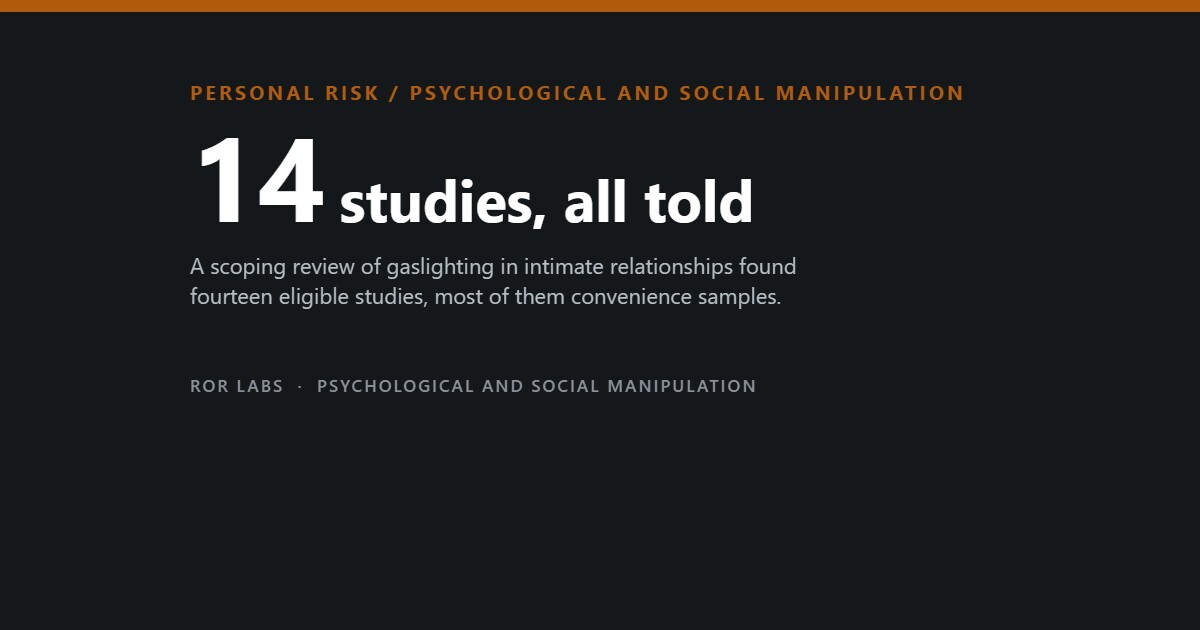
- A 2024 scoping review of gaslighting in intimate relationships found fourteen eligible studies. A 2023 rapid evidence assessment captured fifty articles and retained twelve.
- A 2025 systematic review concluded the term is often inconsistently defined and conflated with broader forms of manipulation.
- The academic definition is narrower than the popular one: a repeated pattern, inside an intimate relationship, that draws on stereotypes and structural inequalities outside it.
- The first cross-culturally validated measure of exposure appeared in 2024: eleven items, 509 Israeli and 395 American participants, internal consistency 0.93 and 0.96.
The word comes from a 1938 play in which a husband dims the gas lamps and tells his wife she is imagining it. Psychiatry picked it up in the 1960s and kept it, quietly, for about fifty years. Then somewhere around 2016 it escaped into everyday speech, and now it is used for everything from a partner rewriting a conversation to a government denying a policy it announced.
A scoping review published in 2024 asked what the scientific literature actually contains on gaslighting in intimate relationships. It found fourteen eligible studies. A rapid evidence assessment the year before captured fifty articles and retained twelve. The first measure of gaslighting exposure whose structure and validity were tested with confirmatory methods across two cultures was published in 2024.
So the honest position is uncomfortable in both directions. The term outran its evidence by roughly a decade, and it is now applied to things it was never meant to describe. And when someone finally built a proper instrument and used it, the construct did something interesting: it predicted depression better than psychological abuse did.

What the word was supposed to mean
The most cited academic treatment is Paige Sweet’s 2019 paper in the American Sociological Review, and its central claim is that gaslighting is not primarily a psychological phenomenon at all. It is a sociological one: it works because the perpetrator can reach for something outside the relationship. Gendered stereotypes, structural vulnerabilities related to race, nationality or immigration status, and institutional inequalities are the raw material. The tactics are gendered, on this account, precisely because they rely on the long-standing association of femininity with irrationality.
That is a specific mechanism, and it is narrower than the everyday use of the word. It requires a power asymmetry, a relationship intimate enough for the perpetrator’s account to matter, and an outside world that will side with them. A stranger cannot gaslight you in a single exchange, on this definition, and neither can someone who simply remembers a conversation differently.
A historical review traces how far the term has travelled from that. Identified more than fifty years ago and confined to psychiatry for most of that time, it has recently expanded both in the contexts where it is said to occur and in the disciplines weighing in on it. The reviewers’ recommendation is to differentiate gaslighting from related constructs — which is a polite way of saying that a lot of what is currently called gaslighting is something else.
How much research there actually is
Machado, M. de O.S. et al., scoping review, 2024; Dickson, P., Ireland, J.L. and Birch, P., Journal of Criminological Research, Policy and Practice, 2023; Adair, J., “Defining Gaslighting in Gender-Based Violence”, Trauma, Violence & Abuse, 2025.
What the research means by it, and what the word is now used for
| In the literature | In common use | |
|---|---|---|
| Duration | A repeated pattern. Repetition is one of the six components victim-survivors and support workers themselves named. | Often a single exchange or statement. |
| Relationship | Intimate, or otherwise close enough for the perpetrator’s account of reality to carry weight. | Anyone: a stranger, an employer, a public institution. |
| Mechanism | Mobilising stereotypes and structural or institutional inequalities that exist outside the relationship. | Disagreeing, denying, or remembering differently. |
| Outcome | The target loses confidence in their own perception, memory or sanity. | The other person is annoying or dishonest. |
Sweet, P.L., American Sociological Review, 2019; Darke, L., Paterson, H.M., Dhillon, H.M. and van Golde, C., “Defining Gaslighting in Intimate Partner Violence”, 2025, for the six definitional components drawn from victim-survivors and support service providers.
The first scale that was properly tested
In 2024 a team working across Israel and the United States published the Gaslighting Relationship Exposure Inventory: eleven items, each describing something a partner does. My partner often denies saying things that I remember him saying. My partner makes me think that I am distorting things. My partner makes me feel like I am impossible to get along with.

They tested it on 509 Israelis and then on 395 Americans, all of them in a romantic relationship at the time. The items loaded onto a single factor in both samples, with internal consistency of 0.93 and 0.96. It behaved as a measure of psychological abuse should: strongly correlated with psychological abuse victimisation, at 0.60 in the Israeli sample and 0.72 in the American one, and much more weakly with physical and economic partner violence.
That gap between the strong and the weak correlations is the technical evidence that the scale is measuring something specific rather than picking up abuse in general. It is also, so far, the only such evidence there is.
What gaslighting exposure correlates with
Correlations with the Gaslighting Relationship Exposure Inventory. Israeli sample first, American second.
Relationship quality ran the other way: −.57 and −.43. The pattern — strong with psychological abuse, weaker with everything else — is what convergent and discriminant validity look like when a measure works.
Tager-Shafrir, T., Szepsenwol, O., Dvir, M. and Zamir, O., “The gaslighting relationship exposure inventory: Reliability and validity in two cultures”, Journal of Social and Personal Relationships, 2024.
It is not simply a synonym for abuse
The more interesting result is what happened when the researchers put gaslighting into a regression alongside every other form of partner violence they had measured.
Predicting depression, psychological abuse and economic control each had their own significant association when entered on their own. When gaslighting exposure was added, the association between psychological abuse and depression fell to non-significance. In both samples. Gaslighting itself remained significantly associated with depression above and beyond demographics and every other abuse scale, and it was the strongest predictor of depression of any form of partner violence measured.
The same held for relationship quality, though there the other associations survived alongside it. In neither case was the effect moderated by gender.
That is a real finding and it deserves to be stated plainly: on this evidence, being made to doubt your own account of events carries a weight that generic psychological abuse measures were not capturing.
What happened when gaslighting was added to the model
Hierarchical regressions predicting depression, with all other measured forms of partner violence already in the equation.
This is a cross-sectional finding. It shows that the two are not interchangeable measures; it does not establish that gaslighting causes depression rather than the reverse, and the authors say so.
Tager-Shafrir, T. et al., Journal of Social and Personal Relationships, 2024, Tables 4 and 7.
The finding that complicates the story
In both samples, men reported more exposure to gaslighting than women. The effect was not small — a standardised difference of 0.46 in the Israeli sample and 0.55 in the American one.
This sits awkwardly against a literature that describes gaslighting as a gendered tactic rooted in the association of femininity with irrationality, and the authors do not pretend otherwise. They offer three qualifications, and all three are worth carrying.
First, the statistical one: their scale showed metric invariance between genders but not full scalar invariance, meaning that direct comparison of the average scores may be biased. Second, these were community samples of people currently in relationships, and the mean exposure was around 2 on a 1 to 5 scale — mild. Mild gaslighting may belong to what the field calls situational couple violence, which tends to be roughly gender-symmetrical. Severe gaslighting, more likely to be found in clinical samples, may be better understood as a coercive control tactic, and those are more commonly used by men against women.
The third qualification is the number that makes the point. In a sample of women who had called a domestic violence hotline, 73.8 per cent reported that a current or former partner had done things on purpose to make them feel they were going crazy. That is not the same phenomenon as a mean of 2 out of 5 in a community sample. It is the same word.
Three sentences that are all supported
The likeliest reconciliation is that mild and severe gaslighting are different phenomena wearing one name, and that community samples can only see the mild end. Nobody has tested that.
Tager-Shafrir et al., 2024, reporting their own results and citing Warshaw, C. et al., 2014, for the hotline sample.
What is still missing
The authors of the only validated scale list their own limitations, and they are the ones that matter. The design is cross-sectional, so causal direction is open: pre-existing mental health difficulties may raise the risk of partner violence victimisation, including gaslighting, rather than the other way round. The scale was validated for community samples and has no cut-off score for clinically significant gaslighting. Everything rests on self-report — and, as they note, some gaslighting tactics are specifically designed to be hard for the target to perceive, which would suppress the measured frequency.
There is a wider problem underneath. Coercive control, the broader construct gaslighting is supposed to sit inside, has been through the same trouble. A scoping review of 57 studies found no consensus on how to define or measure it, and few measures actually designed to capture it in line with existing theory; researchers commonly borrow scales built for something else.
That matters because several countries have now criminalised coercive control, and definitions that were built for a survey are being asked to do work in a courtroom. The 2025 systematic review makes the point directly: with the criminalisation of psychological abuse advancing, it is imperative that researchers develop clear and intentional definitions of abstract concepts.

Questions people ask
Is gaslighting the same as lying, or as remembering things differently?
Not on any definition in the literature. The academic accounts require a pattern rather than an incident, an effect on the target’s confidence in their own perception, and a relationship in which the perpetrator’s version carries weight. Two people recalling an argument differently is the ordinary case; nearly all of the research is about repeated behaviour inside an intimate relationship with a power asymmetry.
Can a company, a government or an institution gaslight someone?
The sociological literature says something close to yes and calls it institutional or epistemic gaslighting, but it is theorised far more than it is measured. Every quantitative study cited here is about intimate relationships. If you see a number attached to institutional gaslighting, it is very unlikely to come from a validated instrument, because none exists.
Why did men report more of it?
Nobody knows. The authors offer three possibilities: a measurement artefact, because the scale is not fully comparable between genders; a genuine symmetry at the mild end that would not hold at the severe end; and greater male sensitivity to or willingness to report these behaviours. Their own preferred reading is that community samples cannot see the severe end at all. All of that is hypothesis.
Does calling it gaslighting help?
The evidence cannot answer that. What the evidence does show is that the specific experience — being made to doubt your own account — carried a stronger association with depression than any other measured form of partner violence, which is at least a reason to take the complaint seriously rather than treat it as a fashionable word.
What should someone do if this describes their relationship?
That is outside what a page of research summary can answer, and we are not going to pretend otherwise. It is worth talking to someone who is not part of the relationship — a doctor, or a local domestic abuse service, both of which deal with this routinely and neither of which will need the word explained.
The short version
- A 2024 scoping review of gaslighting in intimate relationships found fourteen eligible studies. A 2023 rapid evidence assessment captured fifty articles and retained twelve.
- A 2025 systematic review concluded the term is often inconsistently defined and conflated with broader forms of manipulation.
- The academic definition is narrower than the popular one: a repeated pattern, inside an intimate relationship, that draws on stereotypes and structural inequalities outside it.
- The first cross-culturally validated measure of exposure appeared in 2024: eleven items, 509 Israeli and 395 American participants, internal consistency 0.93 and 0.96.
- It correlated 0.60 and 0.72 with psychological abuse victimisation and much less with physical (0.25, 0.46) and economic (0.21, 0.44) partner violence — the pattern a working measure should show.
- When gaslighting exposure was added to a regression, the association between psychological abuse and depression fell to non-significance in both samples. Gaslighting was the strongest predictor of depression of any abuse type measured.
- In both community samples men reported more exposure than women (d = 0.46 and 0.55). In a domestic violence hotline sample, 73.8% of women reported a partner deliberately trying to make them feel they were going crazy.
- Everything above is cross-sectional and self-reported, has no clinical cut-off, and comes from a literature that is roughly a decade younger than the word.
This article summarises published research on gaslighting and psychological abuse in intimate relationships. It is not psychological advice and it is not an assessment tool — the one validated scale described here has no clinical cut-off and was built for research, not diagnosis. This is a sensitive subject, and if any of it is close to home, a doctor or a local domestic abuse service is the right place to take it.
Further reading: Sweet’s 2019 paper in the American Sociological Review is the theoretical starting point, and the 2024 validation paper for the Gaslighting Relationship Exposure Inventory is the only place to see the construct actually measured.
- Cultish, Amanda Montell (2021). A linguist’s analysis of how manipulative, high-control language actually works.
- Calling Bullshit, Carl Bergstrom & Jevin West (2020). A field guide to statistical nonsense, still inside the window.
- How to Talk to a Science Denier, Lee McIntyre (2021). On engaging contested claims without dismissing or overselling them.
Sources
- Tager-Shafrir, T., Szepsenwol, O., Dvir, M. and Zamir, O., “The gaslighting relationship exposure inventory: Reliability and validity in two cultures”, Journal of Social and Personal Relationships, 2024. (Two community samples, Israeli N = 509 and American N = 395, all in a romantic relationship. Eleven items on a single factor; Cronbach’s alpha 0.93 and 0.96. Correlation with psychological abuse victimisation 0.60 and 0.72; physical partner violence 0.25 and 0.46; economic control 0.21 and 0.44; depression 0.41 and 0.56; relationship quality −0.57 and −0.43. In hierarchical regressions the association between psychological abuse and depression fell to non-significance once gaslighting exposure was entered, while gaslighting remained significant, beta 0.35 and 0.45, and was not moderated by gender. Metric gender invariance supported, full scalar invariance not; men reported greater exposure, d = 0.46 and 0.55. Mean exposure around 2 on a 1–5 scale. Stated limitations: cross-sectional, self-report, community samples only, no clinical cut-off, under-representation of some minority groups, and the possibility that tactics hard for the target to perceive suppress measured frequency. Cites Warshaw et al., 2014, for the finding that 73.8% of women calling a domestic violence hotline reported a partner doing things on purpose to make them feel they were going crazy.)
- Sweet, P.L., “The Sociology of Gaslighting”, American Sociological Review, 2019. (Argues gaslighting is primarily sociological rather than psychological, rooted in social inequalities including gender and executed in power-laden intimate relationships. Uses domestic violence as a strategic case to show how perpetrators mobilise gendered stereotypes, structural vulnerabilities related to race, nationality and sexuality, and institutional inequalities; the tactics are gendered because they rely on the association of femininity with irrationality.)
- Darke, L., Paterson, H.M., Dhillon, H.M. and van Golde, C., “Defining Gaslighting in Intimate Partner Violence: Insights from Victim-Survivors and Support Service Providers”, 2025. (Online open-ended survey of victim-survivors and support service providers, analysed by qualitative content analysis. Identifies six definitional components — behaviour, outcomes, intention, repetition, subsidiary tactics, and the role of power and intimacy — and proposes a definition built from them, while noting that intention, repetition and power imbalance remain contested.)
- Adair, J., “Defining Gaslighting in Gender-Based Violence: A Mixed-Methods Systematic Review”, Trauma, Violence & Abuse, 2025. (96 records identified. Concludes that the term is often inconsistently defined and conflated with broader forms of manipulation, and that it is largely examined only in the context of intimate partner violence. Produces a two-part framework of tactics and survivor outcomes.)
- Machado, M. de O.S., da Fonsêca, P.N., Tannuss, A.D.G., Dias, D.G. do N. and Pereira, R.S., “Gaslighting in intimate relationships: a scoping review”, 2024. (Searches of Scopus, CINAHL, MEDLINE, PsycNet, PubMed, PsycInfo and Sage Journals plus Google Scholar. Fourteen studies eligible for the main analysis, investigated from seven perspectives including risk factors, tactics, motivations, assessment tools, harms, coping and correlates. The authors note the selected articles used convenience samples composed predominantly of women, which may influence understanding of the phenomenon.)
- Dickson, P., Ireland, J.L. and Birch, P., “Gaslighting and its application to interpersonal violence”, Journal of Criminological Research, Policy and Practice, 2023. (Rapid evidence assessment capturing 50 articles, 12 retained for thematic review, followed by an online study of 386 adults, 77.2% women. Emotional abuse was broadly related to both perpetrating and experiencing gaslighting, indicating it may represent an extension of emotional abuse. The relationship to trait aggression was limited.)
- Klein, W., Wood, S., Forget, A.-A. and Bartz, J.A., “A historical review of gaslighting: Tracing changing conceptualizations within psychiatry and psychology”, 2026. (Traces the term from its identification more than fifty years ago, when discourse was largely confined to psychiatry, through its recent resurgence and expansion in both the contexts where it is said to occur and the disciplines addressing it. Identifies points of consensus and tension and recommends differentiating gaslighting from related constructs.)
- Johnston, C., Tanrıverdi, B., Sullivan-Toole, H., Reilly, J., Olino, T.M. and Jarcho, J.M., “Understanding Gaslighting: A Data-Driven Analysis of Themes, Features, and Effects on Subjective Memory”, 2025. (250 young adults, open-ended prompts analysed with natural language processing. Romantic partners were the most commonly reported perpetrators; more severe, frequent and long-lasting experiences were associated with broader subjective memory complaints. Both detrimental and, in participants’ own accounts, some beneficial long-term consequences were reported.)
- McIntyre, C.L., “Conceptualizing coercive control in the context of intimate partner violence: scoping the empirical landscape”, Simon Fraser University. (Scoping review of 57 studies. Finds no consensus on how best to define or measure coercive control and few measures designed to capture it in line with existing theory; common approaches borrow scales built for related but different constructs.)
- Wilson, K. and Timmons Fritz, P.A., “Psychometric Properties of the Coercion in Intimate Partner Relationships Scale”, Assessment, 2021. (N = 541. Reports validity and reliability evidence for demand, threat, surveillance and response-to-demands subscales, noting that content validity has been a persistent problem for existing measures of coercive control because they do not assess all of these behaviours.)