Working in the Heat: What the Evidence Shows
Key takeaways · 14 min read
- US records count about 34 heat deaths at work a year from 1992 to 2022, then 55 in 2023 and 48 in 2024. Comparisons between data sources suggest heat illness at work is undercounted several times over.
- New workers face the greatest danger. In OSHA’s 2012–13 heat cases, 9 of 13 deaths came in the first three days on the job, and none of the 20 employers had an acclimatisation programme.
- Heat also raises ordinary injuries. In 2023 OSHA records, the odds of any injury were 15% higher at a heat index of 105°F than at 80°F, in warehouses and factories as well as outdoors.
- California’s heat standard is the best-studied rule: one analysis estimated 33% to 51% fewer outdoor worker heat deaths after enforcement increased, significant only for the periods combined.
Eugene Gates Jr. had delivered mail in Dallas for about 35 years when he collapsed on his route on 20 June 2023. The heat index reached 113°F. He was 66. Official US records list close to a thousand workers killed by heat on the job since 1992, and researchers think the real number is higher.
This article is about heat at work: farm fields, building sites, delivery routes and warehouses. An earlier piece covered heat deaths in the wider population. This one asks how many workers die, who is most at risk and which rules have been shown to help.
The thread running through it is counting. A heat death at work enters the national statistics only when a death certificate, an employer report and an investigator agree. When they do not, the death drops out, and part of the case for prevention goes with it.
How many workers die from heat?
The main US source is the Bureau of Labor Statistics’ Census of Fatal Occupational Injuries (CFOI). The Environmental Protection Agency’s summary of it lists 986 workers killed by heat on the job from 1992 to 2022, about 34 a year. Construction accounted for 334 of them. The census counted 55 heat deaths in 2023 and, under a new classification, 48 in 2024.
How official records count heat deaths at work
United States. The last row comes from death certificates, which record usual job, not place of exposure.
Sources: US EPA climate indicators (CFOI 1992–2022); Szeto et al., JAMA (2026), citing CFOI for 2023; National Safety Council summary of CFOI 2024. Bars for the first and last rows are not on the same scale.
Inside the confidential CFOI files for 2000 to 2010, Diane Gubernot and colleagues found 359 heat deaths, highest among Hispanic workers, men, farm and construction workers, and very small firms. From 1992 to 2016, construction had 6% of the workforce but 36% of heat deaths (Dong et al., 2019).
Death certificates cast a wider net. By usual job, the 2026 JAMA study found the highest rates in the military (1.6 per 100,000), farming, fishing and forestry (1.1), and construction and extraction (1.1), against 0.3 nationally. Not all of these deaths happened at work, but the pattern matches the census.
Why the official count is low
Each source misses cases for its own reasons. Compensation records depend on a claim being filed and accepted: in Washington State, 918 heat-illness claims were confirmed from 2006 to 2017, and 264 were rejected (Hesketh et al., 2020). In California, heat injuries in the national employer survey ran three to six times below the state’s compensation records, a gap described by Heinzerling and colleagues.
Hospital records seldom say what a patient does for a living. In Washington emergency departments, Spector’s group found an employer or job recorded in only 21.5% of heat-illness visits by people aged 16 and over (Wuellner et al., 2024). In the JAMA data, occupation was missing for 23.7% of heat deaths, and heat codes on death certificates have low sensitivity.
A heat death can also be filed as something else. Of 456 deaths in the JAMA study where heat contributed but was not the main cause, 68.4% named a cardiovascular condition first. OSHA’s economic analysis for its proposed rule multiplied the survey count of non-fatal heat injuries by 7.5 to allow for under-reporting.
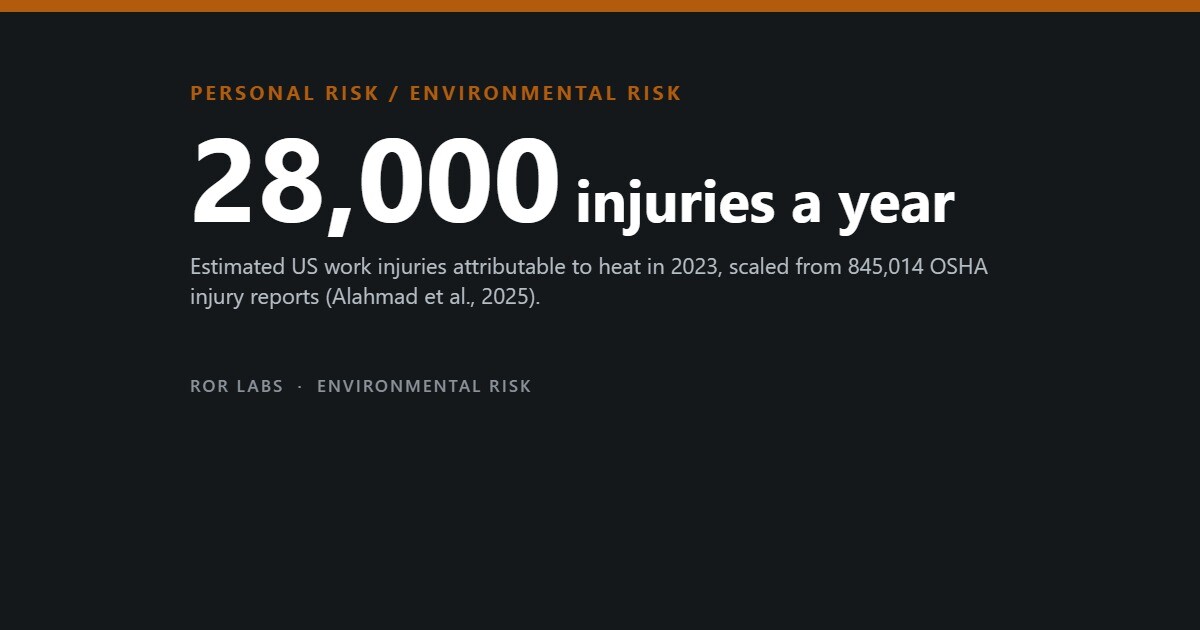
Some injuries never carry heat’s name. Barrak Alahmad, David Michaels and colleagues matched 845,014 injuries that large employers reported to OSHA in 2023 with the heat index at each workplace that day. Scaled to national totals, about 28,000 injuries were attributable to heat, which the authors call a likely undercount.
Injury odds rise with the heat index
Odds of any workplace injury compared with a day at a heat index of 80°F, United States, 2023 (= 1).
Source: Alahmad et al., Environmental Health (2025); 845,014 injuries reported to OSHA by establishments with 100 or more employees in high-hazard industries. One year of data.
Manufacturing and warehousing, largely indoor, showed rises as clear as construction. Smaller firms did not have to report, and the study covers one year.
Four deaths on the record
Gates collapsed in Dallas on a day of excessive heat warnings. The medical examiner gave the cause as hypertensive and atherosclerotic heart disease and hyperthermia. His widow, Carla Gates, told CBS News that his vehicle was not air-conditioned.
In December 2023 OSHA cited the Postal Service for exposing workers to the ‘recognized hazard of high outdoor heat’ and proposed a $15,625 penalty. A citation is an allegation the employer can contest; USPS said it was reviewing it. OSHA’s proposed fixes included training, rest breaks, water, earlier starts and an acclimatisation plan. In June 2024 the penalty was still pending.

On New Year’s Day 2023, a 28-year-old man from Mexico working on a visa started at a farm in Parkland, Florida, hired through a labour contractor. With the heat index near 90°F he said he felt tired and his legs hurt. Co-workers later found him unresponsive in a shallow ditch. It was his first day. OSHA found the death preventable and proposed $15,625 in penalties.
Danny Nolasco was 18 when he collapsed while mixing and hauling cement near Austin on 15 July 2024, with a heat index of 104°F. The Travis County medical examiner ruled the cause undetermined. OSHA classified it as a heat death and found the employer had no heat illness programme, no acclimatisation period and no training.
Five weeks later Rolando Varela Gómez, a Nicaraguan immigrant two weeks into a Texas job, died after pouring concrete near Beasley; OSHA found he developed heat illness and died of acute kidney failure. In each case the conditions OSHA pointed to, from start times to water and a gentle first week, were ones the employer controlled.
Who is most at risk
The first days are the most dangerous. When OSHA reviewed its 2012–13 heat enforcement cases, 9 of the 13 deaths came in a worker’s first three days and 4 on the first day (Arbury et al., 2014). None of the 20 employers had an acclimatisation programme, and 12 had no heat illness programme at all. In Australia, 7 of 13 coroner-confirmed work heat deaths came within a week of hiring (Gun, 2019).
The first days on the job
OSHA’s 2012–13 heat enforcement cases, with an Australian coronial series for comparison.
Sources: Arbury et al., MMWR (2014), 20 federal OSHA cases cited under the general duty clause; Gun, IJERPH (2019), 13 coronial cases.
Experienced workers lose protection in a sudden hot spell. In Washington, on days with ten or more heat-illness claims, 80.2% of claims came after a jump of at least 10°F above the previous five days’ average, against 24.3% on other days (Spector et al., 2023; 1,241 claims, 2006–21).
Pay matters too. Among 97 Washington crop workers, those paid by the piece had about six times the odds of heat-strain symptoms of hourly workers, with a wide interval (1.1 to 34.5). In 283 California farmworkers, piece-rate pay went with four times the odds of acute kidney injury over one shift (Moyce et al., 2016). A worker paid by the bin loses money each time they stop to drink.
Immigrant workers carry more of the risk. Mexican-born construction workers had almost twice the heat-death risk of construction workers overall (Dong et al., 2019). In Kuwait, where migrants are more than 80% of the formal workforce, Alahmad’s team argued that workers tied to one employer by the kafala sponsorship system cannot easily set their own pace.
What heat does to a working body
Working muscles make heat. In hot, humid air or full sun, sweat cannot shed it fast enough and core temperature climbs. Heat exhaustion brings headache, nausea, dizziness and heavy sweating. In heat stroke the body’s cooling fails; NIOSH notes body temperature can reach 106°F or higher within 10 to 15 minutes, with confusion, slurred speech, collapse or seizures.
Muscle breakdown, called rhabdomyolysis, can damage the kidneys and upset heart rhythm. Speed decides outcomes: NIOSH advises calling emergency services and cooling the worker at once, ideally in cold water or ice.
Danger starts lower than many expect. Of 14 outdoor heat deaths OSHA investigated from 2011 to 2016, 6 happened at a heat index below 91°F, a level OSHA guidance then called lower risk. The CDC authors suggested 85°F as a screening threshold (Tustin et al., 2018).
Do heat rules work?
California adopted its outdoor heat standard in 2005, requiring water, shade and training, with extra high-heat steps in farming, construction, landscaping and oil and gas. Adam Dean and Jamie McCallum compared heat deaths among outdoor workers in California and neighbouring states from 1999 to 2020. They found no fall in 2005–09, then estimated reductions of 33% in 2010–14, after enforcement increased, and 51% in 2015–20.
California’s heat standard and outdoor worker deaths
Estimated change in heat deaths among California outdoor workers against neighbouring states, after the 2005 standard.
Source: Dean and McCallum, Health Affairs (2025), 1999–2020. Each period alone was not statistically significant; the combined 2010–20 effect was.
Compensation data point the same way. Olesya Fomenko and colleagues, working for the Workers Compensation Research Institute, estimated that the standard cut injuries by more than 15% on hot days in high-exposure industries, more so among younger workers. It is a working paper, not yet peer reviewed.
Alahmad’s team also compared states with and without heat rules. The intervals overlapped and it is one year of data: a signal, not proof.
Injury odds with and without state heat rules
Rise in the odds of any workplace injury compared with a heat index of 80°F, United States, 2023.
Source: Alahmad et al., Environmental Health (2025). States with rules in 2023: California, Colorado, Minnesota, Oregon and Washington. Intervals for rule states included no change.
Gulf states rely on the calendar. Qatar bans outdoor work from 10:00 to 15:30 between 1 June and 15 September under Ministerial Decision No. 17 of 2021, and work must stop wherever the wet bulb globe temperature exceeds 32.1°C. In Kuwait, with a similar midday ban, an average summer day of 39.4°C still carried 1.44 times the injury risk of a 37.0°C day (Alahmad et al., 2023).
The authors argue that rules based on measured risk would protect better. Worldwide, the International Labour Organization estimated in 2024 that more than 2.4 billion of 3.4 billion workers are likely to face excessive heat at some point, with 18,970 deaths a year attributed to it. Those are modelled figures.
A patchwork of US rules
The United States still has no federal heat standard. OSHA published its proposed rule on 30 August 2024. It would require a written plan, water and rest breaks at a heat index of 80°F, and at 90°F a paid 15-minute break every two hours. The Labor Department estimated it would cover about 36 million workers. Hearings ended on 2 July 2025, the last comment period closed on 30 October 2025, and the rule has not been finalised.
Meanwhile OSHA relies on the general duty clause, as in the cases above, and on a National Emphasis Program revised on 10 April 2026, with fewer targeted industries and no numeric inspection goal.
Some states have gone further. Oregon and Maryland cover indoor and outdoor work from 80°F, with more duties above 90°F. Washington requires rest breaks at 90°F outdoors; Colorado’s rule covers farm work, Minnesota’s indoor work, and California has both indoor and outdoor rules.
Two hot states moved the other way. Texas’s HB 2127 of 2023, called the ‘Death Star’ law by opponents, overrode Austin and Dallas ordinances requiring rest breaks for construction workers; in July 2025 an appeals court dismissed the cities’ challenge for lack of standing. Florida’s HB 433, signed on 11 April 2024, bars local heat protections beyond federal law, and Miami-Dade withdrew a proposal for shaded breaks.
What workers and employers can do
For employers, the evidence points first at the first week. OSHA and NIOSH advise starting new workers, and those back after more than a week away, at 20% of a normal shift in the heat and adding no more than 20% a day. Most deaths in OSHA’s review fell inside that window.
Put cool water, shade and somewhere to sit close to the work, and make rest breaks paid and expected. Measure conditions at the site and move heavy work to early morning. In vans and warehouses, ventilation and a cool break room matter as much as water.
Train supervisors and workers, in their own languages, to recognise heat stroke, and keep ice and cold water ready. Pair new starters with someone experienced. A plan helps only if the crew leader may stop work.
For workers: if you are new or back from leave, say so. Drink water regularly, rest in shade when you can, and stop if you feel dizzy, sick or confused. In the US you can report unsafe heat to OSHA or your state plan, and the law protects workers who raise safety complaints.
What to do
Steps sorted by when they matter. Each one says how strong the evidence is: Measured Official advice Untested
Before
- Employers: start new workers, and anyone back after more than a week away, at 20% of a normal shift in the heat and add no more than 20% a day. Official advice see Sources
- Employers: write a heat illness plan with water, shade, paid rest and a named person who can stop work; in OSHA’s 2012-13 cases, 12 of 20 employers had no plan. Measured see Sources
- Train supervisors and workers, in their own languages, to recognise heat exhaustion and heat stroke. Official advice see Sources
- If you are new to the job or returning from leave, tell your supervisor so your first days can be lighter. Untested see Sources
If it happens
- Drink water regularly and rest in the shade; stop work if you feel dizzy, sick or confused. Official advice see Sources
- Take extra care from a heat index of about 85°F, and during any sudden hot spell, even if you are used to the work. Measured see Sources
- Move heavy work to the early morning and measure heat at the site, not from the city forecast. Official advice see Sources
- In vans, warehouses and factories, use ventilation and a cool break room; injury odds rose with heat indoors too. Measured see Sources
Afterwards
- If a co-worker is confused or collapses, call emergency services, move them to shade and cool them fast with cold water or ice; stay with them. Official advice see Sources
- Report unsafe heat to OSHA or your state plan; the law protects workers who raise safety complaints. Official advice see Sources
What not to do
- Do not assume a day under 90°F is safe; 6 of 14 outdoor deaths OSHA investigated happened below a heat index of 91°F. Measured see Sources
- Do not let piece-rate pay push you past breaks; piece-rate work was linked to higher odds of heat strain and kidney injury. Measured see Sources
- Do not blame a worker who fell ill; in the cases OSHA investigated, the missing protections were the employer’s to provide. Official advice see Sources
Not medical or legal advice. If a worker is confused, collapses or stops sweating in the heat, call 911 or 999 and start cooling at once.
Questions people ask
At what heat index does work become dangerous?
There is no single line. CDC authors found deaths below a heat index of 91°F and suggested 85°F as a trigger for extra care. The proposed federal rule would start at 80°F.
Are indoor workers at risk?
Yes. Injury odds rose with heat in manufacturing and warehousing as well as outdoors, and several states’ rules reach indoor work.
Why are the first days so risky?
The body adapts to heat over days of repeated exposure. New workers have not adapted, may not know the warning signs and may feel unable to slow down.
Is the federal OSHA heat rule in force?
No. It was proposed in August 2024 and has not been finalised.
What should I do if a co-worker seems confused in the heat?
Treat it as possible heat stroke. Call emergency services, move them to shade and cool them fast with cold water or ice. Stay with them.
The short version
- US records count about 34 heat deaths at work a year from 1992 to 2022, then 55 in 2023 and 48 in 2024. Comparisons between data sources suggest heat illness at work is undercounted several times over.
- New workers face the greatest danger. In OSHA’s 2012–13 heat cases, 9 of 13 deaths came in the first three days on the job, and none of the 20 employers had an acclimatisation programme.
- Heat also raises ordinary injuries. In 2023 OSHA records, the odds of any injury were 15% higher at a heat index of 105°F than at 80°F, in warehouses and factories as well as outdoors.
- California’s heat standard is the best-studied rule: one analysis estimated 33% to 51% fewer outdoor worker heat deaths after enforcement increased, significant only for the periods combined.
- The federal OSHA heat rule proposed in August 2024 has not been finalised. Texas and Florida have stopped cities and counties from requiring water and rest breaks.
- A gentle first week, water, shade, paid rest and someone trained to cool a worker fast have the best support. The workers in these cases did not cause their own deaths.
This article summarises research, official reports and news coverage for general information. It is not medical, legal or occupational safety advice. If you have heart disease, take regular medicines or have had heat illness before, ask a doctor how heat affects you at work.
Further reading: Arbury et al., MMWR (2014), for the OSHA case review that showed how many deaths come in the first days. Alahmad et al., Environmental Health (2025), for heat’s hidden share of ordinary injuries. Dean and McCallum, Health Affairs (2025), for the clearest test of whether a heat standard saves lives.
Sources
- AJMC, 8 October 2026.
- Szeto JJ, Khan RF, Hennessy S, Khatana SAM. JAMA (2026), doi:10.1001/jama.2026.18171.
- US EPA. Climate indicators: heat-related workplace deaths (CFOI 1992–2022).
- National Safety Council, Injury Facts: exposure to environmental heat (CFOI 2024).
- Gubernot DM, Anderson GB, Hunting KL. Am J Ind Med (2015), doi:10.1002/ajim.22381.
- Dong XS, West GH, Holloway-Beth A, et al. Am J Ind Med (2019), doi:10.1002/ajim.23024.
- Hesketh M, Wuellner S, Robinson A, et al. Am J Ind Med (2020), doi:10.1002/ajim.23092.
- Heinzerling A, Laws RL, Frederick M, et al. Am J Ind Med (2020), doi:10.1002/ajim.23191.
- Wuellner SE, Turner K, Spector JT. Am J Ind Med (2024), doi:10.1002/ajim.23650.
- Alahmad B, Kessler W, Alwadi Y, et al. Environ Health (2025), doi:10.1186/s12940-025-01231-1.
- WFAA (2023); Fox 4 Dallas, 21 December 2023; CBS News Texas, 25 June 2024; E&E News via Scientific American (2023).
- The Packer, 7 July 2023.
- Inside Climate News, 24 November 2025.
- Arbury S, Jacklitsch B, Farquah O, et al. MMWR 63(31):661–665 (2014).
- Gun RT. Int J Environ Res Public Health 16(19):3601 (2019).
- Spector JT, Sampson L, Flunker JC, et al. Am J Ind Med (2023), doi:10.1002/ajim.23506.
- Spector JT, Krenz JE, Blank KN. J Agromedicine (2015), doi:10.1080/1059924x.2015.1047107.
- Moyce S, Mitchell D, Armitage T, et al. Occup Environ Med 74(6):402 (online 2016).
- NIOSH. Heat-related illnesses (web page).
- Tustin AW, Lamson GE, Jacklitsch BL, et al. MMWR 67(26) (2018).
- Dean A, McCallum J. Health Affairs (2025), PMID 41329892.
- Fomenko O, McInerney MP, Negrusa S. NBER Working Paper 35772 (2026); WCRI, 30 September 2025.
- Alahmad B, Al-Hemoud A, Al-Bouwarthan M, et al. Occup Environ Med (2023).
- The Peninsula (Doha), 2 June 2026.
- International Labour Organization. Ensuring safety and health at work in a changing climate (2024).
- OSHA proposed rule, 89 Fed Reg 70698 (30 August 2024); NPR, 2 July 2024.
- Beveridge & Diamond via JD Supra, 24 April 2026; Ogletree, 8 April 2026.
- Lockton, September 2026; PRINTING United Alliance, 25 August 2025.
- Texas Tribune via KUT, 18 July 2025; Fisher Phillips (2024).