Hazing: What the Evidence Shows
Key takeaways · 13 min read
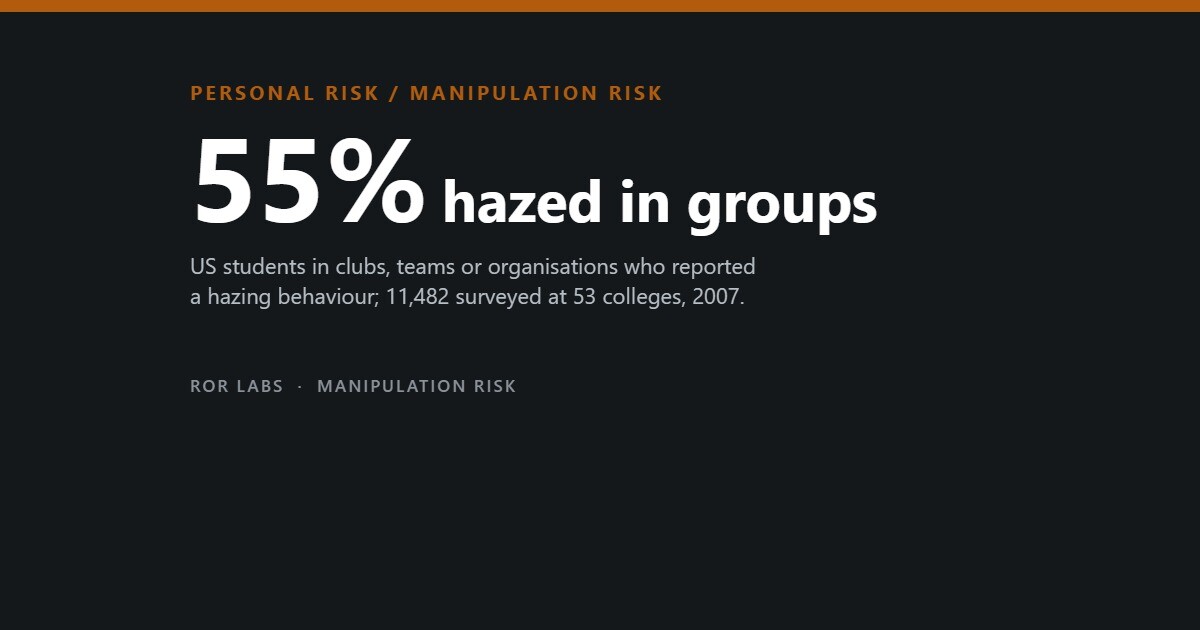
- In a 2007 survey of 11,482 US students, 55% of those in clubs, teams or organisations had experienced at least one hazing behaviour. Only 12% responded, and later surveys found lower rates.
- Most students do not call it hazing: 91% of those who experienced a hazing behaviour did not see themselves as hazed, and 95% of those who did never told campus officials.
- A 1959 experiment suggested harsh initiations increase liking for a group. In real groups, severity goes with humiliation and loneliness, not closeness.
- Alcohol drives the worst harm. Timothy Piazza, Max Gruver and Colin Martinez died after drinking at fraternity events; Danny Santulli was left with severe brain damage.
In this article
- What counts as hazing
- How common hazing is and how it is measured
- The gap between being hazed and saying so
- Does a harsh initiation build loyalty?
- Alcohol, injuries and deaths
- What the laws now require
- What prevention and amnesty have shown
- Practical steps for students and parents
- Questions people ask
- The short version
- Sources
Most people who join a team, a band or a fraternity want the same thing: to belong. Hazing turns that into leverage: new members are told the drinking, insults and errands are what everyone went through, and that complaining proves they do not fit. Usually nobody is badly hurt, but occasionally someone dies.
Below: how hazing is counted, what psychology says about harsh initiations, four documented cases, the laws that followed and what prevention has shown. An earlier article covered the bystander effect, which matters on the night something goes wrong.
Prevalence comes from behaviour checklists with low response rates, and students rarely call their own experience hazing. Deaths are tallied by a journalist rather than an official register, and most prevention studies come from single campuses without a control group.
What counts as hazing
Researchers mostly use Nadine Hoover’s 1999 definition: any activity expected of someone joining a group that humiliates, degrades, abuses or endangers, regardless of the person’s willingness to participate. Later work widened it to cover keeping membership as well as joining (Kerschner and Allan, 2021).
US federal law uses a similar test: the Stop Campus Hazing Act of 2024 covers intentional, knowing or reckless acts, whatever the person’s willingness, linked to joining or staying in a student organisation, that risk physical or psychological injury, with examples running from beatings to pressure to drink.

How common hazing is and how it is measured
The landmark study is Elizabeth Allan and Mary Madden’s National Study of Student Hazing. In 2007 they surveyed 11,482 undergraduates aged 18 to 25 at 53 US colleges. Of students in clubs, teams or organisations, 55% had experienced at least one hazing behaviour: 61% of men and 52% of women.
Hazing is not only a fraternity problem
Share of US students who experienced at least one hazing behaviour in their group, by type of group, 2007.
Source: Allan and Madden, Hazing in View (2008); 11,482 students at 53 colleges. Response rate 12%.
The study’s weak point is that 12% response rate, since students with stories to tell may have been more likely to answer. Later surveys found lower figures. Across seven research universities, 26% of students in groups reported at least one hazing behaviour (Allan et al., 2019). At five smaller NCAA Division III colleges it was 40.9% of varsity athletes and 24.8% of other students (Kerschner and Allan, 2021).
In a 2000 national sample of 1,541 US high school students, 48% of those in groups reported being hazed (Hoover and Pollard). In the US military, no service had measured prevalence by 2016, though about 12% of junior enlisted respondents to climate surveys believed hazing happened in their unit (GAO, 2016).
The gap between being hazed and saying so
Because of a large, consistent gap, hazing surveys list behaviours first and ask about ‘hazing’ only at the end: in the national study, 91% of students who had experienced a hazing behaviour did not consider themselves to have been hazed.
Experienced it, but would not call it hazing
Share of students reporting at least one hazing behaviour, compared with the share who said yes when asked if they had been hazed.
Sources: Allan et al. (2019), 5,880 students; Kerschner and Allan (2021), 2,999 students at five colleges.
Students tend to keep the word for extreme acts such as being tied up or beaten, and file everything else under bonding or tradition. Even those who do name it rarely tell anyone: 95% of students in the national study who said they had been hazed did not report it to campus officials, and the seven-university survey found 94%.
Does a harsh initiation build loyalty?
The classic support for hazing comes from a 1959 experiment. Elliot Aronson and Judson Mills had 63 female college students take an embarrassing reading test to join a discussion group, then hear a deliberately dull recording of it. Those with the severe test liked the group more. The authors explained it with cognitive dissonance: having suffered to get in, people persuade themselves it was worth it.

That study is more than 65 years old and used an imaginary group. Real groups look different: in Dutch field studies, harsher initiations went with frustration and loneliness and no gain in liking (Lodewijkx and Syroit, 1997), and a 2013 replication found no boost to group identity (Kamau). Among 123 Dutch fraternity and sorority members, a tougher initiation went with less closeness to fellow pledges, through humiliation (Mann et al., 2016). In sport, more hazing went with lower or unchanged cohesion (Van Raalte et al., 2007; Lafferty et al., 2017).
Aldo Cimino’s experiments suggest members want to stop newcomers enjoying group benefits for free (2011). Loyalty also shapes who speaks up: among 243 fraternity and sorority members reading a scenario, those who identified most with their group were readier to join in and less willing to blow the whistle when hazing was mild (Richardson et al., 2021). In a crowd where everyone expects someone else to act, trouble can go unanswered for hours.
Alcohol, injuries and deaths
In the national study, drinking games were the most common hazing behaviour, and 12% of hazing experiences involved drinking to the point of getting sick or passing out; alcohol also runs through the serious cases.
Where hazing involves alcohol
Share of hazing experiences or students involving each behaviour. US surveys.
Sources: Allan and Madden, Hazing in View (2008); Kerschner and Allan (2021).
There is no official count of hazing deaths in the US. The usual source is Hank Nuwer, a journalist who compiles cases from news reports and court records. By his count, at least one school hazing death occurred every year from 1959 through 2026. The list is a compilation from reports and includes some deaths ruled accidental.
On 2 February 2017 Timothy Piazza, 19, a sophomore at Penn State, attended a bid acceptance night at the Beta Theta Pi house. He drank at least 18 drinks in under two hours, the Associated Press reported, and suffered several falls that left him with severe head and abdominal injuries. An ambulance was called at 10:48 the next morning. He died on 4 February.
More than two dozen members faced charges, though judges would not approve involuntary manslaughter or aggravated assault, and more than a dozen pleaded guilty to hazing and alcohol offences. The last two, former chapter leaders Brendan Young and Daniel Casey, were sentenced on 1 October 2024 to two to four months in jail after pleading guilty to 14 counts of hazing and one of reckless endangerment.
Seven months later Max Gruver, 18, died on 14 September 2017 at Louisiana State University after a Phi Delta Theta event where pledges were made to drink for wrong answers. His blood alcohol level was 0.496, according to his father. In July 2019 a jury convicted Matthew Naquin of negligent homicide; he was sentenced to five years, half of it suspended.
Some survive with lasting harm. On 19 October 2021 Danny Santulli, a pledge at the University of Missouri’s Phi Gamma Delta chapter, was given a bottle of vodka he was expected to drink. Alcohol poisoning left him with brain damage, unable to see, speak or walk. Eleven people were charged. Seven pleaded guilty to reduced misdemeanours, with jail terms from two days to six months, and four cases were dismissed.
The Northern Arizona case in the news box above follows the same pattern: drinking games, a long delay before anyone called for help, and in the end a guilty plea to a single count of hazing.
What the laws now require
Pennsylvania’s Timothy J. Piazza Antihazing Law, Act 80 of 2018, was signed on 19 October 2018. Hazing that causes serious injury or death is a felony when done with reckless indifference or by forcing the victim to drink or take drugs. Groups and institutions can be fined, and colleges must publish a report of hazing violations, updated twice a year.
It also protects from prosecution people who promptly seek medical help for a victim. Louisiana’s Max Gruver Act made hazing a felony the same year. Neither law applied to the 2017 deaths; Pennsylvania’s attorney general’s office said the two Piazza defendants could otherwise have faced harsher penalties.
The federal Stop Campus Hazing Act, Public Law 118-173, was signed on 23 December 2024. Colleges in federal student aid programmes must count hazing incidents reported to campus security or police in their annual security reports, run ‘research-informed’ prevention programmes, and publish a Campus Hazing Transparency Report naming student organisations found responsible.
The Stop Campus Hazing Act timeline
Key dates and requirements in the US federal law for colleges in federal student aid programmes.
Source: Public Law 118-173 (2024). Reports cover recognised student organisations found responsible; no student names.
Entries must say whether alcohol or drugs were involved, but The American Prospect, citing the HazingInfo database, reported in April 2026 that only 44% of colleges had published the required reports.
What prevention and amnesty have shown
A 2024 review of over 330 studies by Penn State’s Piazza Center found thin prevention evidence: hazing awareness training improves knowledge but is not proven to change behaviour, bystander training has been little studied for hazing, and fear-based messages may not work.
The best-known campus result is from Cornell, which ran a campus-wide public health programme against hazing from 2011 to 2015. Student surveys showed fewer hazing experiences afterwards, which the authors call the first measurable decrease linked to prevention. They also say their design cannot show cause, since there was no comparison campus (Marchell et al., 2022).
Alcohol is central, so in 2002 Cornell tried to remove the fear of calling for help with a Medical Amnesty Protocol: no university discipline for seeking help in an alcohol emergency. Over the next two years, alcohol-related calls to campus emergency services rose and fewer students said they held back to avoid getting a friend into trouble (Lewis and Marchell, 2006).
After amnesty, more calls for help
Cornell University before and after its 2002 Medical Amnesty Protocol. Single-campus case study.
Source: Lewis and Marchell, International Journal of Drug Policy (2006). Survey response rates about 40%.
Critics worry amnesty encourages drinking, yet first-year students surveyed before and after a new policy elsewhere did not drink more, and modestly more contacted residence staff in emergencies (Haas et al., 2018). A policy can only work if students know it exists, and in one survey of 1,012 students about a quarter were unsure whether their school had one (Weaver et al., 2020).

Practical steps for students and parents
Before joining, read the college’s Campus Hazing Transparency Report, ask the group what new members actually do and whether alcohol is involved, and check whether the college has a medical amnesty or Good Samaritan policy. Parents can agree in advance that a call home will be met with help and no blame.
During membership, apply the behaviour test instead of relying on the label: if something is expected of you to belong and it humiliates, endangers or degrades, it counts, whether or not you agreed. If someone is very drunk, unresponsive, breathing slowly or has been hurt, call emergency services at once, because in the Piazza and Martinez cases hours passed before anyone called.
Afterwards, report to the dean of students or campus police, noting dates and who was there. Campus counselling is a confidential place to start.
What to do
Steps sorted by when they matter. Each one says how strong the evidence is: Measured Official advice Untested
Before
- Before joining a group, read your college’s Campus Hazing Transparency Report to see which organisations have been found responsible for hazing. Official advice see Sources
- Ask the group directly what new members are expected to do and whether alcohol is part of it. Untested see Sources
- Find out whether your college has a medical amnesty or Good Samaritan policy: about a quarter of students in one survey did not know. Measured see Sources
If it happens
- Judge by the behaviour, not the label: if something expected of you humiliates, degrades or endangers you, it is hazing even if you agreed. Measured see Sources
- If someone is very drunk, unresponsive, breathing slowly or hurt, call emergency services at once. Measured see Sources
- Do not assume someone else will call: in the cases described here, hours passed before anyone did. Measured see Sources
Afterwards
- Report hazing to the dean of students or campus police, and write down dates and who was present. Untested see Sources
- If what happened still weighs on you, start with confidential campus counselling. Untested see Sources
What not to do
- Do not believe that a harsh initiation will make the group closer: in studies of real groups it went with humiliation and loneliness. Measured see Sources
- Do not stay silent because it seems like tradition: 95% of students who said they were hazed never told campus officials. Measured see Sources
- Do not hold back from calling for help out of fear of trouble: at Cornell, calls rose after amnesty was introduced. Measured see Sources
Not legal or medical advice. If someone is unresponsive or breathing oddly, call 911 or 999 at once.
Questions people ask
Is it still hazing if I agreed to it?
Yes. The research definition and the federal Stop Campus Hazing Act both apply regardless of the person’s willingness to participate.
Will calling 911 get me or my friend in trouble?
Many colleges have medical amnesty policies, and Pennsylvania’s law protects people who promptly seek medical help for a hazing victim. Rules differ by state and campus. Either way, call: delay was part of the harm in the cases above.
Does hazing happen outside fraternities?
Yes. In the national study varsity athletes reported it most often, and it also appears in bands, clubs, high schools and the military.
How can I check a group’s record?
US colleges in federal student aid must publish a Campus Hazing Transparency Report listing recognised organisations found responsible for hazing. It does not cover unrecognised groups or incidents never reported.
Do harsh initiations make teams closer?
The evidence says no. Field studies of real groups found harsher initiations went with humiliation, loneliness and lower or unchanged cohesion. The 1959 lab result has not held up well outside the lab.
The short version
- In a 2007 survey of 11,482 US students, 55% of those in clubs, teams or organisations had experienced at least one hazing behaviour. Only 12% responded, and later surveys found lower rates.
- Most students do not call it hazing: 91% of those who experienced a hazing behaviour did not see themselves as hazed, and 95% of those who did never told campus officials.
- A 1959 experiment suggested harsh initiations increase liking for a group. In real groups, severity goes with humiliation and loneliness, not closeness.
- Alcohol drives the worst harm. Timothy Piazza, Max Gruver and Colin Martinez died after drinking at fraternity events; Danny Santulli was left with severe brain damage.
- Pennsylvania and Louisiana made serious hazing a felony in 2018. The 2024 federal Stop Campus Hazing Act makes colleges publish reports naming groups found responsible.
- Prevention evidence is thin. In one study, medical amnesty did not increase drinking and may help students call for help. If someone is unresponsive, call emergency services at once.
This article summarises research, laws, court records and news reports for general information. It is not legal or medical advice. If someone is unresponsive or hurt after drinking or hazing, call emergency services immediately; a lawyer can advise on a specific case, and a counsellor or doctor can help after hazing.
Further reading: Allan and Madden, Hazing in View (2008), for the national survey and the labelling gap. Mann et al., Cognition and Emotion (2016), for why humiliation pushes pledges apart. Public Law 118-173 (2024), for what the Stop Campus Hazing Act requires of colleges.
Sources
- Former NAU fraternity leader sentenced in student’s hazing death. AZFamily (30 September 2026).
- Allan EJ, Madden M. Hazing in View: College Students at Risk. Initial findings from the National Study of Student Hazing (2008).
- Allan EJ, Kerschner D, Payne JM. College student hazing experiences, attitudes, and perceptions: implications for prevention. J Stud Aff Res Pract (2019), doi:10.1080/19496591.2018.1490303.
- Kerschner D, Allan EJ. Examining the nature and extent of hazing at five NCAA Division III institutions and considering the implications for prevention. J Amateur Sport (2021).
- Hoover NC, Pollard NJ. Initiation rites in American high schools: a national survey. Final report. Alfred University (2000).
- US Government Accountability Office. DOD and Coast Guard: actions needed to increase oversight and management information on hazing incidents involving servicemembers. GAO-16-226 (9 February 2016).
- Aronson E, Mills J. The effect of severity of initiation on liking for a group. J Abnorm Soc Psychol (1959), doi:10.1037/h0047195.
- Lodewijkx HFM, Syroit JEMM. Severity of initiation revisited: does severity of initiation increase attractiveness in real groups? Eur J Soc Psychol 27(3):275 (1997).
- Kamau C. What does being initiated severely into a group do? The role of rewards. Int J Psychol (2013), doi:10.1080/00207594.2012.663957.
- Mann L, Feddes AR, Doosje B, Fischer AH. Withdraw or affiliate? The role of humiliation during initiation rituals. Cogn Emot (2016), doi:10.1080/02699931.2015.1050358.
- Van Raalte JL, Cornelius AE, Linder DE, Brewer BW. The relationship between hazing and team cohesion. J Sport Behav (2007).
- Lafferty M, Wakefield C, Brown H. ‘We do it for the team’: student-athletes’ initiation practices and their impact on group cohesion. Int J Sport Exerc Psychol (2017), doi:10.1080/1612197x.2015.1121507.
- Cimino A. The evolution of hazing: motivational mechanisms and the abuse of newcomers. J Cogn Cult (2011), doi:10.1163/156853711×591242.
- Richardson BK, Rains S, Hall-Ortega C. Joining in, blowing the whistle, or intervening: examining the effects of severity and organizational identification on fraternity/sorority members’ responses to hazing. Oracle 14(2) (2021).
- Nuwer H. U.S. hazing deaths: 2000–2026. hanknuwer.com (accessed November 2026).
- Penn State frat death timeline. Associated Press/KDKA, CBS News Pittsburgh (10 May 2017).
- Office of Attorney General of Pennsylvania. Two former Penn State University students sentenced for roles in 2017 fraternity hazing incident (1 October 2024).
- Ex-leaders of a Penn State frat will spend time in jail for their roles in a hazing death. Associated Press via ABC News (1 October 2024).
- Former LSU student sentenced in death of fraternity pledge Max Gruver. Good Morning America/ABC News (20 November 2019).
- Dunlap C. MU hazing cases end with final defendant’s case dismissed after pledge dad’s plea. Columbia Daily Tribune (17 June 2024).
- Timothy J. Piazza antihazing legislation signed into Pennsylvania law. Penn State News (19 October 2018).
- Troutman Pepper. New Pennsylvania hazing law requires immediate action (2018).
- Stop Campus Hazing Act. Public Law 118-173 (23 December 2024).
- Counts I. Hazing still kills college students. The American Prospect (11 April 2026).
- Timothy J. Piazza Center for Fraternity and Sorority Research and Reform. Hazing Prevention Playbook (2024).
- Marchell TC, Santacrose LB, Laurita AC, Allan EJ. A public health approach to preventing hazing on a university campus. J Am Coll Health (2022), doi:10.1080/07448481.2021.2024210.
- Lewis DK, Marchell TC. Safety first: a medical amnesty approach to alcohol poisoning at a U.S. university. Int J Drug Policy (2006), doi:10.1016/j.drugpo.2006.02.007.
- Haas AL et al. Evaluating the effectiveness of a medical amnesty policy change on college students’ alcohol consumption, physiological consequences, and helping behaviors. J Stud Alcohol Drugs (2018), doi:10.15288/jsad.2018.79.523.
- Weaver GM, Kroshus E, Milroy J, Wyrick DL. Student awareness of campus medical amnesty policies. J Am Coll Health (2020), doi:10.1080/07448481.2020.1767112.