Tech-Support Scams: What the Evidence Shows
Key takeaways · 13 min read
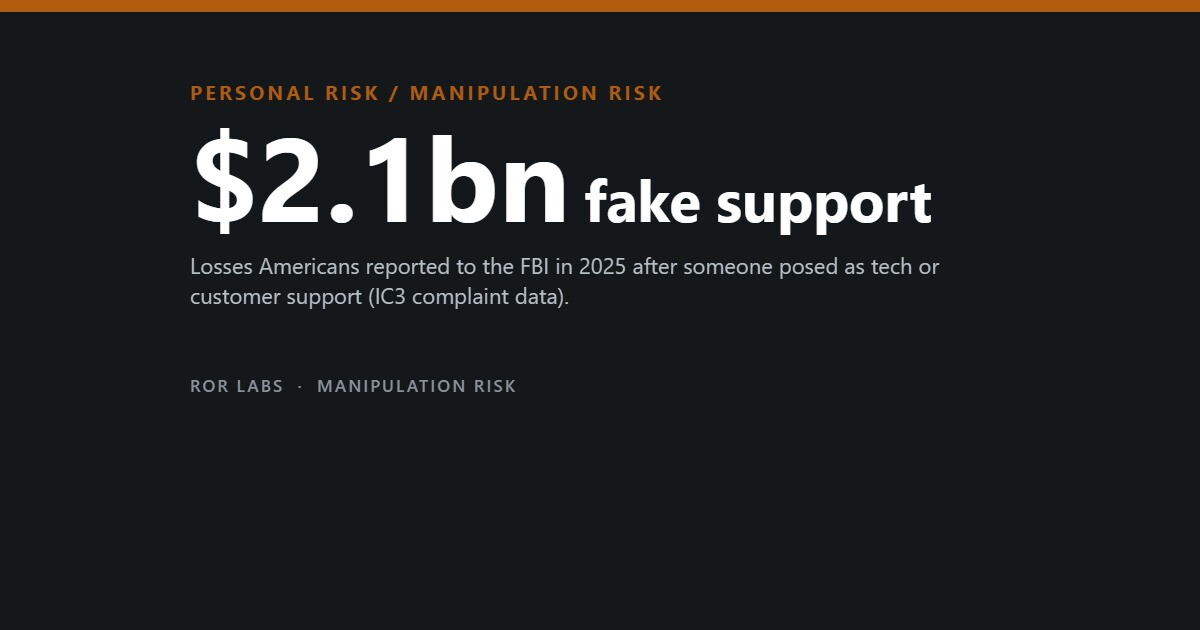
- In 2025 Americans reported losing $2.13 billion to people posing as technical or customer support, the FBI says. That is complaint data; the true total is higher.
- People aged 60 and over filed 45% of those complaints but bore 49% of the losses.
- Researchers who called scam numbers found organised call centres, two remote-access tools in 81% of sessions, and fake ‘proof’ drawn from normal Windows screens.
- The costliest version hands the victim to a fake bank or government ‘fraud team’ that tells them to move their savings to keep them safe.
The warning fills the screen, sometimes with a siren and a familiar logo: your computer is infected, do not switch it off, call this number. Or a polite voice on the phone says it is calling from Microsoft, or from your bank’s fraud team. Soon the caller asks you to install a program so they can take a look. What follows can cost a few hundred dollars or a lifetime’s savings.
The sections below follow that script: how it works, what FBI and FTC complaint data show, what researchers learned by calling the scammers, what recent cases and Indian call-centre raids reveal, and what UK refund rules offer. Earlier articles covered government and bank impersonation scams and AI voice-cloning scams.
Almost everything we know about victims comes from people who chose to complain, and complaint data mix attempts with losses and miss those who stay silent. Surveys and measurement studies give a partly different picture, which affects who gets warned.
How the script works
The classic version begins with a fake alert. A web page, often reached through a malicious advert, fills the browser with warnings, plays an audio message and resists being closed. It gives a toll-free number. Other versions start with a cold call, an email about an antivirus renewal you never bought, or a paid search advert for a company’s support line.
Once the victim calls, the caller asks them to download a legitimate remote-desktop program and read out a code. The scammer can then see the screen and move the mouse, points at ordinary system messages as proof of hacking and sells a ‘repair’. In the refund variant, they ‘accidentally’ show too large a refund in the victim’s bank account and ask for the difference back in gift cards.
The FBI describes a newer three-stage version it calls the Phantom Hacker. A fake technician gets access and asks the victim to open their bank accounts, showing where the money is. A fake bank fraud department then says a foreign hacker is inside and the savings must move to a ‘safe’ account. If the victim hesitates, a fake official, often ‘from the Federal Reserve’, sends letters.

How common and how costly
The FBI’s Internet Crime Complaint Center (IC3) received 47,794 complaints in 2025 from people who said someone had posed as technical or customer support. Reported losses came to $2.13 billion, up from $925 million in 2023. Government impersonation, often the third stage of the same script, added 32,424 complaints and $798 million.
Reported tech-support losses more than doubled in two years
Losses reported to the FBI under ‘tech/customer support’, United States, by year.
Source: FBI IC3, 2025 Internet Crime Report. Complaint data: losses as reported, and many victims never report.
The FTC collects separate reports. Its October 2026 report to Congress said older adults remained more likely than younger adults to report losing money on tech-support scams; press coverage put the gap at more than four times. It estimated that fraud of all kinds cost older Americans up to $119.5 billion in 2025, against roughly $3 billion reported.
The IC3 total works out at about $44,700 per complaint, though a few very large losses pull that average up, and each category depends on how complainants described what happened. These are reports rather than a count of victims, and rising complaints can reflect awareness as well as crime.
Who loses the most
People aged 60 and over filed 21,333 of the 47,794 tech-support complaints in 2025, but reported $1.04 billion of the $2.13 billion lost. Government impersonation shows an even sharper pattern: about a quarter of complaints but just over half the losses.
Older people bear a bigger share of losses than of complaints
Share of 2025 IC3 complaints and reported losses that came from people aged 60 and over, by crime type.
Source: rorlabs calculation from FBI IC3, 2025 Internet Crime Report. Complaint data.
A peer-reviewed analysis by Marguerite DeLiema and Paul Witt of over a million FTC complaints from 2020–2022 compared reports of losses with reports of attempts. About a quarter of tech-support complaints involved a loss, with a median of $1,200. Compared with people in their thirties, those aged 70 and over were about twice as likely to report losing money, and teenagers 85% more likely: a U-shaped curve.
Who reports a loss rather than an attempt
Odds of a tech-support complaint involving a loss rather than an attempt, US FTC complaints 2020–2022. Reference = 1.
Source: DeLiema & Witt, Security Journal (2023); 1,010,748 complaints across six scam types. Sex was inferred from names, and 31–37% could not be classified.
A Microsoft survey found something different. In 2021 YouGov polled 16,254 adults in 16 countries for the company: three in five had met a tech-support scam in the past year and one in six had been drawn in. Younger adults were exposed and fooled more often. This is industry data, from a company whose brand scammers borrow.
Both can be true if younger people are targeted often and lose small sums while older people lose savings. In a Rush University cohort of 1,092 older adults followed for up to 11 years, those scoring high on a scam-susceptibility questionnaire developed Alzheimer’s dementia about seven years earlier than those scoring low. The sample, funded by the US National Institute on Aging, was mostly white and well educated.
Being scammed is not in itself a sign of dementia, since well-rehearsed scripts fool healthy people. A 2026 study of 1,037 older adults born between 1925 and 1944 found that later birth cohorts reported fewer susceptible behaviours, so age alone does not fix the risk.
What researchers found by calling back
The first systematic study came from Najmeh Miramirkhani, Oleksii Starov and Nick Nikiforakis at the NDSS symposium in 2017. Their crawler followed malicious adverts for 250 days from September 2015 and found 8,698 scam domains and 1,581 phone numbers. Many domains were short-lived: 43% pointed to a scam for three days or fewer. Only 7% of the scam domains were on popular blacklists, and phone-lookup apps flagged fewer than 1% of the numbers.
With ethics-board approval, the team then called 60 scammers and gave them access to disposable virtual machines. Calls averaged 17 minutes before a price was named, the average charge was $290.90, and on 62% of calls other voices could be heard in the background. Of the 41 scammers whose IP addresses could be traced, 85.4% were in India.
Inside 60 recorded scam calls
Share of scammers using each tool or tactic in calls made by researchers to numbers found on fake alert pages.
Source: Miramirkhani, Starov & Nikiforakis, NDSS (2017). One research team, 60 calls; the authors say their discovery method cannot be complete.
A follow-up led by Bharat Srinivasan at Georgia Tech, published in 2018, ran 2,600 tech-support searches a day on five search engines over eight months. Of 14,346 distinct adverts, 71.8% led to scam sites, as did 54.3% of organic results. Many were ‘passive’ pages that looked like ordinary support firms and lasted longer than aggressive alerts.
Both studies are now about ten years old. A 2023 study by Jienan Liu and colleagues described campaigns gaming search rankings and built a detector that caught 94.5% of scam links in results, and Microsoft says scammers it tracked in Japan used generative AI to write and translate pop-ups.
Three cases from the record
In March 2026 Michael and Roxanne Chrisman of South Carolina told the Aging Untold team, in a report published by KTTC, how a pop-up said Michael’s computer was locked. ‘It was identified as a Microsoft number, so I was comfortable,’ he said. When he then rang the number on his card, scammers answered as the bank; the report says his calls were being intercepted. They told the couple to buy gold to keep their money safe, and couriers collected it from the house.

The Chrismans lost their life savings, including retirement accounts and an inheritance, and now face tax on the withdrawals. ‘You get victimized by the actual scammers but then you’re left with the IRS,’ Roxanne said. They spoke out, she said, to protect others. The FBI said it was investigating; no arrests had been reported.
The collection end appears in a federal case in San Diego. A 63-year-old Poway man saw a virus pop-up, called the number and was passed to a ‘bank representative’ who told him to withdraw his money for safekeeping. He took out $28,000, grew suspicious and called the sheriff’s department. When Jiaci Liu, a Chinese national, came to collect, police found him outside. Liu was sentenced in August 2025 to 24 months; prosecutors said he had taken over $202,000 from older victims in one week.
The infrastructure surfaced in May 2026, when Adam Young and Harrison Gevirtz, former executives of a US call-routing company, pleaded guilty in Rhode Island to misprision of a felony: knowing of a crime and concealing it. Prosecutors said the firm supplied phone numbers and call tracking to India-based fraudsters and that the pair knew of the fraud from about 2017.
Raids, prosecutions and their limits
Most call centres are abroad, so enforcement depends on partners. India’s Central Bureau of Investigation (CBI) has run a series of operations named Chakra. In July 2024 it arrested 43 people at a Gurugram office posing as a software support firm. In December 2025 the CBI and the FBI dismantled a Noida network linked to more than 600 US victims and over $48.7 million in losses.
The FBI says joint work with the CBI and Indian police led to about 175 arrests in 13 operations in 2025, and over 475 since 2022. Microsoft has supplied intelligence, including for a 2025 case against call centres targeting people in Japan. Even so, losses reported to the FBI kept rising.
Researchers therefore point to the supply chain. Miramirkhani’s team found that four telecoms providers held more than 90% of scam numbers, and that the supply of numbers grew more slowly than that of domains. Cutting off numbers, adverts and payment routes may do more than arresting callers, though no study has measured that directly.

Getting money back
In the UK, since 7 October 2024, banks and payment firms have had to reimburse most victims of authorised push payment (APP) scams, where victims are tricked into making a transfer themselves. That covers the ‘safe account’ stage. The limit is £85,000 per claim, firms may apply a £100 excess, and claims can be refused for a serious lack of caution.
UK bank-transfer scam refunds after 18 months
Claims under the UK APP reimbursement rules, Faster Payments, 7 October 2024 to 31 March 2026.
Source: Payment Systems Regulator, APP scams reimbursement dashboard (updated July 2026). Counts only claims made to a payment firm and in scope of the rules.
The rules apply to bank transfers; gift cards, cash or gold handed to a courier fall outside them, and those are the routes the Phantom Hacker script favours. The US has no equivalent scheme; the FBI says its Recovery Asset Team froze 58% of the money in cases it handled in 2025, which depends on fast reporting.
What to do when a warning or call appears
A web page cannot know your computer is infected, and genuine security warnings never ask you to call a number. No bank, police force or government agency will ask you to move money to protect it, buy gold, or keep the call secret from your family.
If an alert takes over the screen, close the browser, or shut the device down. If you let someone in, go offline, remove the program and change passwords from another device, starting with email and banking. Then call your bank on the number on your card, from another phone if you can, because some scripts intercept or imitate that call.
Report quickly: in the US to IC3 and the FTC, and in the UK to your bank and the national fraud reporting service, because speed matters for freezing transfers. With an older relative, an agreement made in advance, such as ‘I will always ring you before I move money’, does more than warnings afterwards.
What to do
Steps sorted by when they matter. Each one says how strong the evidence is: Measured Official advice Untested
Before
- Agree with older relatives in advance that nobody moves money after an unexpected call without first ringing a family member back. Untested see Sources
- Know that genuine security warnings never show a phone number, and tech companies do not call, email or text about computer problems. Official advice see Sources
- Keep your bank’s real number somewhere you can find it without searching online; scam adverts dominated tech-support search results in research. Measured see Sources
If it happens
- If an alert takes over the screen, close the browser or switch the device off. Do not call the number on it. Official advice see Sources
- Never install software or read out a code at the request of someone who contacted you, or whose number came from a pop-up. Official advice see Sources
- If anyone tells you to move money to a safe account, buy gold or gift cards, or keep the call secret, hang up: no bank or agency does this. Official advice see Sources
Afterwards
- If you let someone in, go offline, remove the program and change your email and banking passwords from another device. Untested see Sources
- Call your bank on the number on your card, from another phone if you can, and report at once: in the US to IC3 and the FTC. Official advice see Sources
- In the UK, claim a refund from your bank for transfers you were tricked into making; since October 2024 most claims are paid, up to £85,000. Official advice see Sources
What not to do
- Do not trust a caller because the number looks like Microsoft’s or your bank’s; numbers can be spoofed and calls intercepted. Untested see Sources
- Do not pay for a ‘refund’ that came out too large; overpayment requests are part of the script. Official advice see Sources
- Do not blame yourself or stay silent; quick reports help freeze money and build cases. Measured see Sources
Not legal or financial advice. If money has gone, call your bank at once and report it to the police or the FBI’s IC3.
Questions people ask
Can a pop-up really detect a virus on my computer?
No. A web page cannot scan your computer. Alerts that flash, sound alarms and give a phone number are adverts for scammers. Your own installed security software may show warnings, but it will not ask you to phone anyone.
Is it dangerous just to have called the number?
A call alone does not give anyone access to your computer. The risk starts when you install a remote-access program, read out a code, share passwords or pay. If you did, follow the steps above and tell your bank.
Will Microsoft or my bank ever call me about a hacked computer?
The FTC says legitimate tech companies do not contact people by phone, email or text about computer problems. A bank will not ask you to move money to a safe account or install software.
Are only older people targeted?
No. In the Microsoft survey younger adults were exposed and fooled more often, and in FTC data teenagers were more likely than people in their thirties to report a loss. Older people tend to lose larger sums.
Will I get my money back?
It depends on how you paid and where you live. UK bank transfers made after October 2024 are usually refunded up to £85,000. Card payments can sometimes be disputed. Gift cards, cryptocurrency and cash are rarely recovered, so report at once.
The short version
- In 2025 Americans reported losing $2.13 billion to people posing as technical or customer support, the FBI says. That is complaint data; the true total is higher.
- People aged 60 and over filed 45% of those complaints but bore 49% of the losses.
- Researchers who called scam numbers found organised call centres, two remote-access tools in 81% of sessions, and fake ‘proof’ drawn from normal Windows screens.
- The costliest version hands the victim to a fake bank or government ‘fraud team’ that tells them to move their savings to keep them safe.
- FBI–CBI operations led to about 175 arrests in India in 2025, yet reported losses kept rising.
- Real security warnings never ask you to call a number, and no bank or agency asks you to move money to protect it.
This article summarises research, agency reports, court records and news for general information. It is not legal, financial or security advice. Rules differ by country; if you have lost money, contact your bank and the police or fraud reporting service promptly.
Further reading: Miramirkhani, Starov & Nikiforakis, NDSS (2017), for what happens inside a scam call. DeLiema & Witt, Security Journal (2023), for who reports losses and how they were contacted.
Sources
- Federal Bureau of Investigation, Internet Crime Complaint Center. 2025 Internet Crime Report (April 2026).
- FBI Little Rock Field Office. The Phantom Hacker: FBI Little Rock warns public of new financial scam (undated, accessed November 2026).
- Federal Trade Commission. FTC issues annual report to Congress on agency’s actions to protect older adults (19 October 2026).
- Techlicious. FTC: older Americans lost up to $119 billion to scams (20 October 2026).
- Federal Trade Commission, Consumer Advice. How to spot, avoid and report tech support scams (accessed November 2026).
- Miramirkhani N, Starov O, Nikiforakis N. Dial one for scam: a large-scale analysis of technical support scams. Network and Distributed System Security Symposium (NDSS) (2017); arXiv:1607.06891.
- Srinivasan B, Kountouras A, Miramirkhani N, Alam M, Nikiforakis N, Antonakakis M. Exposing search and advertisement abuse tactics and infrastructure of technical support scammers. Proceedings of The Web Conference (WWW) (2018); arXiv:1709.08331.
- Liu J, Pun P, Vadrevu P, Perdisci R. Understanding, measuring, and detecting modern technical support scams. IEEE European Symposium on Security and Privacy (2023), doi:10.1109/EuroSP57164.2023.00011.
- DeLiema M, Witt P. Profiling consumers who reported mass marketing scams: demographic characteristics and emotional sentiments associated with victimization. Security Journal (2023), doi:10.1057/s41284-023-00401-5.
- Boyle PA, Wang T, Mottola GR, Stewart CC, Wilson RS, Bennett DA. Scam susceptibility is associated with a markedly accelerated onset of Alzheimer’s disease dementia. Alzheimers Dement (2025), doi:10.1002/alz.14544.
- Yu L, et al. Time trends in susceptibility to scams in community-dwelling older adults. Am J Epidemiol (2026), doi:10.1093/aje/kwag168.
- Microsoft. Tech support scams adapt and persist in 2021, per new Microsoft research (21 July 2021); survey by YouGov.
- Cromer B, Aging Untold Staff. Couple shares story of falling victim to gold bar fraud. Gray Media / KTTC (13 March 2026).
- US Attorney’s Office, Southern District of California. Chinese national sentenced to 24 months in prison for scam targeting elderly Americans (22 August 2025).
- US Attorney’s Office, District of Rhode Island. Two business executives plead guilty in tech support fraud scheme (20 May 2026).
- ThePrint. Armed with scripts, fine-tuned accents, Gurugram call centre agents duped elderly in US, Europe (27 July 2024).
- The Hacker News. Microsoft helps CBI dismantle Indian call centers behind Japanese tech support scam (6 June 2025).
- The Hans India. Illegal international call centre targeting US victims busted in Delhi, 11 held (24 September 2026).
- Payment Systems Regulator. One year on: impact of APP reimbursement on victims (8 October 2025); APP scams reimbursement dashboard (July 2026).