Subscription Traps: What the Evidence Shows
Key takeaways · 13 min read
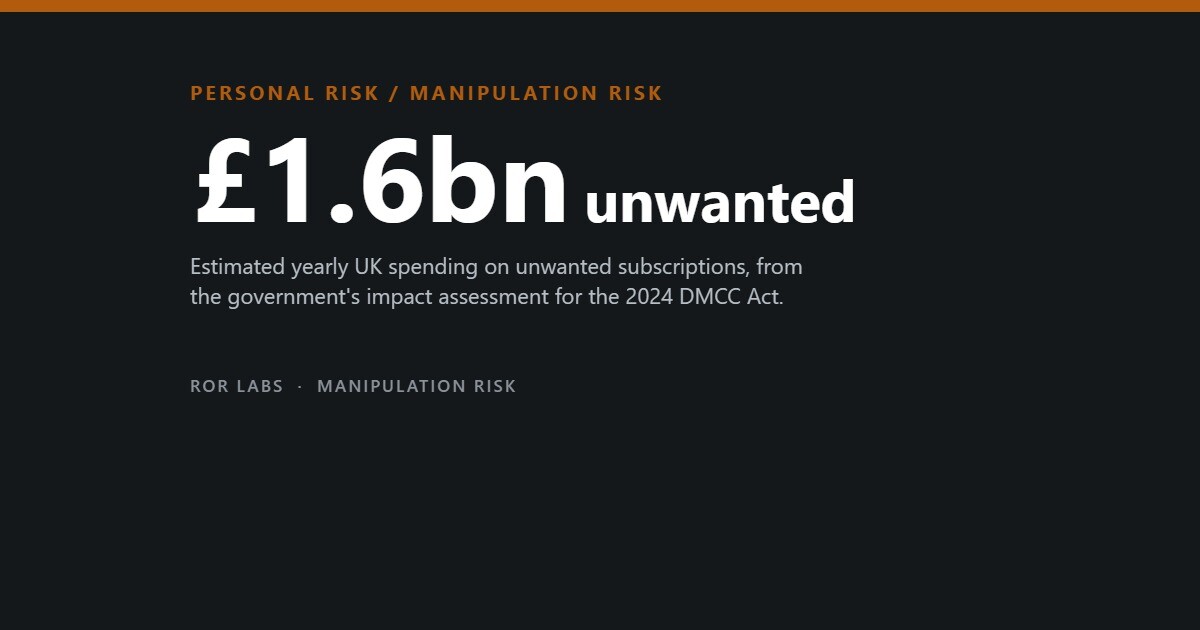
- In the UK, an estimated 9.7 million of 155 million active subscriptions are unwanted, costing about £1.6 billion a year. Over a third follow a free or discounted trial.
- In a randomised experiment with over two million newspaper readers, half of those who took an auto-renewing offer kept paying full price while rarely reading.
- Across ten US subscription services, inattention raised sellers’ revenue by between 14% and more than 200%.
- When members of a fraudulent programme were cancelled by default, 99.8% left; when they had to act, about 36% did.
A free trial asks for a card number and promises you can cancel at any time. A month later the first full charge arrives, then the next. Most people paying for a subscription they no longer want made a reasonable choice at sign-up and then met a system built on the fact that remembering, and acting, takes effort.
Here we cover what unwanted subscriptions cost, what field experiments show about auto-renewal, what cancelling involves, and how US, UK and EU regulators have responded. An earlier article covered dark patterns in general, so this one stays with subscriptions.
The best behavioural evidence comes from one newspaper, three gyms and one card network. The cost figures are government models and surveys, and the enforcement record is mostly allegations, with a handful of court findings.
What unwanted subscriptions cost
The most detailed estimate comes from the UK. The impact assessment for the Digital Markets, Competition and Consumers (DMCC) Act 2024 counts about 155 million active subscriptions, with spending of roughly £26 billion a year. It estimates that 5.8% of them, about 9.7 million contracts, are unwanted, and that consumers spend about £1.6 billion a year on them.
Where unwanted UK subscriptions come from
Estimated number of unwanted subscription contracts in the UK, from the government’s DMCC impact assessment.
Source: Department for Business and Trade, government response to the subscription contracts consultation (April 2026), citing the DMCCA subscription traps impact assessment. Modelled estimates.
Trials matter most: 3.6 million of the unwanted contracts follow a free or discounted trial. Each unwanted subscription a person can leave earlier saves about £14 a month. The government also cites Citizens Advice research that more than 13 million people, 26% of UK adults, took out a subscription by accident in a year.
The US has no comparable official estimate, but complaints point the same way. When the FTC finalised its ‘click-to-cancel’ rule in October 2024, it reported nearly 70 complaints a day about subscription-style ‘negative option’ programmes in 2024, up from 42 a day in 2021.

Paying not to go to the gym
The classic study is Stefano DellaVigna and Ulrike Malmendier’s ‘Paying Not to Go to the Gym’, published in the American Economic Review in 2006. They had contract and day-by-day attendance records for 7,752 members of three US health clubs over three years, so they could compare what people paid with what they actually used.
What a flat monthly fee bought
Members on a flat monthly contract at three US health clubs, compared with a 10-visit pass.
Source: DellaVigna & Malmendier, American Economic Review (2006); 7,752 members of three US health clubs.
A second finding bears on auto-renewal. Members on monthly contracts, which renew automatically, were 17% more likely to still be enrolled after a year than those who had committed to a year, though they paid extra for the freedom to leave. The authors’ leading explanation is overconfidence about future attendance and about how promptly people will cancel.
That is no sign of foolishness: it is the ordinary gap between plans and later behaviour, which a contract that renews unless you act turns into revenue.
What the field experiments show
The clearest test of auto-renewal is a randomised experiment by Klaus Miller, Navdeep Sahni and Avner Strulov-Shlain with a large European newspaper, in which more than two million readers who hit the paywall were offered promotional subscriptions that either rolled into a full-price plan by default or ended automatically. The team followed them for two years; the study is a working paper and has not yet been peer-reviewed.
Auto-renewal in a two-year experiment
Randomised promotional offers to more than two million readers of a European newspaper, auto-renewing v. auto-cancelling.
Source: Miller, Sahni & Strulov-Shlain, ‘Sophisticated Consumers with Inertia’, working paper (Stanford GSB, 2024 version).
Inertia was strong, but many readers also saw the trap coming and stayed away. Auto-renewal earned more in the first months from people paying without reading; after a year the two contracts earned the same, and by two years auto-renewal had left fewer subscribers.
A second approach uses accidents of timing. Liran Einav, Benjamin Klopack and Neale Mahoney, in the American Economic Review (2025), used card-network data on ten US subscription services. When a card expires and is replaced, the subscription has to be re-entered, which forces a decision. On average, retention fell by about 8 percentage points in a replacement month, against about 2 points in other months.
From that gap the authors estimate how many people stay only because they never stop to decide. Inattention raised sellers’ revenue by between 14% and more than 200%, depending on the service, and was greater among cardholders who had taken cash advances, a rough marker of financial strain.
How often a renewal choice is forced
Simulated seller revenue relative to fully attentive subscribers, mean across ten US subscription services. 1.00 = no revenue from inattention.
Source: Einav, Klopack & Mahoney, ‘Selling Subscriptions’ (NBER working paper 31547, appendix table A2; published in American Economic Review, 2025). Model simulations.
A natural experiment gives the largest gap. After a government lawsuit against a fraudulent subscription programme, some members were cancelled by default while others had to cancel themselves. Robert Letzler and colleagues, in the Economic Journal (2017), found that default cancellation reached 99.8% of members, 63.4 percentage points more than when people had to act.
Even escaping fraud depends on the default
Share of members of a fraudulent subscription programme whose membership ended, by how cancellation worked after a government lawsuit.
Source: Letzler et al., Economic Journal (2017). The active figure is 99.8% minus the reported 63.4-point gap.
People in poorer, less educated neighbourhoods were less likely to cancel actively once told they could.
What cancelling actually involves
Ashley Sheil and colleagues, in a 2024 paper for the ACM CHI conference, posed as consumers in Germany, the Netherlands, the UK, Texas and California. In early 2023 they took out 67 subscriptions on 34 news sites and recorded every step of signing up and cancelling. On average, cancelling took more clicks than joining: US sites averaged 3.5 clicks to subscribe and 5.8 to cancel for the American personas.
Four subscriptions could be ended only by phone, one after ten minutes on hold. Most US sites showed exit surveys and offers to stay. One flow required typing a word to confirm; another pre-selected an upgrade to a yearly plan, with the real cancel button at the bottom of the page. Auto-renewal was usually disclosed in fine print.
In April 2020, NPR reported that Jessica Hall, a college English teacher in the Washington area, had stopped going to her gym as the pandemic began and tried to cancel her $88-a-month membership. She could not cancel online, and her emails and calls went unanswered. The chain required cancellation in person or by certified mail.

In the end she cancelled her credit card, and her card company disputed the next charge. The District of Columbia’s attorney general, who had received more than 20 complaints about the chain, threatened legal action with two other states. The parent company did not respond to NPR.
In New York, the attorney general sued SiriusXM, and in November 2024 a state court found that its cancellation process breached federal law because it was far more complicated than signing up. The investigation behind the case included a chat log in which a subscriber asked repeatedly to cancel over 40 minutes and was still charged, and a woman who wrote about a call of nearly 40 minutes made for her 92-year-old mother.
Citizens Advice has published the case of ‘Katy’, a student whose name it changed. She forgot to cancel a free trial and was charged for a full year she could not afford. Her emails went unanswered, anxiety and depression made phoning very hard, and she went into her overdraft.
The Amazon Prime case and other enforcement
The FTC sued Amazon and three executives in 2023. It alleged that Amazon enrolled millions of people in Prime without their consent and made cancelling hard on purpose. According to the complaint, Amazon’s own name for the cancellation route was ‘Iliad’, after Homer’s epic of a long war, and it ran to four pages, six clicks and fifteen options, against one or two clicks to join.
The complaint quoted a 2019 internal memo listing ‘customers sign up without knowing they did’ as a problem. Amazon changed the cancellation flow in about April 2023 and disputed the allegations.
Just before the jury trial began in Seattle in September 2025, Judge John Chun ruled that Amazon had broken the law by collecting billing information before fully disclosing Prime’s terms. On 25 September Amazon settled for $2.5 billion: a $1 billion civil penalty and $1.5 billion in refunds, with a 10-year order to change its Prime practices. Amazon did not admit wrongdoing.
Other cases remain allegations. In December 2025, 21 states and Washington DC joined the FTC’s case against Uber, which alleges that cancelling Uber One could take up to 23 screens and 32 actions. The FTC sued the operators of LA Fitness in August 2025, and in March 2026 the Justice Department announced a proposed $150 million settlement with Adobe over alleged hidden early-termination fees.
What the law now says
In the US, the FTC finalised its ‘click-to-cancel’ rule on 16 October 2024 by a 3–2 vote. It required clear terms, express consent and cancellation as simple as sign-up. On 8 July 2025, days before most of it took effect, the Eighth Circuit Court of Appeals vacated the whole rule because the FTC had skipped a required preliminary regulatory analysis. The court did not rule on the substance.
In March 2026 the FTC restarted rulemaking. Meanwhile it enforces the Restore Online Shoppers’ Confidence Act of 2010, the law used against Amazon, Uber and Adobe. California’s amended automatic renewal law, in force since 1 July 2025, requires express consent, cancellation through the same channel used to sign up, and a yearly reminder.
The UK’s regime under the DMCC Act starts on 1 January 2027, earlier than the spring 2027 date the government had set in April 2026. It covers contracts made from that date. Firms must send reminders before renewals and before trials convert, allow online cancellation for online sign-ups, and give a new 14-day cooling-off period after a trial ends or a contract renews for 12 months or more.
Telecoms, utilities, financial services and some charity memberships are exempt, and the Competition and Markets Authority can fine firms up to 10% of global turnover. In the EU, an online ‘withdraw from contract’ function has been mandatory since 19 June 2026, though only within the withdrawal period. A Digital Fairness Act proposal is expected in late 2026.

Practical steps
The research points to many small moments when nothing prompts you to decide, and you can create those prompts yourself, though the burden should not be yours. When you start a trial, put its end date and the cancellation route in your calendar. Every few months, check your statements for recurring charges and ask whether you would buy each one today. Keep cancellation confirmations.
If you are charged after cancelling, contact the firm first, then your card issuer. In the US you can report the problem to the FTC; in the UK, Citizens Advice can help, and contracts made from 1 January 2027 carry the new cooling-off right. If an older relative has many subscriptions, offer to go through them together.
Where the evidence is thin
The newspaper experiment covers one publisher in one country and is still a working paper. The gym study used three US clubs, and the card-network study covered ten unnamed services and about 30% of their subscribers, with revenue figures that come from a model.
The cost figures are modelled: the UK’s £1.6 billion and 9.7 million come from an impact assessment written to justify a policy, and survey answers about ‘accidental’ subscriptions depend on what people remember. The Sheil study is a snapshot of 34 news sites in early 2023. Most enforcement records are allegations, and settlements such as Amazon’s include no admission of wrongdoing.
Still, randomised trials, natural experiments, contract data and complaint records point the same way: when continuing is the default and leaving takes effort, many people keep paying for things they do not use.
What to do
Steps sorted by when they matter. Each one says how strong the evidence is: Measured Official advice Untested
Before
- When you start a free trial, put its end date and the cancellation route in your calendar the same day. Untested see Sources
- Before paying, check how to cancel: the newer rules (UK from 2027, California since July 2025) require cancellation through the same channel you signed up with. Official advice see Sources
- Read whether an offer renews automatically and at what price; auto-renewal terms are often in fine print on the payment page. Measured see Sources
If it happens
- Every few months, go through your card and bank statements for recurring charges and ask whether you would buy each one today; forced moments of attention, such as a card replacement, sharply raise cancellations. Measured see Sources
- If an older relative has many subscriptions, offer to go through them together. Untested see Sources
Afterwards
- Cancel in writing where you can and keep the confirmation email or a screenshot. Untested see Sources
- If you are charged after cancelling, contact the firm first, then your card issuer to dispute the charge. Untested see Sources
- In the UK, for subscriptions taken out from 1 January 2027, use the 14-day cooling-off period after a trial ends or a long contract renews. Official advice see Sources
- In the US, report unwanted charges or hard-to-cancel subscriptions to the FTC. Official advice see Sources
What not to do
- Do not answer messages offering help with Amazon Prime refunds: the FTC says it is not contacting anyone and payments are automatic. Official advice see Sources
- Do not assume an expired card or a closed account cancels the contract itself; confirm the cancellation with the firm. Untested see Sources
- Do not blame yourself for a forgotten trial; the research shows inertia is common and designed for. Measured see Sources
Not legal or financial advice. Rules on cancelling and refunds differ by country and state.
Questions people ask
Are free trials a trick?
Not always; a trial can be a fair way to test a service. The risk lies in trials that roll into paid plans without a clear reminder. In the UK, 3.6 million of the 9.7 million unwanted subscriptions follow a trial, which is why the new rules require a reminder before one converts.
Is the US click-to-cancel rule in force?
No. The Eighth Circuit vacated it in July 2025 on procedural grounds, and the FTC restarted rulemaking in March 2026. Federal law on online subscriptions, the Restore Online Shoppers’ Confidence Act, still applies, and states such as California have their own automatic renewal laws.
Will I get money from the Amazon Prime settlement?
Under the revised order, the FTC says, eligible people are paid automatically by Venmo, PayPal or cheque. It is not contacting anyone about these refunds, and nobody from Amazon will ask you for money to receive one, so treat such messages as scams.
When do the UK rules start?
On 1 January 2027, for subscriptions taken out on or after that date. An annual plan bought in 2026 that renews in 2027 is not covered. Existing UK consumer law on unfair terms and misleading practices still applies.
Does auto-renewal ever help consumers?
Yes, it avoids gaps in services people want, such as insurance cover. What causes trouble is a default that keeps charging people who have stopped using a service, and in the newspaper experiment it did not even pay off for the publisher after a year.
The short version
- In the UK, an estimated 9.7 million of 155 million active subscriptions are unwanted, costing about £1.6 billion a year. Over a third follow a free or discounted trial.
- In a randomised experiment with over two million newspaper readers, half of those who took an auto-renewing offer kept paying full price while rarely reading.
- Across ten US subscription services, inattention raised sellers’ revenue by between 14% and more than 200%.
- When members of a fraudulent programme were cancelled by default, 99.8% left; when they had to act, about 36% did.
- Amazon settled the FTC’s Prime case for $2.5 billion in 2025 without admitting wrongdoing. The US click-to-cancel rule was struck down on procedural grounds.
- New UK rules apply to subscriptions taken out from 1 January 2027. Until then, a calendar reminder and a regular look at statements help.
This article summarises research, regulators’ documents, court records and news reports for general information. It is not legal or financial advice. Rules differ by country and change over time; for a dispute about a specific contract, contact a consumer advice service or a qualified adviser.
Further reading: Miller, Sahni & Strulov-Shlain’s working paper, for the long-run effects of auto-renewal in a randomised trial. Einav, Klopack & Mahoney, American Economic Review (2025), for how much inattention is worth to sellers. Sheil et al., CHI (2024), for what cancelling looks like step by step.
Sources
- DellaVigna S, Malmendier U. Paying not to go to the gym. Am Econ Rev 96(3):694–719 (2006), doi:10.1257/aer.96.3.694.
- Miller KM, Sahni NS, Strulov-Shlain A. Sophisticated consumers with inertia: long-term implications from a large-scale field experiment. Working paper, Stanford Graduate School of Business (2024 version).
- Einav L, Klopack B, Mahoney N. Selling subscriptions. Am Econ Rev 115(5):1650–71 (2025), doi:10.1257/aer.20231612; NBER working paper 31547 (2023).
- Letzler R, Sandler R, Jaroszewicz A, Knowles I, Olson LM. Knowing when to quit: default choices, demographics and fraud. Econ J (2017), doi:10.1111/ecoj.12377.
- Sheil A, Acar G, Schraffenberger H, Gellert R, Malone D. Staying at the Roach Motel: cross-country analysis of manipulative subscription and cancellation flows. Proc CHI 2024, doi:10.1145/3613904.3642881.
- Department for Business and Trade. Government response to consultation on the subscription contracts regime (2 April 2026).
- Department for Business and Trade. New measures unveiled to crack down on subscription traps (18 November 2024).
- Prime Minister’s Office. PM starts roll-out of everyday fixes on the cost of living (9 August 2026).
- Lewis Silkin. Draft guidance and regulations for new subscription contracts regime (21 October 2026).
- Retail Gazette. Retailers warned to fast-track subscription changes (11 August 2026).
- Citizens Advice. Subscription traps: enough is enough (policy publication).
- Federal Trade Commission. Federal Trade Commission announces final ‘click-to-cancel’ rule (16 October 2024).
- Custom Communications, Inc. v. Federal Trade Commission, US Court of Appeals for the Eighth Circuit (8 July 2025).
- Jones Day. FTC revives click-to-cancel rule: new risks for subscription businesses (May 2026).
- Barnes & Thornburg. California expands automatic renewal law: new requirements now in effect (2025).
- FTC v. Amazon.com, Inc., amended complaint (redacted), W.D. Wash. (20 September 2023).
- Claims Journal / Associated Press. Amazon, FTC reach $2.5 billion deal in Prime subscription case (25 September 2025).
- Federal Trade Commission. Additional payments to consumers from Amazon Prime settlement (17 September 2026).
- Federal Trade Commission. FTC, states file amended complaint against Uber (15 December 2025).
- Associated Press via Spectrum News. FTC sues LA Fitness operators (20 August 2025).
- US Department of Justice. Adobe agrees to $150 million settlement (13 March 2026).
- New York State Attorney General. Press release on SiriusXM court ruling (22 November 2024).
- NPR (local news, Washington DC). Report on a Washington Sports Clubs member trying to cancel during COVID-19 (7 April 2020).
- iubenda. The new online withdrawal function: EU Directive 2023/2673 (2026).
- European Parliament Legislative Train. Digital Fairness Act (accessed November 2026).