Credit Card Minimum Payments: What the Evidence Shows
Key takeaways · 13 min read
- About one large-bank card account in ten in the US pays exactly the minimum (10.15% in mid-2026), and 29% regularly pay at or near it.
- A printed minimum pulls partial payments down. In a classic experiment, planned repayments were 70% higher when it was left off.
- Minimums shrink as the balance falls. In our illustrative example, $5,000 at 22.36% takes about 19 years at the minimum, under five at a fixed $150.
- The US warning box and UK nudge trials changed little. Many minimum payers are short of cash, and no disclosure fixes that.
In this article
A credit card statement offers three numbers: the full balance, the minimum payment, and whatever you choose in between. Nobody calls the minimum advice, yet research suggests it behaves like advice. In the US about one large-bank card account in ten pays exactly the minimum, and many more pay close to it.
This article covers who pays the minimum, the anchoring experiments, the US warning box from the 2009 CARD Act, the UK’s persistent-debt rules and what tends to help. Earlier articles covered buy now, pay later and payday loans, two other places where small regular payments add up.
Paying the minimum is often not a mistake. For someone with no cash buffer it keeps the account in good standing and the late fees away. Good studies try to separate people who could pay more from people who cannot, and both groups are large.
How many people pay only the minimum
The Philadelphia Fed tracks large banks’ card accounts using supervisory data. In the second quarter of 2026, 10.15% of active accounts paid only the minimum, down from a series high of 11.01% at the end of 2024. The share paying the full balance rose to 36.90%. It counts accounts, not people.
The Consumer Financial Protection Bureau’s December 2025 market report, based on 2024 data, found that about half of card accounts carry a balance from month to month. About 15% of general-purpose cardholders made only the minimum payment, up from 13% in the previous report, as did 20% of store-card holders. Cardholders paid $160 billion in interest and $31.3 billion in fees that year.
About one account in ten pays only the minimum
Share of active US large-bank card accounts paying exactly the minimum.
Source: Federal Reserve Bank of Philadelphia (FR Y-14M data), via FRED, October 2026.
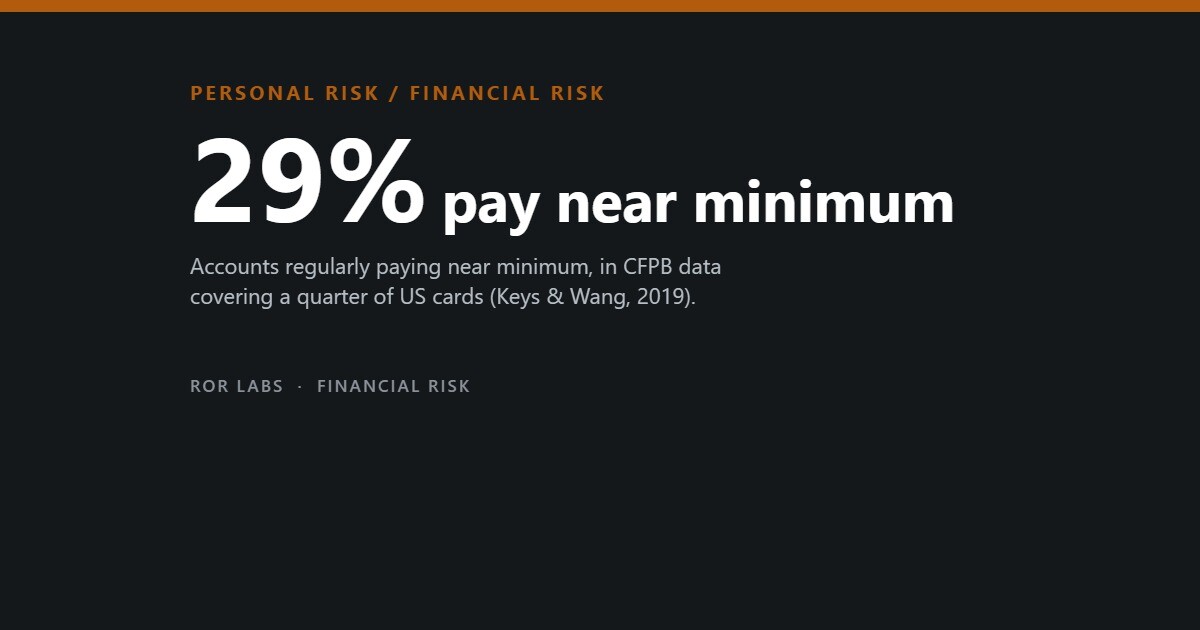
Paying close to the minimum is more common still. Benjamin Keys and Jialan Wang, using CFPB data on about a quarter of the US general-purpose card market, found that 29% of accounts regularly pay at or near the minimum. In the UK, the Financial Conduct Authority’s 2016 market study counted 750,000 people making systematic minimum repayments for three years or more, and another 650,000 in persistent debt over the same span.
Why the minimum pulls payments down
In 2009 the psychologist Neil Stewart gave 413 people a mock UK statement with a balance of £435.76. Half saw a minimum payment of £5.42; half saw none. Those shown the minimum planned to repay £99 on average; the others, £175, a 70% difference. The share paying in full was the same, about 55%, so the minimum worked on people making partial payments.
Daniel Navarro-Martinez and colleagues (2011) repeated the test with US consumers and UK card data, with the same result. Raising the minimum helped most people but did not cancel the effect, and adding future interest and payoff time did little. A 2022 UK experiment led by Hiroaki Sakaguchi, with 699 online participants, found the same pattern.
Repayments with and without a printed minimum
Average planned repayment on mock statements. Bars show share of balance.
Sources: Stewart (2009), 413 participants; Sakaguchi et al. (2022), 699 participants. Hypothetical choices.
Experiments cannot show what people do with their own money; field data can. Keys and Wang used changes in issuers’ minimum-payment formulas and found that at least 22% of near-minimum payers, about 9% of all accounts, moved their payments with the formula in a way that cash limits alone do not explain. In Mexico, each one-point rise in the minimum raised payments by 0.87 points (Medina and Negrín).
That 22% is a lower bound, and it leaves room for many near-minimum payers to be held back by cash rather than by a number. A household paying the minimum because rent is due is not falling for a trick.
What paying the minimum costs
Minimums are small by design. In the UK they are typically interest and fees plus 1% of the balance, or a fixed sum such as £5 or £25, whichever is greater (Sakaguchi et al., 2022). That stops the debt growing, but the payment shrinks as the balance falls, so the tail of a debt is paid off very slowly.
The price of carrying a balance has also risen. On US bank card accounts charged interest, the average rate was 22.36% in August 2026, against 15.91% in February 2021 (Federal Reserve G.19). In January 2026 President Trump called for a one-year 10% cap; by late April, Senate Democrats said banks had not complied, and the Fed’s August figure barely moved. The New York Fed’s measure of card balances moving into serious delinquency was 6.97% in mid-2026.
The illustrative arithmetic below assumes a $5,000 balance at 22.36%, no new spending, and a minimum of interest plus 1% of the balance with a $25 floor. At the minimum it takes 231 months, about 19 years, and $8,241 in interest. A fixed $150, about $7 above the first minimum, needs 53 months and $2,886.
Illustrative arithmetic: one balance, four ways to pay
Total interest on a $5,000 balance, no new spending. Months to clear in brackets.
Source: rorlabs.io illustrative calculation, not data. 22.36% APR (Fed G.19, Aug 2026); minimum = interest + 1% of balance, $25 floor.
A fixed payment stays put as the balance falls; a minimum shrinks with it. UK researchers give a matching example: a £1,000 balance paid at the minimum would take 18 years and 6 months to clear, while a fixed £25 a month would take 5 years and 1 month and save over £750 in interest (Adams et al., 2022).
Most people underestimate this. In a survey after a UK regulator’s trial, 96% of control-group respondents substantially underestimated how long minimum payments take. Only 2.9% of those invited replied, so treat it as indicative.
The US warning box and what it changed
Since the CARD Act of 2009 took effect, US card statements have carried a minimum payment warning. It says that paying only the minimum will increase the interest you pay and the time it takes to repay. A table shows the months needed at the minimum, the total cost, the payment that clears the balance in 36 months, and a number for credit counselling.
Sumit Agarwal and colleagues studied 160 million card accounts. The Act’s limits on fees cut borrowing costs by an annualised 1.6% of average daily balances, about $11.9 billion a year. The warning box did far less: the share of accounts paying the 36-month amount rose by 0.4 percentage points on a base of 5.3%, saving at most $57 million a year in interest (Agarwal et al., 2015).
Keys and Wang’s working paper reached a similar figure: fewer than 1% of accounts adopted the suggested payment, saving about $62 million a year, against more than $2 billion if every anchored borrower had switched. In lab studies, the 36-month figure itself became an anchor for some people who would have paid more (Hershfield and Roese, 2015).
Not every study is negative. A household survey study by Lauren Jones and colleagues found the disclosures raised the share paying in full, with little change among those who kept a balance.
The UK persistent-debt rules
The UK took a different route. The FCA published rules in 2018 on persistent debt: paying more in interest, fees and charges than in repayment of the amount borrowed over 18 months. At 18 months the lender must write to encourage higher payments where affordable. At 36 months it must offer a way to repay within a reasonable period, normally three to four years, and list free debt advice.
If the customer does not respond, the card can be suspended. Early estimates suggested about 2 million accounts could reach the 36-month stage; industry figures later put it at about 950,000 customers with 1.1 million accounts, just over 2% of card accounts (UK Finance). The industry reads the gap as people paying more after earlier letters; plausible, but untested.
Persistent card debt in the UK fell, then rose
Share of UK adults in persistent credit card debt.
Source: StepChange briefing (2026), citing FCA Financial Lives. Estimates not directly comparable.
StepChange, a debt charity, estimates that 2.5 million adults were in persistent card debt in late 2025, 14% of everyone with card debt. Of those, 8 in 10 were struggling to keep up with bills. In a 2022 client survey, 7% said persistent-debt letters made things better and 36% worse; a client group, not a random sample.
Autopay: a safety net and a trap
Automatic payment fixes one problem and can create another. Using a 10% random sample of UK cardholders from 2013 and 2014, Sakaguchi and colleagues found that after people switched to automatic minimum payment, missed payments fell from about 12% to 1% a month. But large payments fell from about 40% to 10% of months, and minimum payments rose from 19% to 52%.
After switching to automatic minimum payment
Share of monthly payments by type, UK cardholders who switched.
Source: Sakaguchi et al. (2022), industry data on UK cards, 2013–2014. Approximate values.
Their simulation put about 8% of card interest and fees down to this switch. The UK regulator then tested fixes. Letters, emails and statement graphics sent to 183,441 cardholders had precisely estimated null effects on debt (Adams et al., 2022).
A firmer test hid the automatic-minimum option from 42,239 people applying for UK cards. Six months later the share paying exactly the minimum was 23% lower, but debt did not fall significantly. Many chose amounts just above the minimum, and missed payments rose. The authors concluded that frequent lack of cash best explained the results (Guttman-Kenney et al., 2025).
What tends to help
A fixed automatic payment set above the minimum is the simplest change with evidence behind it: it keeps the protection against missed payments while stopping the payment from shrinking. It only works if the amount is affordable every month, as the 2025 trial shows. Many issuers let you choose a fixed amount.

With several cards, paying extra on the highest-rate card first, the ‘avalanche’, keeps interest lowest. Few people do it. In UK data on multiple cards, John Gathergood and colleagues found that people spread repayments in proportion to balances, a habit they called balance matching, and that the misallocation did not shrink when more money was at stake.
The ‘snowball’, clearing the smallest balance first, costs more but may keep people going. A field study and three experiments found that concentrating payments on one account, especially a small one, raised motivation to repay (Kettle et al., 2016). Ben Hamilton estimated that the snowball costs the average household 1.8% to 4.3% more interest. No study has tested which method gets more people out of debt.
A 0% balance transfer can buy time, with the caveats in the questions below. In 2014 the CFPB warned that surprise interest charges can make a transfer cost more than leaving the balance where it was.
Nonprofit credit counselling offers budgeting help and, where suitable, a debt management plan that rolls card payments into one and can reduce interest and fees. The evidence is encouraging but mostly not randomised: matched-comparison data link counselling with lower debt, and in a randomised add-on, automated reminders cut 60-day delinquencies by 21% (Roll and Moulton, 2019). The CFPB advises getting fees in writing and checking that creditors have accepted a plan.
Where the evidence is weak
Much of the evidence comes from industry or supervisory data that outsiders cannot inspect, and several UK studies were run with the regulator and lenders. Mock-statement experiments isolate one number, but nobody’s rent depends on a hypothetical answer. Persistent-debt surveys use different methods.
The biggest gap is cash. The field trial that hid the minimum autopay option concluded that a lack of liquid cash best explained its results, and Keys and Wang’s anchoring estimate is a lower bound that leaves many near-minimum payers looking constrained. Linking card payments with bank balances, and testing the minimum formula itself, would settle more than another disclosure.
What to do
Steps sorted by when they matter. Each one says how strong the evidence is: Measured Official advice Untested
Before
- Read the minimum payment warning on your US statement to see how many months the minimum would take and what clears the balance in 36 months. Official advice see Sources
- Before taking a 0% balance transfer, check the transfer fee, whether new purchases will be charged interest, and when the offer ends. Official advice see Sources
- List your cards with their interest rates so you can see which one costs the most. Untested see Sources
If it happens
- If you use autopay, consider a fixed amount above the minimum that you can afford every month, so the payment does not shrink with the balance. Measured see Sources
- Put any spare money towards the highest-rate card first rather than spreading it across every card. Measured see Sources
- If you choose the smallest-balance-first method for motivation, know that it usually costs more interest. Measured see Sources
Afterwards
- If you receive a persistent-debt letter from a UK lender, reply and ask about a repayment plan you can afford. Official advice see Sources
- If repayments are out of reach, contact a nonprofit credit counsellor in the US or a free debt advice charity in the UK. Official advice see Sources
- Before joining a debt management plan, get the fees in writing and confirm with your creditors that they accepted it. Official advice see Sources
What not to do
- Do not miss payments to free up cash if you can pay the minimum; paying at least the minimum keeps the account in good standing. Measured see Sources
- Do not set autopay to an amount you cannot cover, because a failed payment can lead to missed-payment marks. Untested see Sources
- Do not use a counselling firm that pushes a plan before looking at your budget or will not put its fees in writing. Official advice see Sources
Not financial advice. A nonprofit credit counsellor or free government debt advice can help with your own situation.
Questions people ask
Is paying only the minimum ever the right call?
Sometimes. When cash is short, paying at least the minimum on time avoids late fees and missed-payment marks. The cost shows up later, as interest, so it works best as a stopgap rather than a plan.
Does paying the minimum hurt my credit record?
Paying at least the minimum on time keeps the account in good standing. UK Finance notes that UK credit reports show whether minimums were met, but long-term low payments can still affect your rating.
How can I see how long my balance will take to clear?
In the US, the minimum payment warning on your statement shows the months needed at the minimum and the 36-month payment. In the UK there is no standard box, but lenders write at 18 and 36 months of persistent debt.
Will a 0% balance transfer solve it?
It can cut interest for a while. But transfers often carry a fee, new purchases may be charged interest, and the offer ends. It helps most when the balance can be cleared before then.
Where can I get free help?
In the US, the CFPB points to the National Foundation for Credit Counseling, the Financial Counseling Association of America and the Justice Department’s list of approved agencies. In the UK, free debt advice charities such as StepChange can help, and your lender’s 36-month letter must list free advice sources.
The short version
- About one large-bank card account in ten in the US pays exactly the minimum (10.15% in mid-2026), and 29% regularly pay at or near it.
- A printed minimum pulls partial payments down. In a classic experiment, planned repayments were 70% higher when it was left off.
- Minimums shrink as the balance falls. In our illustrative example, $5,000 at 22.36% takes about 19 years at the minimum, under five at a fixed $150.
- The US warning box and UK nudge trials changed little. Many minimum payers are short of cash, and no disclosure fixes that.
- A fixed automatic payment above the minimum, if affordable every month, keeps the protection against missed payments.
- If repayments feel out of reach, nonprofit credit counselling (US) and free debt advice (UK) cost little or nothing.
This article summarises research, regulators’ data and news reports for general education. It is not financial advice and does not take your circumstances into account. If repayments are a struggle, talk to a nonprofit credit counsellor in the US, a free debt advice service in the UK, or your lender, and use free government guidance such as the CFPB’s.
Further reading: Stewart, Psychological Science (2009), the short experiment that started this research. Keys and Wang, Journal of Financial Economics (2019), on telling anchoring from tight budgets. Guttman-Kenney et al., AEJ: Economic Policy (2025), on a nudge that changed behaviour but not debt.
Sources
- Stewart N. The cost of anchoring on credit-card minimum repayments. Psychol Sci (2009), doi:10.1111/j.1467-9280.2008.02255.x.
- Navarro-Martinez D, Salisbury LC, Lemon KN, Stewart N, Matthews WJ, Harris AJL. Minimum required payment and supplemental information disclosure effects on consumer debt repayment decisions. J Mark Res (2011), doi:10.1509/jmkr.48.SPL.S60.
- Keys BJ, Wang J. Minimum payments and debt paydown in consumer credit cards. J Financ Econ 131(3):528–548 (2019), doi:10.1016/j.jfineco.2018.09.009; NBER Working Paper 22742 (2016).
- Agarwal S, Chomsisengphet S, Mahoney N, Stroebel J. Regulating consumer financial products: evidence from credit cards. Q J Econ 130(1):111–164 (2015).
- Sakaguchi H, Stewart N, Gathergood J, et al. Default effects of credit card minimum payments. J Mark Res (2022), doi:10.1177/00222437211070589.
- Adams P, Guttman-Kenney B, Hayes L, Hunt S, Laibson D, Stewart N. Do nudges reduce borrowing and consumer confusion in the credit card market? Economica (2022), doi:10.1111/ecca.12427.
- Guttman-Kenney B, Adams P, Hunt S, Laibson D, Stewart N, Leary J. The semblance of success in nudging consumers to pay down credit card debt. Am Econ J Econ Policy 17(4):72–105 (2025), doi:10.1257/pol.20230568.
- Medina PC, Negrín JL. The hidden role of contract terms: the case of credit card minimum payments in Mexico. Manage Sci (2021, online), doi:10.1287/mnsc.2021.4006.
- Hershfield HE, Roese NJ. Dual payoff scenario warnings on credit card statements elicit suboptimal payoff decisions. J Consum Psychol (2015), doi:10.1016/j.jcps.2014.06.005.
- Jones LE, Loibl C, Tennyson S. Effects of informational nudges on consumer debt repayment behaviors. J Econ Psychol (2015), doi:10.1016/j.joep.2015.06.009.
- Gathergood J, Mahoney N, Stewart N, Weber J. How do individuals repay their debt? The balance-matching heuristic. Am Econ Rev (2019), doi:10.1257/aer.20180288.
- Kettle KL, Trudel R, Blanchard SJ, Häubl G. Repayment concentration and consumer motivation to get out of debt. J Consum Res (2016), doi:10.1093/jcr/ucw037.
- Hamilton B. Two steps forward, one step back? Quantifying the pecuniary costs of debt account aversion and the debt snowball. South Econ J (2022), doi:10.1002/soej.12612.
- Roll S, Moulton S. Credit counseling and consumer credit trajectories. Econ Inq (2019), doi:10.1111/ecin.12802.
- Roll S, Moulton S. The impact of automated reminders on credit outcomes: results from an experimental pilot program. J Consum Aff (2019), doi:10.1111/joca.12252.
- Consumer Financial Protection Bureau. The Consumer Credit Card Market (December 2025).
- Federal Reserve Bank of Philadelphia. Large Bank Consumer Credit Card Balances: Share of Accounts Making the Minimum Payment and Share Making the Full Balance Payment, via FRED (series RCCCBSHRMIN, RCCCBSHRFULL).
- Board of Governors of the Federal Reserve System. Consumer Credit G.19: commercial bank interest rate on credit card plans, accounts assessed interest, via FRED (series TERMCBCCINTNS).
- Federal Reserve Bank of New York. Household Debt and Credit Report, Q2 2026 (press release, 11 August 2026).
- 15 U.S.C. §1637(b)(11), Truth in Lending Act, as amended by the Credit Card Accountability Responsibility and Disclosure Act of 2009.
- Financial Conduct Authority. Credit card market study (MS14/6), final report (July 2016).
- UK Finance. Financial Conduct Authority (FCA) rules on persistent credit card debt: 36 months, actions and frequently asked questions.
- StepChange Debt Charity. Credit cards, financial difficulty and persistent debt (briefing, 2026).
- Consumer Financial Protection Bureau. CFPB warns credit card companies against deceptively marketing promotional offers (3 September 2014).
- Consumer Financial Protection Bureau. What is debt management? Ask CFPB.
- Bisaha S. Trump calls for a 10% cap on credit card interest rates. NPR (12 January 2026).
- US Senate Committee on Banking, Housing, and Urban Affairs, minority office. Warren questions banking regulators on lack of progress on credit card rate cap (press release, 28 April 2026).