Cashing Out Retirement Savings Early: What the Evidence Shows
Key takeaways · 13 min read
- Taking money out of a retirement account early is called leakage. In US tax data, withdrawals by people aged 50 or under equalled about 22% of that group’s contributions in 2003–2015.
- Most of it follows a shock: job loss, falling income, divorce, eviction threats or medical bills. Lower-paid workers face more shocks and withdraw more often when they do.
- The long-run cost is the growth the money never earns. One Australian study put A$10,000 taken 30 years before retirement at up to A$43,000 less at the end.
- Moving small balances automatically to a new job’s plan cut cash-outs of accounts under $1,000 from about half to under one in ten in Vanguard plans.
In this article
A retirement account is meant to stay locked away for decades, yet a steady share comes out early. People leave a job and take the balance as cash, draw on it to stop an eviction or pay a hospital bill, or borrow against it and cannot repay when the job ends. Economists call this leakage, and it quietly makes pensions smaller than planned.
This article looks at who takes money out early, why, and what it costs later, using US tax and plan records, the UK’s 2015 pension freedoms, and two pandemic experiments: Australia’s early release of superannuation and Chile’s three rounds of withdrawals. Related articles cover outliving your savings and how default settings shape choices.
One point runs through everything below. An early withdrawal is often a sensible answer to a real emergency, and most people who make one are under strain, not careless. The evidence can answer narrower questions: how large the long-run cost is, who carries it, and which designs reduce it without leaving people stranded.
What counts as leakage
In the US, a 401(k) or individual retirement account (IRA) can leak in three ways. A worker who leaves a job can take the balance as cash instead of rolling it into another plan. A worker still in the job can take a hardship withdrawal. Or a worker can take a plan loan, which turns into a withdrawal if it is not repaid, most often after a job ends.
The price of early access is set by tax law. Money taken before age 59½ is generally taxed as income and, with exceptions, charged a 10% additional tax. When a plan pays a distribution to you rather than straight to another account, it must withhold 20%, and you then have 60 days to put the full amount into another plan or IRA if you want to avoid tax (IRS).
Early withdrawals measured against new saving
Taxable early withdrawals as a share of new contributions in US tax records. The two studies define age groups differently.
Sources: Argento, Bryant & Sabelhaus, Federal Reserve working paper (2013); Goodman et al., National Tax Journal (2021).
That does not mean a fifth of all savings vanishes: a study of IRS data by Victoria Bryant, Sarah Holden and John Sabelhaus found aggregate leakage modest relative to assets. What matters is that it is concentrated in particular people at particular moments.

Who cashes out, and when
Job changes are the biggest single trigger. Using a panel of more than 140 million person-years of US tax records, Lucas Goodman and colleagues found that a job separation went with more than a 200% rise in the probability of leakage. Separations followed by unemployment insurance, a sign the job loss was involuntary, were linked with more leakage than other separations.
Robert Argento, Victoria Bryant and John Sabelhaus, working at the Federal Reserve and the IRS, looked at what else happened in the year of a withdrawal. In 2010 the predicted chance of a taxable early withdrawal was 12% for people with no shock, 28% with a fall in income of 10% or more, and 17% after divorce, separation or widowhood. In the lowest income tenth it was 27%, against 12% in the highest.
Plan records agree. In Vanguard data on more than half a million participants, Angela Hung and colleagues at RAND found that over half of employees who left a job took a cash distribution. Small balances go most often.
Hardship withdrawals and loans
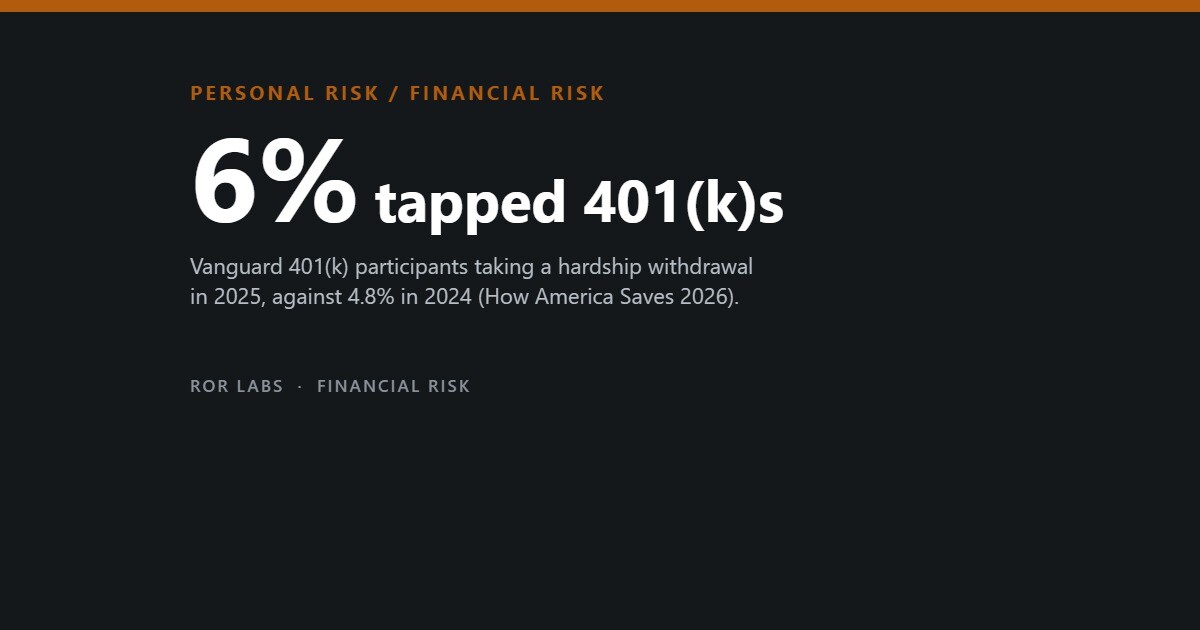
Hardship withdrawals have risen for six years in a row. In Vanguard’s How America Saves 2026, 6% of participants took one in 2025, with a median of $1,900, and nearly half of them took more than one. Vanguard links part of the rise to rule changes: since 2018 workers need not take a loan first, and SECURE 2.0 lets plans accept self-certification.
Who takes hardship withdrawals
Share of Vanguard 401(k) participants who took a hardship withdrawal in 2025, by annual income.
Source: Vanguard, How America Withstands Financial Hardships (March 2026), from How America Saves 2026.
The reasons are hard to call frivolous: 36% of 2025 requests were to avoid foreclosure or eviction and 31% were for medical bills. Withdrawal rates were 2.5% in plans that require documents and 8.5% in the few that accept self-certification, which suggests hassle also holds some back.
Why people took hardship withdrawals
Share of hardship withdrawal requests by reason, Vanguard-administered plans, 2025.
Source: Vanguard, How America Withstands Financial Hardships (March 2026).
Loans look gentler because you repay yourself. The risk comes when a job ends. In Vanguard data on more than 100,000 people who left work with a loan outstanding, Timothy Lu, Olivia Mitchell and Stephen Utkus found that one loan in ten defaulted overall, but eight in ten of those leavers did not repay. Default was more likely among people with lower pay and little other wealth.
What a cash-out costs later
The tax and penalty are the visible costs. The larger one is lost growth. As an illustration only, $10,000 left for 35 years at an assumed 4% a year after inflation grows to about $39,500; taken as cash at 30, it is worth $10,000 less tax and the 10% charge. Real returns vary, and this assumes the money would otherwise have stayed put.

Population models reach large numbers. Alicia Munnell and Anthony Webb of Boston College estimated that about 1.5% of 401(k) and IRA assets leak out each year, cutting wealth at retirement by about a quarter. Their key data come from Vanguard, whose members are probably better off than average, so this is a model, not a measurement.
Other countries show the same shape. Miguel Lorca estimated that each dollar released early in Chile meant about $1.59 less in retirement savings. In Australia, Nathan Wang-Ly and Ben Newell noted that A$10,000 taken 30 years before retirement could mean as much as A$43,000 less, assuming 5% annual growth.
Age cuts both ways. A young worker loses the most compounding per dollar but has decades to rebuild; someone near retirement loses less growth but has little time to replace it. In Chile, Olga Fuentes, Olivia Mitchell and Félix Villatoro projected that three 10% withdrawals starting at 18 would cut a pension by 0.6%, against 27% starting at 64.
The UK pension freedoms
The UK took another path. Since April 2015, people with defined contribution pensions can take their whole pot from 55 instead of buying an annuity. Usually up to 25% is tax-free (GOV.UK) and the rest is taxed as income. This is not leakage in the US sense, since the money is released near retirement, but it raises the same question of whether savings last.
In 2024/25, according to Financial Conduct Authority (FCA) figures reported by Financial Planning Today, 961,575 pension plans were accessed for the first time and 462,160 were fully withdrawn on first access, more than 300,000 of them worth under £10,000. Only 30.6% of first-time access involved regulated advice.
Cashing in a small pot is often reasonable. The FCA’s 2017 interim review found 94% of people making full withdrawals had other retirement income besides the state pension, but also that 52% of fully withdrawn pots went into other savings or investments, often moving money from a tax-sheltered wrapper into a taxed one.
Tax adds friction. The first flexible withdrawal is often taxed on an emergency code. In April to June 2026 HMRC repaid more than £50.3 million to over 12,500 people, almost £4,000 each on average, according to Quilter’s analysis.
When whole countries opened the tap
In 2020 Australia let people hit by the pandemic take up to A$10,000 from their superannuation in each of two rounds, with no proof required. The Australian Taxation Office recorded 4.78 million applications from 3.05 million people and A$37.8 billion approved. People aged 26 to 35 made 31% of approved applications.
In linked bank data on 1.04 million withdrawers, Wang-Ly and Newell found them younger and lower-paid than other customers, with median savings of A$482 against A$1,285 and more credit card arrears (9.7% against 5.8%). Afterwards they paid down cards and personal loans and were briefly less likely to fall behind. Alison Preston, using a national survey, found higher odds among the young, the unemployed, lone parents, people in poor health and those with lower financial literacy.
Tristram Sainsbury, Robert Breunig and Timothy Watson found that people on unemployment payments who got a lump sum early in the pandemic left those payments 32% less often within six months, a gap that closed after about 18 months. A 2026 working paper by Patrick Moran and Patrick Schneider found self-reported self-control difficulties predicted withdrawals alongside income shocks.
Chile went further, with three rounds of 10% withdrawals and a floor that let small accounts be emptied. Using the regulator’s records, Fuentes and colleagues report that about $50 billion left the system and around 4.2 million people were left with nothing. Those who emptied their accounts were more often women, younger and lower-paid.
Chile: projected cuts to self-financed pensions
Modelled drop in self-financed pensions after maximum withdrawals, selected groups of Chilean workers.
Source: Fuentes, Mitchell & Villatoro, Journal of Pension Economics and Finance (2023). Projections, not observed pensions.
Chile’s state pension softens the blow. Alejandra Inzunza and Carlos Madeira estimated an average 21% fall in contributory pensions but only 8% in total retirement income once larger non-contributory benefits are counted. The cost shifts to taxpayers: about 15.8% of pre-pandemic GDP without reform, 12.4% under the 2025 reform.

A worked example: a $20,000 withdrawal
Numbers make the cost easier to see. The IRS says early withdrawals from traditional and Roth IRAs, generally those taken before age 59½, carry a 10% additional tax unless an exception applies, and that this is “in addition to any regular income tax on that amount.” The tax applies only to the part of the distribution that counts as income. The arithmetic below is ours, not an IRS example.
The setup. Suppose a 40-year-old takes $20,000 from a traditional, pre-tax account and sits in the 22% federal bracket. We ignore state tax, which would only make it worse. The 10% additional tax is $2,000. Ordinary income tax at 22% is $4,400. Together that is $6,400, so the $20,000 shrinks to about $13,600 in usable cash, or 68 cents on the dollar.
The part that does not show up on the tax form. If that $20,000 had stayed invested for 25 years at an assumed 7% a year, it would have grown to roughly $108,500 (20,000 × 1.0725), before inflation. The 7% is an illustration, not a forecast. The point is that the real price of the withdrawal is the tax now plus the growth you give up later.
Before you withdraw, check the exceptions. The IRS lists several, including up to $10,000 for a first-time home purchase, unreimbursed medical expenses above a share of income, total and permanent disability, and personal or family emergency expenses. Exceptions for employer plans are covered separately in IRS Topic 558. If your Form 1099-R does not show the right exception code, the IRS says you may need to file Form 5329 to claim it. The IRS also notes that federal tax is withheld on IRA distributions unless you elect out, so the cheque you receive may differ from what you finally owe.
What we could not confirm. The IRS page we read gives no dollar limit for the emergency-expense exception, so we have not quoted one. Roth accounts follow different rules for what counts as taxable. Whether an exception covers your case is a question for a tax professional or the IRS pages themselves.
What seems to help
The best-tested fix targets job changes. Since 2022 a network of large providers has moved small balances automatically into a worker’s new employer plan. In 83 Vanguard plans that joined, cash-outs of balances under $1,000 fell from about half to under 10%; for $1,000 to $7,000 they stayed at 30% to 40%.
Automatic portability and small-balance cash-outs
Share cashing out within 10 months of leaving a job, 83 Vanguard plans that joined the Portability Services Network.
Source: Vanguard, The promise and limits of 401(k) portability (October 2026). Figures are approximate, as published.
The limits are real. The typical user was 31, about six months into the job and earning near $20,000, and the median transfer was $200. Only about 6% had yet been matched to a new plan; the rest sat in interim IRAs, where fees can wear down small sums. About 3% of US 401(k) plans take part.
The other approach is a separate cushion so the pension is not the only pot to raid. In a Nest Insight trial at one UK employer, 53% of new staff auto-enrolled into payroll saving kept saving, against 1% who had to opt in, with no sign of more pension opt-outs. Vanguard reports that people in plans offering its emergency savings account, which it sells, were 16% less likely to take hardship withdrawals.
SECURE 2.0 also created a small, penalty-free emergency withdrawal from 2024: up to $1,000 once a calendar year, self-certified and repayable within three years (IRS Notice 2024-55). The money still loses its growth if it is not put back.
Where the evidence is thin
Much of the detail comes from Vanguard, which runs the plans it studies and sells some of the remedies it reports on, and its participants are employed people in workplace plans. Tax data are broader but blind to reasons: Argento’s team could not see job separations and inferred shocks from income and filing changes.
The long-run costs are almost all modelled. They depend on assumed returns and on whether people would really have left the money alone. If a withdrawal clears a credit card at high interest or prevents an eviction, the trade can be a good one, and the cost estimates do not count that. Wang-Ly and Newell found withdrawers’ financial wellbeing scores rose slightly afterwards.
Each system’s rules shape its results. Chile’s floor let the smallest accounts be emptied, a design Fuentes and colleagues call regressive. Australia asked for no proof. The UK freedoms start at 55. Findings travel between countries only roughly.
What to do
Steps sorted by when they matter. Each one says how strong the evidence is: Measured Official advice Untested
Before
- When you change jobs, ask your old plan how to move your balance into your new plan or an IRA instead of taking it as cash. Measured see Sources
- If your employer offers payroll emergency saving, consider using it so your pension is not your only cushion. Measured see Sources
- Before leaving a job with a 401(k) loan outstanding, find out when and how it must be repaid. Measured see Sources
If it happens
- Check the full cost first: income tax, the 10% additional tax before 59½ unless an exception applies, and 20% withholding on a payment made to you. Official advice see Sources
- Ask whether a smaller option fits, such as the SECURE 2.0 emergency withdrawal of up to $1,000 a year. Official advice see Sources
- In the UK, if you are 50 or over, book a free Pension Wise appointment before taking your whole pot. Official advice see Sources
Afterwards
- If you took a SECURE 2.0 emergency withdrawal, consider repaying it within the three years allowed. Official advice see Sources
- If too much tax was taken from a first UK flexible withdrawal, reclaim the overpayment from HMRC. Measured see Sources
- Restart or raise your contributions once the emergency has passed. Untested see Sources
What not to do
- Do not let a small balance be paid out by default when you leave a job without checking your rollover options. Measured see Sources
- Do not assume a whole UK pot comes out tax-free; usually only up to 25% does and the rest is taxed as income. Official advice see Sources
- Do not feel ashamed of using retirement savings in a real emergency; most withdrawals follow job loss, medical bills or eviction threats. Measured see Sources
Not financial advice. Free government guidance or a regulated adviser can help with your own situation.
Questions people ask
Is it ever sensible to cash out a retirement account early?
Sometimes. Most withdrawals follow job loss, falling income, medical bills or the threat of eviction, and Australian bank data suggest the money helped people clear expensive debt and avoid arrears in the short term. The usual question is whether a cheaper option exists first.
How much does the 10% additional tax actually cost?
In the US, money taken before 59½ is generally taxed as income and, unless an exception applies, charged an extra 10%, and a plan paying you directly must withhold 20%. The bigger cost is often the growth the money would have earned.
What happens to a 401(k) loan if I leave my job?
It usually has to be repaid; if not, the balance is treated as a withdrawal, with tax and possibly the 10% charge. In Vanguard data, eight in ten workers who left a job with a loan outstanding defaulted on it.
What is auto-portability?
A system that moves a small balance automatically from your old employer’s plan into your new one. In Vanguard plans that joined, cash-outs of balances under $1,000 fell from about half to under one in ten. Few US plans take part so far.
I am in the UK and thinking of taking my whole pension. Where can I get help?
Pension Wise, from MoneyHelper, offers a free, government-backed guidance appointment if you are 50 or over with a defined contribution pension, covering your options and the tax. For a personal recommendation, see a regulated financial adviser.
The short version
- Taking money out of a retirement account early is called leakage. In US tax data, withdrawals by people aged 50 or under equalled about 22% of that group’s contributions in 2003–2015.
- Most of it follows a shock: job loss, falling income, divorce, eviction threats or medical bills. Lower-paid workers face more shocks and withdraw more often when they do.
- The long-run cost is the growth the money never earns. One Australian study put A$10,000 taken 30 years before retirement at up to A$43,000 less at the end.
- Moving small balances automatically to a new job’s plan cut cash-outs of accounts under $1,000 from about half to under one in ten in Vanguard plans.
- Australia’s and Chile’s pandemic withdrawals helped people pay bills at the time, but Chilean modelling projects the deepest pension cuts for lower earners and older workers.
- Much of the evidence is from plan providers’ own data or from models. Free guidance or a regulated adviser can help you weigh a withdrawal against alternatives.
This article summarises research, official data and news reports for general information. It is not financial, tax or legal advice and does not take your circumstances into account. Before taking money out of a pension, consider speaking to a regulated financial adviser or, in the UK, booking free guidance through MoneyHelper’s Pension Wise service.
Further reading: Goodman et al., National Tax Journal (2021), for the broadest US tax-data picture of leakage. Fuentes, Mitchell and Villatoro, Journal of Pension Economics and Finance (2023), for what Chile’s withdrawals did to individual accounts. Wang-Ly and Newell, Economic Analysis and Policy (2022), for how Australians used the money.
Sources
- Goodman L, Mortenson JA, Mackie K, Schramm HR. Leakage from retirement savings accounts in the United States. National Tax Journal (2021), doi:10.1086/715819.
- Argento R, Bryant VL, Sabelhaus J. Early withdrawals from retirement accounts during the Great Recession. Finance and Economics Discussion Series 2013-22, Federal Reserve Board (2013); published in Contemporary Economic Policy 33(1):1–16 (2015), doi:10.1111/coep.12064.
- Bryant VL, Holden S, Sabelhaus J. Qualified retirement plans: analysis of distribution and rollover activity. Pension Research Council working paper (2011).
- Hung A, Luoto J, Burke J. Defaulting in and cashing out? The impact of retirement plan design on the savings accumulation of separating employees. RAND working paper WR-1115 (2015), doi:10.7249/wr1115.
- Lu T, Mitchell OS, Utkus SP. An empirical analysis of 401(k) loan defaults. Pension Research Council working paper (2010).
- Vanguard. How America withstands financial hardships (March 2026), drawing on How America Saves 2026.
- Vanguard. The promise and limits of 401(k) portability (October 2026).
- Munnell AH, Webb A. The impact of leakages on 401(k)/IRA assets. Center for Retirement Research at Boston College, Issue Brief 15-2 (2015).
- Munnell AH, Webb A. The impact of leakages from 401(k)s and IRAs. Journal of Retirement 9(3) (2021).
- Internal Revenue Service. Rollovers of retirement plan and IRA distributions.
- Internal Revenue Service. Notice 2024-55: emergency personal expense and domestic abuse victim distributions (2024).
- Lorca M. Effects of COVID-19 early release of pension funds: the case of Chile. Journal of Risk and Insurance (published online 2020), doi:10.1111/jori.12365.
- Fuentes OM, Mitchell OS, Villatoro FF. Early pension withdrawals in Chile during the pandemic. Journal of Pension Economics and Finance (2023), doi:10.1017/S1474747223000112.
- Inzunza A, Madeira C. The Chilean pension withdrawals and the 2025 reform: fiscal and retirement consequences. Journal of Pension Economics and Finance (2025), doi:10.1017/S1474747225000058.
- Wang-Ly N, Newell BR. Allowing early access to retirement savings: lessons from Australia. Economic Analysis and Policy 75:716–733 (2022).
- Preston A. Financial fragility, financial literacy and the early withdrawal of retirement savings during COVID-19. Australian Journal of Labour Economics 25(2):127–147 (2022).
- Sainsbury T, Breunig R, Watson T. COVID-19 private pension withdrawals and unemployment tenures. IZA Discussion Paper 15399 (2022).
- Moran PJ, Schneider P. Self-control and early withdrawal from retirement accounts. Institute for Fiscal Studies Working Paper 26/40 (2026).
- Australian Taxation Office. COVID-19 early release of super (statistics page, August 2023).
- Financial Conduct Authority. Retirement income market data 2024/25 (September 2025).
- Financial Planning Today. 105,000 extra pensions cashed in full each year (18 May 2026).
- Financial Conduct Authority. Retirement Outcomes Review: interim report (July 2017), as reported by Professional Adviser (12 July 2017).
- Quilter. Pension tax repayments hit £50m for Q2 with no sign of fix in sight (30 July 2026).
- GOV.UK. Taking your whole pension pot in one go; MoneyHelper. Understanding what Pension Wise is and how to use it.
- Pensions Age. Autosave emergency saving trial findings ‘very encouraging’ (7 September 2022), reporting Nest Insight.
- Revell E. Americans tap retirement funds at record rates as mounting financial stress takes toll. FOX 13 Tampa Bay (7 March 2026).
- IRS. Topic no. 557, Additional tax on early distributions from traditional and Roth IRAs. irs.gov.