The Four Things Schools Do About Bullying Are the Four the Guidance Says Not To.
Key takeaways · 12 min read
- 19% of US students aged 12–18 reported being bullied at school in 2021–22, down from 28% in 2010–11.
- The two largest categories are rumours (13%) and being made fun of (12%) — neither leaves evidence. Physical types are far smaller.
- Whole-school programmes cut perpetration about 20% and victimisation 17–20% across 44 evaluations. That is the ceiling, not the floor.
- Effects were largest in the weakest designs and smallest in the randomised experiments. Anyone quoting 20% without this is quoting it wrong.
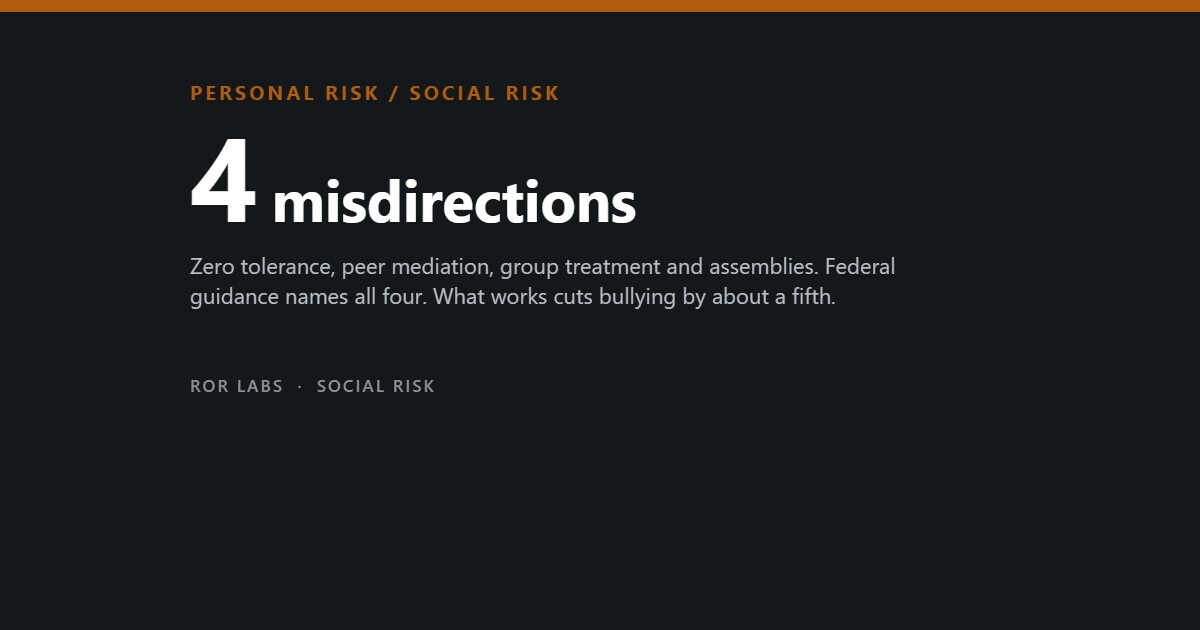
When a school finds out a child is being bullied, four things tend to happen. There is a policy that says bullying will not be tolerated and that offenders face suspension. Somebody suggests getting the two children together to talk it through. The child who bullied is put into a group with other children who bully, to work on anger and empathy. And at some point there is an assembly.
Federal prevention guidance identifies all four as misdirections — approaches that do not work and, in two cases, that can make things worse for the child who was harmed. They persist because each one is intuitive, visible, and cheap. Nobody involved is acting in bad faith.
What does work is slower, dull to describe, and produces a smaller effect than anyone wants: whole-school programmes cut bullying by roughly a fifth. This article is about that gap — how big the problem is, what the meta-analysis actually shows once you look at the better-designed studies, why peer mediation is the item on the list to argue hardest against, and what a parent can usefully do when the school is doing one of the four.

How many, and what it looks like
In the 2021–22 school year, 19% of US students aged 12 to 18 reported being bullied at school. That is roughly one child in five, and it is a real improvement — the same survey found 28% in 2010–11. Something over the last decade has been working, which is worth holding onto while reading the rest of this.
What being bullied actually consisted of
Share of US students aged 12–18 reporting each type at school, 2021–22. Categories overlap.
Source: School Crime Supplement to the National Crime Victimization Survey, 2021–22, reported by the National Center for Education Statistics.
What works, and how much
Maria Ttofi and David Farrington reviewed 53 anti-bullying programmes and ran a meta-analysis on the 44 evaluations that met their criteria. The programmes were mostly whole-school: policy, staff training, classroom rules, supervision of the places where it happens, and work with parents, sustained over time rather than delivered as an event.
Average effect of whole-school anti-bullying programmes
Source: Ttofi, M.M. and Farrington, D.P., “Effectiveness of school-based programs to reduce bullying: a systematic and meta-analytic review”, Journal of Experimental Criminology, 2011.

Now the part that gets left out of the summaries. The review found that effects were greatest in the age-cohort designs and lowest in the randomised experiments. That is the pattern you expect when some of the apparent benefit is coming from the study design rather than from the programme — the more rigorously it is tested, the less it does. So a fifth is not a floor. It is an average across designs of differing quality, and the best designs sit below it.
We are not saying the programmes do not work. We are saying that anyone quoting the 20% figure without that sentence attached is quoting it wrong, and that a school choosing between doing the slow whole-school work and doing nothing should still choose the work — while expecting a change in the culture rather than a solved problem.
The four things that do not work
These come from federal prevention guidance, and each has a stated reason rather than a general disapproval.
What schools do, and why it fails
The pattern across all four: each targets an incident. The evidence supports targeting the environment, sustained over years. That is a much harder thing to announce at a parents’ evening.
Source: “Misdirections in Bullying Prevention and Intervention”, StopBullying.gov, US Department of Health and Human Services.
Why peer mediation is the one to argue about
Three of the four misdirections waste effort. Peer mediation can actively harm the child it is meant to help, and it is the one most likely to be proposed to you personally, in a meeting, framed as reasonable.
The reasoning is worth being able to state out loud. Mediation is a good tool for a dispute — two parties with competing claims, roughly equal standing, and something to settle. Bullying has none of that structure. There is nothing to settle, the standing is unequal by definition, and the process of sitting the two children down encodes a claim that is false: that this is a disagreement, and that the harmed child holds part of it.
The practical damage is specific. A child who has been bullied is being asked to face the person who did it, in a room, and articulate their position. Guidance puts it plainly — this may be very upsetting, and facing the child who bullied may make the child who was bullied feel worse. If a school proposes it, the sentence to use is that bullying is victimisation rather than conflict, and that mediation is not an appropriate tool for victimisation. That is not an opinion; it is the position of the federal prevention guidance.
What a parent can actually do
In order of how much control you have over it
| Step | Why it is in this position |
|---|---|
| 1. Keep a dated written record | What happened, when, where, who was present, what the child said afterwards. The two commonest categories — rumours and exclusion — leave no evidence, so a contemporaneous record is often the only documentation that will exist. It also converts a series of incidents into a pattern, which is what a school has to respond to. |
| 2. Put it in writing to the school | A conversation in a corridor has no status. An email creates a date, a recipient and an obligation. Ask specifically what the school will do and when you will hear back. |
| 3. Decline mediation, and say why | See above. You are not being difficult; you are citing the guidance. |
| 4. Ask about supervision of the specific places | Bullying concentrates where adults are not: corridors between lessons, the bus, changing areas, the parts of the yard nobody stands in. This is a concrete, cheap thing to ask a school to change, and it is a component of the programmes that work. |
| 5. Ask what the whole-school programme is | Not what the policy says — what is actually running, for how long, and who is trained. If the answer is an assembly and a poster, that is the misdirection at the bottom of the list. |
| 6. Watch for the things that need a clinician | Sleep, appetite, refusal to attend, withdrawal from things they used to like, or any statement about not wanting to be here. Bullying victimisation is associated with real mental health harm, and that part is not a school matter. |
Sources: StopBullying.gov prevention guidance; Ttofi and Farrington, 2011; NCES School Crime Supplement, 2021–22.
The anti-bullying market
There is a great deal sold to frightened parents here. We are not linking any of it.
Everything with evidence behind it in this article is either free or is a school-level decision. That is an uncomfortable answer for a parent who wants to do something tonight, and pretending otherwise would be the dishonest version of this article.

Questions people ask
The school has a zero tolerance policy. Isn’t that a good sign?
It is a sign that the school takes it seriously, which is not nothing. But treat the policy and the practice as separate questions. The specific failure mode is under-reporting: when the stated consequence is severe, teachers become reluctant to log borderline incidents and children become reluctant to name friends, so the school’s own numbers fall while the behaviour does not. Ask what happens at the level below suspension — what the response is to the third rumour rather than the first punch. If there is no answer, the policy is a statement rather than a system.
Should I contact the other child’s parents?
Usually not directly, and not first. It is the same structural problem as mediation: it treats the situation as a dispute between two families to be settled privately, and it removes the school’s obligation to act. It also frequently goes badly, at which point you have a second conflict to manage and less standing with the school than you started with. The route with the most leverage is documented, written, and through the institution.
My child begs me not to tell the school. What then?
That fear is rational rather than irrational — children who report often do experience retaliation, and the zero tolerance dynamic above makes it worse. What usually works better than overriding them is negotiating the terms: agreeing what you will say, to whom, and asking the school explicitly to act on the pattern rather than confronting the individual child in a way that identifies the source. Losing the child’s willingness to tell you things is a serious cost, and it is worth spending some time to avoid.
Is online bullying a different problem?
Mostly it is the same problem on a different surface. Among students who were bullied, 22% said some of it happened online or by text — which means it overwhelmingly arrives attached to an existing school relationship rather than from strangers. The practical implication is that solutions aimed at the device tend to miss: blocking an account does not end the relationship, and the school is still the place where the intervention has to happen. Where online genuinely differs is permanence and audience, and those are worth taking seriously in their own right.
Does bullying cause suicide?
This deserves a careful answer rather than a slogan. Bullying victimisation is genuinely associated with depression, anxiety and self-harm, and that association is well documented. But the causal chain in any individual case is not simple, and single-cause explanations are both unsupported and, according to media reporting guidance, potentially harmful in how they frame the outcome for other young people. The useful version is this: bullying is a serious risk factor for mental health harm, that harm needs assessing by someone qualified, and a child in distress needs a clinician rather than a policy meeting. If you are worried about a child right now, that is a conversation to have with your doctor or a mental health service today rather than after the school responds.
The short version
- 19% of US students aged 12–18 reported being bullied at school in 2021–22, down from 28% in 2010–11.
- The two largest categories are rumours (13%) and being made fun of (12%) — neither leaves evidence. Physical types are far smaller.
- Whole-school programmes cut perpetration about 20% and victimisation 17–20% across 44 evaluations. That is the ceiling, not the floor.
- Effects were largest in the weakest designs and smallest in the randomised experiments. Anyone quoting 20% without this is quoting it wrong.
- Four approaches are identified as misdirections: zero tolerance, peer mediation, group treatment for children who bully, and one-off assemblies.
- Peer mediation can make the harmed child worse. Bullying is victimisation, not conflict between equals, and mediation encodes shared responsibility that does not exist.
- Zero tolerance suppresses reporting, which is why a school’s incident numbers can fall while nothing changes.
- What a parent controls: a dated written record, written contact with the school, declining mediation, and asking about supervision of the unwatched places.
This article summarises published prevalence data, one meta-analysis and federal prevention guidance. It is general information and not clinical, legal or educational advice, and school obligations differ between countries and districts. Bullying is a recognised risk factor for mental health harm; if a child seems to be struggling — withdrawal, changes in sleep or appetite, refusal to attend school, or anything they say about not wanting to be here — that belongs with a doctor, a mental health professional or a school counsellor rather than with an article, and it is worth doing sooner rather than waiting to see.
Further reading: Sticks and Stones — Emily Bazelon (Random House, 2013). A reported account of three bullying cases and what the schools, courts and platforms did with them. It is journalism rather than a review of the evidence, it is US-centric, and it predates the current set of platforms — but it is unusually good on why institutions respond the way they do. Find it on Amazon (paid link)
On the links above: some are affiliate links, marked (paid link). If you buy through one we may earn a commission at no additional cost to you. As an Amazon Associate I earn from qualifying purchases. We link to product searches rather than specific items so that recommendations do not break as models change, and we say plainly when we are choosing not to link something. Full policy: Affiliate Disclosure.
Sources
- National Center for Education Statistics, drawing on the School Crime Supplement to the National Crime Victimization Survey, 2021–22. (19% of students aged 12–18 reported being bullied at school, against 28% in 2010–11; subject of rumours 13%, made fun of or insulted 12%, pushed, shoved, tripped or spat on 5%, excluded from activities 4%, threatened with harm 3%; among students who were bullied, 22% reported that some of it happened online or by text.)
- Ttofi, M.M. and Farrington, D.P., “Effectiveness of school-based programs to reduce bullying: a systematic and meta-analytic review”, Journal of Experimental Criminology, 2011. (53 programmes reviewed and 44 evaluations meeting meta-analysis criteria; bullying perpetration reduced by approximately 20% and victimisation by 17–20% on average; effects generally greatest in age-cohort designs and lowest in randomised experiments.)
- “Misdirections in Bullying Prevention and Intervention”, StopBullying.gov, US Department of Health and Human Services. (Zero tolerance policies, conflict resolution and peer mediation, group treatment for children who bully, and simple short-term solutions each identified as approaches that do not work, with stated reasons including suppression of reporting, the mischaracterisation of victimisation as conflict, reinforcement of antisocial behaviour within groups, and the inability of isolated efforts to change school climate.)