E-Scooter Injuries: What the Evidence Shows
Key takeaways · 13 min read
- Where every rental trip is counted, roughly 8 to 20 riders per 100,000 trips needed hospital care.
- Roughly 40–50% of injured riders hurt their heads, and at most about 7% in the main studies wore a helmet.
- Alcohol, night riding and inexperience recur: in Austin, 29% of injured riders had been drinking and a third were on their first ride.
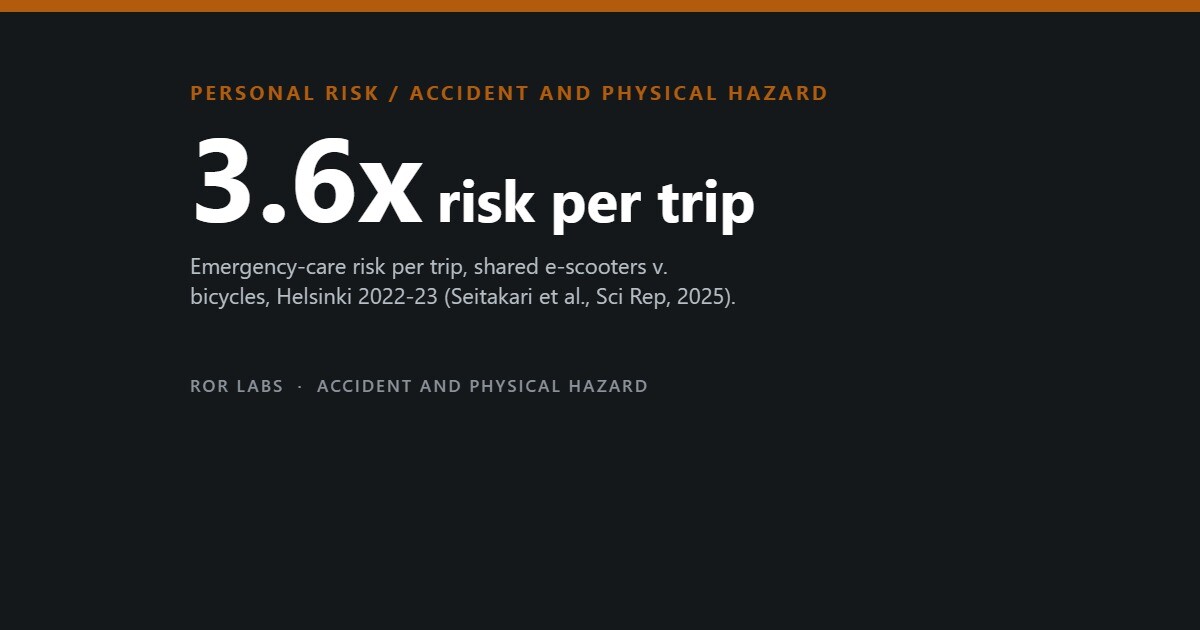
- Per trip, scooters looked 3.6 times riskier than bicycles in Helsinki, but a like-for-like rental study found e-bikes riskier per kilometre.
In this article
- How often riders get hurt
- Per trip, per mile or per hour?
- Heads, helmets and first rides
- Alcohol and riding at night
- Pedestrians and pavement clutter
- Deaths in the US, Britain and Europe
- Trials, bans and speed limits
- How e-scooters compare with cycling
- Riding and charging, step by step
- Questions people ask
- The short version
- Sources
Rental e-scooters reached American pavements in late 2017 and many European cities soon after. Emergency departments noticed at once. Doctors began counting broken wrists, split chins and head injuries, and asking a question that still has no tidy answer: how dangerous is a ride, compared with what?
This article goes through the evidence: the 2018 Austin study run with the US Centers for Disease Control and Prevention (CDC), the first Los Angeles case series, Finnish studies that counted every shared-scooter trip, national figures from three countries, and the rules cities have tried.
The short answer: injuries per trip are real and fairly consistent, and head injuries are common because almost no one wears a helmet. But the counts come from a handful of cities, the trip numbers usually come from operators, and whether scooters look worse than bicycles depends on how risk is measured.
How often riders get hurt
The first study with a proper denominator came from Austin, Texas. Austin Public Health, helped by CDC epidemiologists, searched emergency and ambulance records from 5 September to 30 November 2018 and interviewed the injured. It confirmed 190 injured riders against 936,110 trips logged by the operators: 20 injured people per 100,000 trips. A 2021 review found three US surveillance studies reporting 20 to 25 emergency visits per 100,000 trips.
Los Angeles gives a lower number by a different method. Kimon Ioannides and colleagues used natural language processing to search 36 million clinical notes in one health system, outpatient clinics included, and matched the injuries with city trip data. They estimated 115 injuries per million trips, or 11.5 per 100,000, a conservative figure because people treated elsewhere were missed.
Helsinki has some of the cleanest data, because the city receives every shared-scooter trip through a data platform. From January to August 2021, 528 injured riders reached its public hospitals over 2.85 million trips: 19 per 100,000. Across 2022 and 2023 a later study counted 7.8 per 100,000. Much of that fall followed new rules.
Injuries per 100,000 shared-scooter trips
Riders reaching hospital or emergency care, divided by trips recorded by operators. Each study found its cases differently.
Sources: Austin Public Health (2019); Ioannides et al., PLoS One (2022); Pakarinen et al., JAMA Network Open (2023); Seitakari et al., Scientific Reports (2025). Trip counts were supplied by operators to the cities.
Per trip, per mile or per hour?
A rate needs a top and a bottom. The injury count comes from hospitals, and each study finds cases its own way: interviews in Austin, keyword searches in Helsinki, machine reading in Los Angeles. People who never go to hospital are missed, and pedestrians hurt by scooters are often not looked for.
The exposure is scarcer. For shared scooters it is almost always supplied by operators through city permits, and researchers cannot check it independently. For private scooters there is usually no denominator at all.
The unit matters too. In Austin the 936,110 trips covered 891,121 miles and 182,333 hours, so the average trip was under a mile and lasted about 12 minutes. The same 190 injuries work out at about 20 per 100,000 trips, 21 per 100,000 miles or 104 per 100,000 hours ridden (our arithmetic). Helsinki trips averaged about 2 km in 2021, so its per-kilometre rate was about half the per-trip rate.
One injury count, several denominators
Injured shared-scooter riders expressed per trip, per distance and per hour of riding.
Sources: Austin Public Health (2019), counts of 190 injured riders, 936,110 trips, 891,121 miles and 182,333 hours (rates per mile and per hour are our calculation); Pakarinen et al., JAMA Network Open (2023).
When two modes differ in trip length, a per-trip rate favours the one with shorter trips. None of the units is wrong. A comparison is only fair when both modes use the same unit and the same way of finding injuries.
Heads, helmets and first rides
Most injuries come from simple falls. In the first Los Angeles series, by Tarak Trivedi and colleagues, 80.2% of 228 injured riders had fallen and 8.8% were struck by a vehicle or moving object. Of 249 patients at two emergency departments, 40.2% had head injuries and 31.7% fractures; 6.0% were admitted.
The head is the recurring theme. In Austin, 48% of injured riders had head injuries and 7% showed signs of a traumatic brain injury; the often-quoted 15% is the share among those with a head injury. A 2026 meta-analysis put the pooled share of head and face injuries at 42.1%. In Helsinki, 45.5% of injured scooter riders had head or neck injuries, against 30.9% of injured cyclists.
Helmets were almost absent. One of 190 injured riders in Austin wore one. Among patients admitted with major trauma in England and Wales in 2021, Richard Clough and colleagues found that 7.2% of e-scooter riders and 47% of cyclists had worn a helmet, and that more than a third of the scooter riders had a serious brain injury.
Helmet use among injured riders
Share of injured riders recorded as wearing a helmet. Orange: e-scooter riders. Grey: cyclists in the same study.
Sources: Austin Public Health (2019); Cicchino et al., Traffic Injury Prevention (2021); Seitakari et al., Scientific Reports (2025); Clough et al., Injury Prevention (2023). Helsinki counted missing records as no helmet.
There are no good studies of helmet effect specific to e-scooters. The best evidence comes from bicycles: a meta-analysis of 40 studies by Jake Olivier and Prudence Creighton found that helmeted cyclists who crashed had lower odds of head injury (odds ratio 0.49), serious head injury (0.31) and fatal head injury (0.35). That this carries over to scooters is a reasonable but untested assumption.
Inexperience shows up as well. A third (33%) of interviewed riders in Austin were hurt on their very first ride, and 63% had ridden nine times or fewer. Without knowing how many trips are first trips, that is not a risk estimate, but it suggests a learning curve.
Alcohol and riding at night
Injured scooter riders have often been drinking. In Austin, 29% of interviewed riders had drunk alcohol in the 12 hours before they were hurt, and 39% were injured between 6pm and 6am. In Helsinki in 2022 and 2023, 28.5% of injured e-scooter riders were intoxicated, against 8.2% of injured cyclists; at night the share reached half.
Intoxicated at the time of injury
Share of injured riders recorded as under the influence of alcohol.
Sources: Seitakari et al., Scientific Reports (2025), 2022–2023; Destatis press release N049 (16 July 2026). Recording methods differ.
Alcohol also seems to make injuries worse. Six of the eight Helsinki scooter riders who needed intensive care had been intoxicated, and 76% of intoxicated riders hurt their heads. In the English and Welsh trauma registry, 25.6% of scooter riders had taken alcohol or drugs, compared with 7.2% of cyclists.
Police figures are lower but point the same way. The exact share is uncertain, but no study we read found injured scooter riders more sober than cyclists.
Pedestrians and pavement clutter
The people hurt are not only riders. Of Trivedi’s 249 patients, 21 were not riding: 11 were hit by a scooter, five tripped over a parked one and five were hurt lifting or carrying one.

National police data give scale. In Great Britain in 2025, 235 pedestrians were among the 1,477 people hurt in reported e-scooter collisions; 54 were seriously injured and none died. In Germany, pedestrians were involved in 1,282 injury crashes with e-scooters in 2025, and police judged the scooter rider mainly at fault in 88.7% of them. Three pedestrians were killed.
Tripping over a parked scooter is the least counted harm. Germany’s figures explicitly leave out accidents caused by badly parked e-scooters, and most hospital studies search only for riders. A scooter left across a pavement is an obvious hazard for anyone who cannot see it, but it is rarely measured.
Speed matters for the person who is hit. In 160 computer simulations, Milan Paudel and colleagues found the chance of severe head injury to a struck pedestrian rose steeply between 10 and 15 km/h. That is modelling, not crash data, but it bears on speed limits.
Deaths in the US, Britain and Europe
The US Consumer Product Safety Commission knows of 164 deaths associated with e-scooters from 2017 to 2023, 18 of them on rental scooters. Estimated emergency visits rose from 7,700 in 2017 to 40,400 in 2023. Death reports can lag by two years, so the counts are minimums.
In Great Britain, police recorded 10 deaths in e-scooter collisions in 2025, all of them riders, and an estimated 484 serious injuries. German police recorded 38 deaths: 33 riders, one passenger, three pedestrians, one cyclist and one car occupant. Neither country publishes the trips or kilometres behind these figures.
Among the most badly hurt, scooter crashes are not milder. In a Paris-region trauma registry of 5,233 patients from 2019 to 2022, Arthur James and colleagues found in-hospital mortality of 9.2% after e-scooter crashes, 10.0% for bicycles and 5.2% for motorbikes. In Los Angeles, Ioannides estimated 19 deaths per 100 million scooter trips, close to a published US figure of 21 per 100 million bicycle trips, but that rests on a single death.

Trials, bans and speed limits
Britain has kept e-scooters in a legal grey zone. Rental scooters are allowed only in government trials, now due to run to May 2028 after five extensions, with a 15.5 mph top speed and a driving licence required; helmets are recommended, not compulsory. Private e-scooters remain illegal on public roads, yet the Department for Transport estimates that most scooters in reported collisions are private: about 949 of 1,299 in 2023.
Paris went the other way. In April 2023 about 89% of voters in a city consultation backed ending rental e-scooters, on a turnout of about 7.5%, and the roughly 15,000 shared scooters were to leave the streets from 1 September 2023. We found no peer-reviewed study of what happened to injuries afterwards.
Helsinki offers the clearest evidence that rules can help. In 2022 it capped shared scooters at 20 km/h, cut night-time speeds to 15 km/h from Sunday to Thursday and stopped rentals between midnight and 5am on Friday and Saturday nights. Oskari Pakarinen and colleagues found injuries fell from 19 to 9 per 100,000 rides, and from 9.0 to 5.4 per 100,000 km.
The authors note the limits: three rules came in together, the fleet more than tripled, and only one city was studied. Geofencing, which slows or stops rental scooters in mapped zones, is now common, but we found little published injury data on it. Battery fires are a separate risk, covered in our article on lithium-ion battery fires at home.
How e-scooters compare with cycling
In Helsinki, Laura Seitakari and colleagues estimated a risk of emergency care 3.6 times higher per trip for shared scooters than for bicycles. In Washington, DC, Jessica Cicchino and colleagues at the Insurance Institute for Highway Safety estimated 3.76 times the rate per mile travelled.
Which is riskier depends on how you compare
Ratio of injury or crash rates. Above 1 means the first-named mode looked riskier.
Sources: Seitakari et al., Scientific Reports (2025); Cicchino et al., Traffic Injury Prevention (2021); Kungwengwe et al., Scientific Reports (2026), relative risk among trauma patients; Pai and Dozza, Journal of Safety Research (2025).
The Helsinki comparison is lopsided. Scooter trips came from operator data, while 83 million bicycle trips were estimated from travel surveys at 0.20 trips per resident per day. Injured scooter riders averaged 33 years of age, cyclists 47.
A study that held more constant reached the opposite answer. Rahul Rajendra Pai and Marco Dozza used one operator’s rental e-scooters and e-bikes in seven European cities, on the same streets and with GPS-measured exposure. By distance, rental e-bikes had 8.3 times the crash rate of e-scooters. The crashes were those reported to the operator, only 35 involved e-bikes, and the authors say it is not proof that scooters are safer.
Severity cuts both ways: injured Helsinki cyclists needed surgery more often (13.4% against 8.4%). A fair reading: per trip, shared scooters in ordinary city use look riskier than bicycles; like for like and per kilometre, the gap narrows and may vanish. An earlier article here covers cycling injuries and helmets.
Riding and charging, step by step
CPSC estimated 79,300 emergency-department-treated e-scooter injuries in 2024, up from 58,400 in 2023, and counted 206 known e-scooter deaths from 2017 to 2024, 38 of them in 2024 (2023–2024 counts may change with reporting lags). The steps below come from CPSC’s micromobility safety pages.
Step 1: before you ride. Wear a bicycle helmet. Never ride under the influence of alcohol or drugs. One person per scooter.
Step 2: on the road. Follow local traffic laws, speed limits and signals, use bike lanes where required, and expect drivers and pedestrians not to see you. Keep both hands on the handlebars, avoid abrupt movements, and slow down and lean back at bumps.
Step 3: buying and replacing. Use products certified to the applicable voluntary safety standards, replacement batteries that have been tested and approved, and never a battery pack modified by unqualified people. CPSC warns against “universal” chargers unless tested and approved for your device.
Step 4: charging. Always be present when charging, and never charge while sleeping or when you are not at home. Use the charger supplied or recommended by the maker, and unplug it when the cycle is complete. CPSC says many lithium-ion battery home fires and deaths happen at night while batteries are charging.
What we could not confirm. The CPSC pages we read do not list warning signs such as swelling or odour, so we have not attributed those to CPSC. We did not read the NHTSA, AAP or National Safety Council guidance.
What to do
Steps sorted by when they matter. Each one says how strong the evidence is: Measured Official advice Untested
Before
- Take your first rides slowly somewhere quiet: a third of injured riders in Austin were hurt on their very first ride. Measured see Sources
- Wear a helmet: the head is the body part most often injured, and in cyclists a helmet roughly halved the odds of head injury in a crash. Measured see Sources
- Check the local rules before riding: in Britain private e-scooters are illegal on public roads and rental trial scooters need a driving licence. Official advice see Sources
If it happens
- If someone hits their head and is confused, very drowsy or vomiting, get emergency medical help straight away. Official advice see Sources
- Keep your speed down near pedestrians: in simulations, the chance of severe head injury to a struck pedestrian rose steeply between 10 and 15 km/h. Measured see Sources
- Take extra care at night, when injured riders were far more often intoxicated and head injuries more common. Measured see Sources
Afterwards
- If you had been drinking when you hit your head, get urgent medical advice even if you feel fine; the NHS lists alcohol as a reason to call 111. Official advice see Sources
- Leave the scooter upright and out of the walking line: people trip over parked scooters and are hurt. Untested see Sources
What not to do
- Do not ride after drinking: alcohol was common among injured riders and linked with head injuries and intensive care. Measured see Sources
- Do not ride a private e-scooter on public roads in Britain; it remains illegal. Official advice see Sources
- Do not treat a per-trip injury figure as the whole picture: per kilometre and like for like, the comparison with cycling can reverse. Measured see Sources
Not medical or legal advice. Check the e-scooter rules where you ride.
Questions people ask
Are e-scooters more dangerous than bicycles?
Per trip, in the cities studied, yes: about 3.6 times the emergency-care risk in Helsinki. But scooter riders are younger and more often drunk, and a like-for-like rental study found e-bikes riskier per kilometre. It depends on the measure and on who is riding.
Should I wear a helmet on a rental scooter?
The head is the body part most often hurt. No study has measured helmet effect for e-scooters, but in cyclists a helmet roughly halved the odds of head injury in a crash. Britain’s trial guidance recommends one without requiring it.
Is it legal to ride my own e-scooter in the UK?
No. The Department for Transport says private e-scooters remain illegal to use on public roads, even though most scooters in reported collisions are private. Rental scooters in official trial areas are legal for riders with a full or provisional driving licence, with a 15.5 mph top speed.
Is my first ride really riskier?
A third of injured riders in Austin were hurt on their first ride. The study could not say how risky a first ride is, because nobody knew how many first rides there were. A slow first ride somewhere quiet costs little.
When should someone go to hospital after a scooter fall?
The NHS says to call 999 if someone who hit their head cannot stay awake, has a fit, or has problems understanding or speaking, and treats a head blow in a road accident as an emergency. It advises urgent help through NHS 111 if they are being sick or had been drinking.
The short version
- Where every rental trip is counted, roughly 8 to 20 riders per 100,000 trips needed hospital care.
- Roughly 40–50% of injured riders hurt their heads, and at most about 7% in the main studies wore a helmet.
- Alcohol, night riding and inexperience recur: in Austin, 29% of injured riders had been drinking and a third were on their first ride.
- Per trip, scooters looked 3.6 times riskier than bicycles in Helsinki, but a like-for-like rental study found e-bikes riskier per kilometre.
- After Helsinki capped speeds and limited night rentals, injuries per ride roughly halved.
- Pedestrians are hurt too, and trips over parked scooters are barely counted.
This article summarises research, official statistics and news reports for general information. It is not medical or legal advice; rules differ by country and city. After a head injury, follow the advice of a doctor or your local health service.
Further reading: Pakarinen et al., JAMA Network Open (2023), a before-and-after test of speed and night limits. Pai and Dozza, Journal of Safety Research (2025), a like-for-like comparison. Austin Public Health (2019), the first study with trip, mile and hour counts.
Sources
- Statistisches Bundesamt (Destatis). 38,1 % mehr E-Scooter-Unfälle mit Personenschaden im Jahr 2025. Press release N049 (16 July 2026).
- Austin Public Health. Dockless Electric Scooter-Related Injuries Study, Austin, Texas, September–November 2018 (April 2019).
- Trivedi TK, Liu C, Antonio ALM, et al. Injuries associated with standing electric scooter use. JAMA Netw Open 2(1):e187381 (2019), doi:10.1001/jamanetworkopen.2018.7381.
- Ioannides KLH, Wang PC, Kowsari K, et al. E-scooter related injuries: using natural language processing to rapidly search 36 million medical notes. PLoS One (2022), doi:10.1371/journal.pone.0266097.
- Iroz-Elardo N, Currans KM. Injury burden of introducing e-scooters: a review of e-scooter injury studies using retrospective review of emergency department records, 2015–2019. Transp Res Rec (2021), doi:10.1177/03611981211032216.
- Pakarinen O, Kobylin A, Harjola VP, Castrén M, Vasara H. Speed and nighttime usage restrictions and the incidence of shared electric scooter injuries. JAMA Netw Open 6(11):e2341194 (2023), doi:10.1001/jamanetworkopen.2023.41194.
- Seitakari L, Pakarinen O, Harjola VP, Castrén M, Vasara H. Comparing the characteristics of electric scooter and bicycle injuries: a retrospective cohort study. Sci Rep 15:27599 (2025), doi:10.1038/s41598-025-12627-x.
- Cicchino JB, Kulie PE, McCarthy ML. Injuries related to electric scooter and bicycle use in a Washington, DC, emergency department. Traffic Inj Prev (2021).
- Pai RR, Dozza M. Is e-cycling safer than e-scootering? Comparing injury risk across Europe when vehicle-type, location, exposure, usage, and ownership are controlled. J Safety Res (2025), doi:10.1016/j.jsr.2025.06.015.
- Clough R, Platt E, Cole E, Wilson M, Aylwin C. Major trauma among e-scooter and bicycle users: a nationwide cohort study. Inj Prev (2023), doi:10.1136/ip-2022-044722.
- Kungwengwe G, Gach MW, Gowda S, et al. E-scooter riders sustain more head and internal injuries than motorcyclists and cyclists in England and Wales. Sci Rep (2026), doi:10.1038/s41598-026-59829-5.
- Käckenmester W, Hönning A, Voß HBH, et al. E-scooter-associated injury types and injury severity: a systematic review and meta-analysis. J Clin Med 15(6):2154 (2026).
- Olivier J, Creighton P. Bicycle injuries and helmet use: a systematic review and meta-analysis. Int J Epidemiol (2017).
- James A, Harrois A, Abback PS, et al. Comparison of injuries associated with electric scooters, motorbikes, and bicycles in France, 2019–2022. JAMA Netw Open (2023).
- Paudel M, Yap FF, Rosli TBM, et al. A computational investigation of the dynamic factors governing severity of head injury to pedestrians involved in e-scooter collisions. Transp Res Interdiscip Perspect (2023), doi:10.1016/j.trip.2023.100972.
- Tark J. Micromobility products-related deaths, injuries, and hazard patterns: 2017–2023. US Consumer Product Safety Commission (September 2024).
- Department for Transport. Reported road casualties Great Britain: e-scooter factsheet, 2025 (30 July 2026).
- Department for Transport. Rental e-scooter trials. GOV.UK (updated 29 October 2026).
- NHS. Head injury and concussion. nhs.uk (reviewed 29 May 2025).
- Associated Press. Parisians eliminate e-scooter rentals in overwhelming vote. PBS NewsHour (3 April 2023).
- CPSC. Micromobility products-related deaths, injuries, and hazard patterns: 2017–2024, April 2026. cpsc.gov.
- CPSC. Micromobility information center. cpsc.gov.
- CPSC. Urges consumers not to buy or use “universal” chargers, 5 September 2024. cpsc.gov.