Furniture and TV Tip-Overs: What the Evidence Shows
Key takeaways · 14 min read
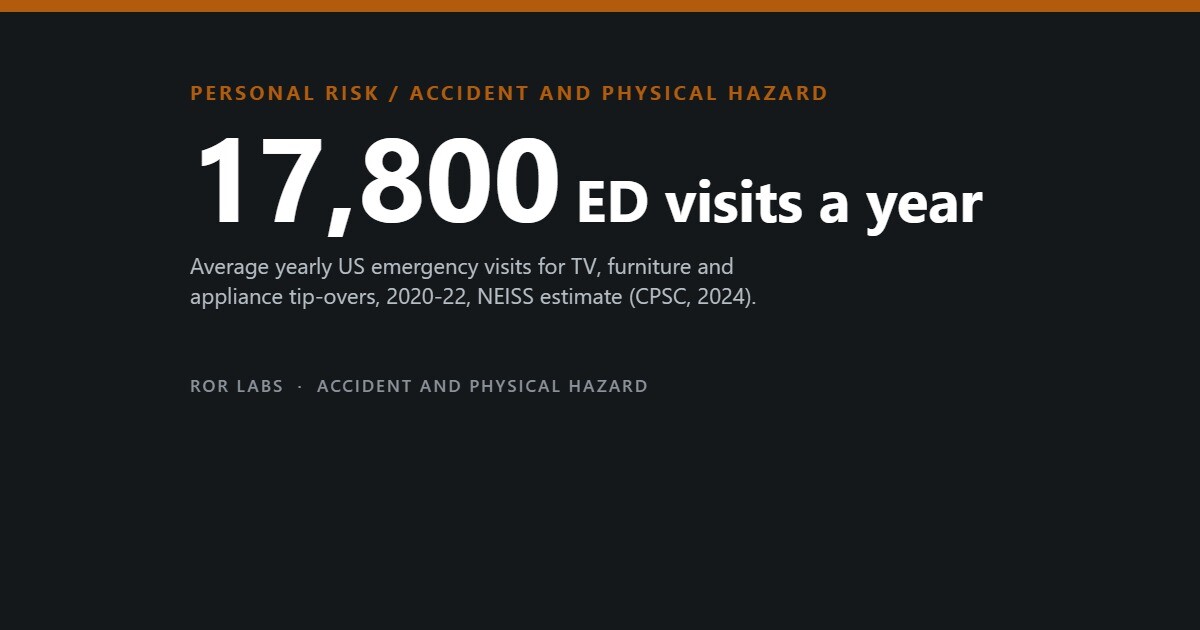
- In the US, about 17,800 people a year were treated in emergency departments for TV, furniture and appliance tip-overs in 2020–2022. That is an estimate from a hospital sample with a range of 13,800 to 21,700.
- Young children carry most of the harm: 71% of the 217 tip-over deaths CPSC staff recorded from 2013 to mid-2023 were children. Older adults made up 26%.
- Injuries from falling TVs dropped sharply after 2010, probably because heavy tube TVs left homes. Dressers and chests remain a leading cause of child deaths.
- Since September 2023, new US dressers and chests must pass a mandatory stability test that simulates a 60-pound child, carpet, loaded drawers and pulling.
A dresser falls over in about the time it takes to turn round. A toddler pulls out the bottom drawers, steps on them, reaches for something on top, and the centre of gravity moves past the front edge. A television on top comes down with it. Nearly all of these accidents happen at home, and the furniture involved is usually ordinary: a chest of drawers, a TV stand, a bookcase.
This article looks at what is known about tip-overs: how many people are hurt, who they are, why TV injuries fell faster than dresser injuries, the IKEA MALM recall, the US STURDY Act standard of 2023, and whether wall anchors work. An earlier article here covered falls at home, which are a different hazard with a different evidence base.
One caution runs through all of it. The injury figures are estimates from a sample of US emergency departments, and the death figures are reports collected by a regulator, not a complete count. The case for anchoring rests on laboratory tests and case reports rather than trials. None of that makes the hazard smaller; it makes the numbers softer than they look.

Where the numbers come from
Almost every US injury figure on this topic comes from the National Electronic Injury Surveillance System (NEISS), run by the Consumer Product Safety Commission (CPSC). About 100 hospital emergency departments report product-related visits, and statisticians weight them up to national estimates. People treated by a family doctor or urgent-care clinic, or not treated at all, are missed (Lu et al., 2021).
Because NEISS is a sample, its estimates come with wide margins. CPSC staff put the average for 2020–2022 at 17,800 emergency visits a year for tip-overs of TVs, furniture and appliances, with a 95% confidence interval from 13,800 to 21,700. Estimates for small subgroups can be labelled unstable and should be read as rough orders of magnitude.
Deaths are counted differently. CPSC compiles them from death certificates, medical examiners, news stories, hotline reports and company reports. Its 2024 report lists 217 tip-over deaths from January 2013 to July 2023 and warns that the latest years are incomplete because reports arrive late. A death that no one reports to the agency is not in the total.
Who gets hurt
Young children dominate the serious cases. Lu and colleagues analysed 30 years of NEISS data, 1990–2019, and estimated 560,203 children treated for furniture or TV tip-overs, an average of 18,673 a year. Children under six made up 69.9% of them, and injuries peaked at age two. Most happened at home, and 3.4% of the children were admitted to hospital.
Small children are hurt differently. Under-sixes were 1.72 times as likely as older children to injure the head or neck, and 1.81 times as likely to have a concussion or closed head injury. A 2023 meta-analysis of toppling-TV studies by Carlos Nunez and colleagues found similar patterns: younger children had higher odds of head and neck injury (odds ratio 2.13) and of hospital admission (2.28).
Who is hurt, and who dies
Share of US emergency-department injuries (2020–2022 average) and of reported deaths (2013 to July 2023) from TV, furniture and appliance tip-overs, by age.
Source: Suchy, CPSC tip-over report (February 2024). Injury shares are NEISS estimates; deaths are 217 reports collected by CPSC, with 2021–2023 incomplete.
Older adults are the group most often left out. In CPSC’s figures, people aged 60 and over accounted for about 4,200 emergency visits a year and 56 of the 217 reported deaths. Most of those deaths involved furniture alone, and crushing was the most common manner of death. The report gives few details of how these incidents began, so prevention advice for older adults is thinner than for children.
Dressers versus televisions
For two decades the story was about televisions. A 2009 study in Clinical Pediatrics by Bethany Gottesman and colleagues estimated 14,700 child tip-over injuries a year from 1990 to 2007, with TVs involved in 47.4%. A 2013 Pediatrics paper by Ana De Roo found the number of injuries from falling TVs rose 125.5% from 1990 to 2011, and those from a TV falling off a dresser or chest rose 344.1%.
Then the curve turned. In Lu’s data the rate of TV-related tip-over injuries among children climbed to 18.5 per 100,000 in 2010 and fell to 2.2 by 2019, a drop of 88.1%. The authors point to the heavy, front-weighted cathode ray tube (CRT) set. A 2017 CPSC report they cite found that 91% of injuries from TVs falling off furniture involved CRT TVs, which are no longer made.
The rise and fall of child tip-over injuries
Emergency-department injury rate per 100,000 US children under 18, furniture and TV tip-overs.
Source: Lu et al., Injury Epidemiology (2021), NEISS 1990–2019. National estimates from a hospital sample.
Dressers fell more slowly. Lu’s team found the rate for clothing storage units, their term for dressers, chests and wardrobes, halved after 2010 but still reached about 2,560 children in 2019. Dressers were involved in only 17.2% of child injuries, yet in half of the estimated child deaths, though the authors flag those death estimates as potentially unstable.
CPSC’s own death reports show the same weight. Of 155 children who died in 2013–2023, 58 were killed by furniture alone and 50 by a TV and furniture falling together, typically a set on top of a dresser. Chests, bureaus and dressers were involved in 79 deaths, and 81% of those were children.
What fell in the child deaths
Share of 155 reported tip-over deaths of children under 18, by product, January 2013 to July 2023.
Source: Suchy, CPSC tip-over report (February 2024). Counts come from reports to CPSC and are incomplete for recent years.
The IKEA MALM recall
The recall that made tip-overs a household phrase came from IKEA. In June 2016 the company and CPSC recalled MALM and other chests and dressers that did not meet the voluntary US stability standard, ASTM F2057. In November 2017 they announced the recall again after another death. The US count was revised to about 17.3 million units.
The reannouncement listed eight children killed, aged 20 months to three years, in deaths dating from 1989 to May 2017. It also counted 186 tip-over reports for MALM models, 91 with child injuries, and 113 reports for other models. Owners were offered a refund or a free wall-anchoring kit.
The MALM case also showed how hard recalls are to complete. Many units were bought years earlier, moved between homes and sold on, so a recall notice may never reach the people who own the furniture. Recalls continue: CPSC’s 2026 notices include dressers sold online only months before.
The STURDY Act standard
For years the US relied on a voluntary standard. Under ASTM F2057-19, a unit 27 inches or taller had to stay upright with all drawers open and with a 50-pound weight hung on one open drawer, on a hard, level floor. Paediatric and consumer groups argued that 50 pounds was too light, and CPSC staff backed 60. Lu’s team added that the hard floor was unrealistic, since most nonfatal incidents with a known floor type happened on carpet.
Compliance was also poor. A CPSC sample of 61 units, reported by Lu and colleagues, found that half failed the stability tests, three in ten came without a tip restraint, and few carried a fully compliant warning label. A 2016 Kids In Danger report found that only 9 of 19 dressers and chests passed.
The market before a mandatory rule
Results of CPSC staff testing of 61 clothing storage units, 2016, and a separate test of 19 units by Kids In Danger.
Sources: CPSC staff study as reported by Lu et al., Injury Epidemiology (2021); Kids In Danger and Shane’s Foundation (2016). Small samples, not representative of all products.
Congress then passed the STURDY Act, and CPSC adopted ASTM F2057-23 as a mandatory rule from 1 September 2023. It covers free-standing chests, dressers and similar units at least 27 inches tall and 30 pounds in weight. Bookcases, shelving and office furniture are excluded, as are units made before that date.
The new tests are harsher. Drawers are loaded to simulate clothing, a horizontal pull simulates a child yanking a handle, and the unit is tilted forward to mimic carpet while a 60-pound weight sits on an open drawer. That figure is roughly the 95th-percentile weight of a six-year-old. No study has yet measured the rule’s effect on injuries.
Does anchoring work?
In physics, an anchor that holds is decisive: a dresser strapped to a stud cannot rotate forward. Lu’s team put the caveat plainly: an anchoring system prevents tip-overs only if it is installed correctly. The test standard for restraints, ASTM F3096, requires them to withstand a 50-pound pull, which raises the question of how much force a climbing child produces.
A CPSC-funded laboratory study by Matthew Reed and colleagues at the University of Michigan measured it. Forty children aged 20 to 65 months climbed on instrumented handles built to mimic a dresser. In every handle behaviour the tipping force exceeded the child’s body weight; averaged across trials, bouncing and leaning reached 2.7 times body weight and yanking 3.9 times.
What is missing is evidence from homes. Case series show the pattern without measuring the effect. In a US emergency-department study of 26 children hurt by falling TVs, none of the TVs, or the furniture under them, was secured, and 85% of the adults had not known this kind of injury could happen. There is no randomised trial of anchoring, and no study comparing injury rates in anchored and unanchored homes.
How hard small children pull
Tip-over moment produced by children aged 20–65 months in laboratory climbing tasks, as a multiple of their own body weight (averaged across trials).
Source: Reed, Ebert and Jones, UMTRI-2020-11, University of Michigan, sponsored by CPSC (2023). 40 children, laboratory apparatus, not real furniture.
Uptake is the other weak point. In a CPSC survey of parents and caregivers released in September 2020, 55% said they had ever anchored furniture and 47% had ever anchored a TV. Lu’s team list the reasons people give: renters may not be allowed to drill, some lack tools or skills, and many simply do not know the hazard exists.
What helps at home
Prevention specialists rank fixes in an order: first make the product stable, then add a restraint, then warn. Warning labels sit lowest because research on warnings shows they change behaviour poorly, as Lu’s team note. That ranking also puts responsibility where most of it belongs, on design, rather than on parents watching every second.
CPSC’s Anchor It! campaign advice is simple. Anchor TVs and tall furniture such as dressers and bookcases to the wall. Put TVs on a sturdy, low base and push them as far back as possible. Keep toys and remote controls off the top of furniture, store heavy items in lower drawers, and keep cords out of reach.
Two other points come from the research. Do not put a TV on a dresser, which was not built to carry it; that combination appears again and again in the death reports. And if an old tube TV moves to a spare room or a grandparent’s house, anchor it there too. Before buying second-hand, check CPSC’s recall list for the model.
Anchoring furniture, step by step
The US Consumer Product Safety Commission (CPSC) counted 217 tip-over deaths between 2013 and July 2023, of which 155 (71%) were children. Between 2020 and 2022 an estimated 17,800 injuries a year were treated in emergency departments, 7,800 (44%) of them children. CPSC says most anti-tip kits cost under $20.
Step 1: gather the kit. A furniture or TV anchoring kit, a drill and bit, a screwdriver and a stud finder.
Step 2: fix the wall bracket. Attach a bracket to the wall. Step 3: move the furniture close to the wall and attach the other bracket or plate to the furniture or TV. Step 4: connect the strap to both brackets. Step 5: tighten the strap. Step 6: tug on it to confirm it holds.
Televisions. CPSC says to place TVs only on furniture designed to hold a television, mount flat screens on the wall or furniture, and anchor TVs that are not wall mounted. If you cannot anchor, use a sturdy, low base, push the TV back as far as possible and keep cords out of reach.
Around the house. Store heavier items on lower shelves, keep toys and remotes off the top of TVs and furniture, and keep supervising children even when furniture is anchored.
What we could not confirm. The pages we read do not specify anchor type, strap length or how many anchors to use, so follow your kit’s instructions. The figures come from a report published in February 2024, and we found no newer annual report.
Where the evidence is weak
NEISS narratives are short. Lu’s team could not tell how tall the furniture was, whether the TV was a CRT or a flat screen, whether a restraint was fitted or what the floor was. So the explanation for the TV decline, the shift away from CRT sets and fewer TVs per home, is plausible but not proven. CPSC’s own tip-over report draws the same link without putting a number on it.
Total tip-over injuries were already falling before the mandatory rule. CPSC estimates dropped from 33,800 in 2013 to 17,400 in 2022, and TV-only injuries from 10,500 to 2,200. Any future fall cannot simply be credited to the STURDY standard without a careful comparison. The death counts are too small, and too dependent on reporting, to show a trend over a few years.
For older adults the gap is wider. They account for about a quarter of reported deaths, yet the research literature is almost entirely about children, and the CPSC report did not describe how the incidents happened. The fair summary: the hazard is real and concentrated, the products are now better regulated, and the household measures make physical sense but have never been tested at scale.
What to do
Steps sorted by when they matter. Each one says how strong the evidence is: Measured Official advice Untested
Before
- Anchor TVs and tall furniture such as dressers and bookcases to the wall. Official advice see Sources
- Put a TV on a sturdy, low base designed for it and push it as far back as possible; do not stand it on a dresser. Official advice see Sources
- Keep toys, remote controls and other tempting items off the top of TVs and furniture, and store heavy items in the lowest drawers. Official advice see Sources
- Check CPSC recall notices for your dresser or chest, including second-hand and recently bought online units. Measured see Sources
If it happens
- If a child or adult is pinned or hurt under fallen furniture or a TV, call emergency services at once. Untested see Sources
- Lift the furniture off the person only if you can do it safely, and get help to hold it. Untested see Sources
Afterwards
- Get a head injury in a young child checked by a doctor: head and neck injuries are the most common in under-sixes, and concussion is frequent. Measured see Sources
- Report the incident to CPSC so it can be counted; deaths and injuries that are not reported are missing from its totals. Untested see Sources
- Anchor the piece, or replace it if it is a recalled or unstable model, before using it again. Official advice see Sources
What not to do
- Do not use a dresser or chest that is under recall unless it is anchored; recall notices say to stop using unanchored units and keep them away from children. Official advice see Sources
- Do not assume a new or modern unit cannot tip: 2026 recalls covered dressers that broke the mandatory standard. Measured see Sources
- Do not leave an old tube TV unsecured when moving it to a spare room or a relative’s home. Official advice see Sources
Not professional advice. Follow the furniture maker’s anchoring instructions.
Questions people ask
Is a wall-mounted TV safer than one on a stand?
CPSC links the fall in TV tip-overs partly to lighter flat screens and wall mounting, though nobody has measured that link directly. A mount only helps if it is fixed as the maker instructs. If a TV stays on a stand, CPSC advises a low, sturdy base with the set pushed back and anchored.
We have no young children. Do we still need to anchor anything?
Children are most at risk, but adults aged 60 and over made up about a quarter of the deaths CPSC recorded, mostly from furniture alone. Visiting grandchildren also count. Tall, heavy pieces and any TV on furniture are the main candidates.
I rent and cannot drill holes. What can I do?
Ask the landlord, since many will agree to anchors for safety. Otherwise follow CPSC’s fallback advice: TVs on a low, sturdy base pushed well back, heavy items in the lowest drawers and nothing tempting on top. Lu’s team suggested factory-fitted adhesive restraints as an option for renters, but these have not been evaluated.
Is a new dresser safe without anchoring?
Dressers made for the US market after 1 September 2023 must pass the STURDY tests, which are tougher than the old ones. But the 2026 recalls show non-compliant units still reach buyers online, and older units are not covered. CPSC still advises anchoring.
How do I know if my furniture has been recalled?
CPSC publishes recalls on its website with brand, model and photos. The MALM recall offered a refund or a free anchoring kit; the 2026 dresser recalls offer refunds. If you cannot identify a second-hand piece, treat it as unverified and anchor it.
The short version
- In the US, about 17,800 people a year were treated in emergency departments for TV, furniture and appliance tip-overs in 2020–2022. That is an estimate from a hospital sample with a range of 13,800 to 21,700.
- Young children carry most of the harm: 71% of the 217 tip-over deaths CPSC staff recorded from 2013 to mid-2023 were children. Older adults made up 26%.
- Injuries from falling TVs dropped sharply after 2010, probably because heavy tube TVs left homes. Dressers and chests remain a leading cause of child deaths.
- Since September 2023, new US dressers and chests must pass a mandatory stability test that simulates a 60-pound child, carpet, loaded drawers and pulling.
- Anchoring makes physical sense, but no trial has measured it in homes, and in a 2020 CPSC survey only about half of respondents had ever anchored furniture.
- Put TVs on low, sturdy bases or mount them, anchor tall furniture, keep tempting items off the top, and check recall notices. Stable products matter as much as anchors.
This article summarises research, agency reports and news for general information. It is not professional safety or legal advice. If a child or adult is trapped or hurt under fallen furniture, call emergency services; for advice on your own home, follow the manufacturer’s instructions and your national product safety agency.
Further reading: Lu et al., Injury Epidemiology (2021), for the 30-year picture of child tip-over injuries in the US. CPSC’s annual tip-over report (Suchy, 2024), for deaths by age and product and the limits of the data. The Federal Register notice of 4 May 2023, for exactly what the STURDY rule tests.
Sources
- US Consumer Product Safety Commission. 5-drawer dressers recalled due to risk of serious injury or death from tip-over and entrapment hazards (UHOMEPRO). Recall 26-448 (30 April 2026).
- Suchy A. Product instability or tip-over injuries and fatalities associated with televisions, furniture, and appliances: 2023 report. US Consumer Product Safety Commission, Directorate for Epidemiology (February 2024).
- Lu CM, Badeti J, Mehan TJ, Zhu M, Smith GA. Furniture and television tip-over injuries to children treated in United States emergency departments. Inj Epidemiol (2021), doi:10.1186/s40621-021-00346-6.
- Gottesman BL, McKenzie LB, Conner KA, Smith GA. Injuries from furniture tip-overs among children and adolescents in the United States, 1990–2007. Clin Pediatr (2009), doi:10.1177/0009922809334352.
- De Roo AC, Chounthirath T, Smith GA. Television-related injuries to children in the United States, 1990–2011. Pediatrics (2013), doi:10.1542/peds.2013-1086.
- Nunez CA, Eslick GD, Elliott EJ. Toppling television injuries in children and adolescents: a systematic review and meta-analysis. Inj Prev (2023), doi:10.1136/ip-2022-044773.
- Ota FS, Maxson RT, Okada PJ. Childhood injuries caused by falling televisions. Acad Emerg Med (2006), doi:10.1197/j.aem.2006.01.021.
- Reed MP, Ebert SM, Jones MLH. Forces and postures during child climbing activities. Report UMTRI-2020-11, University of Michigan Transportation Research Institute, for the US Consumer Product Safety Commission (2023).
- US Consumer Product Safety Commission. IKEA reannounces recall of MALM and other models of chests and dressers due to serious tip-over hazard. Recall 18-040 (21 November 2017).
- US Consumer Product Safety Commission. Safety standard for clothing storage units. Federal Register 88(86), document 2023-08997 (4 May 2023).
- US Consumer Product Safety Commission. ‘Even when you’re watching’: Anchor It! campaign video shows how quickly children can be injured or killed (news release, 10 September 2020).
- Kids In Danger and Shane’s Foundation. Furniture stability: a review of data and testing results (2016).
- HealthDay. About 3,000 Wayfair dressers recalled over child tip-over risk (13 March 2026).
- US Consumer Product Safety Commission. SOOWERY 6-drawer dressers recalled due to risk of serious injury or death from tip-over and entrapment hazards. Recall 26-261 (12 February 2026).
- CPSC. Anchor It! anchorit.gov.
- CPSC. Product instability or tip-over injuries and fatalities: 2023 report, February 2024. cpsc.gov.
- CPSC. Anchor It! campaign marks 10 years, 29 July 2025. cpsc.gov.