9,377 Workers, Two Years, and the Back Belt Made No Difference. Neither Did the Lifting Training.
Key takeaways · 13 min read
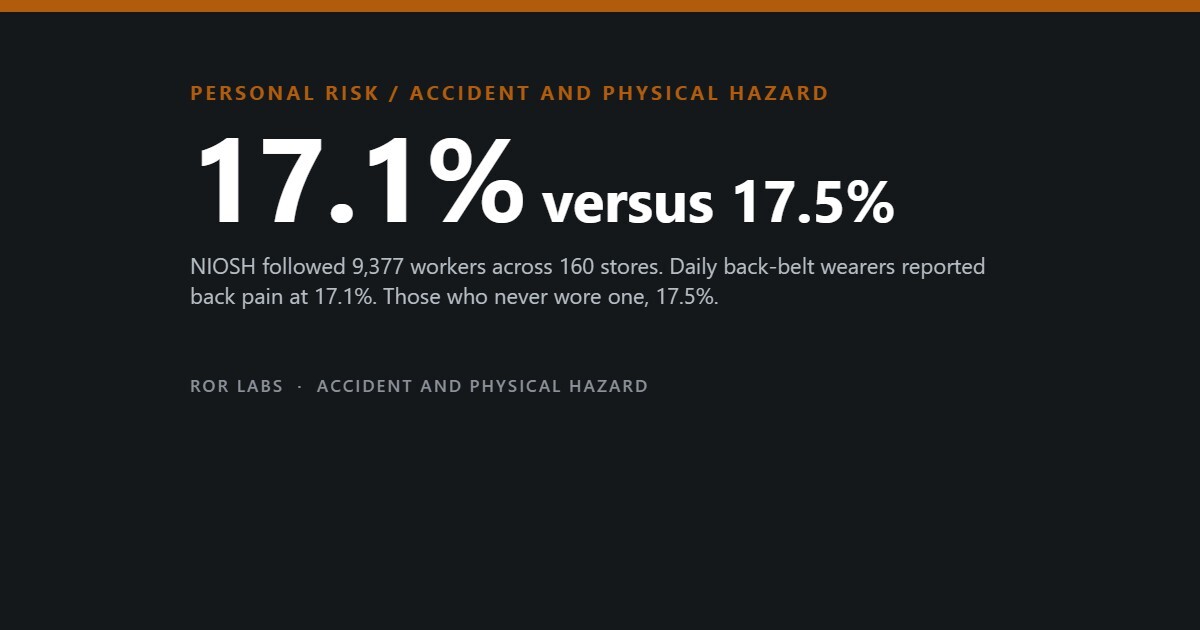
- 9,377 workers, 160 stores, two years. Back pain 17.1% among daily belt wearers against 17.5% among those who never wore one.
- Store policy comparison — the one least distorted by self-selection — was 2.98 against 3.08 claims per 100 workers. Nothing.
- NIOSH had already concluded in 1994 that the evidence was insufficient. The 2000 study was the large test, and it agreed.
- Cochrane, nine randomised trials and 20,101 workers: handling training, with or without assistive devices, does not prevent back pain. Moderate-quality evidence.
Walk through any warehouse, any home improvement store, any removals job, and you will see them: wide elastic belts pulled tight across the lower back, worn all shift, often required by the employer. They are cheap, they are visible, and they feel like they are doing something. That last part is the problem.
Between April 1996 and April 1998, researchers at the US National Institute for Occupational Safety and Health followed 9,377 employees across 160 newly opened retail stores, some of which required back belts and some of which did not. It remains the largest prospective study of the question ever run. Workers who wore a belt every day reported back pain at 17.1%. Workers who never wore one, or wore one rarely, reported it at 17.5%. The injury claim rates were similarly indistinguishable.
Eleven years later a Cochrane review looked at the other half of the ritual — the training session where someone demonstrates bending at the knees — across nine randomised trials covering 20,101 workers. It reached the same place. This article is about why two interventions that feel so obviously sensible do so little, what the measurement tool that is supported actually says, and what that implies for anyone who lifts things for a living or moves house at the weekend.
The largest study found nothing, in two different ways
The NIOSH study was designed around a natural comparison. Some stores in the chain required belt use; others left it voluntary. That matters, because comparing belt-wearers to non-wearers within a store has an obvious flaw — people whose backs already hurt are more likely to put a belt on. Comparing stores sidesteps much of that. Both comparisons were run. Both came out flat.
Back injury claims per 100 full-time equivalent workers
Two years, 160 stores, 9,377 employees. Neither comparison separates.
Source: Wassell, J.T. et al., “A prospective study of back belts for prevention of back pain and injury”, JAMA, 2000; NIOSH announcement of the findings.
Self-reported low back pain told the same story: 17.1% among daily wearers against 17.5% among those who never or rarely wore one. And even among workers in the most physically strenuous jobs — the group a belt is supposed to protect — there was no protective effect.
This was not a surprise to NIOSH. In 1994 the agency had already reviewed the available literature and concluded there was insufficient scientific evidence that back belts prevent injury. The 2000 study was the attempt to settle it with data at scale, and it did.
The training does not work either
“Lift with your legs, not your back” is probably the single most repeated piece of occupational safety advice in the English language. It is delivered in inductions, printed on posters, and signed for in training records. As a way of reducing back pain across a workforce, it does not appear to do anything.
A Cochrane systematic review by Verbeek and colleagues pooled nine randomised controlled trials covering 20,101 workers, plus nine cohort studies covering a further 1,280. Its conclusion was that there is moderate-quality evidence that manual material handling advice and training, with or without assistive devices, does not prevent back pain. The review is unusually blunt for the genre: training workers in proper handling technique, or handing them assistive devices, are not effective interventions by themselves.
The two rituals, and the evidence behind each
Sources: Wassell et al., JAMA, 2000; Verbeek, J.H. et al., “Manual material handling advice and assistive devices for preventing and treating back pain in workers”, Cochrane Database of Systematic Reviews, 2011.
It is worth being precise about what this does and does not mean. It does not mean technique is irrelevant to a single lift — the physics of a load held far from the spine are not in dispute. It means that teaching technique, as an intervention delivered to a workforce, does not show up as fewer people with back pain months later. People revert under time pressure, the awkward lifts are awkward regardless of instruction, and much back pain is not caused by one identifiable lift at all.
What did predict injury
The NIOSH study did find something with a clear separation. It just was not the belt.
Back injury claims per 100 FTE, by prior injury history
Source: Wassell et al., JAMA, 2000, as summarised by NIOSH.
This is the pattern that runs through occupational injury research generally. Interventions aimed at the worker — equipment worn on the body, instruction delivered to the head — perform poorly. The variables that predict who gets hurt are properties of the person’s history and of the task they are given.
The tool that is supported measures the task, not the person
NIOSH did not simply say “no” and stop. It published the revised lifting equation, which is the closest thing occupational ergonomics has to a ruler. It answers a different question from the one the belt tries to answer. Instead of asking how to protect a body from a load, it asks how heavy a load is allowed to be, given how it has to be lifted.
The equation starts from a load constant of 23 kg (about 51 lb) — the weight considered acceptable under ideal conditions — and then multiplies it down by a series of factors for every way the real lift departs from ideal. Recommended Weight Limit equals LC × HM × VM × DM × AM × FM × CM. Divide the actual load by that limit and you get the Lifting Index; above 1, risk is increased.
What each departure from ideal costs you
The multipliers in the revised NIOSH lifting equation. Each one reduces the weight the task should involve.
| Factor | What it measures | Practical meaning |
|---|---|---|
| Horizontal (HM) | Distance from the midpoint between the ankles to the hands | The dominant term. Holding a load at arm’s length rather than against the body can roughly halve the allowable weight on its own. |
| Vertical (VM) | Height of the hands at the start of the lift | Floor level and above-shoulder both penalise. Knuckle height is where the equation is kindest. |
| Distance (DM) | How far the load travels vertically | Floor to shelf costs more than shelf to shelf. |
| Asymmetry (AM) | Angle of trunk twist during the lift | Turning while loaded is penalised heavily. This is the factor a pallet placed behind you creates. |
| Frequency (FM) | Lifts per minute and duration of the task | The same box is a different job at one lift an hour and at four a minute. |
| Coupling (CM) | Quality of the grip | Handles, cut-outs and a rigid box score better than a sagging sack with no grip. |
Source: NIOSH, Applications Manual for the Revised NIOSH Lifting Equation, publication 94-110; CCOHS summary of the RWL calculation.
The horizontal term is the one worth internalising even if you never calculate anything. Reaching into the back of a car boot, or over a shelf edge, or across a pallet, moves the load away from your spine and multiplies the force at the lower back. That single geometric fact does more work than any advice about knees.
So what actually reduces the risk
This is the honest part, and it is less satisfying than a product. The evidence base for what does prevent back pain at work is thinner than the evidence for what does not. What survives is a direction rather than a list: change the task so the lift is smaller, closer, less frequent and less twisted, rather than trying to armour or instruct the person doing it.
Where the leverage is
Ordered by how much of the load each one removes from the spine, not by how easy it is to arrange.
Sources: NIOSH revised lifting equation, publication 94-110; Verbeek et al., Cochrane Database of Systematic Reviews, 2011; Wassell et al., JAMA, 2000.
We are not recommending a product here
This is the rare article where the honest answer is that the thing you would buy is the thing the evidence tested and did not support.
We do link mechanical aids in other contexts, and a trolley or a lift table can genuinely change a task. But the Cochrane review specifically tested assistive devices alongside training and did not find prevention of back pain, so we are not going to sell you one on a safety claim it has not earned. If a device removes a lift entirely, that is a real change. If it just accompanies the same lift, it is not.

Questions people ask
My employer requires a back belt. Should I refuse?
No — a required belt is a condition of the job and the evidence says it does not help, not that it hurts. The study found no harm either. The useful move is to stop treating the belt as your protection and start paying attention to the variables that the lifting equation actually weighs: how far the load is from your body, how high it starts, whether you are turning while loaded, and how often. If your workplace has a health and safety representative, the store-policy result — mandatory 2.98 against voluntary 3.08 claims per 100 workers — is the number to bring.
Weightlifters use belts. Why is that different?
Because the task is different. A powerlifting belt is used for a small number of maximal, planned, symmetrical lifts, where raising intra-abdominal pressure against a rigid belt may help stabilise the trunk for a few seconds. Occupational lifting is repeated, sub-maximal, asymmetric and unplanned, over eight hours. The gym use case does not generalise to the warehouse one, and the warehouse one is what the 9,377-worker study measured.
Is the NIOSH study reliable? It was not a randomised trial.
It was a prospective cohort study, which is a real limitation and worth naming. People choose whether to wear a belt, and people whose backs already hurt are more likely to choose to. That confounding would tend to make belts look worse than they are, which is roughly what the individual-level comparison shows. The design feature that answers it is the store-level comparison — mandatory policy against voluntary policy, which the individual worker did not choose — and that comparison found nothing in either direction. Taken with the 1994 literature review and the later Cochrane work on training, the picture is consistent rather than dependent on one study.
I am moving house this weekend. What actually helps?
Smaller boxes than you think, packed so that heavy items go in small containers and light items in large ones. Loads held against the body rather than at arm’s length. Nothing lifted while turning — move your feet instead. Straight-line routes with the destination in front of you. More trips. And if there is one item that clearly exceeds what two people can carry closely and without twisting, that is the item to hire equipment or help for, because the equation says it is the one that will hurt you.
Does any of this apply to office work?
Only partly. The lifting equation is about manual handling, not seated work, and the evidence on desk ergonomics is a separate and generally weaker literature. The transferable idea is the same though: interventions aimed at the task and the schedule have done better in research than products worn on the body or advice delivered once at induction.
The short version
- 9,377 workers, 160 stores, two years. Back pain 17.1% among daily belt wearers against 17.5% among those who never wore one.
- Store policy comparison — the one least distorted by self-selection — was 2.98 against 3.08 claims per 100 workers. Nothing.
- NIOSH had already concluded in 1994 that the evidence was insufficient. The 2000 study was the large test, and it agreed.
- Cochrane, nine randomised trials and 20,101 workers: handling training, with or without assistive devices, does not prevent back pain. Moderate-quality evidence.
- The strongest predictor in the data was a previous back injury — 5.14 against 2.68 claims per 100 workers.
- The supported tool measures the task: 23 kg ideal, reduced by horizontal distance, height, travel, twist, frequency and grip.
- Horizontal distance is the big one. Bring the load in. That single change outperforms anything worn on the body.
This article summarises occupational health research and is general information, not medical advice or a workplace risk assessment. If you have back pain, particularly with numbness, weakness, or bladder or bowel changes, that is a matter for a clinician rather than an article. Workplace duties and legal requirements around manual handling vary by country; where your employer requires a control, comply with it and raise the evidence through the proper channel rather than unilaterally.
Further reading: The Way Out — Alan Gordon with Alon Ziv (Avery, 2021). Built on the Pain Reprocessing Therapy trial published in JAMA Psychiatry, on the neuroscience of chronic pain and why fear of movement keeps it going. The evidence base is still fairly thin — one main trial — and some critics say the book oversells certainty for a therapy still being validated. Find it on Amazon (paid link)
On the links above: some are affiliate links, marked (paid link). If you buy through one we may earn a commission at no additional cost to you. As an Amazon Associate I earn from qualifying purchases. We link to product searches rather than specific items so that recommendations do not break as models change, and we say plainly when we are choosing not to link something. Full policy: Affiliate Disclosure.
Sources
- Wassell, J.T., Gardner, L.I., Landsittel, D.P., Johnston, J.J. and Johnston, J.M., “A prospective study of back belts for prevention of back pain and injury”, JAMA, 2000. (9,377 employees at 160 newly opened retail stores, April 1996 to April 1998; 3.38 against 2.76 back injury claims per 100 full-time equivalents for daily wearers against never or rare wearers; 17.1% against 17.5% self-reported low back pain; 2.98 against 3.08 claims per 100 FTE for mandatory against voluntary store policies; 5.14 against 2.68 claims per 100 FTE by prior back injury history; no protective effect among the most strenuous jobs.)
- National Institute for Occupational Safety and Health, announcement of the back belt study findings, and the 1994 NIOSH review concluding that evidence for back belts preventing injury was insufficient.
- Verbeek, J.H., Martimo, K.-P., Karppinen, J., Kuijer, P.P., Viikari-Juntura, E. and Takala, E.-P., “Manual material handling advice and assistive devices for preventing and treating back pain in workers”, Cochrane Database of Systematic Reviews, 2011. (Nine randomised controlled trials covering 20,101 workers and nine cohort studies covering 1,280; moderate-quality evidence that advice and training, with or without assistive devices, does not prevent back pain.)
- National Institute for Occupational Safety and Health, Applications Manual for the Revised NIOSH Lifting Equation, publication 94-110. (Load constant of 23 kg; Recommended Weight Limit as the product of horizontal, vertical, distance, asymmetry, frequency and coupling multipliers; Lifting Index above 1 indicating increased risk.)
- Canadian Centre for Occupational Health and Safety, summary of the NIOSH lifting equation and the calculation of the Recommended Weight Limit.