Three Per Cent of American Deaths Abroad Were War or Terrorism. And the Evacuation, If It Comes, Is a Loan.
Key takeaways · 13 min read
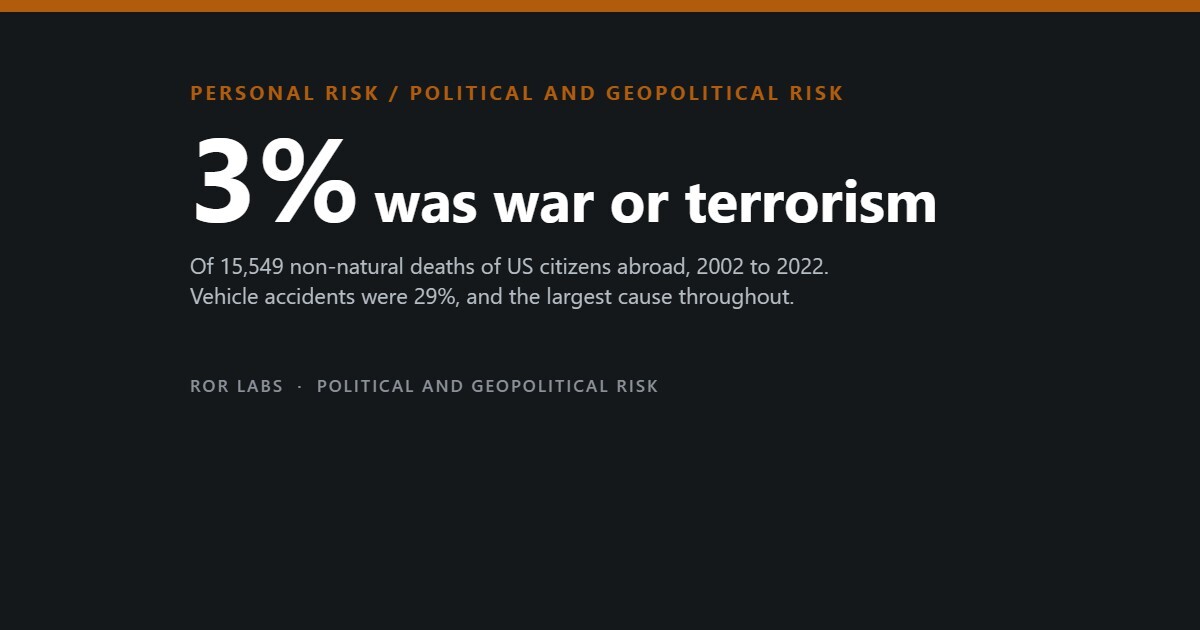
- Of 15,549 non-natural deaths of US citizens abroad between 2002 and 2022, war and terrorism were 422 — 3%. Vehicle accidents were 4,482, or 29%, and the largest cause throughout.
- Per 100,000 US-originating passengers: 0.186 vehicle deaths against 0.018 from war and terrorism.
- Advisory levels are country-level and trigger nothing. The letter codes carry the information; the number does not.
- US law authorises evacuating private citizens on a reimbursable basis. Evacuees sign promissory note DS-5528, are billed up to a full-fare economy ticket at pre-crisis prices, and an unpaid crisis loan is grounds for passport denial.
Between 2002 and 2022 the US State Department recorded 15,549 non-natural deaths of American citizens abroad. War and terrorism together accounted for 422 of them — 3%. Vehicle accidents accounted for 4,482, or 29%, and were the largest single cause in every period examined. Whatever a country’s politics are doing, the thing most likely to kill a visitor there is a road.
That is worth holding onto, because the rest of this article is about what happens when the politics do turn, and almost none of it works the way people assume. The advisory levels do not mean what they appear to mean. The insurance was written to exclude precisely this event. And the government evacuation, if one comes at all, is a loan: American law authorises it on a reimbursable basis, evacuees sign a promissory note for the seat, and an unpaid crisis loan can cost you your passport.
None of that is a scandal. It is simply how the system is built, and it is written down. The problem is that the picture most travellers carry — a government aeroplane, arriving free — comes from television, and the gap between the two only becomes visible at the worst possible moment.

What the advisory levels actually are
The US State Department publishes a four-level advisory for every country, along with letter codes for the specific risk driving it: C for crime, T for terrorism, U for civil unrest, K for kidnapping, D for wrongful detention, H for health, N for natural disaster, O for other. The letters are the useful part and the number is the part everyone quotes.
The four levels, and what each one does not do
| Level | What it says | What it does not do |
|---|---|---|
| 1 | Exercise normal precautions | None of the four levels triggers an insurance payout, obliges any government to remove you, or reflects the risk in the particular city you are going to. The advisory is country-level; the risks that drive it usually are not. A Level 3 for one province produces a Level 3 for the whole country, and a Level 2 for a country with one dangerous border tells you nothing about the coast. |
| 2 | Exercise increased caution | |
| 3 | Reconsider travel | |
| 4 | Do not travel |
Source: US Department of State, Travel Advisories, travel.state.gov. Risk indicators: C, H, K, N, O, T, U, D.
The evacuation is a loan
This is the part that surprises people, and it is not obscure — it is in the statute and in the Foreign Affairs Manual, the State Department’s own rulebook. The relevant law, 22 U.S.C. 2671(b)(2)(A), authorises the evacuation of private citizens whose lives are endangered by war, civil unrest or natural disaster on a reimbursable basis to the maximum extent practicable. Authorises, not requires.
What signing for the seat means
Sources: 22 U.S.C. 2671(b)(2)(A); US Department of State, Foreign Affairs Manual, 7 FAM 1800 Appendix D (crisis evacuation loans and evacuation documentation), and 8 FAM 803.9 (passport denial for crisis loan indebtedness).
There is a second, quieter point in the same statute. It permits evacuation; it does not promise one. Whether an assisted departure happens, when, from where and for whom is a judgement made in the middle of the event, and the answer has differed enormously between crises. Planning that treats it as guaranteed is planning on a discretionary power.
The insurance was written to exclude exactly this
Travel insurance is the other thing people assume covers them, and the war exclusion is close to universal. Most policies exclude loss arising from war, invasion, civil war, rebellion, insurrection and similar armed conflict. Beyond that the picture is genuinely inconsistent, which is the part worth reading rather than assuming.
What a standard policy does with a political crisis
| Event | Usual treatment |
|---|---|
| War, invasion, civil war, rebellion, insurrection | Excluded in most policies, in near-identical wording. |
| Terrorism | Varies. Some policies treat it separately from war and list it as a covered reason for cancellation or interruption; others do not. This is a policy-by-policy question with no default answer. |
| Civil unrest, riot, disorder | Inconsistent. Some exclude it outright; others provide limited benefits depending on the wording and the facts. |
| A government advisory issued after you booked | Depends entirely on the policy. Insurers commonly treat a situation as a foreseeable event once it is publicly known — which means the moment the news makes you want the cover is often the moment you can no longer buy it for that event. |
| Cancel for any reason | An optional upgrade, usually bought within days of the first deposit, typically reimbursing 50 to 75% of prepaid costs, and usually requiring cancellation at least 48 hours before departure. |
Source: standard US travel insurance policy structures as described by insurers and brokers. Wording varies by policy and by state; the exclusions above are typical rather than universal, and the only reliable source is the certificate for the policy you actually hold.
What actually happens to travellers
Now the calibration, because an article about political risk that leaves you more frightened than informed has failed. A 2025 analysis in the Journal of Travel Medicine went through two decades of State Department records of non-natural deaths of US citizens abroad.
How Americans actually died abroad, 2002 to 2022
15,549 non-natural deaths recorded by the US Bureau of Consular Affairs. An average of 654 a year, peaking at 1,065 in 2010 and trending down from 2015.
Source: Jacob-Leonce, M. and Leonce, J.G., “Analysis of the non-natural deaths of US citizens while abroad”, Journal of Travel Medicine, 2025, using US Department of State Bureau of Consular Affairs data.
The same paper puts the two side by side per unit of travel, which is the fairer comparison because it accounts for how many people went.
Deaths per 100,000 US-originating passengers
Source: Jacob-Leonce and Leonce, 2025, Table 1 and Table S3.
Something similar holds for disasters, which occupy a comparable place in the imagination. An earlier review of 7,963 non-natural deaths between 2002 and 2012 found 163 disaster-related deaths — 2.0% — and 121 of those, three quarters of the total, came from a single event, the 2010 Haiti earthquake. The category is not so much rare as lumpy: almost nothing, most years, and then one day that dominates the decade.
What that 3% does not tell you
Three honest limits, because the number is easy to over-read in the other direction.
Three things this figure is not
Sources: Jacob-Leonce and Leonce, 2025 (limitations section). Partridge, R., Bouslough, D. and Proano, L., “Disaster-related fatalities among US citizens traveling abroad”, American Journal of Disaster Medicine, 2013.
The order in which things close
If there is one useful structure to carry, it is this one. A political crisis does not remove your options all at once. It removes them in a sequence, and the sequence is almost always the same.
What goes first, and what it means for you
| Closes | What it looks like | What is still available |
|---|---|---|
| 1. Cheap seats | Fares on the remaining flights rise steeply while the schedule is still intact. | Everything. This is the window in which leaving is a decision rather than a problem, and it is the one people spend deciding. |
| 2. Commercial flights | Airlines suspend routes or airspace closes. Insurance for the event, if you did not already hold it, is now unbuyable as a foreseeable risk. | Land borders, ferries, a different airport in a neighbouring country. Slower and more expensive, and still your own decision. |
| 3. Land routes | Borders shut or become dangerous to reach. Local banking and card networks may stop working before this point. | Whatever the embassy organises, on its own timetable and terms — which is a loan, per the section above. |
| 4. Consular presence | Embassy operations reduce or suspend. In some crises this happens quickly. | Very little. This is the state everyone pictures when they imagine being evacuated, and it is the state in which the fewest options exist. |

Two smaller things follow from the same logic. Money that depends on the local banking system is not money in row three, so a small amount of cash in a widely accepted currency does work that a card does not. And documents matter more than usual: a passport with real validity left on it, held separately from the copy of it, because replacing one in a reduced consular section is measured in weeks.
There is one situation where the calculus is different, and it is worth stating plainly because it catches people by surprise. If you hold the nationality of the country you are in as well as your own, the government you would expect to help may not be able to. States are not obliged to recognise your other nationality on their own territory, and consular access can be refused on exactly that basis. If that describes you, the planning has to happen earlier and the assumptions have to be weaker.

Questions people ask
Does registering with my embassy do anything?
It puts you on a list for messages and it is free, which makes it worth doing. It is not a request for help and it creates no obligation on anyone. Treat it as a way to receive information rather than as a form of protection — the value is that alerts about closing airspace and departure options reach you in row one rather than row three.
If I buy insurance the day the news breaks, am I covered?
Almost certainly not for that event. Insurers commonly treat a situation as foreseeable once it is publicly known, which is the mechanism by which cover for political events has to be bought while the event still seems absurd. This is not a trick; it is how insurance against a known event has to work if it is to exist at all. The corollary is that the decision belongs at the deposit, not at the departure.
Will the government really bill me for an evacuation?
The statute says evacuation of private citizens is on a reimbursable basis to the maximum extent practicable, the Manual sets the amount at up to a full-fare economy ticket at pre-crisis prices, and evacuees sign a promissory note. Whether every debt is ultimately pursued is a separate question from whether it exists. The consequence attached to it — passport denial for crisis loan indebtedness — is not theoretical, and it is the reason to know about it before rather than after.
Is a Level 4 country actually dangerous for me specifically?
The advisory cannot tell you, because it is a country-level judgement and you will be in one part of it doing particular things. Read the letter codes and the body text, which name the actual driver, and then ask whether that driver reaches where you are going. A terrorism code and a crime code call for completely different responses, and a kidnapping code is the one that most changes what a normal itinerary should look like.
So should I worry about political risk when I travel at all?
Worry about it in proportion. Over twenty years war and terrorism were 3% of American non-natural deaths abroad and vehicles were 29%. The realistic geopolitical harm is not death; it is being stuck somewhere expensive with no flight and no working card. That is a logistics problem, and logistics problems respond to preparation in a way that mortality risks generally do not.
The short version
- Of 15,549 non-natural deaths of US citizens abroad between 2002 and 2022, war and terrorism were 422 — 3%. Vehicle accidents were 4,482, or 29%, and the largest cause throughout.
- Per 100,000 US-originating passengers: 0.186 vehicle deaths against 0.018 from war and terrorism.
- Advisory levels are country-level and trigger nothing. The letter codes carry the information; the number does not.
- US law authorises evacuating private citizens on a reimbursable basis. Evacuees sign promissory note DS-5528, are billed up to a full-fare economy ticket at pre-crisis prices, and an unpaid crisis loan is grounds for passport denial.
- Standard travel insurance excludes war, invasion, civil war and rebellion. Terrorism and civil unrest vary by policy. Once a situation is public, insurers commonly treat it as foreseeable and therefore uninsurable.
- Options close in order: cheap seats, then commercial flights, then land routes, then consular presence. Everything useful happens in the first two.
- The realistic harm from a political crisis is not death. It is being stranded, at cost, with a card that no longer works — which is a logistics problem and responds to preparation.
This article describes US statutes, US State Department policy and US travel insurance practice, because that is where the documentation and the data are. Other governments operate differently, and several will not organise departures at all. It is not legal advice; if you hold more than one nationality, or you are travelling somewhere your government has advised against, the details matter more than any general article can capture and are worth checking with your own foreign ministry before you go.
Further reading: the primary sources here are free and better than any summary of them. The US Foreign Affairs Manual is published in full at fam.state.gov — 7 FAM 1800 Appendix D is four pages and covers the evacuation loan completely. Country advisories, with the letter codes, are at travel.state.gov.
- Doom, Niall Ferguson (2021). On why institutions fail to prevent or respond well to disasters.
- Noise, Daniel Kahneman, Olivier Sibony & Cass Sunstein (2021). On unwanted variability in judgment under pressure, including in a crisis response.
- The Data Detective, Tim Harford (2020). Ten rules for reading numbers in the news skeptically.
Sources
- Jacob-Leonce, M. and Leonce, J.G., “Analysis of the non-natural deaths of US citizens while abroad”, Journal of Travel Medicine, published 2 July 2025, using US Department of State Bureau of Consular Affairs data. (15,549 non-natural deaths, 2002–2022; vehicular accidents 4,482 or 29%, homicides 3,279 or 21%, other accidents 2,629 or 17%, suicide 2,242 or 14%, drowning 2,098 or 13%, war and terrorism 422 or 3%, disasters 211 or 1%. Deaths per 100,000 US-originating passengers: vehicular 0.186, war and terrorism 0.018. Average 654 deaths a year; peak 1,065 in 2010. Proportional mortality ratios for vehicular and non-vehicular accidents rose from 2003–2012 to 2013–2022; homicide and suicide ratios stable. Limitations include under-reporting and more than 2,500 deaths left unclassified.)
- Partridge, R., Bouslough, D. and Proano, L., “Disaster-related fatalities among US citizens traveling abroad”, American Journal of Disaster Medicine, 2013. (7,963 non-natural deaths October 2002 to June 2012; 163 disaster-related, 2.0%, across 19 events in 15 countries; the 2010 Haiti earthquake accounted for 121 of them, 74.2%, and the 2004 Thailand tsunami for 22, 13.5%.)
- Sherry, M., Mossallam, M., Mulligan, M., Hyder, A.A. and Bishai, D., “Rates of intentionally caused and road crash deaths of US citizens abroad”, Injury Prevention, 2013. (5,417 non-natural death events 2003–2009; rates of road traffic crashes were higher than rates of intentionally caused deaths in almost every country examined.)
- 22 U.S.C. 2671(b)(2)(A), authorising evacuation of private US citizens whose lives are endangered by war, civil unrest or natural disaster, on a reimbursable basis to the maximum extent practicable.
- US Department of State, Foreign Affairs Manual, 7 FAM 1800 Appendix D, crisis evacuation loans and evacuation documentation. (Billing at no greater than a full-fare economy flight priced immediately before the events giving rise to the evacuation; promissory note and loan agreement form DS-5528; refusal to sign does not relieve the debt where transport was used; cross-reference to 8 FAM 803.9 for entry in the lookout system and passport denial for crisis loan indebtedness.)
- US Department of State, Travel Advisories, travel.state.gov. (Four levels: exercise normal precautions, exercise increased caution, reconsider travel, do not travel. Risk indicators C crime, H health, K kidnapping or hostage taking, N natural disaster, O other, T terrorism, U unrest, D wrongful detention.)
- Standard US travel insurance policy structures, as described by insurers and brokers: near-universal exclusion of war, invasion, civil war, rebellion and insurrection; variable treatment of terrorism and civil unrest; the foreseeable-event doctrine once a situation is publicly known; cancel-for-any-reason upgrades typically reimbursing 50 to 75% of prepaid costs, purchased within days of the initial deposit and requiring cancellation at least 48 hours before departure. Wording varies by policy and by state; the only authoritative source is the certificate you hold.