Alternative Medicine Instead of Cancer Treatment: What the Evidence Shows
Key takeaways · 13 min read
- Complementary therapies are used alongside cancer treatment; alternative medicine is used instead of it. The evidence of harm concerns the second.
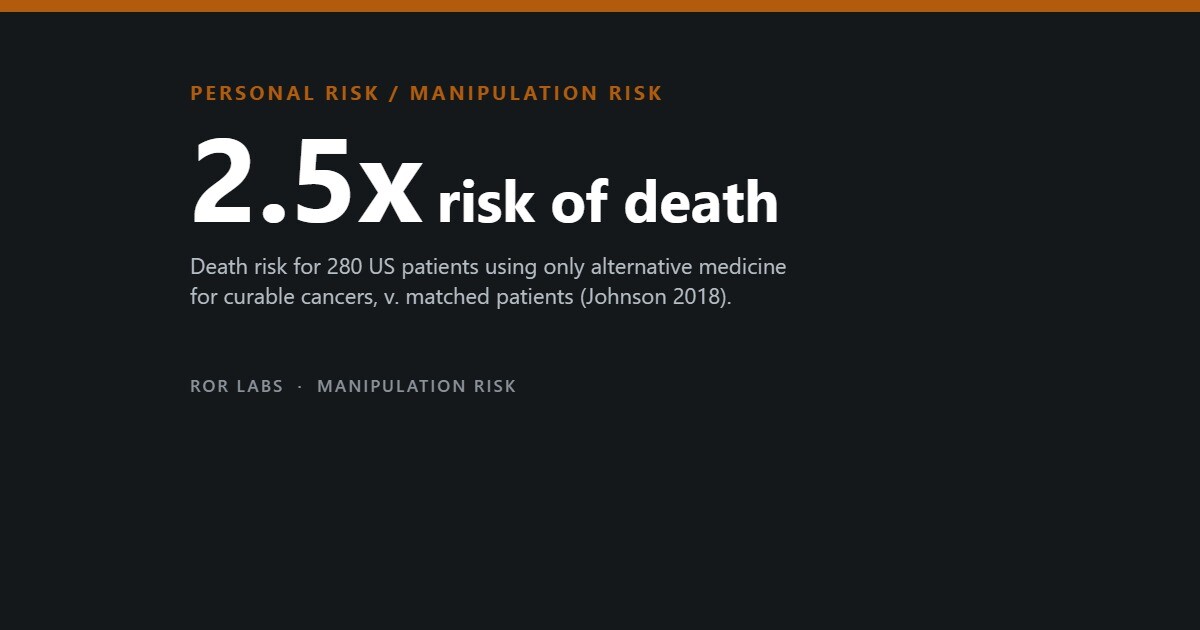
- In a US registry study of curable cancers, people who used alternative medicine alone had 2.5 times the risk of death of matched patients (Johnson, 2018).
- Complementary medicine users refused parts of standard treatment far more often. Once refusal was counted, their extra risk of death was no longer significant.
- These are observational studies of a few hundred people in one US database. The direction is consistent; the exact size is uncertain.
In this article
- Complementary is not the same as alternative
- What the survival studies found
- The harm runs through refusal
- Who chooses another route, and why
- How misinformation reaches patients
- Four documented cases
- What regulators do about false cancer claims
- What patients and families can do
- Questions people ask
- The short version
- Sources
Many people with cancer try something beyond what their oncologist prescribes: a diet change, acupuncture, a supplement a friend swears by. Usually that is harmless, but a much smaller group turns down surgery, chemotherapy or radiotherapy for an unproven route, and there health misinformation carries a measurable cost.
What follows covers the outcome studies, why the harm seems to run through refusing treatment, who takes the alternative route and why, how false claims reach patients, and what courts and regulators have done, with four documented stories told with care.
The best measurements are few and imperfect, but they agree: complementary therapies alongside treatment are not linked to worse survival once refusal is accounted for, while replacing treatment is.

Complementary is not the same as alternative
The US National Cancer Institute defines a complementary therapy as ‘used along with standard medical treatment’ and an alternative therapy as ‘used instead of’ it. Its definition of integrative medicine combines conventional care with practices that research has shown to be safe and effective.
The two are often lumped together. A review by Barrie Cassileth and Gary Deng described most complementary therapies as helpful additions that control symptoms and improve quality of life, while literal alternatives are unproven or disproven. Trouble starts when a product or practitioner claims to treat the cancer itself, or when a patient comes to believe that the gentler option can stand in for surgery or chemotherapy.
What the survival studies found
The study cited most often comes from Skyler Johnson and colleagues at Yale, published in the Journal of the National Cancer Institute in 2018. Using the US National Cancer Database for 2004 to 2013, they found 281 people with non-metastatic breast, prostate, lung or colorectal cancer whose only recorded treatment was ‘other-unproven’ therapy given by non-medical staff.
The 280 who could be matched with 560 patients on conventional treatment, for age, stage, other illnesses, insurance and cancer type, had 2.5 times the risk of death (hazard ratio 2.50). The gap was widest in breast cancer, and prostate cancer, which often grows slowly, was not among the groups with a reported increase.
Risk of death with alternative medicine alone
Hazard ratio for death, alternative medicine alone versus matched patients on conventional treatment (= 1).
Source: Johnson et al., JNCI (2018); 280 alternative-medicine patients and 560 matched controls, US National Cancer Database, 2004–2013. No increase was reported for prostate cancer.
People with breast or lung cancer, higher socioeconomic status, stage II or III disease, few other illnesses and homes in the western US were more likely to choose this route: on paper, patients with good chances.
An older Norwegian cohort of 515 patients points the same way, more weakly: alternative medicine users had an adjusted hazard ratio for death of 1.30, just short of statistical significance (Risberg et al., 2003).
The harm runs through refusal
Later in 2018, in JAMA Oncology, Johnson’s team studied people who used complementary medicine as well as at least one standard treatment. From 1,901,815 patients at 1,500 US centres, they matched 258 such users with 1,032 who used none.
The complementary group was far more likely to turn down part of its treatment.
Refusing part of standard treatment
Share refusing each recommended treatment: complementary medicine (CM) users v. matched non-users.
Source: Johnson et al., JAMA Oncology 4(10):1375–1381 (2018); 258 CM users and 1,032 matched patients with non-metastatic breast, prostate, lung or colorectal cancer.
Five-year survival was 82.2% with complementary medicine and 86.6% without (hazard ratio 2.08). When refusal and delay were added to the model, the hazard ratio fell to 1.39, with a confidence interval from 0.83 to 2.33. The extra deaths appear to be explained by the missing treatment rather than the extra therapies.
Studies of refusal for any reason agree. Among two million US breast cancer patients, refusing surgery carried a hazard ratio for death of 2.7 (Moya et al., 2021); in colorectal cancer, refusing surgery went with five times the risk of dying of the cancer (Delisle et al., 2020).
Refusing treatment, in other large datasets
Adjusted hazard ratio for death after refusing a recommended treatment, for any reason.
Sources: Delisle et al. (2020), SEER, 983 people who refused surgery, 2004–2015; Moya et al., American Surgeon (2021), National Cancer Database, 2,058,568 breast cancer cases, 2004–2016.
Both Johnson studies are observational and rely on one database, where unproven treatment sits under a single code that registrars may miss. The authors warn that complementary use was probably under-counted, and more likely to be recorded when it led to a refusal, which could inflate the link.
Other biases run the opposite way: the complementary group was younger, wealthier and healthier, which should have favoured its survival. Several authors disclosed industry funding or honoraria. The alternative-only sample was 281 people and the data are over a decade old, so the direction is consistent but the size of the risk is not settled.
Who used complementary medicine
The 258 complementary medicine (CM) users compared with all non-users in the database.
Source: Johnson et al., JAMA Oncology (2018). Mean age was 56 for CM users and 62 for the comparison group.
Who chooses another route, and why
Choosing another route is rarely a moment of gullibility. Among 649 GoFundMe campaigns from 2011 to 2019 for alternative cancer therapy, 42.8% sought it first and 57.2% after conventional treatment. The commonest reasons given were a belief that standard treatment would not work (54.1%), fear of side effects (43.3%) and a preference for natural or holistic care (36.5%).

The authors note that campaigns are written to raise money, sometimes by relatives, and could not be checked against medical records. About one in five cited an unorthodox account of how cancer works, and some framed refusing chemotherapy as an act of faith.
Older studies heard similar themes: survivors who had declined treatment wanted to avoid damage to the body, and patients with advanced cancer using alternative therapies reported a stronger desire for control over treatment decisions. A 2025 study of 39 people who had refused treatment found eight patterns of motivation, one defined by people who did not distrust the medical system at all.
Refusal is also linked to age and access: in the large breast cancer study, those who refused were older and more often uninsured, so not every refusal can be put down to misinformation.
How misinformation reaches patients
Johnson and colleagues examined 200 of the most popular social media articles on the four commonest cancers: a third contained misinformation, and three quarters of those could harm a patient.
How often patients meet cancer misinformation
Four studies with different designs and denominators; not directly comparable.
Sources: Johnson et al., JNCI 114(7) (2022), 200 articles; Fridman et al., JMIR Infodemiology (2025), 45,791 posts; Lazard et al., JMIR Cancer (2023), 603 adults; University of Florida pilot study of 110 patients, April 2026 release.
Harmful articles also drew more engagement, with a median engagement of 2,300 against 1,500 for safe ones. Repetition matters here: a claim seen again and again starts to feel true, a pattern covered in our article on the illusory truth effect.
In a 2023 survey of 603 US adults, half of those with cancer had been offered advice on an alternative cure, most often by family (39.4%) or friends (37.3%). Advertising plays a part: a December 2021 snapshot of Meta’s ad library found 310 adverts from 11 alternative cancer clinics, a quarter claiming to cure or prolong life.
Four documented cases
These four cases come from an inquest, court rulings and a regulator’s decision, as reported by reputable outlets. They show how the harm happens, and none is a judgement on anyone frightened and looking for hope.
Paloma Shemirani. In December 2023 doctors in Kent diagnosed this 23-year-old Cambridge graduate with non-Hodgkin lymphoma and told her chemotherapy gave her about an 80% chance of recovery. She declined it and followed coffee enemas and a strict diet, advised by her parents. She died in July 2024.
At the inquest in October 2025, the coroner, Catherine Wood, found that her parents’ influence had contributed ‘more than minimally’ to her death, and that she would probably have survived with chemotherapy had she been supported to consider it with an open mind. Her mother, a nurse struck off in 2021, had probably raised doubts about the diagnosis.
Belle Gibson. This Australian wellness blogger built an app and cookbook on the story that she had treated brain cancer naturally after rejecting conventional treatment. In 2017 the Federal Court found her cancer claims obviously false. Its A$410,000 in penalties concerned promised charity donations never paid; the judge left open whether she believed she was ill.
Barbara O’Neill. In 2019 the NSW Health Care Complaints Commission banned this unregistered naturopath for life from providing health services. It found she had presented cancer as a fungus treatable with bicarbonate of soda, advice that would have discouraged patients from chemotherapy. She denied claiming to cure cancer.
The Grenon family. In October 2023 a federal court in Miami sentenced Mark Grenon and three sons, convicted by a jury, to between five and over twelve years in prison. Through what they called a church they sold ‘Miracle Mineral Solution’, which the FDA likens to drinking bleach, as a cure for COVID-19 and dozens of diseases, cancer among them.

What regulators do about false cancer claims
In the US, the FDA and the Federal Trade Commission share the job. In 2017 the FDA warned 14 companies selling more than 65 unapproved products claiming to treat or cure cancer. Its consumer guidance flags phrases such as ‘treats all forms of cancer’ and ‘more effective than chemotherapy’, and warns that such products may cause harm by delaying proven treatment.
The FTC targets advertising. Its 2008 sweep, Operation False Cures, brought 11 cases against sellers of phony cancer remedies; in one, a judge found in 2009 that marketers of shark cartilage and herbal products had no reliable evidence and ordered them to tell past customers.
Britain’s Cancer Act 1939 makes it an offence to advertise an offer to treat cancer, prescribe a remedy or advise on its treatment. Trading Standards prosecutes; a repeat offence can bring three months in prison, but reported fines have been modest.
The Advertising Standards Authority’s code says marketers ‘must not discourage essential treatment’ (rule 12.2). In December 2025 it ruled against adverts for home prostate tests and supplements, some of which discouraged essential treatment; 2026 monitoring found compliance among prostate supplement adverts still below 1%.
What patients and families can do
If you are a patient, tell your oncology team about everything you take or try, including supplements and diets. The NCI advises asking whether a therapy has been shown to work and whether it could interfere with treatment. A good team will not scold you, and it needs the full list.
If you are drawn to stopping or delaying treatment, ask plain questions first. What are my chances with it, and without it? How long can I take to decide? Get a second opinion from another cancer centre, not from someone selling an alternative. If standard options have run out, ask about clinical trials.
For families, ridicule pushes people away; oncology staff in Western Australia spoke of ‘keeping the door open’ for patients who decline treatment. Listen to the fear beneath the decision, offer to come to appointments, and share a reliable source rather than a counter-meme.
What to do
Steps sorted by when they matter. Each one says how strong the evidence is: Measured Official advice Untested
Before
- Tell your oncology team about every supplement, diet or remedy you use or plan to try, even ones that seem harmless. Official advice see Sources
- Ask whether a therapy has been shown to work and whether it could interfere with your treatment. Official advice see Sources
- Be wary of products that say they cure cancer, treat all forms of cancer or work better than chemotherapy. Official advice see Sources
If it happens
- If you are thinking of declining or delaying a treatment, ask your team what your chances are with it and without it. Measured see Sources
- Get a second opinion from another cancer centre rather than from someone selling an alternative. Untested see Sources
- If standard options have run out, ask your oncologist about clinical trials. Official advice see Sources
Afterwards
- If you have turned down a treatment, you can still go back to your team and ask what is possible now. Untested see Sources
- If a relative has declined treatment, keep talking and keep the door open rather than arguing. Untested see Sources
What not to do
- Do not stop or replace surgery, chemotherapy, radiotherapy or hormone therapy with an unproven product; refusing treatment was linked to higher death rates. Measured see Sources
- Do not treat a testimonial or advert as proof that an alternative cured someone’s cancer. Untested see Sources
- Do not ridicule a family member’s choice; it tends to push people away from care. Untested see Sources
Not medical advice. Talk to your oncology team before starting, stopping or adding any treatment.
Questions people ask
Is it safe to use acupuncture, yoga or supplements during cancer treatment?
Most complementary therapies can help with symptoms, and in Johnson’s study they were not linked to worse survival once refusal was counted. Tell your team what you take and ask whether it could interfere with treatment.
Why do some people say an alternative treatment cured them?
Testimonials cannot show what would have happened otherwise. Some people also had standard treatment, some had slow-growing disease, and those who did badly rarely appear in adverts, more than half of which used testimonials in the Meta study.
How can I spot a false cancer claim?
Be wary of phrases the FDA flags, such as ‘cures cancer’ or ‘selectively kills cancer cells’, and of bold claims paired with a small disclaimer. In the UK, an advert offering to treat cancer is itself likely to break the law.
What should I do if a relative wants to refuse treatment?
Stay close and keep talking. Ask what worries them most, help them take their questions to the oncology team, and suggest a second opinion. An adult with capacity has the right to decide, with full information and support.
Are there legitimate ways to try something new?
Yes. Clinical trials test new treatments under medical supervision, and the FDA points to them as the legal route to experimental care. Your oncologist can tell you which ones you might join.
The short version
- Complementary therapies are used alongside cancer treatment; alternative medicine is used instead of it. The evidence of harm concerns the second.
- In a US registry study of curable cancers, people who used alternative medicine alone had 2.5 times the risk of death of matched patients (Johnson, 2018).
- Complementary medicine users refused parts of standard treatment far more often. Once refusal was counted, their extra risk of death was no longer significant.
- These are observational studies of a few hundred people in one US database. The direction is consistent; the exact size is uncertain.
- About a third of 200 popular cancer articles on social media contained misinformation, and harmful ones drew more engagement. Family and friends pass it on too.
- Tell your oncology team everything you use, ask what you would lose by declining treatment, and get second opinions from another cancer centre, not a seller.
This article summarises research, regulators’ actions and news reports for general information. It is not medical advice. If you are weighing up a treatment decision, talk it through with your oncology team before changing or stopping anything.
Further reading: Johnson et al., JAMA Oncology (2018), on how refusal explains the survival gap. Johnson et al., JNCI (2022), on cancer misinformation online. Swire-Thompson and Johnson (2023), on cancer as a model topic for misinformation research.
Sources
- Johnson SB, et al. Use of alternative medicine for cancer and its impact on survival. J Natl Cancer Inst 110(1) (2018), doi:10.1093/jnci/djx145.
- Johnson SB, et al. Complementary medicine, refusal of conventional cancer therapy, and survival among patients with curable cancers. JAMA Oncol 4(10):1375–1381 (2018), doi:10.1001/jamaoncol.2018.2487.
- Johnson SB, et al. Cancer misinformation and harmful information on Facebook and other social media: a brief report. J Natl Cancer Inst 114(7):1036–1039 (2022).
- Risberg T, et al. Does use of alternative medicine predict survival from cancer? Eur J Cancer (2003), doi:10.1016/s0959-8049(02)00701-3.
- Moya J, et al. Patients with invasive breast cancer who refuse treatment. Am Surg (2021), doi:10.1177/00031348211024170.
- Delisle ME, et al. Refusal of colorectal cancer surgery in the United States: predictors and associated cancer-specific mortality in a SEER cohort (2020).
- Peterson JS, et al. Timing and motivations for alternative cancer therapy with insights from a crowdfunding platform. JMIR Cancer (2022).
- Shumay DM, et al. Why some cancer patients choose complementary and alternative medicine instead of conventional treatment (2001), PMID 11742609.
- Yates PM, et al. Patients with terminal cancer who use alternative therapies: their beliefs and practices. Sociol Health Illn (1993).
- Gleeson RA, et al. Exploring behavioural motivations of treatment refusal in cancer: a Q-methodological approach (2025), doi:10.1007/s00520-025-09666-5.
- O’Connor M, et al. Treatment refusal by cancer patients: oncology health professionals’ views and experiences in Australia (2025), doi:10.1155/ecc/1610728.
- Cassileth BR, Deng G. Complementary and alternative therapies for cancer. Oncologist 9(1):80 (2004).
- Fridman I, et al. Identifying misinformation about unproven cancer treatments on social media. JMIR Infodemiology 5:e62703 (2025).
- Lazard AJ, et al. Exposure and reactions to cancer treatment misinformation and advice: survey study. JMIR Cancer 9:e43749 (2023).
- Zenone M, et al. Advertising alternative cancer treatments and approaches on Meta social media platforms. JMIR Infodemiology (2023).
- Swire-Thompson B, Johnson SB. Cancer: a model topic for misinformation researchers. Curr Opin Psychol (2023).
- Tiller NB, et al. Generative artificial intelligence-driven chatbots and medical misinformation. BMJ Open (2026); News-Medical report (21 April 2026).
- University of Florida. Study finds most cancer patients exposed to misinformation (12 April 2026).
- National Cancer Institute. Complementary and alternative medicine (cancer.gov).
- US Food and Drug Administration. Products claiming to ‘cure’ cancer are a cruel deception; AJMC report on warning letters (26 April 2017).
- Federal Trade Commission. Judge upholds FTC staff complaint against marketers of bogus cancer cures (11 August 2009).
- Cancer Act 1939, s. 4; CNHC guidance on the Cancer Act 1939 (28 February 2024).
- Advertising Standards Authority. CAP Code rule 12.2; CAP enforcement report on prostate tests and supplements (September 2026).
- ITV News. Woman who died after refusing chemotherapy ‘adversely influenced’ by mother (2 October 2025).
- SBS News (15 March 2017) and The New Daily (28 September 2017), reports on the Federal Court case against Belle Gibson.
- AusDoc. ‘Naturopath’ banned over bicarb soda cancer cure claims (4 October 2019).
- US Attorney’s Office, Southern District of Florida. Leaders of Genesis II Church sentenced (6 October 2023).