Running injuries and the arthritis that did not happen
Key takeaways · 10 min read
- Collegiate cross country runs 4.7 injuries per 1,000 exposures for men and 5.3 for women, below the 6.0 average across 25 sports.
- Recreational injury rates are far higher — 30 to 79% a year depending on definition — and are almost all overuse injuries of the lower limb.
- Hip or knee arthritis: 3.5% in recreational runners, 10.2% in sedentary people, 13.3% in competitive runners.
- That comparison is cross-sectional, so people who stopped because of their knees are counted as sedentary.
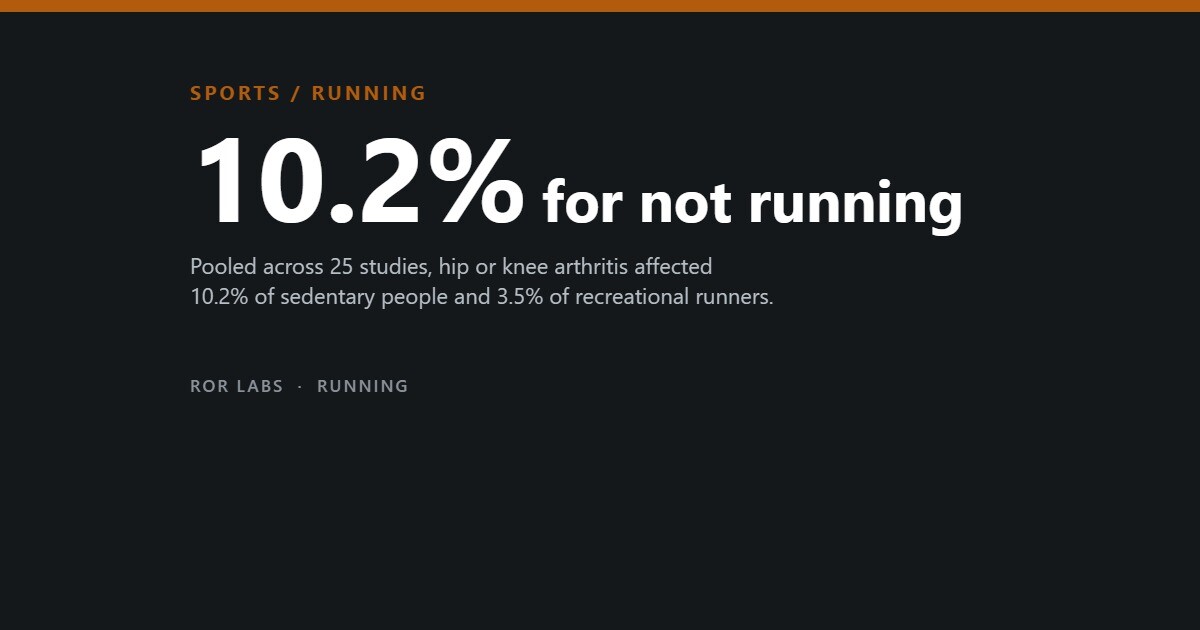
The thing people say about running is that it wears out your knees. The largest pooled comparison found hip or knee osteoarthritis in 10.2 per cent of sedentary people and 3.5 per cent of recreational runners. The runners had less of it, not more.
That number is not the end of the argument, and most of this article is about why. But it is the right place to start, because it inverts the assumption that everything else in the subject is usually reasoned from.
Running does injure people, frequently, and the injuries are almost entirely of one kind. What is unusual about running is how little of the standard advice for avoiding them survives a randomised trial — including the two rules every beginner is told.
What actually gets injured
Collegiate cross country runs 4.7 injuries per 1,000 athlete-exposures for men and 5.3 for women, against an average of 6.0 across the twenty-five sports in the same surveillance programme. Track is lower still: 2.7 for men outdoors, 3.5 for women.
Injuries per 1,000 athlete-exposures
NCAA Injury Surveillance Program, 2009-10 to 2013-14. One exposure is one athlete at one practice or one meet.
Source: CDC, MMWR 64(48), 2015, NCAA Injury Surveillance Program.
That understates the everyday experience, because a collegiate exposure is short and supervised. Studies of recreational runners have reported annual injury rates anywhere from 30 to 79 per cent depending on how injury is defined, and Dutch national figures put it at about 5.1 injuries per 1,000 hours of running. Novice runners are injured considerably more often than experienced ones.
Severity looks like the rest of college sport rather than worse than it. Across all twenty-five sports about a fifth of injuries cost seven days or more, four per cent led to surgery, and roughly half were sprains and strains. Running produces a great many complaints and comparatively few catastrophes.
The injuries themselves are monotonous. They are overuse injuries of the lower limb — the knee, the shin, the Achilles tendon, the plantar fascia, the hip — arriving gradually rather than in a single moment. There is no equivalent of the tackle or the landing. Almost nothing in running injures you suddenly, which is exactly why the advice is all about how quickly you increase things.
The arthritis question
The comparison at the top comes from a meta-analysis of 25 studies covering 125,810 people. Hip or knee osteoarthritis was present in 3.5 per cent of recreational runners (95% CI 3.4 to 3.6), 10.2 per cent of sedentary controls (9.9 to 10.6), and 13.3 per cent of competitive or elite runners (11.6 to 15.2).
Hip or knee osteoarthritis, by how much running
Source: Alentorn-Geli et al., J Orthop Sports Phys Ther 47(6):373–390, 2017. 25 studies, 125,810 individuals.
Two things in that figure deserve equal weight. The recreational bar is well below the sedentary one. The competitive bar is above it. Whatever running is doing to joints, it is not doing the same thing at 20 miles a week as at 80.
And the design will not carry as much as people want it to. These are cross-sectional prevalence comparisons, which means the runners were running at the moment they were counted. Anyone whose knees had already made running unpleasant had left the runner group and joined the sedentary one. That single mechanism could produce the entire gap without running doing anything protective at all.
A separate meta-analysis of sport and osteoarthritis makes the honest version of the finding clearer: across twelve studies, running carried a risk ratio of 0.86 with a confidence interval from 0.53 to 1.41 — no significant protection, and no significant harm. Soccer, in the same analysis, came out at 1.42. The defensible claim is not that running protects your knees. It is that recreational running has not been shown to damage them, which is a good deal more than most people assume.
Where the risk does not concentrate
Every other sport in this series has a match-to-practice gap. American football carries 39.9 injuries per 1,000 exposures in competition against 5.9 in practice. Basketball is 15.0 against 6.7. Running is the sport where that gap nearly closes.
How much a competition concentrates the risk
Competition rate divided by practice rate. Calculated from the published injury and exposure counts.
Source: CDC, MMWR 64(48), 2015. Competition and practice rates derived from the reported counts.
For men’s cross country the race is barely more dangerous than the training run. That single number reorganises the whole subject. There is no play to legislate away, no equipment to mandate, no moment to coach differently. Whatever is going to prevent a running injury has to work on the ordinary weekday, which is where all the exposure is.
The counts say the same thing from the other side. Of the 4,418 injuries recorded in men’s cross country over those five seasons, 3,977 happened in practice — exactly 90 per cent. In women’s cross country it was 4,989 of 5,724, or 87 per cent. Across all twenty-five sports the practice share is 63.8 per cent. Running does almost all of its damage on days nobody is watching.
What has actually been tested
Two pieces of advice are given to every new runner: increase your weekly distance by no more than ten per cent, and progress gradually rather than suddenly. Both have been tested in randomised trials, and both trials came back empty.
Two randomised trials of how to progress
Sources: Buist et al., Am J Sports Med 36(1) (2008); Ramskov et al., BMJ Open Sport Exerc Med 4:e000333 (2018).

It would be wrong to read those as proof that how you progress does not matter. Both trials were in people who were already going to run a fixed amount by a fixed date, which compresses the thing being varied. What they do establish is that the specific, confident, universally repeated version of the advice has no trial support behind it, and has not had for nearly twenty years.
The same holds for most of the rest of the standard list. Static stretching before a run has not been shown to reduce injury. Prescribing a shoe by the shape of a runner’s foot has been tested in large military cohorts and did not reduce injury rates either. The honest summary is that running injuries are common, well described, and not reliably preventable by anything that has been put in front of a control group.
The rare thing people actually fear
Cardiac arrest during a race is what makes the news, so it is worth having the denominator. Between 2000 and 2010, across 10.9 million runners in United States marathons and half-marathons, there were 59 cardiac arrests.
Cardiac arrest per 100,000 race participants
United States marathons and half-marathons, January 2000 to May 2010. 10.9 million runners, 59 arrests.
Source: Kim et al., New England Journal of Medicine 366(2):130–140, 2012.
One arrest per 185,000 participants overall, and one per 99,000 in the marathon specifically. Fifty-one of the fifty-nine were men, the mean age was 42, and cardiovascular disease accounted for most of the arrests — which is to say the race did not create the condition, it found it. The highest-risk group, male marathon runners, had most of its events in the latter part of the race.
The comparison worth making is not against zero. It is against the same population not running at all, where the cardiovascular disease that caused most of those arrests continues to exist and is not being exercised. A race is a stress test that a small number of people fail in public.
Why the answer is not to stop
Put the two halves of this article together and the shape is unusual. The injury rate is high and the preventive advice is weak. The outcome people are most afraid of goes, at recreational volumes, in the opposite direction from the folklore. And the catastrophic outcome is real but sits at roughly one in two hundred thousand.
What the evidence supports is not a technique. It is a posture: expect to be injured at some point, treat that as ordinary rather than as a sign you are doing it wrong, and recognise that the things marketed as prevention — the shoe, the stretch, the ten per cent — are not carrying the weight they claim to. The variable with the clearest evidence behind it is how much, not how.
And the dose-response in the arthritis figure is the sentence to keep. Recreational volume sits below sedentary. Elite volume sits above it. Almost nobody reading this is near the second one.
Questions people ask
So running does not cause arthritis?
The defensible statement is that recreational running has not been shown to cause it, and is associated with less of it than sitting still. That association is confounded by who stops running. What the data does not support is the confident claim that running wears knees out.
Is the ten per cent rule useless?
It has no randomised support, which is different from being wrong. It is a reasonable default with nothing behind it. The trial that tested it directly found the same injury rate in both arms.
Should I be fitted for shoes by my gait?
Large military trials that assigned shoes by foot type did not find lower injury rates. Comfort is a better guide than arch classification, and it is the one thing you can assess yourself.
Do I need a cardiac screen before a marathon?
That is a question for a clinician who knows your history, and the answer depends on symptoms and family history rather than on the race. The population rate is about one arrest per 99,000 marathon starters.
Does running injury risk rise with age?
The surveillance data here is collegiate, so it says nothing about masters running. What the arthritis meta-analysis adds is that the association held in the subgroups with more than fifteen years of exposure as well as fewer, which is at least not evidence of a threshold that arrives with time.
What about running on concrete?
Surface hardness has been studied repeatedly and has not emerged as a reliable predictor of injury. The body adjusts leg stiffness to the surface, which is part of why the effect keeps failing to appear.
The short version
- Collegiate cross country runs 4.7 injuries per 1,000 exposures for men and 5.3 for women, below the 6.0 average across 25 sports.
- Recreational injury rates are far higher — 30 to 79% a year depending on definition — and are almost all overuse injuries of the lower limb.
- Hip or knee arthritis: 3.5% in recreational runners, 10.2% in sedentary people, 13.3% in competitive runners.
- That comparison is cross-sectional, so people who stopped because of their knees are counted as sedentary.
- The ten per cent rule and gradual progression have both been tested in randomised trials and neither reduced injuries.
- Cardiac arrest ran at 0.54 per 100,000 race participants, 1.01 in marathons and 0.27 in half-marathons.
This describes what published research has reported about a sport, not advice about any individual. Chest pain, unexplained breathlessness, fainting or a family history of sudden cardiac death are reasons to talk to a doctor before training, not reasons to read an article.
Further reading: Alentorn-Geli et al., Journal of Orthopaedic and Sports Physical Therapy 47(6):373–390 (2017), for the arthritis meta-analysis. Buist et al., American Journal of Sports Medicine 36(1):33–39 (2008), for the ten per cent rule. Kim et al., New England Journal of Medicine 366(2):130–140 (2012), for the race cardiac arrest data.
- Good for a Girl, Lauren Fleshman (2023). What distance running asked of the women who were good at it, from someone who was. A memoir with an argument, and the argument is contestable.
- The Comfort Crisis, Michael Easter (2021). The case for deliberately seeking out physical hardship — the opposite instinct to this article’s, and worth reading against it.
- How to Read Numbers, Tom Chivers and David Chivers (2021). Short and specific on why a prevalence comparison between groups people sort themselves into is the hardest kind to read.
Sources
CDC, MMWR 64(48):1330–1336 (2015), NCAA Injury Surveillance Program 2009-10 to 2013-14: cross country and track rates, competition and practice counts, severity distribution.
Alentorn-Geli E, Samuelsson K, Musahl V, et al. The association of recreational and competitive running with hip and knee osteoarthritis: a systematic review and meta-analysis. J Orthop Sports Phys Ther 2017;47(6):373–390.
Tran G, Smith TO, Grice A, et al. Does sports participation increase risk of osteoarthritis? A systematic review and meta-analysis. Br J Sports Med 2016;50(23):1459–1466.
Buist I, Bredeweg SW, van Mechelen W, et al. No effect of a graded training program on the number of running-related injuries in novice runners. Am J Sports Med 2008;36(1):33–39.
Ramskov D, Rasmussen S, Sørensen HT, et al. Run Clever — no difference in risk of injury when comparing progression in running volume and running intensity in recreational runners. BMJ Open Sport Exerc Med 2018;4:e000333.
Kim JH, Malhotra R, Chiampas G, et al. Cardiac arrest during long-distance running races. N Engl J Med 2012;366(2):130–140.
Verhagen E. Prevention of running-related injuries in novice runners: are we running on empty? Br J Sports Med 2012;46(16):1119–1120 (Dutch national rate of 5.1 injuries per 1,000 hours).