Sanctions and Access to Medicines: What the Evidence Shows
Key takeaways · 15 min read
- Medicines are exempt under almost every sanctions regime, yet banks, insurers and suppliers often avoid the trade anyway, a pattern UN experts call over-compliance.
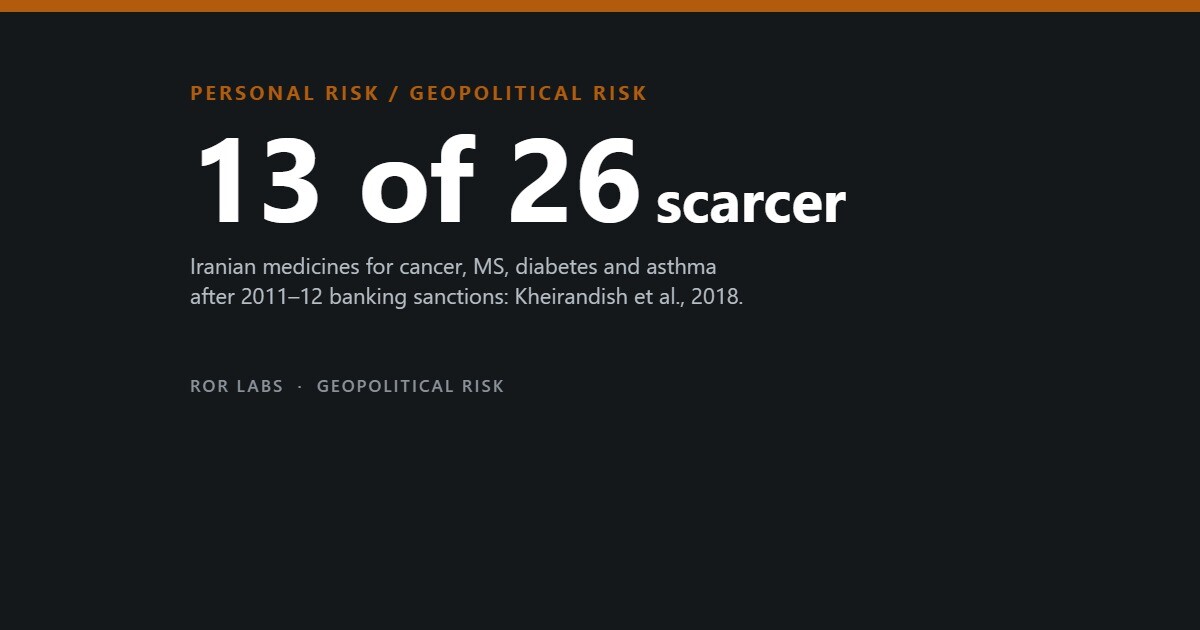
- In Iran after the 2011–12 banking sanctions, 13 of 26 tracked medicines for cancer, multiple sclerosis, diabetes and asthma became significantly less available.
- Patients needing imported, hard-to-substitute treatments, such as clotting factors and cancer drugs, show the sharpest drops in access.
- Attribution is hard: currency collapse, war and domestic policy often move at the same time, and in Venezuela medicine imports had already fallen by more than four-fifths before US financial sanctions began.
Sanctions are meant to squeeze governments, not patients. Almost every modern regime says so in writing: food, medicines and medical devices are exempt, or can be licensed. Yet doctors in sanctioned countries have described the same problems for decades – drugs that stop arriving, prices that jump, scanners that sit idle waiting for a part. The question is how much of that is caused by sanctions, and how much by everything else that tends to happen at the same time.
That second part is what makes the subject hard. Countries under heavy sanctions usually also face a collapsing currency, inflation, conflict or poor economic management, and each of these can empty a pharmacy shelf on its own. Researchers have tried to separate the strands with pharmacy surveys, sales data and cross-country statistics. Their answers are more consistent than the politics would suggest, but less precise than either side of the debate tends to claim.
This article looks at how humanitarian exemptions are supposed to work and why they often do not, what studies measured in Iran, Venezuela, Syria and Russia, and what UN bodies and sanctioning governments have changed. It does not judge whether any sanctions regime is justified; the site’s separate article on whether sanctions work covers effectiveness. It is general information, not legal, financial or medical advice.
Exempt on paper
Sanctions come in two broad kinds. Multilateral ones are agreed by the UN Security Council and bind every member state. Unilateral ones are imposed by a country or bloc, such as the United States or the European Union, and the US version often reaches further through “secondary” measures that threaten foreign banks and firms dealing with a target. Both kinds almost always carry humanitarian exemptions, either written into the rules or granted through licences, for food, medicine and medical equipment.
On paper, then, a hospital in Tehran or Damascus should be able to buy insulin or chemotherapy. In practice, a sale needs more than permission to ship the goods. It needs a bank willing to move the money, an insurer for the cargo, a shipping line, and a supplier prepared to fill in forms and accept the legal risk. Each of those firms can say no, and each has reasons to do so even when the trade is legal.
Why exempt goods still stall
The UN Special Rapporteur on unilateral coercive measures, Alena Douhan, uses the term over-compliance for what happens next. In her 2023 report on the right to health she described excessive de-risking by banks and companies, which turn away exempt trade rather than carry the compliance risk; for a bank, a small humanitarian payment can look not worth a possible large fine. Licensing rules that are burdensome or unclear, and the spread of secondary sanctions, make that caution more likely.
Iran’s shortage list, 2016
Characteristics of 73 medicines reported in short supply in Iran, % of the list.
Source: Setayesh S, Mackey TK, Globalization and Health (2016), doi:10.1186/s12992-016-0168-6. List compiled from published, NGO, media and Iranian government sources, not a national audit.
A 2016 analysis by Sogol Setayesh and Tim Mackey in Globalization and Health shows the gap in numbers. Of 73 medicines reported in short supply in Iran, 89% treated non-communicable diseases and 44% were on the WHO list of essential medicines. Yet 96% fell under the US general licence, the easiest category to export. One example they cite: a $60 million order for a transplant anti-rejection drug from an American firm never reached Iran because no bank would process the payment.
Money is not the only friction. A systematic review in BMJ Global Health in 2023 by Matteo Pinna Pintor, Marc Suhrcke and Christoph Hamelmann describes licensing systems that raise transaction costs, vague definitions of “dual-use” items that might have military uses, and insurers and shipping firms that pull back. It records cases where dual-use claims turned out to be unfounded, such as spare parts for breast X-ray equipment denied to Cuba. Where hospitals are state-run, bans on dealing with government bodies can block exempt deliveries too.
Sanctions also work through the economy as a whole. When export earnings shrink and the currency falls, every import costs more in local money, whether or not it is sanctioned. In early 2013 The Lancet reported that Iran’s rial had lost about 80% against the dollar in a year, and that firms and banks were reluctant to risk fines. That channel is real, but it is also the one most easily confused with a country’s own economic mistakes.
Iran: what was measured
Iran is the most studied case because the 2011–12 sanctions on its banks and central bank came suddenly, and because the country makes most of its own generic medicines while importing many raw materials and specialist drugs. A study by Mehrnaz Kheirandish and colleagues in the Eastern Mediterranean Health Journal tracked monthly national sales of 26 medicines for diabetes, asthma, cancer and multiple sclerosis from 2008 to 2013, using an interrupted time-series design.
Market availability fell significantly for 13 of the 26 and fell, but not significantly, for ten more. Use of interferon alfa-2b dropped from 0.014 to 0.008 defined daily doses per 1,000 people a day between 2010 and 2013, and of the leukaemia drug cytarabine from 1.40 to 0.96 mg per 1,000 people a day. A survey of 40 Tehran pharmacies found the same direction at street level.
Asthma inhalers in Tehran pharmacies
Share of 40 community pharmacies stocking at least one product, before and after the height of sanctions.
Source: Ghiasi G, Rashidian A, Kebriaeezadeh A, Salamzadeh J, Iranian Journal of Pharmaceutical Research (2016). Before-after design, no comparison group.
The pharmacy study, by Golbarg Ghiasi and colleagues, visited the same shops in July 2012 and March 2013. Imported inhalers became 67% to 86% less available, but locally made ones also fell, by 20% to 62%, probably because local factories depended on imported ingredients and packaging. The authors also note that availability was already limited before the sanctions peaked, and that inflation was eroding what households could afford at the same time.
A national study of 28 health indicators from 2000 to 2020, by Efat Mohamadi and colleagues, gives a wider and more mixed view. Eleven indicators changed trend after 2009 and four deteriorated significantly, among them out-of-pocket spending on health. Most did not. Shortages, in other words, are well documented; a broad collapse of Iranian health is not, which is one reason Iranian researchers describe their country as complicating the global mortality estimates.
Cancer, rare diseases and machines
The patients hit hardest are those who depend on a few patented or specialised products with no local substitute. A survey in southern Iran by Mehran Karimi and Sezaneh Haghpanah followed 69 people with thalassaemia and 40 with clotting disorders from 2009 to 2012. Access to freeze-dried factor VIII, the clotting protein people with haemophilia A need, fell from 96.7% of patients to 3.3%, and joint damage worsened significantly over the period.
Specialist treatments in southern Iran, 2009 to 2012
Patient-reported access among people with thalassaemia and clotting disorders.
| Treatment | Who needs it | Change in access |
|---|---|---|
| Freeze-dried factor VIII | Haemophilia A | 96.7% to 3.3% of patients |
| Deferoxamine | Thalassaemia (iron overload) | Fell by almost 70% |
| Deferasirox (oral) | Thalassaemia (iron overload) | Fell by about half |
Source: Karimi M, Haghpanah S, Health Policy (2015), doi:10.1016/j.healthpol.2014.12.011. 109 patients at one regional centre; self-reported access plus clinical records.
Iron-chelating drugs for thalassaemia showed similar declines, and patients’ iron levels rose. Cancer care follows the same pattern in smaller studies. Setayesh and Mackey’s shortage list included rituximab, cetuximab, sorafenib and older chemotherapy drugs, and interviews with cancer patients and charities in Tehran in 2020 described price swings, scarcity, long waits and profiteering by distributors. These are small or self-reported samples, but they agree on who carries the burden.
Equipment is the quieter problem. Scanners, radiotherapy machines and dialysis units need spare parts, software updates and service engineers, often from a handful of Western makers. The 2023 review lists bottlenecks reported from several countries, including X-ray materials, laboratory reagents and inputs for radiopharmaceuticals in Iran. After a 2022 visit to Syria, Douhan reported that blocked payments and refused deliveries had caused serious shortages of specialised equipment, particularly for chronic and rare diseases.
Venezuela and the timing problem
Venezuela shows why timing matters. The United States imposed its first broad financial sanctions on the government in August 2017 and an oil embargo in January 2019. But the health system was in trouble well before. In 2014 Science reported that malaria was surging and that a shortage of dollars made it nearly impossible to import medical supplies. Per-person income fell by 72% between 2012 and 2020, and most economists agree that domestic policy played a significant part in the start of the slump.
Venezuela’s medicine imports before sanctions
Monthly imports of medicines, US dollars, reconstructed from UN trade data.
Source: Rodríguez FR, Sanctions and imports of essential goods: a closer look at the Equipo Anova (2021) results, arXiv:2212.09904 (2022). A working paper, not peer reviewed.
Monthly medicine imports fell from about $123 million two years before the sanctions to $21 million when they arrived, a drop of more than four-fifths. What happened next is disputed. A Venezuelan consultancy argued that imports stabilised after 2017, implying sanctions did not cut supplies. The economist Francisco Rodríguez, who has also published estimates of sanctions’ harm, replied that the analysis had coding and method errors and that imports simply stopped falling at very low levels.
Most researchers accept the basic sequence: shortages began with falling oil revenue and policy failures, and sanctions arrived on top of a collapse already under way. The open question is how much harder sanctions made recovery, for instance by cutting off credit and oil sales. That is a question about counterfactuals, what would have happened without them, and no single dataset can settle it.
Syria and Russia
Syria adds war to the mix. Douhan’s 2022 statement said 90% of Syrians lived below the poverty line and urged action on over-compliance by businesses and banks. Syrian doctors writing in The Lancet Global Health in 2015 argued the opposite emphasis: most sanctions targeted weapons and dual-use goods, humanitarian items were exempt, and systematic attacks on hospitals and health workers did far more damage. Both accounts can be partly true at once.
The United States lifted most Syria sanctions in 2025, with a general licence in May, an executive order in June and repeal of the Caesar Act in December. Access has not simply recovered. A 2026 survey of 1,042 residents of Homs, a convenience sample, found only 10.9% reported easy access to medicines during the war, and high prices were the most cited barrier, named by 69.7%.
Russia is a different case: a large economy with its own industry, facing sanctions since 2022 that exempt medicines. A 2025 trade analysis by Alexander Firanchuk found that imports, about half of Russian drug consumption, kept roughly the same share through 2024 and still came mostly from “unfriendly” Western countries, though finished medicines declined while ingredients from neutral countries rose. Early concerns centred on boycotts, the departure of doctors and the fall of the rouble rather than formal bans.
Counting the wider toll
Cross-country studies try to measure the overall health cost. Jerg Gutmann and colleagues, studying 98 countries from 1977 to 2012, estimated that an average episode of UN sanctions cut life expectancy by 1.2 to 1.4 years, against 0.4 to 0.5 years for US sanctions. A 2025 study in The Lancet Global Health by Francisco Rodríguez, Sílvio Rendón and Mark Weisbrot, covering 152 countries, linked unilateral US and EU sanctions to about 564,000 deaths a year.
Three ways of counting
Main cross-country and review findings on sanctions and health.
| Study | Data | Finding |
|---|---|---|
| Gutmann et al. 2021 | 98 countries, 1977–2012 | UN sanctions: 1.2–1.4 years less life expectancy; US: 0.4–0.5 |
| Rodríguez et al. 2025 | 152 countries, 1971–2021 | Unilateral sanctions: 564,258 deaths a year (range 367,838–760,677); no clear effect of UN sanctions |
| Pinna Pintor et al. 2023 | Systematic review, low- and middle-income countries | 21 of 27 studies found harm; only one used a quasi-experimental design |
Sources: Gutmann J et al., J Dev Stud 57(1):139–162 (2021); Rodríguez F et al., Lancet Glob Health 13:e1358–66 (2025); Pinna Pintor M et al., BMJ Glob Health 8(2):e010968 (2023). Modelled, observational estimates.
The two big studies disagree on a basic point: one finds UN sanctions worst, the other finds no clear effect from them. Weisbrot co-founded the Center for Economic and Policy Research, which has long criticised sanctions, and the estimate is modelled from observational data. The 2023 review found 21 of 27 studies reported harm but judged almost all to have important weaknesses, chiefly confounding. Some Iraq studies rested on surveys later implicated in fraud, a story the site covers separately.
What has changed in the rules
Governments and the UN have tried to narrow the gap. In December 2022 the Security Council adopted Resolution 2664, by 14 votes with India abstaining, creating a standing exemption from UN asset freezes for humanitarian assistance and basic human needs. Eleven days later the US Treasury issued general licences across its UN-linked programmes, including for medicine, medical devices and their spare parts and software updates. The EU added a similar exception for its terrorism listings in 2024.
These changes make legal permission clearer; they cannot force a bank to take a customer. Douhan’s 2024 report set out methods for monitoring sanctions’ humanitarian effects, echoing the 2023 review’s conclusion that only prospective data collection can show whether civilians are protected. In Iran in 2026, with war and a blockade added to sanctions, the news card shows how quickly the old pattern can return.
What the evidence suggests
Humanitarian exemptions do not, on their own, keep medicines flowing. Studies in Iran consistently show falling availability after banking sanctions, sharpest for imported specialist drugs, and UN experts document the same over-compliance elsewhere. How much harm sanctions cause overall is far less certain: currency collapse, war and domestic policy move at the same time, the best mortality studies disagree, and in Venezuela the medicine collapse largely preceded sanctions. Shortages are well evidenced; precise death tolls are modelled estimates.
Questions people ask
Are medicines banned under sanctions?
Rarely. Most regimes exempt medicines or allow them under licence. Shortages usually come from payment, shipping and insurance problems, and from falling currencies.
What is over-compliance?
When banks or companies avoid legal, exempt trade with a sanctioned country because the cost of checking, or the risk of a fine, seems too high.
Which patients are most affected?
People who rely on imported, hard-to-substitute treatments: clotting factors, some cancer and multiple sclerosis drugs, and care that depends on specialist equipment.
Do sanctions kill hundreds of thousands of people a year?
One 2025 model estimates about 564,000 deaths a year from unilateral sanctions. It is an observational estimate, and other studies reach different conclusions about which sanctions matter.
Did lifting sanctions on Syria fix medicine supply?
Not quickly. A 2026 survey in Homs still found high prices the main barrier, reflecting war damage and poverty as well as past sanctions.
The short version
- Medicines are exempt under almost every sanctions regime, yet banks, insurers and suppliers often avoid the trade anyway, a pattern UN experts call over-compliance.
- In Iran after the 2011–12 banking sanctions, 13 of 26 tracked medicines for cancer, multiple sclerosis, diabetes and asthma became significantly less available.
- Patients needing imported, hard-to-substitute treatments, such as clotting factors and cancer drugs, show the sharpest drops in access.
- Attribution is hard: currency collapse, war and domestic policy often move at the same time, and in Venezuela medicine imports had already fallen by more than four-fifths before US financial sanctions began.
- Global death estimates are modelled and disagree on which sanctions matter; new UN and US humanitarian licences since 2022 clarify the law but cannot oblige banks to act.
This article summarises published research and official documents for general information. It is not legal, financial or medical advice, and it does not take a position for or against any sanctions regime. Rules change often: anyone trading with, sending aid to or seeking treatment in a sanctioned country should check current official guidance and take qualified legal advice. Patients facing a medicine shortage should talk to a doctor or pharmacist before changing or stopping any treatment.
Further reading: Pinna Pintor et al., BMJ Global Health 8(2) (2023), for the systematic review of sanctions and health. Setayesh and Mackey, Globalization and Health (2016), for the Iranian shortage list. Kheirandish et al., Eastern Mediterranean Health Journal 24(1) (2018), for the time-series study of Iranian medicines.
- The Economic Weapon, Nicholas Mulder (2022). A history of how sanctions were invented after the First World War as a tool of coercion. Rich on origins and civilian suffering in the interwar years; it says little about today’s medicine supply chains.
- Backfire, Agathe Demarais (2022). An economist explains how modern US sanctions work through banks and why firms over-comply. Clear on the mechanics; it is written mainly about consequences for Western interests, with limited health data.
- Chokepoints, Edward Fishman (2025). A former US sanctions official’s account of economic warfare against Iran and Russia. Detailed from the inside; it reflects a policy-maker’s view and gives humanitarian effects less space.
Sources
Setayesh S, Mackey TK. Addressing the impact of economic sanctions on Iranian drug shortages in the joint comprehensive plan of action. Globalization and Health (2016), doi:10.1186/s12992-016-0168-6. — Kheirandish M, Varahrami V, Kebriaeezade A, Cheraghali AM. Impact of economic sanctions on access to noncommunicable diseases medicines in the Islamic Republic of Iran. East Mediterr Health J 24(1) (2018), doi:10.26719/2018.24.1.42. — Ghiasi G, Rashidian A, Kebriaeezadeh A, Salamzadeh J. The impact of the sanctions made against Iran on availability to asthma medicines in Tehran. Iran J Pharm Res (2016). — Karimi M, Haghpanah S. Health Policy (2015), doi:10.1016/j.healthpol.2014.12.011. — Mohamadi E et al. Globalization and Health (2024), doi:10.1186/s12992-024-01084-2. — Nazari M et al. BMC Health Serv Res (2025), doi:10.1186/s12913-025-12501-6. — Mohammadi D. Lancet (2013), doi:10.1016/S0140-6736(13)60116-6. — Majdzadeh R. Lancet Glob Health (2026), doi:10.1016/j.langlo.2026.104046. — Pinna Pintor M, Suhrcke M, Hamelmann C. BMJ Glob Health 8(2):e010968 (2023). — Gutmann J, Neuenkirch M, Neumeier F. Sanctioned to death? J Dev Stud 57(1):139–162 (2021). — Rodríguez F, Rendón S, Weisbrot M. Effects of international sanctions on age-specific mortality. Lancet Glob Health 13:e1358–66 (2025). — Rodríguez FR. Sanctions and imports of essential goods. arXiv:2212.09904 (2022), working paper. — Wade L. Science 345(6196):499 (2014), doi:10.1126/science.345.6196.499. — Sekkarie MA, Murad LB, Sahloul Z. Revival of basic health services in Syria. Lancet Glob Health (2015). — Al-Deeb R et al. Glob Health Action (2026), doi:10.1080/16549716.2026.2726661. — Firanchuk AS. Russia’s pharmaceutical imports under sanctions. Russian Foreign Economic Journal (2025). — Dyer O. BMJ (2022), doi:10.1136/bmj.o745. — UN Special Rapporteur on unilateral coercive measures: Syria end-of-visit statement (10 November 2022); A/HRC/54/23 (2023); A/HRC/57/55 (2024). — UN Security Council Resolution 2664 (9 December 2022). — US Treasury OFAC, FAQ 1105 (December 2022). — Council of the EU press release (19 February 2024). — Just Security, Caesar Act repeal (December 2025). — Al Jazeera (9 September 2026).